

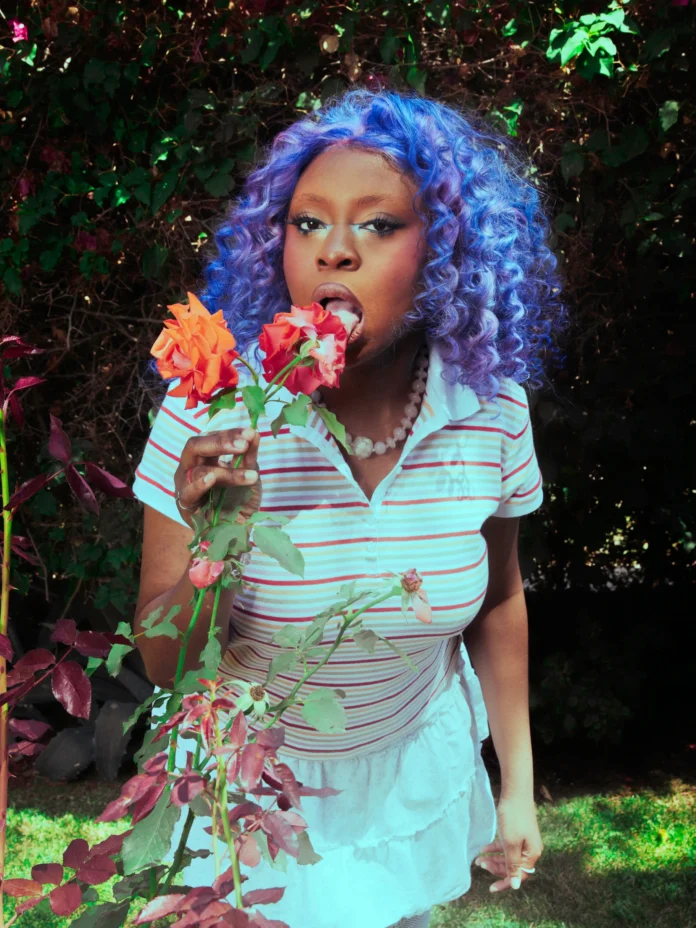
hemlocke springs is the project of Isimeme “Naomi” Udu, who grew up in Concord, North Carolina. Her religious upbringing brought her in proximity to gospel music, but in her own time, she also got into making tracks on GarageBand just as bedroom pop was flourishing in the mid-2010s. She studied biology at Spelman and went on to earn her master’s degree in medical informatics from Dartmouth, remaining interested in music as a hobby. One of the songs on her debut album dates back to her Dartmouth days, which was also when ‘girlfriend’ and ‘gimme all ur luv’ went viral on TikTok. Those tracks appeared on 2023’s going…going…GONE! EP, which not only showcased her knack for larger-than-life, 80s-inspired, maddeningly catchy art-pop, but also led to her opening for the likes of Conan Gray, Ashnikko, and Chappell Roan, the latter of whom interviewed her “favorite artist” in light of the apple tree under the sea, which is out today. (I wish that piece had been published before I asked Udu my first question.) A pop debut more conceptual but just as zany, melodramatic, and adventurous as Roan’s own, the album traces back hemlocke springs’ origin story while interrogating the narratives that have been projected upon her – not just lyrically but musically, through eclectic, triumphant production crafted alongside BURNS. It’s escapist pop you wouldn’t mind becoming more and more inescapable.
We caught up with hemlocke springs for the latest edition of our Artist Spotlight series to talk about the trajectory of her debut album, realizing the viability of a musical career, embracing the unknown, and more.
I was watching your conversation with Allie X from a couple of years ago, which was around the time I interviewed her. It made me wonder if you’ve had any conversations with artists in the lead-up to your debut album that sort of put things in perspective for you, or made you look at it in a different light. I know you’ve toured with artists who have at least one or several albums to their name.
I was lucky to be able to support Chappel on her tour, and I was lucky to have talked to her about the album. I think she had said, “You’re very brave, releasing a concept album as your first album.” I was like, “Maybe I should ask a follow-up, but in the moment, I was like, “Thank you!” After, I was like, “Oh, I am? What did I do?” [laughs] I feel like I’m known more for my ha-ha-hee-hee personality for songs, and that’s definitely present in the album, but I take more of a serious route that maybe people weren’t expecting. I was like, “That could be brave.” I didn’t think of it like that. At the time I was like, “I need to finish the album.” But thinking about its contents now, I’m like, “Good for you, you’re taking your serious thoughts and putting them to a funky beat that people can dance to, at the end of the day.
You recently announced a vinyl edition of your going…going…GONE! EP for Record Store Day. Having that extra bit of hindsight now, how do you look back on that release and what it represented for you?
When I was doing going…going…GONE!, I was like, “Fuck it. Let’s just go for it.” It was right after grad school – some parts were even during grad school. This time, I really did want to take myself more seriously. I was being called this quirky, whimsical, weird girl, and I’m like, “That’s cool, but how did we get here?” Why am I the way that I am?” I feel that this album served for me as kind of an origin story, because a lot of these songs were made in periods of time where I felt repressed, and that repression maybe led to the more open person I am today. If going…going…GONE! is a presentation of hemlocke, let’s see, how did we get here? I’m very lucky to have had the opportunity to do that. In a way, the two projects are linked story-wise for me. I present myself in going…going…GONE!, but it’s almost like a prelude to this project. Now, I’m interested in seeing the progression of hemlocke and the next project, because I can only imagine it’s a combination of the two, musically and lyrically.
There was a moment on going…going…GONE!’s ‘enknee1’ that struck me in retrospect, that line about “struggling to find what was simple.” On the album’s ‘the beginning of the end’, you sing about the allure of different kinds of simpleness-es, like “fraternizing paranoia.” They come from different places, but I think there’s something to that craving for simplicity that becomes impossible when we grow up.
I feel like ‘the beginning of the end’ is one of the easier songs on the album, if not the easiest song to grasp. It’s interesting, too, because it technically came before ‘enknee1’ – it’s just a matter of release. Why was ‘the beginning of the end’ not released, and ‘enknee1’ was? When I was younger, I was like, “When I get to adult age I’m gonna know exactly what to do,” and now I’m 27, so that’s pretty adult age, and I’m like, “Oh, everybody lied, nobody knows what’s going on. Okay. Understood.” I felt I was in a stage where I was overcomplicating things, and that song was just very straightforward – I love the flowery language, don’t get me wrong, but let’s just get straight to the point. I feel like ‘the beginning of the end’ served that purpose for me in a way that ‘enknee1’ didn’t, but I love ‘enknee1’, because it was younger me trying to figure out the puzzle pieces. I started ‘the beginning of the end’ when I was really young, and I still feel a little connection towards it. It’s my least favorite song on the album, but I still feel this red thread to it, where I’m like, “Wow, nothing really has changed, huh?”
You’ve talked about how going to college opened you up to different experiences, but I’m curious if your relationship to music remained private in a way that was similar to making songs on GarageBand growing up.
I don’t talk about that a lot, but when I was in college, it was during that time where it was suddenly hitting that, “Oh, I think I can do songs.” I can sit down, I can make a little instrumental or a little beat, and I can put lyrics to it, and that’s a song. Maybe unconsciously, I did want to go down that path, but I guess consciously I was like, “Let’s just develop this skill more.” And I remember reaching out to people on SoundCloud and being like, “Can I write over this?” Nothing big ever materialized, but it was cool to have that skill in the back of my pocket and whip it out and be like, “I can do this.” But I did keep it private, so I whipped it out to nobody. [laughs] But in my mind, I’m like, “One day somebody’s gonna be like, what can you do.” And I’m like, “I can do this!” But I remember during my undergrad at Spelman, there was this music thing going on that I went to. I was able to meet some people who wanted to do music, and they knew that they were going to be in music for a long time. I remember talking to someone, and they’re like, “You know, what you do is producing. You produce. You’re a songwriter. That’s awesome.” And I’m like, “Oh, I am?”
I feel like I had a newfound appreciation for it, but it’s weird – I could talk to strangers about it, but in my own inner circle I didn’t really say much, if anything, about these endeavors. I just kind of kept it to myself, and that’s how it went through college and then going to grad school, because generally, in my mind, I’m like, “Oh, this is a cool hobby to do.” When I was on the biology route, we would have talks, people would come in,and they’d be like, “I’m a doctor, and I also do this on the side.” There was somebody who came along, they were a doctor, and they also sang in bars on the side, because why not? I’m like, “Oh, that’s cool. I think I would do that.” But now, I don’t do that. Now, everything revolves around music. But back then, I never told anyone. I kept it to myself. I don’t know whether I was insecure, but I genuinely didn’t think of it as a viable path for me.
What about finding a viable community around music? Was that something you also didn’t perceive and experience until later on? You grew up singing in choir, and you reached out to people on SoundCloud, but was there a moment where you felt your life revolving around music in an actually communal way?
I definitely think music definitely called to me, it felt spiritual in a sense. But I grew up very, like, “You’re a doctor, you’re a lawyer, you’re an engineer. Anything else outside of that, you’re never going to get money from it.” But I think that on the side, probably starting in middle school, I realized it can be such a spiritual experience, listening to music. These days, I find myself going on Reddit, like, “Do you know this song? Does anybody know this B-side?” I remember looking up ‘Fools’ by Depeche Mode, because I had just discovered that song, and I’m like, “Is there anybody listening to this song the way that I do?” And then I go on Reddit, and there’s this whole group. I was like, “I love that this is not a unique experience.” Everybody wants to feel included in some type of way, and you have to search for that inclusion. I wasn’t necessarily aware of that fact until I began searching, meeting people. It’s how I was able to talk to some people at Spelman and find community there. Else you’ll always just be in your little corner, which is fine if that’s where you want to be, but I kind of want it half and half: I love the solo time, but I also want to connect with people on the music that I do/the music that others do. Talk about a line for hours and stuff.
It sounds like you also began to separate the religious and the spiritual quality that music took on. Although the album references your upbringing by using that kind of religious language, especially on the opening track ‘the red apple’, which feels like an explicit acknowledgement of where you came from.
Yeah, I was like, “Lately, red apples are tasty.” [laughs] Sincerely, though, the whole thing with Christianity is pledging your life to God, and I’m not knocking anything. I’m just talking about myself here, but for me, even the thought of asking questions – because I was more inquisitive than I am now, but I felt like I couldn’t ask anything about it. It would be like, “Oh, I’m questioning the authority.” For me, Christianity could be a little bit of a bubble, especially if you’re in a very small town. But you still see what’s outside the bubble, if it’s a clear bubble. I grew up, and a lot of my friends have different sexualities, different identities, and I was on the path of discovering my own identity. It was like these red apples, which could be seen as sins, they were tasty – they’re not red apples, they’re not sins, but for the context of the song. It was definitely the starter for a reason, because I feel like that’s quite literally where I started. The history that song has is probably where hemlocke started – I think it’s like larvae or something, to be in the little cocoon.
You know biology, I don’t…
[laughs] Barely. I’m kind of forgetting. I need to start quizzing myself more. But that was definitely where things started. I feel like ‘Moses’ follows a similar kind of route.
One of my favorite vocal moments on the record is on ‘sense (is)’, when you sing, “There was nothing I could do but take the wrong turn down.” What are your memories of getting that song and the prelude done?
I loved making that song. I had the verses that I made on Logic, and we added some elements in the studio. I didn’t have the bridge or the outro yet, but I knew the bridge needed to hit hard. I knew we had to be throwing things until it finally sticks. The bridge was definitely a matter of throwing, throwing, throwing, and it did get very climatic. I remember finishing the bridge, and I looked at BURNS, like, “That’s a bridge!” It was the most fun because it came the easiest, in a way. For some reason, the tap was really on full, which I loved. Also, I took multiple takes, which usually I don’t. I think for going…going…GONE!, it was 5 takes or it’s over. I kicked BURNS out a lot, actually, doing the vocal for a lot of these songs, but particularly that song. I remember being like, “You go hang out with your partner and your children, I’m gonna just loop this section. I’m going to get it, I swear!” So I’m pretty proud of that.
One of my favorite lyrics is in that song: “Only me and I could turn an inch into a mile, but have I lost myself walking on foot?” I wish I could be like, “I kind of ate with that, it just came to me.” No! That took so long. But sometimes the best things do.
The prelude before, I was like, “I need a kind of reset, because I’m not gonna end the album on a serious note.” It nearly ended on a serious note, but I’m like, “This doesn’t make sense. This needs to end on a positive note.” I needed a reset from the intensity that was the first half, so that we can go through this second half, which is what the prelude served for me.
One moment that illustrated in my mind the atmosphere in the studio is on ‘set me free’, where I’m guessing it’s your laughter included in the recording.
Yeah, definitely. It’s interesting, too, because ‘set me free’ was made before even the concept of the album was created. I remember it was going to be on going…going…GONE!. A lot of songs were supposed to be on going…going…GONE!, but I was just like, “No, this is not fitting the way that I want it to fit.” Luckily, we went back and did a good bit of some edits with ‘set me free’ that I feel like really made it the song that it is now. I feel that ‘set me free’ has more of an R&B-ish pop feel, and that’s something that I hadn’t really gone for before. When first making it, I remember BURNS happened to come across the drums that are in the track, he was like, “We have to find different drums.” And I’m like, “Why? Let’s just go for it.” And it was really fun, because at that point, when making a lot of tracks on the album, it was really just like, “Who cares? Does it sound good?” That’s all that matters. If it doesn’t fit this genre that I’m known for, that’s cool. All the more reason to explore what is gravitating toward me.
You also explore writing outside of your personal story, though still from your perspective, particularly on the latest single ‘w-w-w-w-w’, which was inspired by the documentary Father Figures. What was it like doing that on an album about self-discovery?
This song, I was asked to change one of the lyrics – the major lyric, “I would rather kill myself.” My manager had suggestions, and I was like, “No.” But I feel like it’s because I was definitely thinking of high school me, and high school me was a little bit intense. I feel like if you ask other people from my high school, they’ll be like, “Oh, she was fine.” But in my head, I was a little bit more intense than I am now. So I was like, “I think that’s the lyric, unfortunately.” I also think it’s interesting it’s that song. It’s weird because I’m writing from my perspective, but my older perspective, and there are certain points to my older perspective that I feel like I’m pressing on the girl who I feel like was the victim in this story a little bit. Because I’m like, “Why would she do that? She’s quite literally only a girl.” I won’t spoil the documentary, but she was really young, and there’s just so many things that are working against her.
During that time, I think I was in this white picket fence era of myself, where it’s like, “You get a job, you date, you marry, you have kids.” It was almost as if I knew what was going to happen to myself for the rest of my life, and I had a plan for the rest of my life.
When you wrote this song?
Or when I started the song, and I think that as I started to think about what I wanted, I remembered the documentary that I was watching, and I was having a conversation with my father about arranged marriages. My mom and my dad, they weren’t arranged, but my dad’s side does arrange marriages sometimes. I think everything started compiling, and I was like, “No, no, no, no, no. What is going on? Why are things this way?” It was, I guess, a meltdown for me, which maybe is a bit selfish on my part, but I don’t know. Now I’m just ranting.
How did the conversation go?
I feel like it was… My parents want grandchildren, so it’s like, “You’re gonna get to the age where you want children, and you say you don’t want children now, but you could want children there, and you gotta go find a husband.” One of my mom’s friend’s daughter got married at 23 or something like that, it’s like, “The age is coming up. You ha- not you have to, but it’s on the horizon.” And I’m like, I barely started. I got up today, and I ate some Cheerios. I’m in my pajamas. [laughs] Can I just sort out what’s in the now? Can I just be in the present for just a moment? I was saying how I didn’t want to have kids during that time, but I was also like, “Do I even want to get married? I just want to focus on this.” At the time, I was like, “I’m going to be a doctor,” blah blah blah. But it wasn’t necessarily an argument. It wasn’t necessarily a conversation either. It’s more just being talked to, and I’m just here listening.
Back then, I didn’t question it, and when the idea of the song formulated, I was still in that mindset, but I was also thinking back to that documentary. For some reason, I was like, “This is a lot more complicated than I thought.” It’s sold as something that has to be done, so I felt that I had to be on this journey. I was like, I wonder if that girl feels that way too – she just has to marry that man. In a way, I found myself relating to her. Her situation is way different, and in my opinion, way worse than mine. But I found myself relating and writing about everything.
I feel like the album leans into that complexity, but ‘be the girl’, as a closer, goes back to the straightforwardness you were talking about with ‘the beginning of the end’. It’s just sincerity at this point, really getting the message across. Where was your head at in terms of that journey at that point?
I feel like I was more holistic. A motto I generally say a lot is, “It be what it be and do what it do.” [laughs] I think at that point, when doing that song, I was like, “It really do be what it be, and it really do be what it do. Oh my gosh!” I think that I had an idea of how I thought life was going to go, and I guess in my mind, it was gonna be some downs, but mostly ups. If life were described in terms of being good or bad, I feel like for me, the majority of my life has been kinda neutral, and I think I thought it was just gonna be really, really good. By that time of doing the song, I’m realizing I really actually have no clue where I’m going. I think the unknown scared me for a long time; when you’re outgrowing things from your childhood, it’s almost like there’s a gap, like, “What is there now?” And that’s okay. That’s perfect. Like, “Theoretically, you still have three fourths of a way to go. You’re good, girl.” It was kind of my hug to myself, to be like, “I don’t really know where we’re going, but let’s go.” But I know that I can’t go back. I can’t be the girl who I was, and I don’t think I want to.
This interview has been edited and condensed for clarity and length.
hemlocke springs’ the apple tree under the sea is out now via AWAL.

