

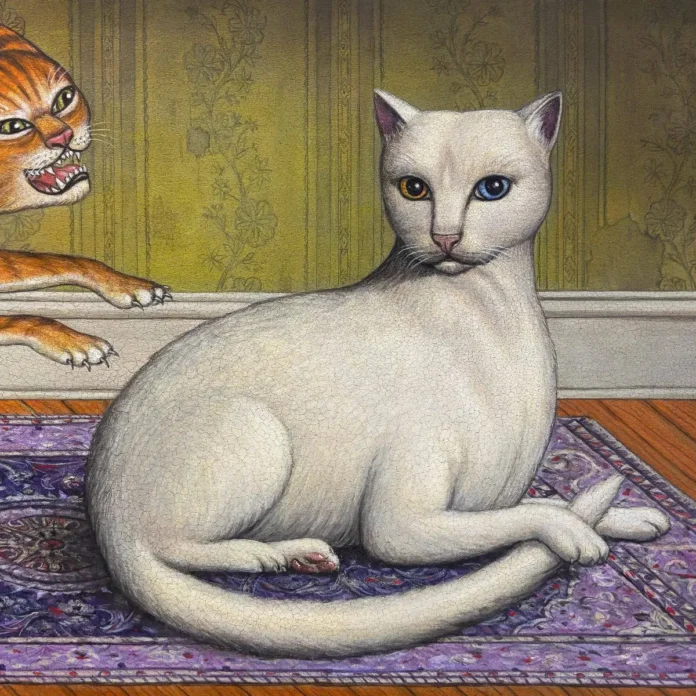
At first, the title of Mitski’s new album seems as declarative as her last, The Land Is Inhospitable and So Are We. But it leaves a bit more room for interpretation. Take it one way, and Nothing’s About to Happen to Me is ominous, portending the darkness that’s always impending in the singer-songwriter’s music. Or perhaps it’s an affirmation, mirroring the illusory warmth of her post-Laurel Hell material. Or, if you’ve listened to enough of its songs, it’s downright misleading: whoever the protagonist is, billed simply as a “reclusive woman” in press materials, she’s far from passive in her pursuit of Nothing. As beautifully pastoral as her last record, with live instrumentation by the band that accompanied her on The Land tour, Mitski’s startling eighth album gestures at a cohesive narrative rather than breathing life into a series of interconnected vignettes. Still, there’s more than one way to connect the dots: from one song to the next, from new to old, nothing to everything. Just listen, though, and you might find her longest album (at 35 minutes) to also be her boldest statement to date.
1. In a Lake
“I should move to a brand new city and teach myself how to die,” Mitski sang 14 years ago on ‘Brand New City’, a sort of precursor to the opening track on Nothing’s About to Happen to Me. ‘In a Lake’ carries none of the fatalistic angst that powered one of the grungiest songs on Lush; it swims in the tangy sense of nostalgia that makes your heart ache wherever you go. Over the past few years, Mitski has been recontextualizing old songs to suit the pastoral sound of The Land Is Inhospitable, but the accordion, banjo, and strings beaming up the new album seem to serve a more overt narrative purpose. Our protagonist begins by declaring that she’d never live in a small town, clearly having lived in one long enough to have found a single place of refuge from its narrow people: “In a lake you can backstroke forever/ The sky before you, the dark right behind.” That spurs the thought of starting over in a big city, as if the feeling of infinite possibilities is comparable, a chance to belong to the dark. As drums crash and strings swirl towards the finale, it couldn’t sound more like coming alive.
2. Where’s My Phone?
As the lead single from the album, ‘Where’s My Phone?’ signalled a return to the fuzzed-out guitars of Bury Me at Makeout Creek, spinning familiar themes of dissociation and claustrophobia before descending into gothic horror. But oh, how it decimates the pastoral veneer of ‘In a Lake’ like a jump-cut to the chaos of a city that shoves you deeper into the recesses of your own mind. The dark she romanticized as being “safe inside”? It’s suddenly taken on a twisted dimension: “If night is like you punched a hole into tomorrow/ I would fuck the hole all night long.” There’s no pursuit of a safer tomorrow, only a frenzied cycle of erasure – starting over, over and over again.
3. Cats
Mitski regains her wistful composure as a doomed relationship enters the picture – one whose fate is entirely up to the other person. The stillness of ‘Cats’ is almost as devastating as its solitude, the protagonist’s sole consolation being the titular companions: “Our two cats,” she tragically clarifies, sleeping by her side, “Making sure I’ll be alright.” They’re embodied gorgeously by Fats Kaplin’s pedal steel and Ty Bailie’s keys; unlike the first two songs, though, the instrumentation hardly crescendos, lying helplessly dormant.
4. If I Leave
The narrator is granted a choice, after all, but is certainly no happier for it. If Jeni Magaña and Bruno Esrubilsky’s sturdier rhythm section is a sign of newfound agency, they also mirror her mounting anxiety: painstakingly, she lists every place in the city where the flurry of people only reminds her of the one who could truly see her. “I’ve let only you know/ How I ride through a tunnel and it’s dark the whole way,” she sings, dialing the distortion back up. Mitski has illuminated it several times before, but there’s more to this story.
5. Dead Women
Who gets to tell it, though? Here, the reclusive woman – women, in the title, underlining the song’s allegorical power – imagines herself dead, her story to be exploited by anyone who pleases. The end is chilling – “She gave her life/ So we could fuck her as we please” – its violent dreaminess punctuated by the first deployment of synths on the album.
6. Instead of Here
Mitski has transformed her live concerts into striking one-woman shows, for which ‘Instead of Here’ provides excellent material. You can imagine her acting out – slowly, to match the song’s ambling pace – the first line, “Right as I dip/ A toe in the abyss,” then opening the door to Death and lying down beside her. The lush instrumentation isn’t meant to contradict the quietly morbid drama – in her solitude, the protagonist has reached an almost blissful level of untouchability. Almost humorously, death plays more of a therapist’s role, saying “she wished I’d known that I’m still just a kid” before clocking out. In flirting with Death, turns out, she may actually teach herself how to live. Old friend misery would never bother with such lessons.
7. I’ll Change for You
On ‘If I Leave’, Mitski’s protagonist wandered from “this street” to “this mall” to “this bar,” stressing how nobody knows about her predicament. The order is hardly accidental, as she finds herself in that last stop again on ‘Instead of Here’: “Bars/ Such magic places/ You can be with other people/ Without having anyone at all.” If the song’s arrangement is any indication, it could be a jazz bar, where the music is playing with her ambivalence about the death of a relationship. As she watches all the cars passing by, she compares herself to “a kid waiting for my ride,” Death’s insight ringing out. By the final refrain, her desperation turns to conviction as she belts out one more “I’ll do anything.” Magic places make it seem possible; then it’s closing time.
8. Rules
“I’m slow to learn all the rules,” Mitski sings on the opening track, and eight albums into her career, we’re treated to her relationship rulebook, which starts with her coming over and (spoiler) ends with her “crying ‘cause it feels good.” Good how? you might be wondering, a question she and her collaborators answer with old-timey orchestration – at this point, less of a new haircut for Mitski than a full-on body suit, so sparkly you can’t help but see (and dance) through the disguise.
9. That White Cat
‘Working for the Knife’? More like working for that white cat – not the two cats that the earlier song was about, but a new one in the neighbourhood marking out its territory. The Rid of Me-esque aggression and wordless additional vocals of ‘Where’s My Phone?’ return – I guess if you don’t find those things worthy of an existential spiral, Nothing’s About to Happen to Me is not the album for you. But you gotta make something out of nothing to figure out what that something is all about, and Mitski’s breathtaking performance pierces right through it.
10. Charon’s Obol
On ‘I’m Your Man’, an unsettling highlight off The Land Is Inhospitable, Mitski pictured throwing herself to the hounds as punishment for faking her way through being loved. How poetic, then, that on the penultimate track of the new album – and most complete, story-wise, as she switches to the third person – the protagonist is the one feeding the dogs circling her new house, reclaiming ground haunted by death as she restarts her own life. When she goes out to feed them, Mitski sings, “Her memories bathe in the moonlight for a while” – the only other keeper of her memories is not a lover, but the outside world, driving her into that emotional lane for a brief moment. No matter how cut off from humanity we can pretend to be, the things we consider less animate than us might still hold the key to our fragile hearts.
11. Lightning
One of my most cherished live memories is hearing Mitski sing “Every drop of rain singing ‘I love you, I love you, I love you’” to a crowd that’d been standing for hours through a storm at Primavera Sound 2024. I’d go through it all again to hear the repeated line “All hail the rain” on the final track of Nothing’s About to Happen to Me. The setting, of course, isn’t a festival stage but that same house, the rain drops hitting like “ghosts on the roof/ Running like they’re feeling alive again.” There’s no doubt the song – poised, but as thunderously climactic as it should sound – is hurtling towards death, but not without flirting with the idea of rebirth, of reflecting the moonlight that might stir another’s empty soul. I won’t spoil its punchline of an ending, but your tomorrow won’t be the same after hearing it. More than glowing praise, that’s just the record’s truth: hole up in your house, hollow out your heart, believe it’s dark the whole way – no matter what you do, nothing’s going to be the same as yesterday taught you. And Mitski could try to make the same record and end up with another masterpiece.

, Nothing's About to Happen to Be might be her boldest, most cohesive statement to date.)