

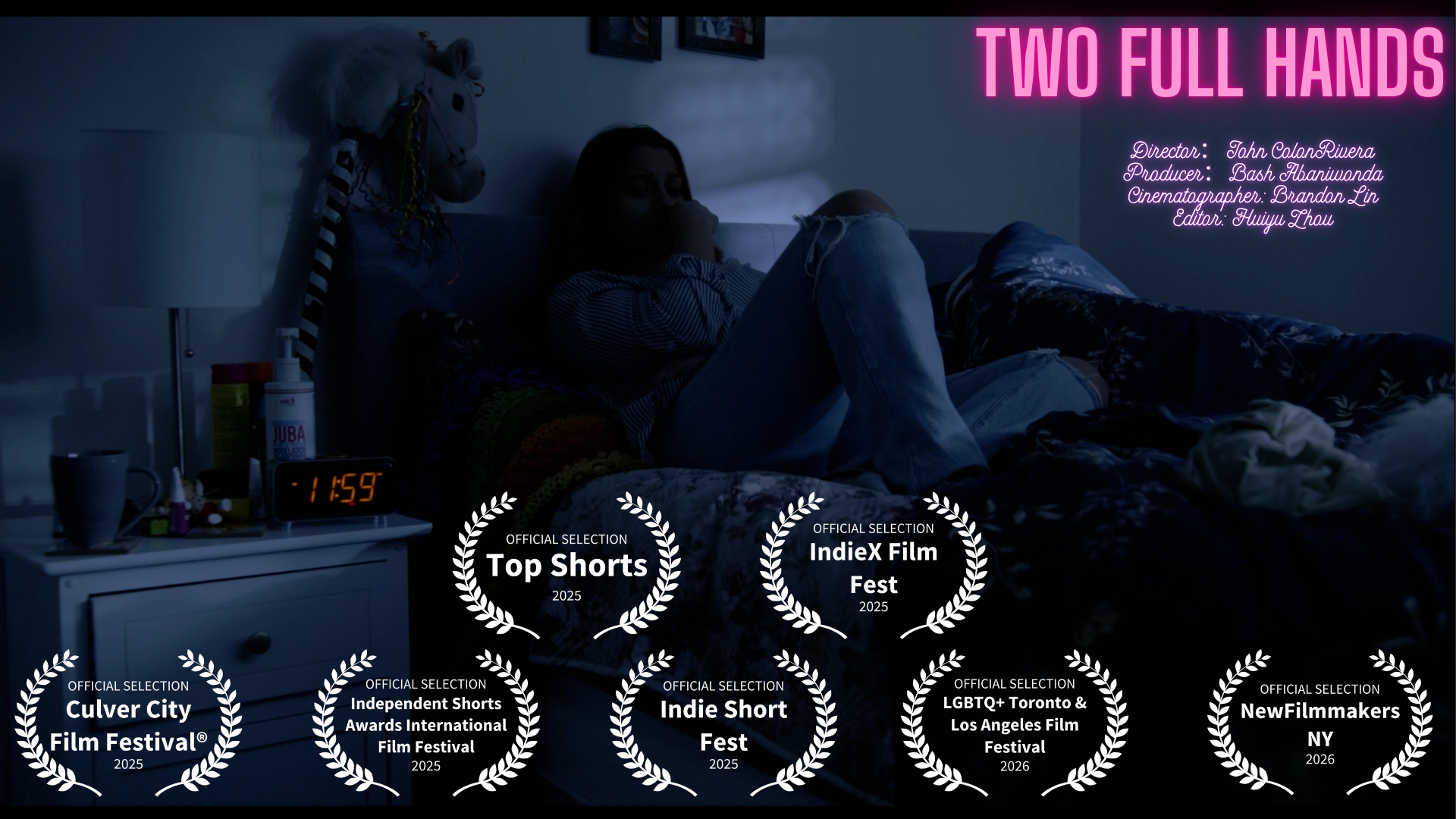
A quietly affecting independent short, Two Full Hands explores hardship, care, and the possibility of belonging beyond blood ties. Directed by John Colón Rivera, the film follows a single mother struggling to balance work and family life under the steady pressure of everyday hardship. Her situation is shaped not by one dramatic crisis, but by the cumulative weight of ordinary survival: responsibility, fatigue, and the emotional strain of carrying too much for too long. As the story unfolds, her isolation is gradually interrupted by the kindness of strangers. Through small acts of warmth, empathy, and support, the film opens onto a larger idea: family is not always confined to blood ties, and belonging may sometimes be formed through care itself.
Under Rivera’s direction, the film remains closely attuned to the pressures of daily life, resisting any impulse to inflate its material into melodrama. That restraint keeps the story grounded in work, caregiving, exhaustion, and the fragile forms of connection that emerge within them. Pedro Riera’s screenplay gives shape to this world not through spectacle or dramatic excess, but through accumulation. Its emotional force builds from lived pressure rather than narrative escalation.
Zhou’s contribution, however, extends far beyond maintaining tonal restraint. Her editing becomes a central structuring force that shapes how the film is experienced. Working with footage marked by hesitation, uneven timing, and the subtle inconsistencies of non-professional performances, she resists the conventional impulse to smooth or normalize the material. Instead, she preserves pauses, lingering glances, and minor behavioral shifts, allowing the film’s rhythm to emerge from within the instability of lived experience rather than imposing an external order.
This approach produces a temporal texture defined less by continuity than by duration and interruption. Moments are allowed to extend slightly beyond narrative necessity, creating space for fatigue, uncertainty, and emotional latency to register. Rather than compressing time for efficiency, the editing selectively elongates experience, drawing the viewer into the weight of daily endurance. In doing so, Zhou shifts the function of editing from facilitating narrative flow to articulating psychological and physical strain.
Her handling of the strangers’ appearances is particularly revealing. The editing avoids rhythmic acceleration, dramatic emphasis, or affective cues that might elevate these encounters into moments of narrative climax. Instead, their gestures remain grounded, almost incidental, unfolding at a scale consistent with the film’s broader social reality. This restraint prevents the scenes from slipping into sentimentality, allowing care to appear not as resolution, but as a modest and credible intervention within ongoing difficulty.
The result is a viewing experience marked by a subtle but persistent friction. The pacing is not entirely smooth, the emotional cues are not fully guided, and meaning is not immediately resolved. Yet it is precisely within this partiality that the film achieves its sense of intimacy. Zhou’s editing does not conceal the roughness of life; it makes that roughness perceptible, turning it into a formal condition through which the film’s themes of pressure, vulnerability, and interdependence are felt rather than simply understood.
From there, the film enters a wider cultural conversation about interdependence. It asks what becomes of the idea of family when inherited structures are no longer enough to contain the demands placed upon them. It also asks whether belonging should be understood only in biological terms, or whether it may also take shape through shared vulnerability and response. Zhou’s editing reinforces that idea through the film’s quiet rhythm and close attention to human interaction. The answer Two Full Hands offers is understated but significant. Family is not rejected here; it is widened. The film makes room for the possibility that care can extend beyond obligation, and that social connection may be built through attention rather than origin.
The title itself reinforces that reading. Two Full Hands evokes a condition of burden: a life already occupied, already carrying, already stretched by what it must hold. For the mother at the center of the film, care is not an abstract virtue but a continuous demand placed on the body, the emotions, and the rhythms of daily life. The image is simple, but it carries force. It suggests not only labor, but limit, while also hinting that even a life defined by pressure remains bound up with others.
The film’s intimate scale keeps it close to the dimensions of ordinary experience and preserves the emotional proximity of its subject. Nothing in Two Full Hands pushes its world beyond the human scale of the story it tells. The short has also found recognition on the festival circuit, including an award at Top Shorts, official selection by the Culver City Film Festival, and a semi-finalist placement at IndieX Film Fest. That recognition carries particular weight in the case of Top Shorts and IndieX. Widely regarded as a leading online short film festival, Top Shorts has earned strong recognition for its visibility and critical reception within the short film community. IndieX, based in Los Angeles, its past honorees have included Academy Award winners, Oscar nominees, Emmy winners, and Sundance-recognized filmmakers. Seen in that context, the film’s festival recognition suggests that its emotional and thematic concerns have resonated beyond its immediate production context.
Ultimately, Two Full Hands reflects on how people become present in one another’s lives through acts of care. By tracing the fragile support that arises between strangers, it expands the meaning of family beyond bloodline without turning that expansion into a slogan. Its cultural force lies precisely in that restraint. In a social world marked by pressure, precarity, and emotional overextension, Two Full Hands suggests that one of the most consequential forms of belonging may be the one created when someone chooses, however briefly, not to let another person carry everything alone.

