

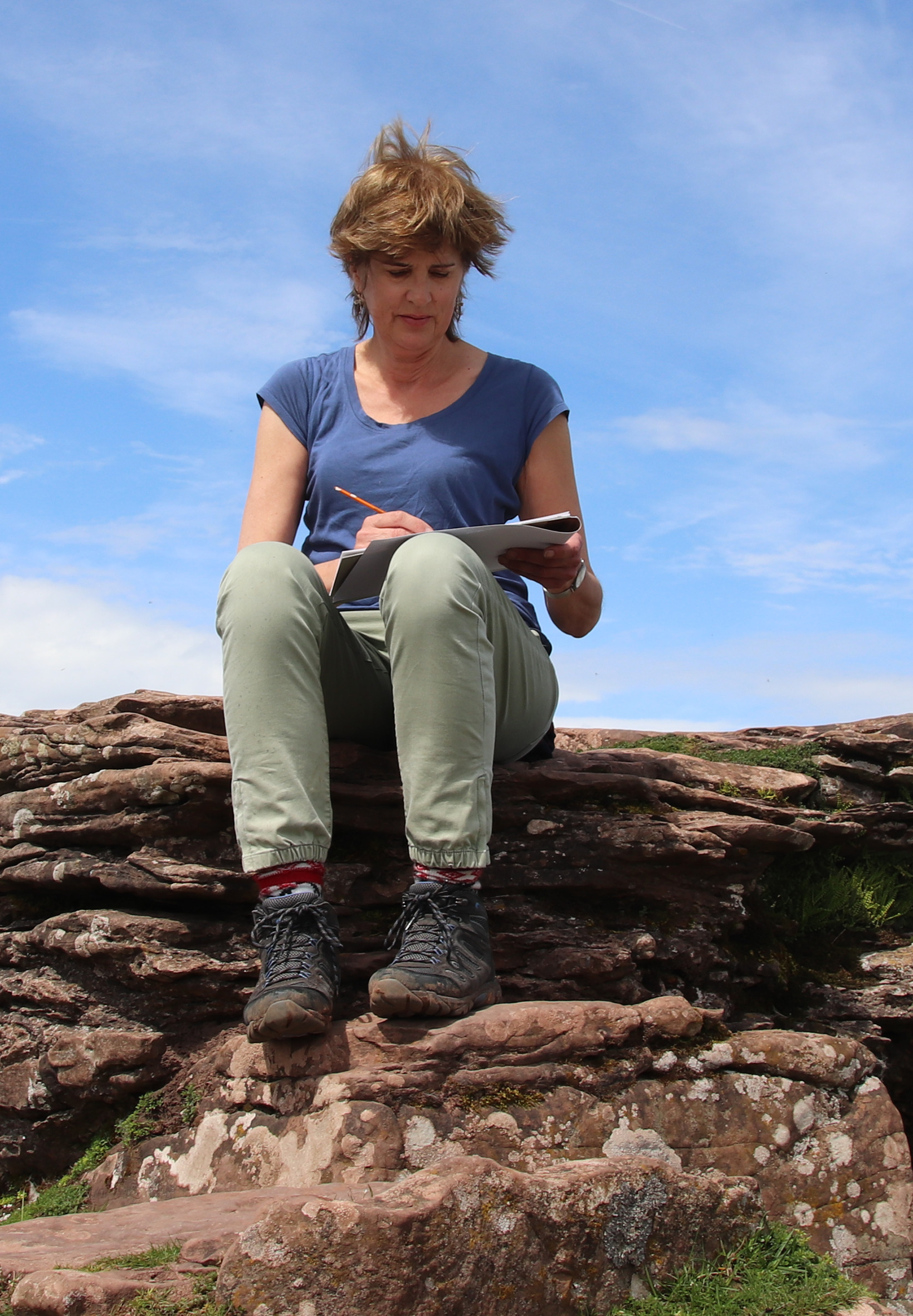
Emma Stibbon was born in 1962 in Münster, Germany. She studied for her Fine Art BA at Goldsmiths, University of London, and completed an MA in Research Fine Art at the University of the West of England, Bristol.
Stibbon’s research has led her to undertake residencies including Artist Placement in Antarctica, organised by the Scott Polar Research Institute; the Arctic Circle.org expedition to Svalbard in the High Arctic; Josef and Anni Albers Foundation, Connecticut; Artist in Residence at Hawai‘i Volcanoes National Park; Artist in Residence at Death Valley National Park and to document receding glaciers in Ecuador with Project Pressure. She was elected Royal Academician in 2013, while in 2018 she was awarded an Honorary Doctor of Letters from the University of Bristol. In 2019, she was awarded the Queen Sonja of Norway Print Award, Svalbard, High Arctic.
Stibbon’s first large-scale exhibition at a major UK institution opened at Towner, Eastbourne in 2024, later touring to The Burton at Bideford. It was exhibited at Cristea Roberts Gallery in October 2025. In this exhibition, the artist’s monumental watercolours, drawings and site-specific installations brought audiences to the frontlines of climate change, connecting vanishing polar ice and surging sea-levels with the alarming rate of erosion taking place on UK coastlines.
Her work is held in numerous private and public collections including the British Museum, London; National Museums Liverpool, Liverpool; Victoria and Albert Museum, London; Bristol City Museum and Art Gallery, Bristol; Pallant House Gallery, Chichester; the Fitzwilliam Museum, Cambridge; and Royal Academy of Arts, London.
Emma Stibbon lives and works in Bristol, England.
Your work sits somewhere between art, fieldwork and environmental record. When you look back, was there a point where those things came together into a clear sense of what you were doing?
I’m interested in landscapes undergoing transition and change and I almost always start my projects with walking and drawing out in the field. Being out in the elements and experiencing that physical, visceral feeling of being in a place is essential to my work back in the studio.
Rather than a single point I think my recognition of the sheer scale of environmental change has been incremental. We are living through a time of unprecedented change due to climate warming and many sites I have worked from are changing beyond recognition in my own lifetime – I can clearly see that. In particular, I’ve been preoccupied with glaciers and Polar ice for some time now, and visiting both the Arctic and Antarctica has been life changing. Witnessing the incredible beauty and wonder of ice sheets and glaciers is incredible but this of course is set against the knowledge of what is happening with climate warming. I feel a commitment to communicating that in my work.
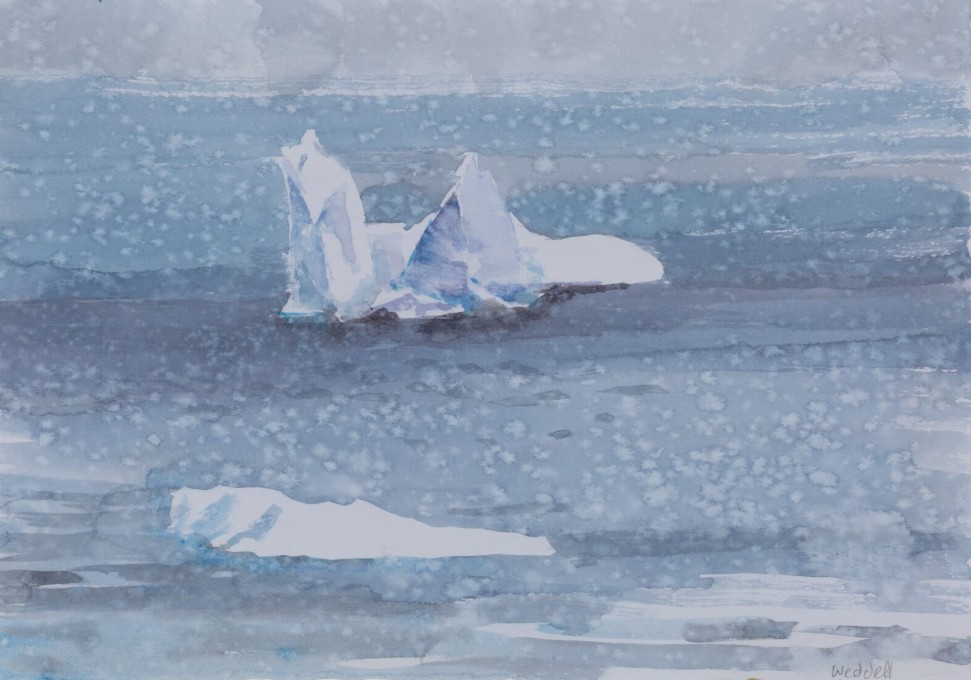
Watercolour with snow spots
21 x 30 cm
Courtesy of the artist © Emma Stibbon
Your work alongside geologists and scientists informs your art. What does each side of that exchange give the other, and has a scientific perspective ever pushed back on or changed what you thought you were seeing?
When I’m preparing for a project, I often seek out expertise from specialists who are looking at aspects of climate impact, usually in the earth sciences. It’s incredibly helpful to learn from their profound knowledge and gives me insight into the dynamic forces that drive change in the landscape so I can begin to identify features when I’m out in the field. For example, when I was looking at the impact of sea level rise on coastal retreat for my Melting Ice | Rising Tides project, I was assisted by geohazards Professor Dylan Rood from Imperial College London. Dylan has studied the rates of retreat at the field sites in Sussex and north Devon, where I wanted to site the work in response to the two exhibition tour venues, Towner Eastbourne and the Burton, Bideford. Dylan had carried out cosmic dating measurements a few years prior at both sites, so he had very clear data showing significant increase in cliff retreat over a very short timescale linked to rising sea levels and storm events. In geological terms this is remarkable and terrifying. I think we both realised that there was value in the dialogue around art and science – we had a lively gallery discussion during the London show at Cristea Roberts and Dylan contributed to a short film that I made alongside the show.
Melting Ice / Rising Tides makes an explicit link between vanishing polar ice and the accelerating erosion of UK coastlines. Was that connection something that arrived gradually through the fieldwork, or did it snap into focus at a particular moment?
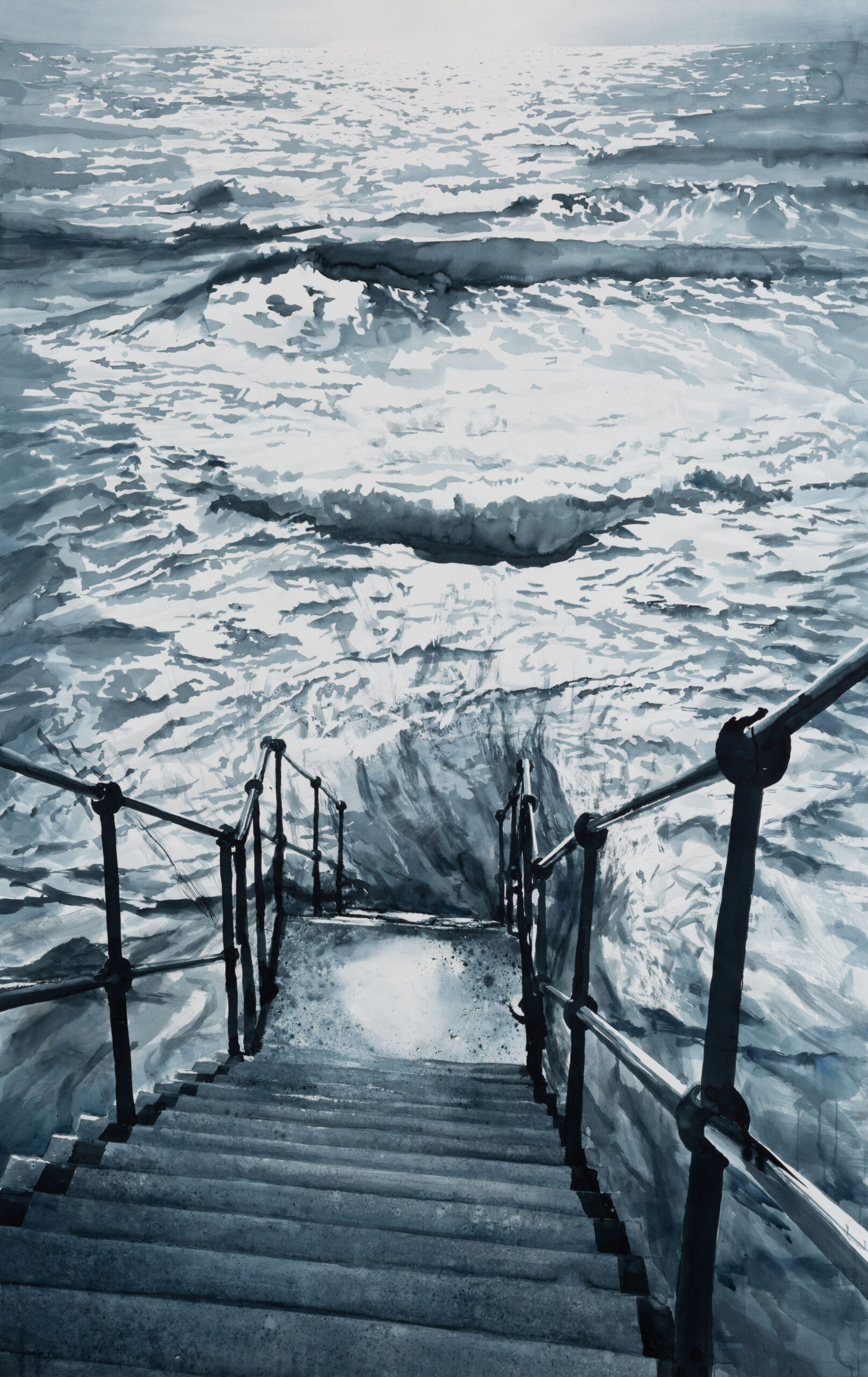
The invitation to show at Towner Eastbourne prompted me to think about the gallery’s situation adjacent to the Sussex coastline. These iconic chalk cliffs are undergoing rapid erosion accelerated by rising sea levels. I wanted to connect this very immediate location to the gallery with the seemingly remote events of polar ice sheet melt caused by global warming so that visitors could consider how interrelated our actions are on what is happening. Similarly when the exhibition toured to the Burton at Bideford, situated on the north Devon coastline, I made a large installation that represented a section of Bideford Bay. I think walking the sections of coastline and observing many of the cliff falls and erosion informed the work. There were several erosion events during my research period such as the closure of the Hope Gap steps that happened due to a storm surge that undermined the foundation of the steps.
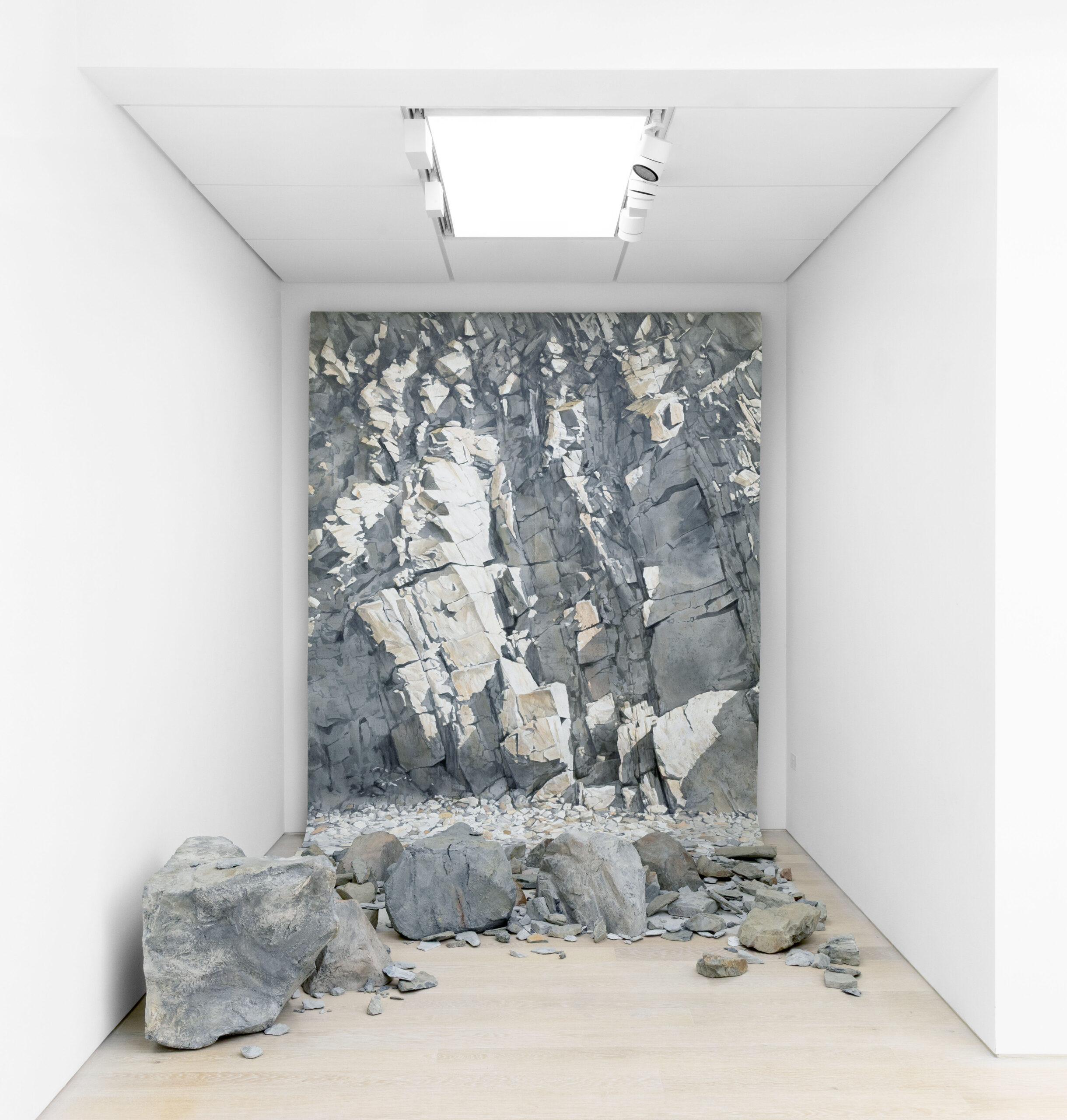
North Devon sourced pigments and rocks, paper and mixed media
320 x 270 x 270 cm
Installation view of Rock Fall, Bideford Bay, 2025, in Emma Stibbon: Melting Ice | Rising Tides at Cristea Roberts Gallery, London, 2025. Courtesy Cristea Roberts Gallery, London. Photo: Sam Roberts.
In 2018 you retraced Turner’s Alpine route and drew the same mountain scenery he had recorded, finding that the glaciers dramatically diminished. What was it like to hold his image and your image of the same place in your mind simultaneously?
I have visited the Chamonix, Mont Blanc region several times now and it is salutary to see how quickly the glaciers there are retreating. In 2018 I contributed to a BBC Radio 3 programme In Search of the Sublime that traced Turner’s Alpine tour of 1802. You can see in his St Gothard and Mont Blanc Sketchbook a watercolour of the Glacier du Bois below the Mer de Glace. In Turner’s day the glacier reached down to the valley floor, now the Glacier du Bois has completely retreated. The artist’s representations of glaciers are now important records that document the extent of change, which was of course pre photography.
You describe your impulse to draw as a desire to ‘act as a witness.’ In environments where a camera could document everything in a fraction of a second, what does the slowness of drawing do that photography cannot?
I’m increasingly aware that I am witnessing these events in my lifetime and I feel compelled to try to capture something of that in my sketchbook drawings. There is the immediate challenge of being out in the elements, that can imprint itself into the media with rain spots or even ice. The natural phenomena of constantly changing skies and mood of weather also adds urgency to getting it down on the page. I use my digital camera extensively but I find drawing makes me slow down my observation and scrutinise what I’m looking at. It is often an emotional, physical thing – the relationship between mark, process and idea are inextricably linked. Perhaps this is due to the temporality of making a drawing; when I draw I have enormous recall, unlike photography the act of drawing somehow imprints it on my memory.
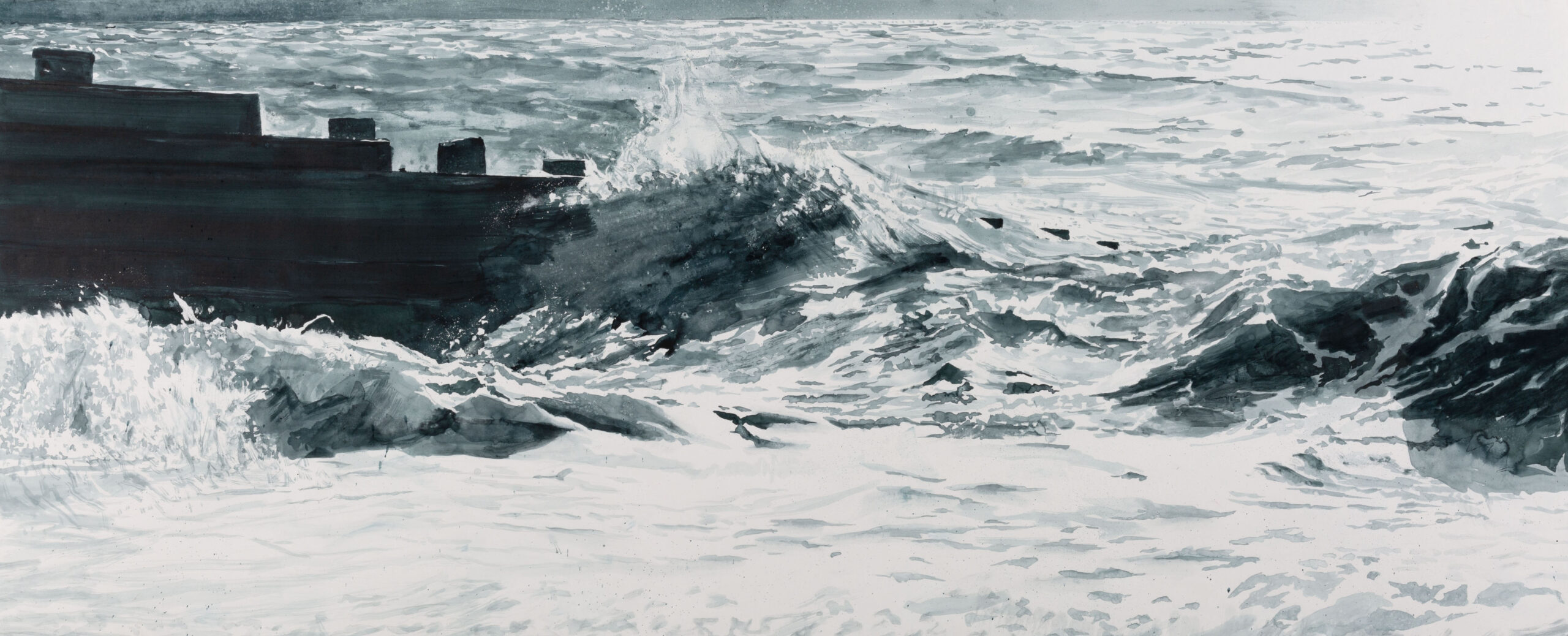
Ink and sea salt on paper
102.5 × 249 cm
Is there a landscape you’ve visited that has stayed with you more than any other?
Yes, Antarctica.
How do you feel about the word “activist” in relation to your work?
I’m unsure whether I make “activist” work – primarily I am responding to the wonder and beauty of the planet. I think when you are confronted with a single piece of my work, you could read it as an iceberg, a toppling cliff or a breaking wave. But I am compelled to represent the changes I am witnessing and by juxtaposing these in the gallery I want to set up a narrative for the viewer to communicate the precarious state of ice sheets and glaciers across the globe and the profound effect the effects of warming is having on flooding and sea level rise. As an artist, I feel working from landscape is very relevant. We are living through a period of rapid change and with the many impacts of human induced climate warming, I am committed to communicating that.
A few months into the new year, is there any artwork you have found particularly inspiring lately?
I recently visited the British Museum’s A Kingdom Crossing Oceans exhibition that had a beautiful Kapa made from mulberry bark on display – this is a ceremonial loin-cloth decorated with natural sienna pigment. When I was an artist in residence on Big Island, Hawai’i in 2016 I learnt about Animism, a Hawaiian spirit-based faith where all material phenomena have agency, not only humans, but animals, plants and rocks – even shadows can embody a presence. I like the idea that the substance of a place holds its memory in its physical entity. That experience of being in a landscape where volcanic, elemental forces are at work is chastening, it’s a salutary reminder of our ever-changing environment. Despite our devastating impact on the planet we are fairly powerless in the face of nature. We should take notice.
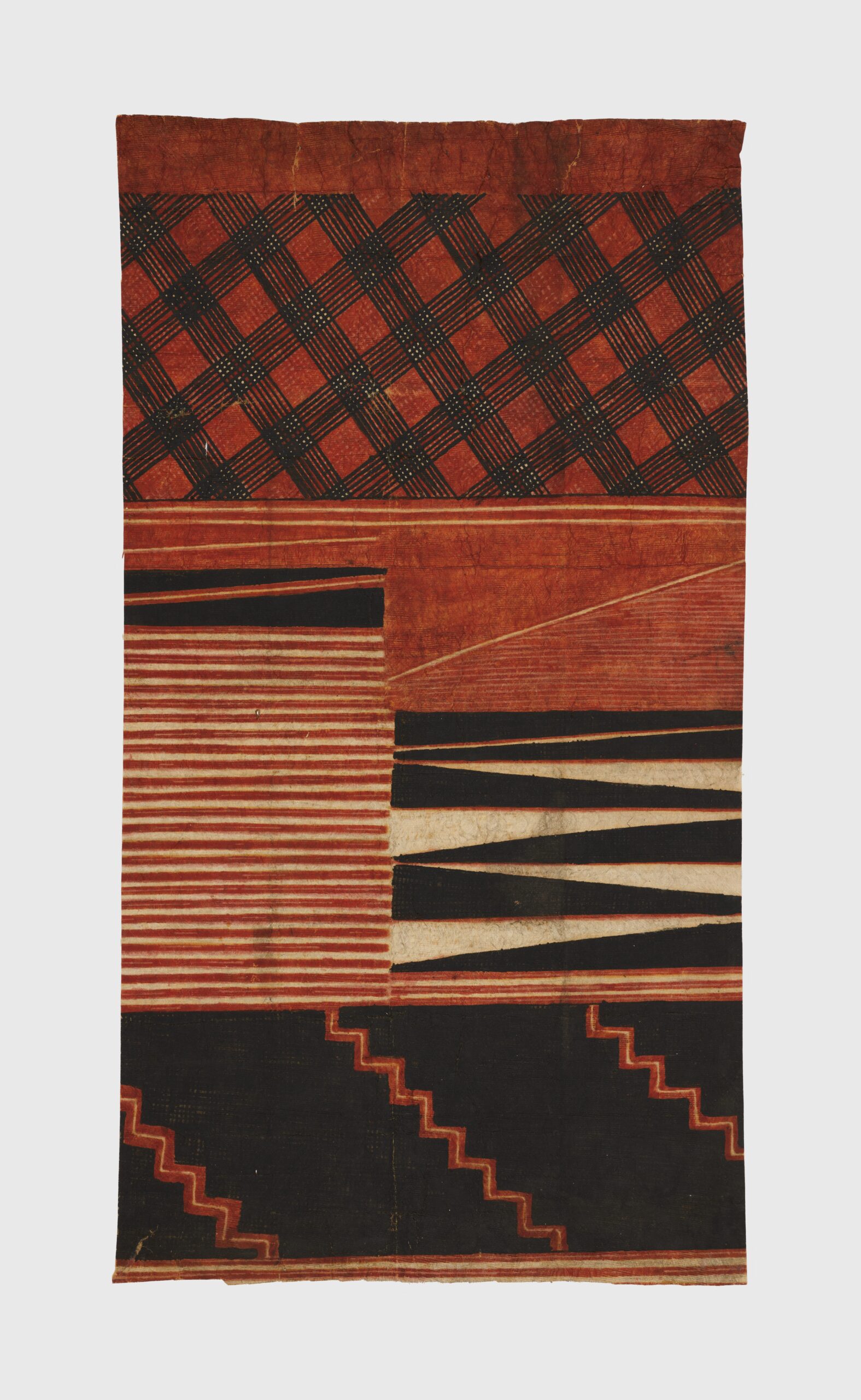
© The Trustees of the British Museum Kapa (barkcloth) is made from the inner bark (bast) of the paper mulberry and other plant fibres. As a medium, kapa is a connector between the land, the people and the gods. Different forms of kapa had many uses, from everyday life to ritual practice, including as chiefly garments, spatial dividers, blankets and wrappings for bones.
Emma Stibbon’s work Hope Gap is currently on show in Cromer, as a large reproduced outdoor installation. On view from Spring 2026, it is displayed as part of the Towner 2026 Bigger Picture. The artist’s work is also currently displayed in the group show Sublime Landscapes. For more, listen to Emma Stibbon’s BBC Radio 3 Sunday Feature, In Search of the Sublime, here.

