

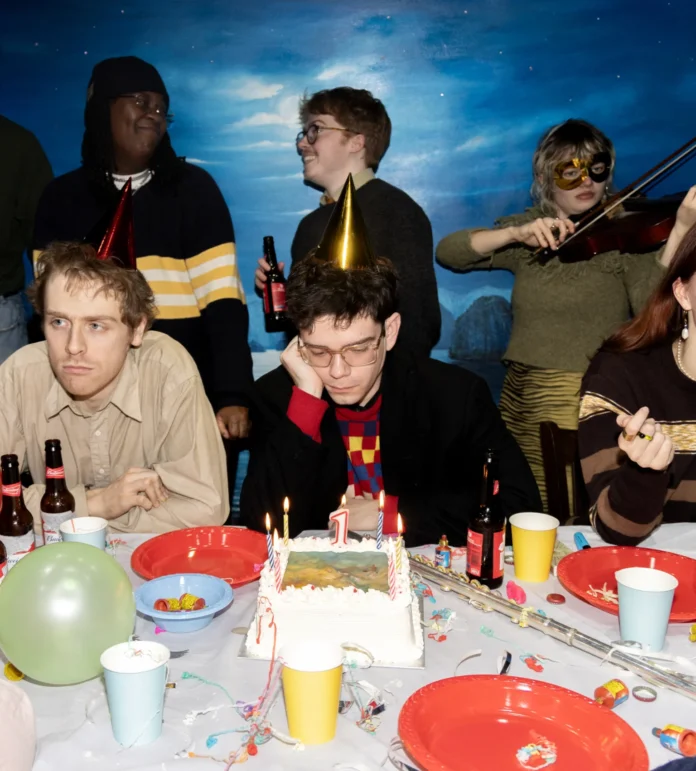
My New Band Believe is the new project of Cameron Picton, who was a founding member of the experimental rock band black midi. The name came to him in a feverish haze while touring China with his former band, when the musician was overwhelmed by flashes of odd imagery and fragmented text. Initially reluctant to pursue another outfit following the band’s dissolution in August 2024 – frontman Geordie Greep was the first to release a solo album, The New Sound, later that year – Picton tested out different aliases, but it was this phrase that stuck when it was time to seriously consider how to move forward. The original idea was to make a collaborative album with the avant-folk octet caroline, but it ended up being a more open-ended studio endeavour that included most of that group, as well as members of Black Country, New Road, shame, and more. Just as he handled most of the writing by himself, Picton then helmed the editing process, creating a magnificent illusion of natural coherence – the way dream logic convinces you this scene makes sense after that one, before the waking mind offers ambivalent interpretations. Fluidly arranged and no less tender than it is delirious, My New Band Believe makes the frantic possibilities of a single night, record, and group structure feel infinitely, intimately mutable.
We caught up with My New Band Believe’s Cameron Picton for the latest edition of our Artist Spotlight series to talk about the visuals accompanying their self-titled album, the openness of the recording process, the future of the project, and more.
You’ve put out a couple of music videos after the album’s release, and you’ve said you’d like to do one for every track. Is that something you’re still working on?
We have videos for half of the tracks. There were some people that I approached – I thought it would be really cool to get them to do a video, but I don’t think they know how to use their phones.
What do you mean?
As in, I don’t think that they know how to access DMs on Instagram or anything like that. It’s kind of hard to get in touch with them, so maybe I just need to let go of that idea. But we’ll see. Maybe at the last minute, they’ll be like, “Hello?”
I imagine it may be trickier to commission or conceptualize ones for the longer songs.
Possibly, but what I’ve said to most people is that there’s a small budget. Basically, the way it’s worked is that instead of doing a big budget video, – there’s not exactly loads of money flying around for this project, but instead of putting all the money into one extra single, it’s split amongst the rest of the songs. It’s not much money, but the director then has kind of total creative freedom to do what they want, and in some cases, they can repurpose old footage, like the Park Kyujae video for ‘One Night’. He just had a roll of film that he hadn’t developed yet and developed it. If you have an idea that you haven’t had a chance to do, that you’re not sure if it’s gonna work or not, why not do it on this, where it’s low stakes.
With the live shows, you’re treating the afterlife of these songs as a fluid thing, whereas it sounds like the videos are less of an extension of the album’s narrative world. It’s more of an opportunity to showcase and work with different artists.
Yeah, and I don’t really like it when music videos are particularly tied to the narrative of the song anyway. In the past, when I’ve been quite prescriptive about a narrative in the song and then it comes out in the video, I’m always a bit disappointed. But with this, I’ve tried to steer away from that as much as possible and to push people into abstraction.
In the ‘Numerology’ statement, you briefly mention the artist who did the cover painting, Kuo Jun You. Could you talk more about that cover in a less numerological way? I know it’s a scene lifted from a dream, but what did it stir up to see it brought to life?
I was interested in recreating it as a photo initially and trying to restage the scene, which obviously would have been really expensive, and that’s why we didn’t do it. But I looked at different ways of bringing the image out through different mediums. I had an idea of maybe getting someone to embroider it, or getting a miniatures artist to do it, and then obviously, painting is the easiest one. I was gonna approach multiple people to do it, but I ended up approaching Kuo Jun. He said that he would get a sketch together, and then end up doing the finished painting, and I thought that, obviously, he did a really good job. It just ended up being like, “Well, we’ve got this now, we don’t really need to approach the other people.” I was keen to get a frame, because I don’t love it when the album cover is just a scan of the painting, and I wanted the painting to have some reverence as an object. It took a while to work out the best way to do that, and the painting was, not stuck, but it was in Taiwan for a long time. Once it came to England, there wasn’t that much time to photograph it, so we did it at a gig. It was hung up above our heads, so that was cool.
And the spotlit quality of it – I don’t know how you feel about the animated thing on Apple Music, but it emphasized something for me in terms of the shifting lyrical perspectives, where it sometimes feels like you’re illuminating a part of the scene, moving around, and then suddenly in the next verse you’re looking at a different part of the same scene, or from a different vantage point.
The Apple Music video thing is funny. It’s one of those things that the label asks you to do. Obviously, it must have some kind of benefit. So I just thought, it would be good to do something with it that deepens your understanding of the artwork itself, or the situation. I think people don’t really fully get that the cover is an actual photograph in real life, so I think it goes some way to remedying that. And like you said, helps you focus on different parts of the painting. The deluxe CD is a cardboard cutout – you pull out the inner sleeve, which is the painting, and the circle is over the man with the detonator.
Do you tend to analyze your dreams and what they symbolize? The birds on the cover, for example, are this watchful, sickening force at one point on the record.
I mostly just forget my dreams after having them. It’s like when you’re falling asleep and you’re having the most amazing idea that you’ve ever had in your whole life and the whole world is gonna be changed by this idea, but you’re really being pulled into sleep, so you can’t quite bring yourself to get up and write it down. And then the times that you do write it down, it usually doesn’t mean anything.
Do you find yourself being pulled to write at night or in that sleepless state?
If I have a good idea or something, then I’llkeep working at it until late at night. But it’s more just about getting really into that focused state, where nothing else really matters and you’re working on this one thing. It doesn’t necessarily have to be late at night or early in the morning, or a sleepless thing, or any kind of altered state – having drinks or anything like that. It’s just about, “Keep going at it.”
Another thing about the cover is that it was finished in two days, which speaks to the spontaneity of your own approach on the record. Part of what intrigued me about you working with caroline is, I remember them telling me around their debut about how over-analytical they are every step of the way. I’m curious if you found those tendencies clashing or complementing each other in ways that you maybe previously hadn’t experienced.
Yeah, I like to work very quickly. One of the reasons that I went in with them in the first place was that I knew that they worked quite differently than me, and I wanted to have something to push against, or to open my eyes to a different way of working. When you’re working with a band, there’s a set group dynamic, which is quite interesting. That was one of the reasons why I was keen to work with a band, as opposed to a producer, or to put a band together; I just thought it was interesting to come into another band’s dynamic. And then also found the same thing touring with Black Country, New Road at various different points. It’s just interesting to see different groups of people that have worked together for a long time work things out and talk things through.
Those guys, yeah, they talk for hours before doing anything, which works really well for them. I think that there were certain things in this that it helped with, in terms of not just doing something for doing something’s sake, and for having a narrative or conceptual reason for doing everything on the record. It was useful to talk through, before other people came in, what actually we wanted from it. But I also generally find doing things and then working it out later is my preferred way of working.
Seeing caroline, seeing Black Country, all those group dynamics post-black midi – I wonder to what extent you find yourself adapting to or absorbing those different approaches, as opposed to just observing and working with them.
Whoever comes in, hopefully it’s a mutually beneficial thing, where you’re both thrust into a strange dynamic. I did it with this band [called Popstar] the other day, where they don’t really have any music out, but they’ve known each other for a long time, and two of them are cousins. They play quite different music, and the songs are usually quite static, and the things that they play with in their music is a lot different. But they’re the band for one of the shows coming up. On the one hand, they’re trying to work out how to adapt the way that they play to the songs, but also, I’m trying to do the same. It’s a thing where you’re both pushing each other to try and do something different. The challenge is often trying to convince people that they can just play how they want, how they see the music should be played, or how they want the music to be played. The songs themselves are obviously reasonably set, but the way that they’re played doesn’t necessarily have to be the way that it is on the album, or the way that it’s been done in shows before.
It’s just trying to convince people that it is actually open. Because people often say, “Oh yeah, the music can be whatever” – and this kind of happened to an extent in black midi – but then, “But not that, and not that, and not that.” This hopefully is a more open proposition where there is actually space for it to be anything. Maybe it’s not gonna necessarily be good, but if it’s for a show, then it’s a one-night thing. The risk of it potentially being good is also what makes it worth it, because sometimes you have a rehearsal and you think, “Oh, that was a bit rough,” and then you come into the space of performing it, and everyone actually realizes, “Let’s just go for it,” and it suddenly becomes really good.
Have you imagined what the album might have sounded like if the timelines had aligned in such a way where you collaborated with caroline from start to finish? What was the benefit of finishing the writing of the songs on your own? Is that something that you’d like to arrange in a different way next time around?
I guess the way that I’ve been working with this has only really come about in the last few months since finishing the album. I wanted to make the record in a way that the way that I was performing them solo suggested in what felt quite natural ways. Moving forward, we’ll see – I’ve got lots of songs, and lots of half ideas, and lots of songs that even are kind of recorded, but not quite finished. I think it’s just a case of probably needing to spend a month putting stuff together, and then we’ll see about hopefully doing some more recording over the summer. I also have this idea about developing live recordings. I think that hopefully by the end of the year, we should have some kind of other big release that could happen, whether it’s a live record or studio record. There’s no reason to commit to it.
With the writing and the lyrics, are you still inclined to keep that part to yourself, at least in those initial stages, or when you’re whittling down and tinkering with ideas?
I’ve got a lot of ideas, and it’s useful to have people that can be honest about what they think about it. They’re kind of few and far between, because it’s quite hard to have a good relationship with someone where they can feel like they can tell you an idea is bad, and vice versa. But there’s hopefully a few songs that are in the stage of, “Okay, let’s stop showing this to people now.”
Now that I said this, I’m remembering the part of your ‘Numerology’ statement that mentioned a good deal of words being credited to others.
Oh, yeah. That was more just some lines I’d taken from conversation. Or, some lines were from a friend’s diary entry that she’d told me about, that I then put in the song. Another was from another friend’ song that I guess already existed. That was more just a thing of crediting people for their contributions, even if it was me taking it from somewhere else and putting it in a new context, at least just acknowledging that that’s their line. But for example, in ‘Numerology’, there’s a couple of lines where I would write out the lyrics with Seth, and he’d go through and be like, “Does this line work?” And then you say, “This line could be better,” and then I’d find a different one. That’s happened a few times, but lyric writing and doing the vocals is a very sensitive thing for a lot of people. People generally aren’t really massively open to criticism, because it’s something that we can take quite personally. But also people don’t really want to suggest stuff because it can be quite hard to get people to be really critical of your work, even if you want them to.
Which is why I’m fascinated that you say some lines were from a friend’s diary. I mean, some of the lyrics are confessional and diaristic, but I wouldn’t expect in such a literal way.
Well, it was something she kind of told me in jest, but I obviously asked her if it was okay. It was a thing that she told me that she wrote in her diary when she was a kid, which was kind of a funny line. It wasn’t anything particularly revealing or anything like that.
You mentioned vocals being a sensitive thing, too. There’s different singers on the album – 21, I believe – but only you sing lead. That one voice works in an interesting way, given those perspective shifts. But I wonder if there were times where you thought about someone else taking on another vocal part, or if it’s something you might be interested in in the future.
Most of the way that I’m writing at the moment is just for one voice. But that doesn’t necessarily have to be my voice, I guess. I’ve done it in shows recently where someone else has come and sung one of the songs.
Did that affect you in some way?
Yeah, it was interesting. But it was the first time I was also performing that song [‘One Night’], so I was focused on different things. Also, the show that we did had a different band for every song.
You were talking about the flexibility and openness of the recording process. I think people may perceive that as an enticing thing to try out, but it also sounds potentially very chaotic. Is there a part of it that’s maybe less exciting to talk about that has to do with reining it in when it gets messy, or organizing possible ideas and contributors?
I think that you have to have some kind of executive thought about each thing that happens. Sometimes, you have to think about how everything is obviously about that song and serving the song, as everyone always says. It’s more just about coming through it afterwards, giving people the space in that moment to play whatever they feel is good. But obviously, when you do five or six takes across the whole track, you can’t use everything. So it’s just about whittling it down and making sure that the best stuff is used. Which is sometimes just one chord.
I know caroline’s Jasper Llewellyn and Mike O’Malley are credited as producers alongside you. Would you describe yourself as being more in that executive role?
They were very present for all of the studio sessions up to towards the end of the process, when they were doing the album campaign for caroline 2. From then on, I took it over, so the edit stage of the album was basically me. A lot of the overdubs, and obviously all the guitars I just did by myself. But any session with an external contributor, they were present and helping give notes and making sure that we got the right performance and the right sound out of every musician.
What appeals to you about that part of the process that’s stitching together different recordings and editing, compared to the writing and recording?
I think it’s interesting and rewarding to create something that couldn’t have been done in real life and to try and make it sound natural and like it was performed in the room. A lot of the album, when you consider the parts and how they work together, it’s not really plausible. But it’s making something unnatural sound very natural. There’s times on the record when I’ve tried to push beyond that, where there’s a big distortion riser or anything like that, trying to remind you that this is an edited performance rather than something that’s actually happening in a room.
Or making something that was recorded in different studios sound like one room. It’s obviously easier for you to discern which parts were recorded where, but that’s not necessarily the case for an outside listener. One moment, though, that really kind of stands out as illuminating that space is the bedroom-recorded intimacy of ‘Opposite Teacher’.
Yeah, it’s just one mic. I intended to record it again later, and I was like, “We’ll just cut this in, this section later, and I’ll just do this as a placeholder.” There’s a couple of moments where it just cuts to one microphone, like in ‘Target Practice’, the first chorus was recorded in my friend’s bedroom. And there’s also the end of ‘Pearls’, where the microphone physically leaves the studio and goes out into the street outside and starts clipping from the wind.
Do you collect a lot of phone recordings? Beyond demos, do you have ones that are just you humming melodies or lyrics?
Yeah, it’s just a useful and convenient way of recording any ideas, so I use it frequently. Every so often, if I have a long car ride or something like that, then I’ll go through them and delete or keep as appropriate. But mostly they’re just kind of sat there.
I know that you set some rules for this record that weren’t necessarily there for you to stick to, but helped you frame this record. Is there another set of limitations that you’d be interested in exploring, even if you still break out of them?
Well, I guess this trying to get different people every time is its own limitation in a way, because we can’t really develop anything over a period of time. Despite every day supposedly being different, you don’t necessarily get this thing of trying to work out something a bit more complicated, or something that requires a bit more thought. It’s obviously fun to work on instinct, and you get a lot of good stuff out of it, but I think it’ll become more appealing as time goes on to start pulling people back a bit more, and say, “Come and do this tour,” or, “Why don’t we do three or four shows, and then maybe go into the studio after that?”
This interview has been edited and condensed for clarity and length.
My New Band Believe’s My New Band Believe is out now via Rough Trade Records.

