

Ancient Chinese Taoist thinking returns repeatedly to the question of the boundary between the self and the other, the living and the dead, treating it as a passage to be traversed. This enquiry into the limits of reality and imagination finds further articulation in contemporary practices of mise en scène in photography. As Jean-François Lyotard argues in “The Unconscious as Mise-en-Scène,”1 the act of staging in art shares a similar mechanism with the unconscious in psychoanalysis. Just as psychoanalysis reads the symptom as the visible surface through which an unconscious drive makes itself legible, Kaiyuan Yang approaches ritual as the staged surface through which a collective desire persist.
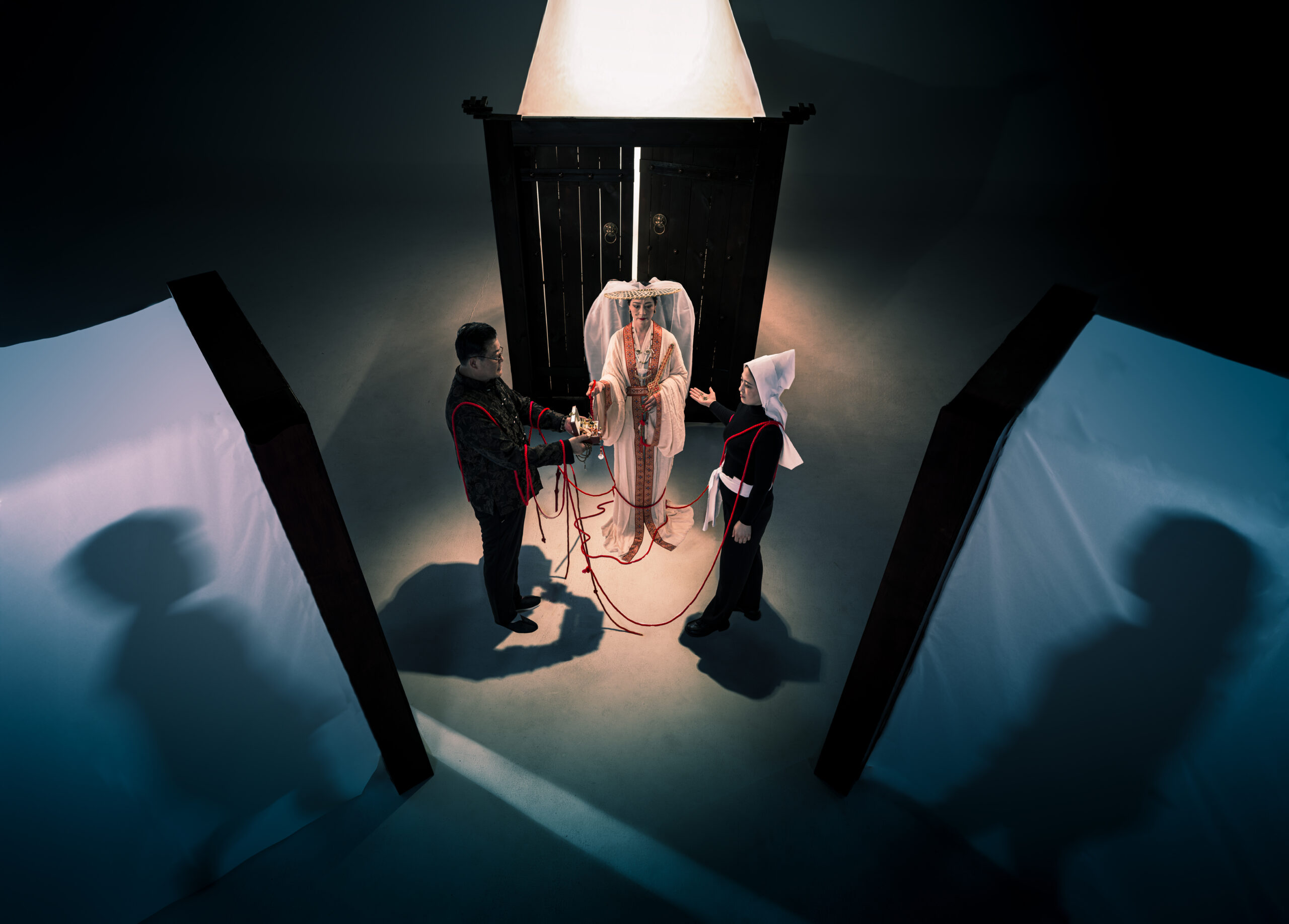
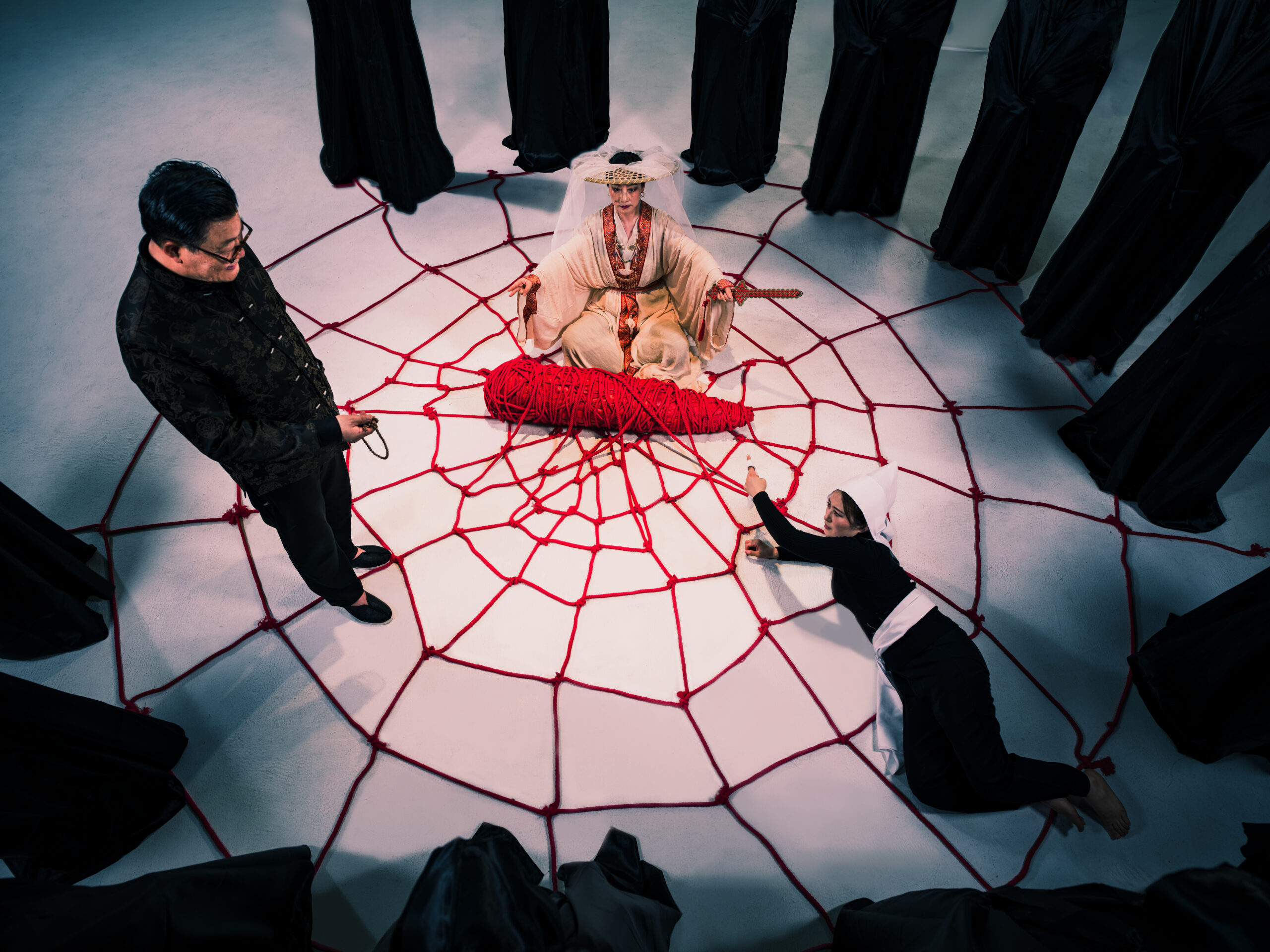
Yang’s project Ghost Marriage (2024) sits precisely within these registers. A series of six photographs accompanied by sculpture pieces, takes as its subject the posthumous marriage rite. The family of a deceased unmarried son procures a deceased bride of similar age to complete the lineage in the afterlife. Throughout the project, Yang meticulously recreates the imagined dreamscape in which the ghosts gather to fulfil the wishes of the living. In 三扇门交易 (Three-Door Transaction), three central figures stand in front of the gates that signify a connection to the underworld. They are connected by red strings, each dressed in clothing that identifies them with different but entangled social classes. In 蜘蛛网 (Spider’s Web), the three figures occupy a vast red web that marks the inescapable nature of ritual in Chinese tradition. Yang poses the question of whether the wealthy classes exercise control over such rituals, or are, in fact, themselves at the mercy of tradition and the unethical practices it perpetuates. Thirteen figures stand behind them around the periphery of the red web, silent witnesses who form part of the ghost marriage.
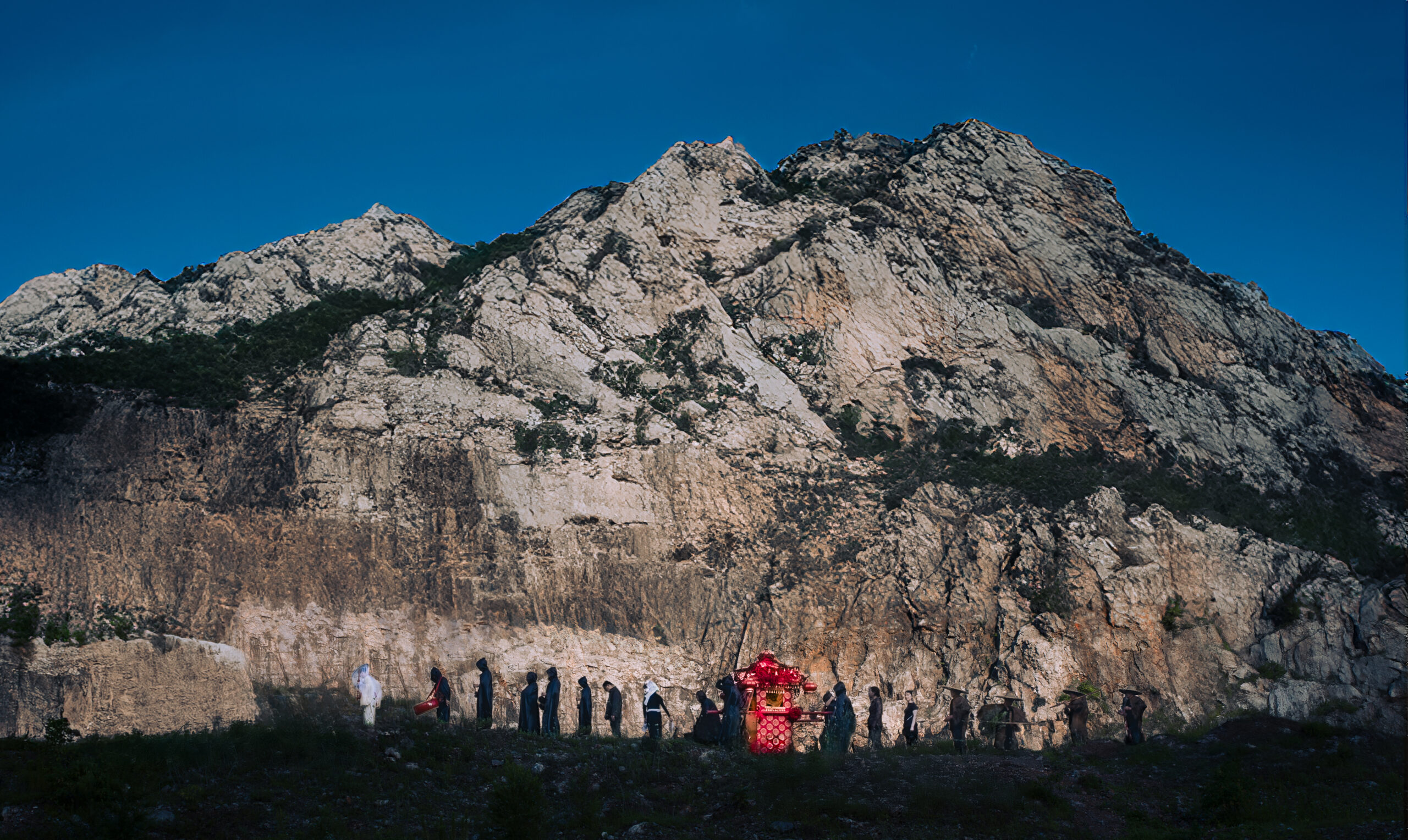
The red bridal palanquin, referencing traditional Chinese wedding customs, becomes the recurring motif at the centre of Ghost Marriage. Although the bride remains unseen throughout the series, the palanquin carried aloft by the procession signals her presence. Her concealment operates as a gesture of ownership, shielding the bride from the spectator’s gaze. Yang photographs the mountain passages along which the ritual procession advances towards an imagined site of union between the living and the deceased.
By capturing rituals that deceptively belong to a distant past yet continue to haunt contemporary society, the work foregrounds the question of the collective unconscious. Yang’s photographic practice, grounded in mise en scène, demonstrates how the boundary between the real and the imagined dissolves, and how human desire remains the one red thread connecting generations. Ghost Marriage registers the troubled persistence of rituals whose ethical violence has never fully receded. By staging these dreamlike spectacles, Yang invites the viewer, positioned as the imagined audience of such rituals, to reflect on what our societies take for granted in their service to human desire.

