

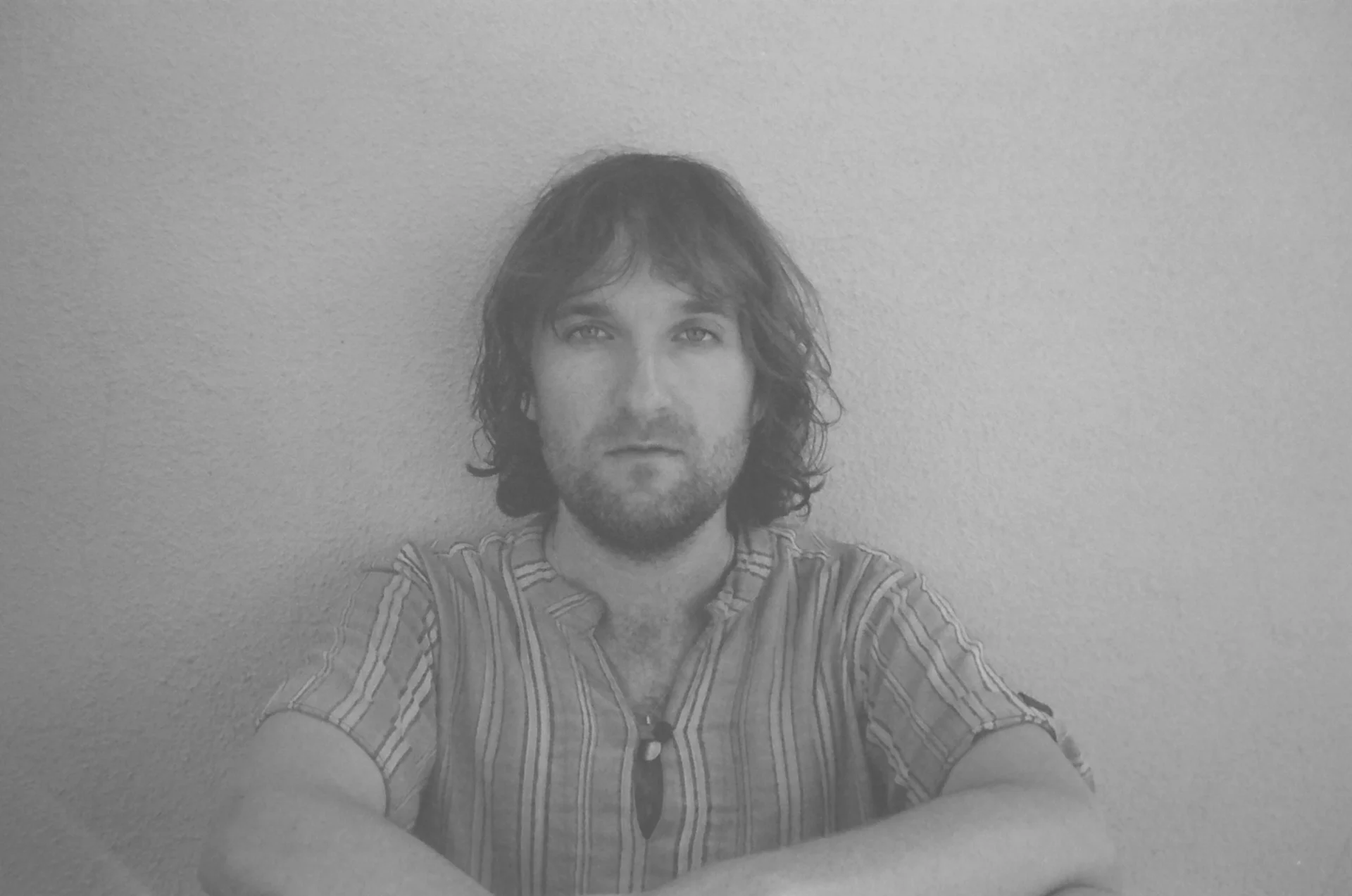
Angelo De Augustine was used to making music on his own. Some may have initially become aware of him around the release of A Beginner’s Mind, his 2021 collaborative album with Asthmatic Kitty label mate Sufjan Stevens, but the singer-songwriter has largely kept the writing and recording of his solo albums a solitary process; his studio is literally called A Secret Place. His new album, Angel in Plainclothes, the follow-up to Toil and Trouble, was once again written, recorded, arranged, produced, and mixed by De Augustine. But he invited outside contributors for the first time in years – including strings arranger Oliver Hill, harpist Leng Bian, Tomb producer Thomas Bartlett, and his mother, Wendy Fraser – in part because the physical burden of taking on every part was overwhelming. The looming backstory of the album is that, after being hospitalized with an undiagnosed illness in early 2022, De Augustine had to relearn how to walk, talk, see, hear, play music, and sing again. But though at times emotionally devastating, it is no document of suffering; it’s unguarded and mystical in its intimacy, shimmering with the kindness of those who have helped him survive. “Sometimes life is too much, you know,” De Augustine told me in 2023. Angel in Plainclothes captures an artist determined to live it.
We caught up with Angelo De Augustine to talk about his healing journey, Kauai, swimming, and other inspirations behind his new album, Angel in Plainclothes.
Healing journey
Revisiting our conversation around Toil and Trouble, you’d said you had albums’ worth of songs that didn’t make it onto that record. I’m curious if there were pre-2022 songs that appear on Angel in Plainclothes, or if they were all written in the period after you were hospitalized.
I wrote this record fairly quickly, if you were to compare it to the last one. It took me about a year to write and record it and arrange it from start to finish, and then mix it. It took me about a year. Toil and Trouble is three years, I think. But these all came probably in 2024, and then I finished the record in 2025.
Was it because it all felt like they were coming from the same place?
Yeah, they were coming from a similar place. I don’t really know why certain songs fit together and why others don’t, and maybe they could fit together. Maybe all you have to do is just say that they do fit together. I’ve got lots of songs that have never come out. Maybe I’ll do a B-sides thing or whatever, but I’d never really done that before. My experience writing is that sometimes you’ll even write songs in the same period of time, but they don’t feel like they fit either, so it’s about finding the ones that feel like they fit together. That’s a process that’s difficult to… talk about, because I don’t really know why it is. Maybe it’s more of an instinctual feeling.
Did your journey of relearning how to see, talk, hear, and play music shift your instincts at all, or the way you were following your intuition?
Oh, that does make a lot of sense. For a long time, I felt like I couldn’t trust myself at all anymore, because I felt like I couldn’t trust my body or what was going on. It took a long time before I could play music again, and then after I could play music, to trust myself more again. It took me probably two years before I could really play music again. At first I couldn’t do it, and then it just felt weird for a long time to play the guitar, to do these things, because I was dealing with all this other stuff. I’ve been on this journey of healing for a while, and what I found with it is that the journey isn’t really linear, in what I normally thought of as linear: you get sick with a cold and you get better in a week. It definitely challenged my view of what’s normal. In that sense, it made it hard to trust anything anymore.
There was no conclusive evidence from doctors, nobody was able to tell me what was going on, nobody was able to help give me anything. So, I had to do a lot of my own research. What I think happened for me is that I was under a lot of stress for a long period of time, and what can happen to people sometimes is that when they are under a lot of stress for a long period of time, and they have a few things that happen that are really challenging at the same time – it’s rare for this to happen, but sometimes it can push someone over the edge of what their nervous system is capable of, and they call that the allostatic load. Basically, that’s how much we can tolerate in our nervous system. And then the nervous system usually calms back down. But sometimes when you go over that threshold, you go into a state of fight or flight, where the brain doesn’t recognize that it can go back to homeostasis, so it stays in that fight-or-flight loop. When that happens, it can cause manifestations of all kinds of physiological symptoms or sensations that don’t really make any sense. But really, what they found is that it’s just the brain creating these symptoms; they’re not a result of anything that’s wrong biologically.
In my journey, I’ve found a number of different ways to try to calm the nervous system. The more you calm it, the more the symptoms go away, and they don’t come back, because the brain goes back to homeostasis and doesn’t feel like it has to create these symptoms anymore. The more you do it, the better you get at it, and the more the brain understands that it’s safe – that you’re safe. But it’s a process of learning to trust again and being educated on how the brain works.
A lot of people don’t know this, but we’ve known since the 1970s that the brain is not fixed. The brain is neuroplastic, meaning it can change its structure and form and its neuronal pathways. That’s why you see a lot of people are able to fully recover from strokes and things like that, because the brain can actually change its structure and how it works. Just knowing that is interesting, especially with something like what I’ve been going through, which is obviously very different than anything that’s, like, diagnosable. What I’ve been dealing with is something that they don’t diagnose, because there’s no physiological cause. People have a lot of names for these things, but they don’t really mean anything. They’re all kind of the same: it just means dysregulated nervous system.
Hiring outside musicians
This record was written in spurts, because I wasn’t often feeling well enough to write a whole song and record it in a day like I used to do. A lot of these songs were written in spurts, and then with the recording, I wouldn’t labor over it that much. I would just try to get a take. I would just give myself an amount of time, and then try to get a take that felt emotional. It didn’t have to be perfect, necessarily, but it just had to have a feeling. At that time, I couldn’t do a lot of the things that I normally wanted to do. I couldn’t set up drums, I couldn’t move around a lot of things, because I was having trouble lifting heavy things. That’s why I wound up bringing a lot of other people in to take some of the heavy lifting, or take some of the burden off of some of the process.
I usually pretty much do everything myself for my records. It’s a self-contained thing that’s probably unusual. I think most people have a producer, they hire a band, they have somebody mix their record for them, and they have someone engineer it. I kind of do all of it. But because I needed some help with some of it, some of the physical aspects of making a record, I hired some people to play. There were a few people: there’s a lady that played harp on it, and my mom did a little on it, my friend Thomas Bartlett played on a couple, and my friend Jonathan Wilson played drums one song. It’s funny, because in the past, I just would never have allowed anybody, really, to play on my stuff. But because I was forced to, it was the only way I was going to get it done. But it wound up actually being a nice experience. I just let people play what they wanted to play. I didn’t micromanage anyone’s performances. What you’re hearing on the record is probably the first or second take that everybody did.
Maybe this is just a semantic thing, but does hiring outside musicians differ to you from the idea of collaboration as you’ve done it in the past?
Yeah, for me, the collaboration thing is a totally different thing. I know people use that word a lot now. But I don’t see hiring outside musicians as a true collaboration. For me, a true collaboration is writing a song with somebody. That’s something that I really never do, and only have done one time with a friend. When I’m hiring people, I feel it as an extension of the song, and they’re just playing whatever they felt at the moment. They’re not invested in the writing of the song, they’re more of a hired gun. And then they leave, and then I’m back to working on my own. Whereas when you’re having a true collaboration with somebody, you’re in the weeds together the whole time. It’s as much your song as it is theirs. At least the way I look at it, but I know people use that word really loosey-goosey these days, and everybody’s collaborating with everybody, and you’re not really sure to what extent people are actually involved.
Kauai
I went there before the record was finished. It felt like my first step towards getting better. It was a subtle shift, but I feel like a lot of times those subtle shifts are actually more profound than we take them for, because they can bring about greater change. When you even take a small step in a direction, I think it allows for greater change. For me, going there was important because it was the first time I had gone on a plane since everything happened to me in the hospital. I was going to a place that, as far as I know, is the most isolated landmass in the world. As you can imagine, it’s a scary thought for somebody in that position to go so far away from home, and you’re not close to hospitals and things like that. But it showed me that I could do it, and it showed my brain that I could do it. And that’s really what this whole thing is about, is showing my brain that I can do anything, and it doesn’t need to freak out.
That was a great thing for me to do, not only because of that, but just because it’s such a beautiful place. It feels like going to heaven or something, it feels like a paradise. That island in particular feels like it’s not on Earth. They call it the Garden Island for a reason. It’s an otherworldly kind of place. I used to go snorkeling every day and see all kinds of beautiful fish. It was good for me to get out of where I was here, and to go there, have a change of scenery, and also a little bit of hope that I can do these things.
You mentioned it wasn’t easy to leave home at the time, but there’s also a deep longing for home, too, on the record. I wonder if you had to reconcile those two things, the need for home and a kind of escape, even if it was mentally going somewhere else.
They do kind of clash with each other. But it was so hard to find home. For so long, I felt like I wasn’t the same person. I felt like I was a different person; in fact, I didn’t even feel like a person. What I went through was so strange, and anybody who I told, they either didn’t believe me, or they just thought, “Well, that’s crazy, that doesn’t even make sense.” For a while, I was just this ghost walking around. I was looking at everybody else living their life; I was just stuck in my house. I suffered a great deal of suffering for a long time. And my version of home is probably most people’s version, which is just feeling like yourself. Not really a place; it’s just feeling like you’re home within yourself. I’m still on that journey of trying to find myself again.
I get glimpses of it. I get more and more glimpses of it, and it’s really nice to feel that, even for a little while. They’re like, “Oh yeah, there I am.” But it’s a journey, for sure. My goal is to find me again, and that’s a lot of what the record is, you’re right: escaping, but also finding yourself. I don’t know if it’s the same thing or if it’s different. I’m not really sure. I think I’ll probably find out as time goes on.
Mary Medallion
The title Angel in Plainclothes, when I think about it, I think about when people go through really horrible things, they usually find something that is helpful for them, whether it’s a symbol or a person. But there’s usually some sort of entity or idea that comes into people’s lives. To me, that’s what an angel in plain clothes is. For me, the Virgin Mary showed up a lot, and the symbol of the Virgin Mary. There happened to be one near my house that I would go to a lot, just to sit by, because I felt some kind of connection or comfort with the idea of this motherly figure. Some feeling of being cared for by that symbol. Now I always wear a gold medallion of the Virgin Mary on a chain, because it makes me feel more protected. It’s a symbol that I think is all over the album. There’s lots of lyrics that reference Mary on the album.
I wound up reading a lot about her after I felt a connection. Mary is the mother of all mothers. I grew up with a single mother, and so mothers are really important to me. I didn’t have a father figure around, so mothers are a big deal to me. But Mary’s also symbolized by the red rose, so there’s a lot of that in the record, too. I felt like I owed it to give some sort of thanks.
It’s funny, when you go through something so horrible, certain people in my life showed up really horribly, and certain people showed up really amazing and said the exact right thing that you need to hear. And I feel like it’s just a manifestation of the goodness in the world coming through. Sometimes the people you least expect say the things that are the most helpful.
Could you share one thing?
I think the thing that was so helpful for me, that kept me alive and kept me going, was just that I had a few people tell me, “You’re gonna be okay, it’s all gonna be okay. This isn’t forever. You’re gonna heal, and you’re gonna be happy. It may be really horrible right now, but ultimately, things are gonna work out good.” That was really helpful to hear when it feels like you’re under so much uncertainty. I had people in my family tell me that, I had some friends tell me that, and that’s what I would tell somebody in a position where they feel they’re going through something really hard, and they feel afraid or overwhelmed. I would probably just tell them that everything’s gonna be okay, because I believe that now. I believe that, ultimately, good things are gonna happen in our lives. We just don’t know when it resolves and it becomes good, but ultimately, I think there’s a plan for our lives that will end up being good.
Your mother, Wendy Fraser, is credited as a background vocalist and percussionist on the record. I’d love for you to maybe tell me more about working with her on the record, or her life in music, or any conversations you had while making the album and making the album.
Yeah she did contribute some background vocals on the record, and then she did some percussion. I feel like mostly, though – I had to go back and live with her, because I couldn’t do anything for a long time. I was really not able to take care of myself, and she’s a big reason why I’m alive and okay, so I owe everything to her. I feel like her contribution to the record is much more than just what he played. It’s more that she took care of me when I wasn’t doing well. If it wasn’t for that, this record wouldn’t even exist. She doesn’t really do music that much anymore, so whenever I ask her to do something, I think she really likes to play or sing on things. It’s nice to have a project she could play on. I think it brings her joy to do that.
Swimming
You mentioned snorkeling, but swimming was another big part of your recovery, specifically in the form of going to your local spa.
That was the first thing that really made a difference for me. I joined this spa near my house, I’m so lucky that it exists. It came about at a time where I really needed it. There’s a lot of different swimming pools and saunas there, and you can go pretty much whenever you want, so I pretty much went most every day for a number of years. I still go sometimes. It was the first realization that this must be nervous system related, that when I went in the water, my symptoms would go away, because I was calm in the water, I felt safe, after not feeling safe for a long time. Water has always been relaxing for me, and discovering that was a really big help in slowly bringing my nervous system back to being in homeostasis again.
Do you feel a part of you had forgotten it was a safe place, or was it a surprise to you that it had this effect?
I was just so grateful that it gave me some relief. I was in a period of such intense desperation for so long that I was just so grateful it gave me some relief, even for a while, because usually it would come back when I got out. It was nice to have something that had some consistency.
Brain retraining
I joined a program which people can join. Lots of people around the world have dealt with similar things to what I went through, things that people haven’t been able to explain, or doctors haven’t been able to really help with. There are a few of these programs that have popped up in the last number of years, because the theory and the programs have gotten a lot more exposure, because they actually work for people. There’s a lot of research that has come out in the last probably five years, where it’s becoming a little more of a mainstream thing. People are learning more about the nervous system, and how this is actual science instead of just some weird thing where people are trying to take people’s money. That’s the worst, when people prey on people that are desperate.
At least the one I went to is not that way. It’s not expensive. It’s not something that you have to do with them. You don’t have to buy their pills, they don’t make pills. It’s more of a practice that you learn, tools that you learn. It would be hard for me to summarize exactly what you do in the program, but if I were to have to summarize it, you’re essentially telling the brain that it’s safe. You do this through acting out motions, through visualization. They use a lot of different modalities in it, but it’s all essentially about retraining your brain, because you’re retraining those neural pathways that got off whack, bringing them back to where they were. A good analogy is a farmer plants a crop of vegetables, and you’re just allowing them to go fowl, and then you’re raking new soil over them, and you’re creating ways for things to grow.
How did retraining the neural pathways relate to music? Did it affect that kind of muscle memory at all, or was it separate from music entirely?
It’s different, because music to me is something I can’t really define. It’s more of a spiritual thing, or a mystery. thing. It doesn’t really have to do so much with thinking a lot about it. Obviously you think about it, but I feel it more as a manifestation of something much greater than me, so I don’t really view it as a muscle or as a craft. That being said, relearning how to do it felt kind of like a muscle, but not really. It was like I was learning this completely new thing that I had no context for. And for a while, I was like, “Is this even true?” But then I actually saw the results of it, and that’s what helped me to believe that it was real.
Rare antique instruments
You talked about playing 27 different instruments on the last record. Given all that we’ve talked about, was the process of experimentation different this time?
For me, I just select the ones that less people know about, just because I’d like to have my records sound like my records. That’s why I collect those, and it’s also kind of like a hobby. I’ve been doing it for a long time. You could dress this song up any way you want; it’s not of huge importance to me, the production side. The thing that I care about the most is the writing of the song. If you have a great song, you could probably arrange it in any way, and it would be great, or you could stick nothing on it, and it would be great. Very few people do that successfully. My main focus has always been trying to get this song so that it could work on its own, but then if you want, you can, and it’s just an extra fun thing.
Where do you find these instruments?
I find them in stores, or online, like on eBay. I find them from people, sometimes I buy them from friends. I’m always finding these instruments that nobody else wants. Usually, they don’t work, and you have to fix them, or you have to source somebody to fix them, and it can be kind of difficult sometimes.
Not trying
That’s one of those things, you can’t try to sound like yourself. But at the same time, you had to try to feel like yourself through this process, even if the musical expression didn’t require the same kind of effort.
Yeah, that’s what I meant by it, the musical side of it. For a long time, before all this happened, when I was in the hospital and all that, my only focus in my life was like, “I want to be a great songwriter.” And I think I paid the price for that, because I neglected taking care of myself. I really changed my whole life, in terms of how I interact with the world and my career, in the sense that I would much rather be healthy and happy and okay than be a great songwriter. I’ve noticed that when you lose your health, you have nothing. You could have all the money in the world, and you can’t spend it if you don’t have your health, or you can’t enjoy anything. You could have a great talent but not be able to use it. Going through everything really made me prioritize me over my career.
Of course I try; it’s an exaggeration when I say “not trying.” It’s up to a certain point. It’s not forcing, not trying so hard that it is harmful, or that I neglect parts of myself that should be cared for. In the music industry, you’re more viewed as a machine or somebody that generates money. You’re not really viewed as a person. A lot of times people that are making creative work are people that need a lot more care and consideration, because a lot of the time they’re really sensitive. That whole thing of not trying, it just applies to making my health and my well-being a priority over any career thing. That is not important in the grand scheme of my life.
Having that realization was a big thing for me, because I was forced to have it. If I could go back, I wish would have just taken care of myself earlier, because then I never would have gone through any of this. But then again, maybe in the future, I’ll feel differently. Maybe I’ll feel like this was all really important to go through so that I could realize this, and so that I could have a nice life. People probably won’t all agree with this, but the way I view it is, regardless of whether artists create better art when they suffer or not, I don’t want them to suffer. I don’t care if they don’t make good art; that’s not really that important. It’s much more important that they have a nice life, to me. After going through what I’ve gone through, it made me really, really compassionate towards other people that are going through things. I wouldn’t care if somebody created great art; I’d rather have them be happy than do that.
This interview has been edited and condensed for clarity and length.
Angelo De Augustine’s Angel in Plainclothes is out now via Asthmatic Kitty.

