

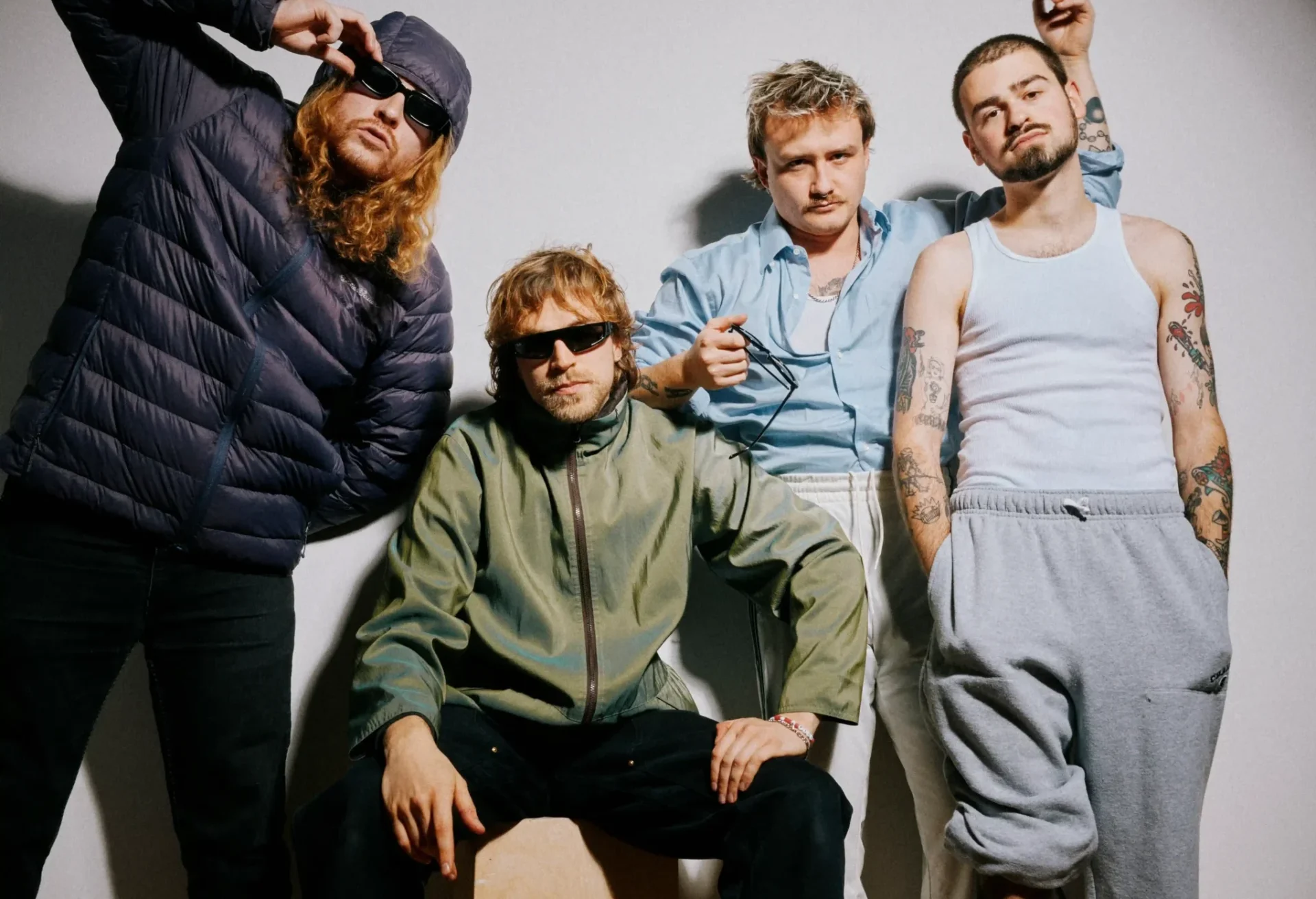
If you’re unfortunate enough to have recently scrolled through the platform currently known as X, you may have stumbled upon ads for dark web monitoring services offering to evaluate whether your personal information has been leaked. It stokes a pervasive internet-age fear that such a thing, in fact, is already happening to you, as if the very fact of your data being sold to capture your attention isn’t already a form of stealing. You may or may not believe that music writers such as myself get impersonated by scammers charging for coverage (sure, this famously elusive band has been dormant for over a decade, but they’ll respond to your invoice), just like you may or may not believe the premise behind Theft World, Lip Critic’s monstrously riveting new album. Frontman Bret Kaser’s identity was purportedly stolen while the Brooklyn quartet was writing the follow-up to their 2024 debut Hex Dealer; the thief turned out to be a devoted fan who believed he’d cracked the code to the band’s loosely conceptual universe. For a record that toes the line between absurdist fantasy and depressing realism, that origin story is almost too good, but the frenetic machinations of the record itself are even better: a melting pot of delirious characters, adrenaline-fuelled propulsion, and ingenious experimentation. Outlandish or not, it drives home the same truth: It’s happening to you right now.
We caught up with Lip Critic’s Bret Kaser to talk about the Internet Archive, a Banksy documentary, Stalker, and other inspirations behind their new album, Theft World.
Internet Archive
We’re huge Internet Archive heads, we’re huge open access media people. We basically grew up pirating everything. We’re all mid-20s people that grew up out of the ‘90s. When it came time to try and record music, all the software was just too expensive. We were trying to make, you know, Skrillex music, Deadmau5 stuff, and you could get a crack of Ableton really easily, and you could get all these Omnisphere patches and Serum stuff, a bunch of drum packs. As an adult, where things have become a little more legitimate, I still find myself leaning on these bastions of open-access media. It used to be stuff like uTorrent and Pirate Bay, and now it’s — I mean, I don’t even wanna blow up the real good ones.
But a lot of the stuff on the Internet Archive is so cool, because it’s public domain. There was a ton of audio in there that was super inspirational. There were a bunch of interviews with people that had worked on Mount Rushmore, people that had been working in these big public works projects that were being interviewed, construction people and architects. And a lot of weird sample packs that were on DVDs – this just came up with the last Oneohtrix Point Never record. I have a bunch of them that, coincidentally, are actually Greek, these DVDs that would have all these drum packs on them, CDs as well, that you could download stuff that were coming off of these Akai samplers. People would just put grooves together, and then put them on these discs and sell them. They’re all so weird, because they were mass-produced by, essentially, not musicians, so it’s just people going “Disco Groove,” and then they’ll put in some insanely fast drum pattern and these early MIDI bass things. The actual record itself doesn’t have a ton of the samples. A lot of them we remade, or they were in demos, and then we ended up having the drummers replay a lot of this stuff, and used it as flavor inspiration more than direct samples.
But the Internet Archive is such an important thing for the world right now, and it’s under attack at the moment. It’s so important archiving all this stuff that is so ephemeral, that is so ready to just get deleted. As soon as some new version of something comes out, the old version is just gone in the digital world, so it’s really important to have back cataloging, Wayback Machine, all this stuff where we can retrace the steps of things that don’t really have a legitimate footprint on the internet.
I do remember that being a big talking point with the last Oneohtrix Point Never record, Tranquilizer. But that came out late last year, so I’m guessing the record was done by then.
Yeah, we had been done when that one came out. We basically finished the record in September, October of last year.
How would you say the non-musical ephemera you stumbled upon seeped into the ideas or structure of the album?
I like saying the records are kind of like media tiramisous, these layers of things – a lot of them are not musical. Things that we really love sampling and that we like to work with are tones that would be for something like an elevator, or the buttons of an ATM are sampled a ton on this, because they do different notes and they have all these different sounds – they’re kind of these weird, diegetic synthesizers that just exist around us. We were just filming a video in Atlantic City, and a bunch of the slot machines allow you to select how much money you’re putting in, the denomination, and how loud it is, and each of these things have a little different sound quip thing. So we had multiple people messing with the buttons to try and sort of play them like synthesizers.
There’s one that was really good of a guy, one of these dudes who worked a jackhammer on Mount Rushmore, where he had this patter to his voice that was very musical. You put it into a slicing sampler, you take this sentence, and you chop each morpheme and phoneme up on a key, it ends up being this weird microtonal synth that you can’t really play like any other instrument. It’s like a new instrument. We would find little things and end up forcing them to be musical, bending them a little bit to where, like, “Oh man, I got a four-note keyboard out of this guy’s sentence.”
Ecological collapse
It’s Earth Day, so it’s fitting that we’re talking about this.
The whole record is about this idea of the yin-yang of stealing, the concept of theft, how it’s very pervasive in the world. It comes down to small things, like your attention span, housing prices, inflation, all these things are becoming more expensive. Things being taken from you without you having any say in it. It feels like an increasing idea, where everyone in our generation’s like, “Well, I’ll never buy a house, yet I’m working, a full-time job, and I’m doing gig economy work, and I just can’t get there.” It’s that concept of housing security or something has been stolen out from under us. And our attention spans, same thing, where we’re just pelted with advertising and algorithmically personalized content machines that are just made to farm our attention.
The bigger scale of that is something like our future is being stolen away from us. A lot of us that are coming up, even the Gen Alphas, the little iPad kids that are growing up now, they’re being born into a future where people have had control over it who do not care about that future. It’s the oil lobbyists, and it’s the multi-billion-dollar corporations now that have a stranglehold on the future of the livability of the Earth. And we’re out here trying to basically do our best to live inside of it, and affect it, but at the end of the day – you have to try, but it is extremely hard without the power structures going along with it. Obviously, oil is a huge one that essentially controls most of the movements of the entire Earth, in my eyes. When we say, “Hey, we need to look into alternative energy sources, we have to reevaluate how we’re interacting with the product as a whole,” all those massive power structures, those corporations, governments, all go, “No,” and then the world continues.
That was a prevailing theme: these characters on the record that are like, “Man, I’m so attention-farmed by corporations, and I’m so broke, yet I’m still working.” And then they’re like, “Who even cares, because I don’t even have a future in the first place to ready myself for.” It’s grim, and I do think that, despite all of it, we are hopeful as a group of people, the band. We’re hopeful about trying to turn stuff around as much as we can. But it definitely was a theme that seeps into everything that I do, this prevailing dread about, how do we fix this? How do we kind of unscrew the situation that we’re in when it seems so daunting?
One thing that’s interesting to me is that some of the most cutting words on the subject are spoken, not screamed. These lines on ‘Debt Forest’ about “all the mycelium scorched from earth/ The spore still asleep under the dirt, the cow is just the unmade purse/ Best believe I know its worth.”
That’s very perceptive. I definitely rock with doing that in lyrics, where a lot of the stuff that feels more emotionally potent ends up being hollered or screamed. But then there’s almost this Trojan horsing of some of the more elastic, quippy lyrics being the ones that I’m trying to make very targeted – less emotional and more precise-feeling. So, the line “That’s enough oil for 200 years/ Right on the west side of Texas is/ Turning into unraveled stitch/ Cough into white handkerchief” is a deep-cut reference to a Mitt Romney-Barack Obama debate from 2008. That would have been his re-election. It was talking about energy independence, and Mitt Romney said, “We should be able to drill in all of our national parks, we have oil in the U.S,” and he says, “There’s enough oil for 200 years on the west side of Texas, all we have to do is turn half of Texas into oil fields.” [laughs] And you’re like, “How short-sighted is that? Are you only worried about the next 200 years?” We should be thinking about maybe a couple more generations down the line before we’re like, “Hey, let’s destroy the entire country and all of our national parks.” But yeah, a lot of it is meant to be extremely fun to listen to and engaging, and then if you want to spend the time to dig into it, it will be fruitful. It is 100% ecstatic party music, and cathartic music is our goal, but it also is something where if you want to get real Rate Your Music about it, and go on Genius and put everything in, we are thinking about each line quite a bit. Nothing is a gimme on the record or just put there as filler. Everything has an intention behind it, and a connected meaning to the other tracks.
The Banksy documentary Exit Through the Gift Shop
Well, this is kind of goofy. It’s a Banksy documentary, but I saw it, and Connor, who also produces, saw it when we were really young right when it came out. Maybe we were 13 or 12 when we watched. It’s basically this Italian guy who is documenting all of these street artists, and then he ends up coincidentally running into Banksy, and he gets obsessed with him. He videotapes a bunch of his really big pieces that are being done, like the Guantanamo Bay Disneyland piece that gets him arrested. And then he breaks off from Banksy, and he just starts being his own street artist, who’s named Mr. Brainwash, and rips every artist that he has documented for the last couple years, just rips off every idea, and puts on this massive show in LA. All of these LA brain-dead people bite on it, they don’t know the references and everything, and they’re like, “Yeah, this is awesome.” The guy ends up becoming exceedingly wealthy, and he still is an extremely highly paid artist.
It was one of those things that came up really early – it’s such a perfect concept of the yin-yang of stealing, how so many of these street artists are all about kind of referencing things in culture. Shepherd Fairy with Obey, he’s stealing this Andre the Giant image, he’s repurposing it, and then people start to steal his ideas, they repurpose them, and then Banksy starts repurposing all these other images of the Queen and the British pound, and he remakes it and does different versions. It’s all this kind of Andy Warhol pop art thing, and it’s symbiotic, everybody taking from everyone. And then here comes this guy who sees money in it, and he studies it, and he’s not a part of the culture at all. He’s never done graffiti. He’s not a graffiti artist. He owns a vintage clothing shop, and then he comes out and basically rips the whole thing off in this gallery thing, and it works. It’s such a beautiful, disgusting idea to me. And Banksy makes this documentary basically out of footage that the Italian guy shot about the Italian guy ripping everyone off, so he steals the guy’s footage to then make the documentary about the guy. It’s like a way of communicating: this is how we make art, it’s how we settle problems, by taking things and reinterpreting them.
Like you said, it’s a relatively old documentary, but I wonder if you rewatched it differently or if it made you think about this symbiotic relationship in your world of music.
Yeah, it’s totally the same thing. The amount of songs we love that we didn’t realize were samples of things – we just grew up listening to Wu-Tang, and then you listen to 36 Chambers, and every track’s got a sample on it, every track’s referencing something. The same thing goes for all the Skrillex and Deadmau5 stuff that we were obsessed with when we started trying to make electronics work. So much of it is referential to YouTube culture and video games, and it’s definitely a part of how we came up making stuff. We were just ripping beats off SoundCloud and trying to imitate them and figure out how Raider Klan was making those beats, trying to figure out how Skrillex was getting these sounds on Massive. This stealing and reinterpreting is definitely a part of our DNA is this stealing and reinterpreting.
Could you talk about your film-watching habits with Connor? Do you watch a lot of films together nowadays?
Yeah, definitely. Especially on tours, we’ll watch a good amount of movies together. Basically anytime we have an off day, that’s what we’re doing. When we played in Austin, we flew out for this thing called Halloween Freakend, and it was right when Bugonia had gotten released. We ended up going to Bugonia, and I double-featured it then with the Chainsaw Man movie. It’s kind of addicting, espcially when you find somebody that you really feel a kinship with, or some magnetism towards it. I felt that with Pedro Almodovar, when I got into his stuff, it was like, “Man, I just want to only watch this for forever.” Or when I got into Kyoshi Kurosawa, the guy that did Cure. It’s kind of my favorite movie ever now, and I saw it last year. But we definitely watch a lot separately, too. We’re all avid Letterboxers as well, so a lot of the time, it’ll be one of us seeing somebody watch something on Letterboxd, and we’ll be like, “Was that actually good?” And then we’ll all watch it and commune after that.
I’m looking forward to the “Letterboxd Four Favorites” with Lip Critic.
Oh my god, I would freak out. I would be sweating bullets.
Passwords
We’re delving into the lore of the album, which involves your passwords being stolen by a scammer, which then inspired the structure and the conceptual framework of this new record. But there’s also this layer to it of there being messages in your music to be decoded, which goes back to what you were saying about all the tracks being connected.
I mean, I think they’re hella interesting. They’re these weird little poems that everybody writes, regardless if you are a poet or not. I love you the classic parent’s password, where it’ll be just your dog’s name, and it’ll be on their bank and their email. This is something about Stalker too, this line between fantasy and real life being weirdly close. If you think about something like the concept of a protection spell or a force field spell in traditional fantasy, like Lord of the Rings world, a password is kind of a real-life protection spell, where you’re conjuring up this set of words to try and protect something that’s important to you. I liked turning this idea of an email password or a banking password into some kind of a magical spell, some weird code.
And then, yeah, it was heavily influenced by the fact that we lost this chunk of money from banking information getting stolen. Our passwords were pretty wild – we weren’t doing 1234 or anything, believe me. So, there was this reinterpretation of a lot of very simple mundane security things, like PIN numbers, the banking transaction that happens in the middle of ‘Talon’, and passwords, as these weird metaphysical things that you have to conjure up and cast to protect yourself.
The bio you wrote is out there for people to read, and you’ve gone on the record saying that’s all true. But I’m curious about the extent to which this scammer’s theory actually acted as a guide for Theft World or more of a starting point.
It was definitely a starting point. It was mainly kind of unintelligible, rambling, so it wasn’t like he plotted out some kind of massive narrative. It was just little sketches of weird ideas that influenced it. This weird chronically online kid being like, “I get it. Nobody else gets.” But we got really impressionistic with it. We took it much farther than he intended, for sure.
You talked about passwords as both protection spells and little poems, which made me think about using poetry as a kind of protective layer in lyric writing. I get the sense that with this record, you’re even more direct and exacting with what you’re trying to say, not really hiding behind the words. Does that feel accurate?
I found myself definitely being more open on this one, wanting to be more understood. The last record also had the same nonlinear concept situation going on, where there were characters that I wanted to follow this flowing narrative, this whole faith healer angle of a traveling church. It felt like it was just a touch too abstract. I always liked the fact that music can’t tell a story so abstractly, in a way that almost any film would have a hard time doing because people get annoyed. If you’ve watched Twin Peaks: The Return, or any of the later David Lynch stuff, when you get abstract with a film narrative, people are like, “Hold up, where are we?” But music is so fluid and non-visual, so you’re allowed to be so much more abstract. There were a few moments where I was trying to really balance, like, “I want this to be very foggy, and I want this one to be very bold and upfront.” Create some more contrast than the last one.
Especially since your music can elicit a very visceral reaction in a live setting, are you still surprised when people come up to you with elaborate theories or dissect the record in these conceptual ways?
Yeah, it’s always fun when somebody is like, “I get it, this song is about a football coach.” I think that a huge part of the enjoyment of music, at least for me, is really digging into lyrics and albums overall as interconnected bodies of work. We’re all huge fans of Death Grips, these bands that take records as mission statements, over it just being snapshots in time. I’m obviously surprised anybody’s listening to anything we make, because we’re definitely making music for an audience of four, for ourselves, so anytime anybody really takes the time to dig into it, it’s always super interesting.
Radio soundboards
I have really fond memories of playing Grand Theft Auto 4, driving around listening to the radio stations, and it makes the whole thing feel so ridiculously immersive. When you can flip on the radio in a video game, and there’s constantly people talking and music happening that you haven’t heard anywhere else, it’s a crazy feeling. So we made 15 or 20 of these, Connor and I, these big, transition effect sounds, and then “Theft World” being said, or “Theft World Radio,” “Theft Systems International.” And then we slammed them in the record, in moments where you’d put a beat tag or something. It was a big part to me of the record feeling concrete, feeling finished. It was super inspirational listening to them throughout time – how intense they are now is hilarious. It used to just be a chord, and then someone would be like, “You’re tuned in!” And now it’s a nuclear bomb dropping, and there’s construction sounds, there’s a train whistle, there’s people cheering, and there’s the giant robot guy being like, “You’re tuned in!”
Going back to Oneohtrix Point Never, that brings to mind the Weeknd album he helped produce, Dawn FM.
Oh, yeah. We’re definitely gonna keep revisiting it.
Music piracy
The references to stealing on the record often feel quite material, taking place in junk spaces and yard sales, so it’s interesting to hear you emphasize the digital realm.
The aesthetics of early music piracy are very burned into our brains. Connor and I both had this experience where we downloaded records as kids that were downsampled, super low quality, and we never really clocked it. So there’s all these Future records that we grew up listening to, and then when we became adults, we heard the full fidelity versions when we had streaming services. I was like, “Oh my god, I’ve never heard anything above 2000 Hz on this record.” But there’s something that is kind of delicious about downsampling and aliasing and all these weird, watery, muffled effects you get from just audio that’s compressed, or downloaded from some server a million miles away.
We were injecting a lot of that into the sounds of the record intentionally, with a bunch of different effects. There’s one that’s called Spectral Gating, which basically cuts out parts of the frequency spectrum that would be sacrificed in the name of compressing the audio more, so less information in a smaller file. I would basically finish mixes of the drums, and I’d be like, “Man, this sounds too good. They sound way too nice.” So we’d compress the file again and put it back into the session after everything’s been sent back and forth from an iPhone to an Android, and then from an Android to an iPhone again, and then plug it back into the session. It’s funny how the piracy angle of it is actually mainly aesthetic, where we kind of want the record to sound like it’s been downloaded off of some MediaFire link that’s been up for five years.
How did that complicate the process of mixing overall? Was it trickier?
Every Lip Critic record that I have mixed has been tricky. Trying to figure out how to fit everything we’re doing in the sonic spectrum is ridiculous. We want a Migos-level low-end, a Future-level low-end, but we also want a Soundgarden-level drum sound. Those two things just can’t really coexist, so you end up in an alien territory with both of them. We’ve been re-amping a lot of 808s, sending huge sub-basses through guitar amps and bass amps and distortion pedals, rigs that you would use for a slam hardcore band, and tweaking the frequency spectrum of the subs to fit more like a really deep bass/guitar combo or something. It’s definitely a puzzle every time, but it’s a really fun puzzle. It’s half the game: How do we get this to sound good when all the elements are just as big as a house and you’re trying to fit everything in two headphones?
Andrei Tarkovsky’s Stalker
You’ve talked about Tarkovsky as an inspiration in the past. What put this film on the mood board this time around?
First off, it’s a great movie. It’s very good. It’s maybe the best. I saw the 4K restoration at IFC when I was in college, and I literally sobbed in the theater. I was crying. The only other movie I’ve cried in is Paddington 2. I don’t know if you’ve seen that.
Oh, many times. I think most Letterboxd users would agree they’re both up there.
They’re honestly way closer than you would think. They’re very different animals, but, boy, they’re both amazing. Let’s swap Stalker out for Paddington 2, actually. But Stalker is one of those movies that perfectly balances fantasy, science fiction, and realism. All the forces in Stalker that are supernatural are completely unseen – there’s obviously no CG, there’s no real special effects, there’s no costuming, there’s nothing practical even, really. It’s just a bunch of people, truly, walking around, but it somehow feels like this massive sci-fi epic. That was a big part of this idea of theft as a force, as a positive and a negative yin-yang. You obey the laws of it, you work within it, you treat it with the respect it deserves – theft gives you these beautiful things. You abuse theft, you use it for evil, it turns into a monster. A big concept in stalker is this idea of, the stalker is guiding a group of people through the zone, and you have to follow all these rules to make it through the zone, and if you get to this one spot, you’ll be rewarded. All these different people come looking for the zone to basically solve their problems, to fix them. Theft is kind of like that. Theft is essentially like the zone. You can exist within it, but, you have to follow the rules or you’ll get got.
Instagram reels
You’ve said the song ‘Talon’ is about scrolling through hell. This came up in another one of these interviews with the band Nothing, where the singer was talking about writing a song about doom scrolling as more of a subconscious thing than, “I have this thing in my palm, and it’s making me feel this way, so I’m gonna write a song about it.” It sounds like that was also the case with this one.
Yeah. There was one really sort of specific instance where I was looking at Instagram stories, and they were pretty mundane. I can’t remember when exactly it was, but there had been a few extremely horrible attacks in Palestine that had been very well documented, so I was scrolling through, and this one guy had all these RuPaul’s Drag Race clips that were something from the latest episode that had been funny or referenceable. It’s all these RuPaul clips, and then the next one I clicked on was the cadaver of a child.
From the same person?
Yeah. And then the next one was another RuPaul clip. It was this moment where I had already been reeling from it dawning on me, the reality of the situation in Palestine, for the last couple of months at that time, being like, “Oh my god, this really cannot be remedied. The things that have happened, they are in stone.” The way that it was layered in social media, it felt like it was all about just getting the click. Once they register engagement, I don’t think Instagram’s thinking about what they are putting up there. It’s just the fact that it’s getting engagement. It’s thrown to the top of your feed or in your Discover page. It was this idea that we’re already existing in a global reality, so we know about stuff that’s happening in Yemen and Djibouti, as well as in Brazil, and in all these other places where there’s massive unrest, there’s huge humanitarian crises going on. We’re aware of it all, but we’re not really aware of how to deal with it, how we can place it in our head in a way that is productive, in a way that is helpful.
The song is about that emotion, about the compounding dread and stacking grief without ever processing it, because you have a constant sedative of whatever clip comes up next that is maybe a funny fail video, or a clip from a show you like. The song follows this extremely literal path of basically witnessing something horrible, and they have this mounting anger, this sense of grief, and then there’s this whole middle section, which is the return to a sense of numbness, where the person is back on whatever the last meme they were looking at is. And then they’re snapped out of it at the very end to act and do something against this force that’s done the atrocity. I don’t expect necessarily that everyone hears that and they go, “Oh yeah, 100%, I got that.” It’s more supposed to convey some vague emotion that insinuates that.
This interview has been edited and condensed for clarity and length.
Lip Critic’s Theft World is out May 1 via Partisan.

