

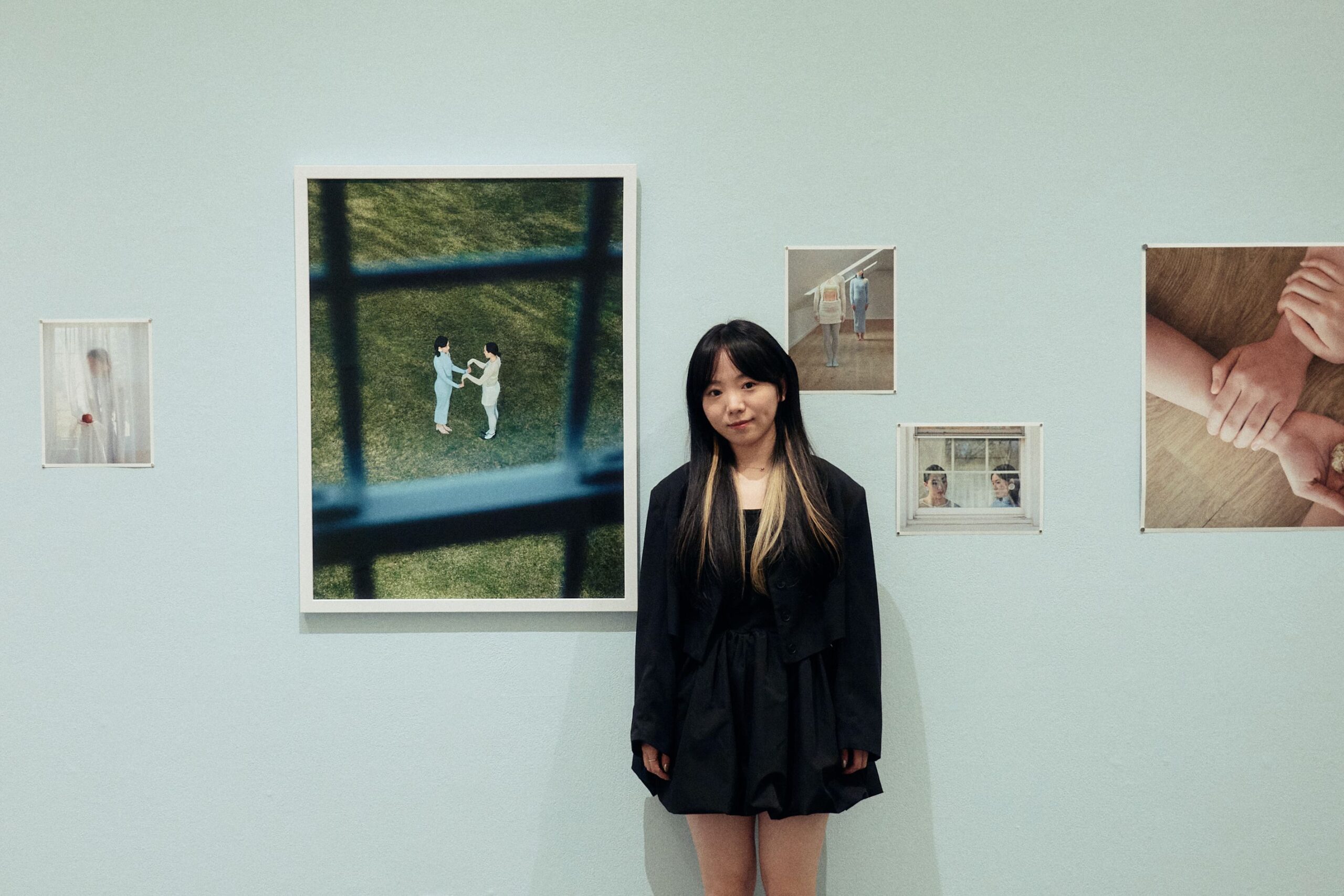
At a moment when contemporary photography often oscillates between spectacle and confession, Jingyi Yu(Jane)’s work occupies a quieter and more resistant register. Her images rarely announce themselves. They arrive obliquely, often withholding as much as they disclose, asking less to be interpreted than inhabited. Working between fine art and fashion photography, Jane has developed a practice shaped by emotional conditions that resist stable form. A room, a gesture, an object, the pressure of light across a surface: ordinary materials recur, but seldom remain merely descriptive. Interiors feel unsettled, objects seem burdened with psychic residue, and even stillness appears under strain.
What distinguishes the work is not atmosphere alone, but the degree to which atmosphere slows down reading. In a visual culture conditioned by immediacy, that delay can feel quietly oppositional. Yet this territory is not without its risks. Contemporary photography has made ambiguity into a familiar aesthetic resource, and weaker work often mistakes indeterminacy for complexity. Jane’s practice occasionally approaches that threshold. At times, her commitment to restraint can verge on a kind of visual self-discipline so rigorous that the work risks becoming overly resolved in its own ambiguity. What is meant to remain open can sometimes harden into mood.
Still, the strongest images push beyond that impasse. They refuse to make uncertainty itself into style. Emotion in these photographs is displaced rather than performed, emerging through spatial relations, interruptions, and what the image withholds from completion. Meaning does not arrive as revelation but accumulates as pressure.
This dynamic is particularly visible in With Myself, Through Winter, a body of work produced during her first winter-to-spring transition in New York. Made at a moment of personal instability, the project stages an internal division rather than a singular subject: two versions of the self that confront and sustain one another at once. Rather than externalizing this conflict through overt narrative, Jane embeds it into the structure of the images. Figures appear doubled, mirrored, or psychologically split, but never fully resolved into symbolic clarity. What emerges instead is a quieter tension — a sense that the image is holding an argument it refuses to settle.
The project’s strength lies in its refusal to dramatize that internal conflict. Even as it draws on themes of isolation, perfectionism, and self-division, it resists turning them into visual spectacle. The photographs remain measured, even gentle, allowing emotional friction to register through atmosphere rather than event. In this sense, the work exemplifies both the power and the limitation of Jane’s broader approach. It sustains ambiguity with discipline, though at times one wonders whether a greater degree of rupture might deepen, rather than dilute, its stakes.
This is perhaps where Jane’s relation to fashion becomes most interesting. Though clearly informed by fashion image-making, the work often seems skeptical of fashion’s ordinary economy of seduction. Clothing appears, but seldom as spectacle. Bodies are stylized without becoming idealized. Surface matters, though often as something placed under pressure rather than celebrated. There is a friction between formal precision and emotional instability that keeps the work from slipping into mere elegance.
And yet elegance remains a danger close at hand. Some images flirt with a polished melancholy too familiar within contemporary art photography, where fragility itself can become aesthetic currency.
Jane is strongest when she resists that tendency, when the image feels less composed around beauty than unsettled by it.
As one curator familiar with her work observed, what is compelling is not that the photographs depict instability, but that they seem formally organized through it. Even in highly refined works, something often remains structurally unresolved. That incompletion matters. It prevents the work from sealing itself too neatly. One occasionally wishes, however, for rupture to enter more forcefully. Jane often trusts subtlety almost to a fault. There are moments when one senses the work could risk more, lose more control.
That question of risk has become more interesting in her recent material experiments, where photography begins to operate not only as image but as object, trace, and constructed surface. These works suggest a move away from the photograph as autonomous image toward something slower and more resistant. The direction feels significant, though still uneven in places. Some gestures feel exploratory rather than fully metabolized into the practice. But perhaps that incompletion is part of their charge.
Recent recognition, including awards from the American Photographic Artists Awards and Prix de la Photographie Paris, has brought wider visibility to this sensibility, including for works from With Myself, Through Winter, though such markers explain less than they ratify. More notable is the consistency with which Jane has pursued vulnerability, identity, and the emotional charge of ordinary materials without allowing those concerns to calcify into signature motifs. Across projects, there is less repetition than pressure applied from different angles.
That trajectory extends into her curatorial thinking as well. Her forthcoming co-curated exhibition Not for Sale, opening at A Space Gallery and currently in open call, proposes forms of making rooted in instinct, pleasure, and necessity rather than strategic productivity. The premise is compelling, though not innocent. Art’s refusal of instrumental logic has long been vulnerable to romanticization, and one of the productive tensions surrounding the project is whether such refusal can ever stand outside the systems it critiques. The exhibition appears most persuasive not when it resolves that contradiction, but when it allows it to remain active.
There is, in both the curatorial and photographic work, a politics of refusal, though “quiet politics” may be too gentle a phrase. What the work resists is not simply acceleration, but the demand that images become fully legible, emotionally consumable, or conceptually closed. In that sense, hesitation here is not mood but structure.
What gives Jane’s practice its force is not uncertainty as theme, but uncertainty as discipline. This distinction matters. The best works do not offer mystery as seduction, nor ambiguity as prestige. They sustain tension without converting it into atmosphere alone.
If there is a recurring limitation, it may be that the work sometimes trusts indirection more than conflict. But that critique is inseparable from what makes the work compelling. Its intelligence lies precisely in treating instability not as something to dramatize, but as something form can think through.
And that is rarer than contemporary photography often allows.

