

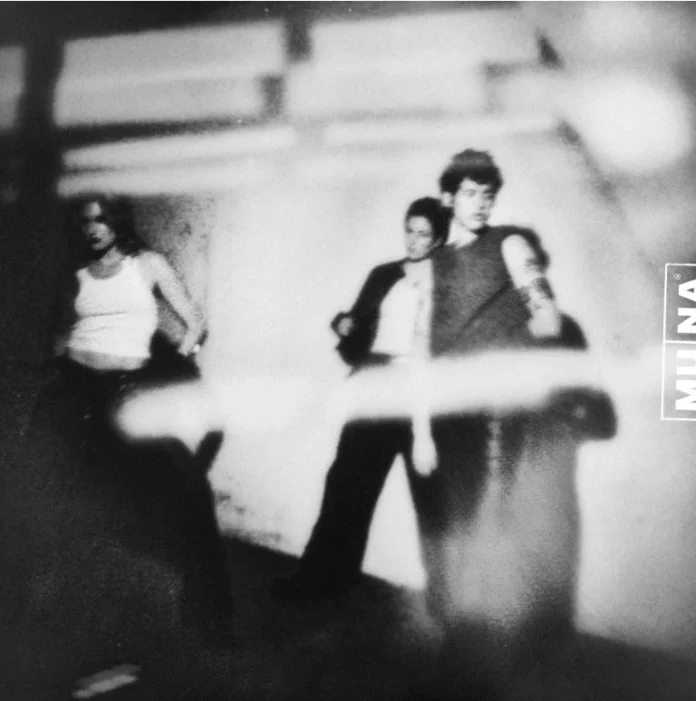
Towards the end of MUNA’s new album, Katie Gavin is convinced she’s past her prime – “and everyone knows it.” It’s a natural insecurity, but it’s laced with the understanding that “everyone” now implies a larger group of people who are far from friends or devoted fans. The band’s self-titled 2022 effort spawned their most successful song, the Phoebe Bridgers collab ‘Silk Chiffon’, and they don’t shy away from the reality of what that means, in interviews or on record. Whenever the band comes up in the lyrics of their latest, Dancing on the Wall – self-produced, like all their records, but with a heightened urgency – it’s to affirm that they’re doing alright, if with a knowing sigh. “Lots of people love me now,” Gavin sings to deal with an unrequited love, “Lots of people.” Whatever personal grievances these often dizzyingly infectious songs latch onto, they point to a band continuing to grow into themselves rather than self-consciously aging out of their peak.
1. It Gets So Hot
The album’s first dance-pop jam isn’t about being at the club so much as the thrill of anticipation: “And she’s so hot when she’s putting on her makeup,” Katie Gavin sings, eager to watch her sweat it off in a matter of seconds. But there’s a reason the song’s called ‘It Gets So Hot’ – more than the object of her desire, it’s about the atmosphere percolating: the house that doesn’t have AC, the sweat dripping down the concrete. Her lyrics are as vivid as the song’s pulsating production, delaying the euphoric release.
2. Dancing on the Wall
The opening song’s lack of catharsis is explained by the rejection that fuels the title track – “I had visions dancing in my mind, but/ You’re so last minute with your new excuse.” MUNA make up for it with one of their most infectious songs to date, one that encapsulates their most appealing qualities.
3. Eastside Girls
After channeling desperation into a universal anthem on ‘Dancing on the Wall’, the group offers a more localized, winking take on the formula, one that’s both celebratory and self-deprecating. The bridge is designed to be shouted by members of the same scene it lovingly makes fun of, shrugging at everything from non-monogamy to roommate drama. The rest of the record is broad enough to earn a couple of “If you know, you know” type songs like this one.
4. Wannabeher
The band offers their take on Bikini Kill’s ‘Rebel Girl’, which is punchy without quite being punky. Even with the song’s sultry tension dialed up, it feels slightly watered-down by MUNA’s standards; they could’ve done more with the classic premise.
5. On Call
The track is less in-your-face than the ones that come before, but the anxious-avoidant dynamic that’s been established heightens its sense of drama. “I wanna be somebody to you/ But if you just want a warm body, that works too,” Gavin sings, but you already feel the cold shivering up.
6. So What
Confusion around unrequited desire bubbles into bittersweet acceptance, which is mirrored in Naomi McPherson’s finest production on the album. It’s wistful but vibrant, adding more colourful flourishes to offset the flat cynicism of Gavin’s lyrics. The second verse jumps out: “The reviews that came in/ The fangirls and harshest critics/ Are all in agreement/ It’s my best work without you in it.” The singer’s personal affairs are inadvertently projected onto a group that’s found itself in the spotlight. I don’t know that I agree, though; if anything, their best work revolves around an “I” that feels larger than itself.
7. Party’s Over
in case the title doesn’t get the message across, you can feel the unease creeping up on this interlude.
8. Big Stick
Though not a proper single, ‘Big Stick’ was made available for a limited amount of time prior to the album’s release, with proceeds going toward Pal Humanity. You could argue the overtly political song would make more sense as a one-off track, allowing it to make an actual impact without stifling the flow of the record. Delivered with a mix of cool detachment and earnest intensity, though, it feels well-placed to kick off the record’s back half.
9. Mary Jane
Gavin goes back to laying out her frustration over a despondent lover, though it doesn’t inspire the same cathartic recklessness as the title track.
10. Girl’s Girl
At this point, Gavin keeps hammering the point home: “Isn’t it so ironic/ How you’re giving away your love/ Except to the one who wants?” But there’s a lighthearted aloofness to the accusation, not to mention a willingness to name names. Guitarist Josette Maskin especially has fun with the extent to which the lyrics are laying it on thick, shredding and stepping back in equal measure.
11. …Unless
The point, of course, is that there’s no hope for this relationship. So you know where this is going.
12. Why Do I Get a Good Feeling
Anchoring in a shuffling beat, this is another example of McPherson’s standout production, which makes use of the song’s five whole minutes to cast away the listener’s skepticism: After all this disappointment, how could anyone still get a good feeling for a person like this? It’s dizzying, self-aware, and convincing against all odds.
13. Buzzkiller
A sudden shift in perspective? A bout of low self-esteem? Whatever the impetus for ‘Buzzkiller’, it’s a sign that getting the queasy feelings off their chest gives MUNA permission to close with a big-hearted ballad, reaching new levels of vulnerability. “And the band’s doing well,” Gavin sings, quickly correcting herself, “I mean, we’re doing alright.” The specificity is in their performances: the slow strum of guitar that amplifies the chorus’s indelible melody, the strings struggling to find their place after the last track’s swirling propulsion. The record starts and ends in anticipation, just a different kind of knot in the throat. Maybe you still feel it after a protest or concert that should have given you hope; it doesn’t mean you don’t come out of it unchanged.

