

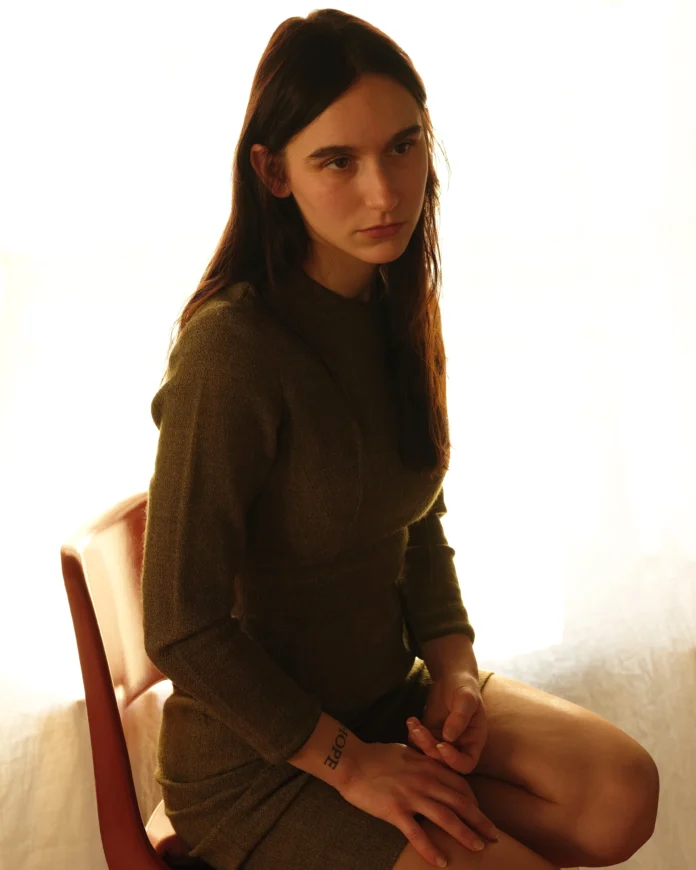
Ivy Knight is a New York-based singer-songwriter who grew up in Oakland, California. Her parents were tapped into different strains of alternative music: her dad brought her into the world of punk and experimental music early on, while her mom put on indie mixtapes in the car. That’s where we find Knight on the opening track of her debut album, Iron Mountain, where she sings, “You’re painting colors/ A picture for the sky/ The thin blue beads/ On the mirror while you’re speeding.” It becomes clear she’s absorbed those formative influences as deeply as she takes in her surroundings, her oneiric, often escapist imagery mirrored in frequent collaborator Deer park’s organic production. After a couple of blearier, stripped-back EPs, Feet of Mud and near the lake we forget to count the days, her first full-length homes in on subtly accented folk-rock, harking back to songwriters like Marty Robbins and Kate Wolf. If the vocal filters and synth flourishes position her as part of a new wave of alt-pop, they’re also just tools for her to blend into her own creative landscape, planting dreams into the earth.
We caught up with Ivy Knight for the latest edition of our Artist Spotlight series to talk driving, getting into old folk music, collaborating with Deer park, and more.
Driving is kind of a motif on the record, and I saw that you’re working on getting your license. How’s that going?
Well, getting the driver’s license is not going well. I was taking driving classes from a driving instructor when I was living upstate. I think I had about 10 lessons, but he wouldn’t let me go on the highway, and he also wouldn’t let me brake, really, ever. He was in charge of the brakes. So I have a weird relationship with driving, where I know how to do it, I just don’t know how to brake, and I don’t know how to go on the highway. [laughs] It’s weird, because I grew up in Northern California, so people are shocked when I tell them I don’t know how to drive. Those are places that you definitely need a car to get around. But I’ve always been a public transportation girl. And getting driven around by other people – that’s a special thing for me, even though it really pisses off all of my friends that drive and have to drive me everywhere. But I love it. I love to just look out the window and not have to do any of the work. I love the idea of somebody else taking me somewhere, and I’m just along for the ride. When I lived upstate, that was a big way that a lot of my relationships with people developed – in the passenger seat of their car, driving to class or some lookout.
I was the same way, but getting comfortable going on the highway totally affected my relationship to music as a listener. There’s a different kind of freedom there. I’m curious if that’s something that excites you.
Totally. All of my escapism fantasies are of me driving, basically. I’m always like, “Eventually, I’ll drive and do some big cross-country road trip by myself.” I’m almost nervous because I’ve gone so long without driving that I wonder how it’ll change my relationship to the car, if I actually can drive. I’m worried in some ways it’ll take away from what I like about it so much. But I do think that getting more comfortable being in a position of control versus passivity definitely feels powerful, like something big could happen in that shift.
Do you mind sharing some of your earliest memories of listening to music in a car?
My mom had this – in my mind it’s a cassette tape, but that could be wrong. We had this purple Volvo when I was a kid that took cassettes, and she would make these mixtapes of the songs that she was liking at the moment. She’d also burn a ton of CDs. My memories of my mom when I’m a kid are of her just burning CDs. She would put together these playlists that, still, if I hear any songs off of them, it’s deeply nostalgic for me. She was really into Belle and Sebastian, and she really liked LCD Soundsystem. She had hipster music taste, which is really funny now, because I’ll hear this kind of music now in the context of it being topical or trendy, and I’m like, “That’s my childhood music.” But, obviously, you can’t say that to people, because it’s super annoying. [laughs] But she really liked Cocteau Twins, My Bloody Valentine, stuff like that. And then when the Strokes and Interpol was happening, she was really into them as well, which is also interesting, because she was in California, and she was raising a young kid, and somehow she was still being tapped in with the up-and-coming New York music scene. Which maybe speaks more to the fact that radio plays were kind of a bigger deal during that time, because you didn’t have social media in the same way. Maybe she heard it on NPR or something. But those are definitely my earliest memories of music, just being completely enchanted by it.
Later on, did that give you an impulse to maybe go further back in time and discover music that was older? To have a different kind of affection for songs that weren’t trendy even 20 years ago?
I’ve never thought about it that way, but that seems totally right to me. I didn’t ever have the period of time where I was like, “Let me just get really into the 90s alternative now, because that’s an untapped world for me.” I know people that were raised on old folk and old country; that seems way more standard, especially for where I’m from in Northern California. So I definitely think that that was an untapped world for me, that I could develop my own taste in and find these hidden gems.
When did that start becoming curious about that world?
It’s pretty recent. I think it was in the past two years, probably. I was listening to a lot of new music through most of college. And then I think I hit a point where I was like, “Okay, something else.” I think that overlaps with finding ‘50s country trail songs, which is music that’s even older than the recordings.
That must have coincided with the making of this record.
Definitely. A lot of the music that I’d made previously was more like stripped-down bedroom stuff, and then I think for a second I was maybe leaning more into electronics. I’m definitely not afraid of electronics – I love incorporating electronic stuff into my music still. But I think that there was kind of a switch where I was like, “I would like to use banjos and cellos.” I was interested in the more acoustic stuff, and I definitely think either that sparked the interest in the older music, or the older music sparked the interest in incorporating that into my work. It’s hard to say what came first, but definitely the two are related.
You mentioned growing up in California. I wonder if, being based in New York, you’ve noticed certain ways that you hold nostalgia for your upbringing that feel unique or interesting to you.
It’s funny, I was thinking about this last night. When I was a kid, my dad played music, so I have a lot of memories as a kid being in these rehearsal spaces with him while he was practicing with his band. And now, the time I’ve spent in rehearsal spaces in New York, it’s the same thing. They smell the same, it’s the same vibes, but suddenly, I know the people. They’re the same age, or they feel more tangible. I also would go to shows with my dad a lot as a kid, and I remember the experience of being an audience member at a show. I was always so fascinated with how people were able to perform their music and remember their lyrics and their chords and see the before and after of the sound check and the breaking down. Everybody just kind of knew what they were doing, and it was this dance that I did not understand at all. And I think about it every time I perform now, where I’m like, “Wow, I’m a part of a long-standing tradition of live music, and now I’m getting to feel what it feels like to be that person up on stage.” It’s a really weird perspective shift, because I still will have it about myself sometimes. It’s really trippy.
Do you still get that fear, maybe before you get on a stage, where you feel like you suddenly won’t remember anything?
Completely. I don’t understand, really, how people are not terrified every single time that they go on stage. It is really scary to me. And I still don’t understand exactly how it doesn’t happen or it doesn’t happen as much; it definitely does happen in smaller ways. Also, now I realize that that’s why you make a setlist, and you can make notes on your setlist, and there’s ways that people kind of get around it. Whereas before, I thought you just kind of got up there and tapped into this ingrained knowledge.
What do you remember about those early show-going experiences?
My dad was in the punk, experimental world, whereas my mom was more twee hipster, so I got both sides of the hipster experience. [laughs] My dad would take me to punk shows, and I remember wearing earplugs. I remember one specific show that he took me to. His friends were in this legendary Bay Area ska band called the Uptones. We went to see their reunion show, and I fell completely asleep on a table in the corner. And I think about that sometimes, because to fall asleep during ska is really crazy to imagine, and I think it speaks to how not novel it was. I was literally just like, “This is a place you go with your dad. Your dad brings you to this show, and that’s a part of being a kid.” But it’s funny, because my first show that I ever went to on my own accord was One Direction. Maybe it also speaks to some desire to rebel for a while against the music taste of my parents, which only lasted so long. I definitely think it came full circle at the end. But my dad also took me to Survival Research Labs, which is a really cool Bay Area experimental noise performance where they build these giant robots that explode and hit each other. I’m so glad that I got to go and see stuff like this, even if I didn’t understand it at the time.
How did that compare to the feeling of going to shows on your own and discovering a scene in a different part of the country?
I feel like when you have a childhood memory of something, you fictionalize it. There’s a narrative to it. When I was in New York going to shows and stuff like that, it’s almost hard to not have the same sort of effect, where you’re looking at the people performing, and you’re like, “Oh, you are this version of this thing that I saw when I was a kid,” or trying to make it all fit together, if that makes sense. I’m like, “You guys would have been my dad’s friend.” I think it can get kind of meta in that way, where then you could go two ways, where you’re either like, “It’s beautiful that this thing has changed a lot, but doesn’t really change – there’s still some fundamental stuff that will always remain.” Or you can be like, “Oh my god, it’s all the same.” But it does feel really exciting to me, where it makes me feel like I’m grown up. Like I’m one of my dad’s friends, and I’m on the other side of it.
Was your relationship to songwriting something that changed when you moved? What were your attempts at making music like early on?
When I was a kid, like a lot of kids, I feel like I was making up songs a lot. I did these rock band camps where we would write songs, but I was really intimidated by the idea of songwriting until I was living in New York City. I moved to New York in 2021 or 2022, and I lived in the city for a year before I transferred to college upstate. But it was when I was living in the city that I started to actually write complete songs and record them. I would say that my songwriting has drastically changed since then. I’m sure a lot of people have this, but you look back on it, and you’re like, “It’s a little bit cringey.” Music that I have out, that people love, and it has a special place in my heart, but it’s hard for me to not be like, “No, now I’m doing the thing that feels the most authentic.” It’s funny to think about how that’ll change in five years, too. I might look back and be like, “Oh my god.” But it’s just part of growing and learning.
Do you feel like you’re someone who needs to set a certain mood to get into that songwriting headspace? Going back to what we started talking about, do you tend to write when you’re in transit, or do you need to have your personal space?
I think I definitely have to be alone. Either alone or with Andy, who’s Deer park, who produced the album. Whenever I’m with him, I can usually tap into stuff that I don’t think I can tap into when I’m alone. But when I’m developing a song, if I’m stuck or something, I think of this grid of space that has objects from the themes that I’m interested in, and I’m like, “Let’s traverse this. We can walk through and see this theme, and then what about this object or this item?” Placing them in space physically, and then it gives me some structure to get to each thing. I’ve talked to other people before about this, and it’s funny, because I think that that’s more common than I thought it was. We all are doing some telepathic thing, where I’ve talked to other people, and they’ve been like, “Yeah, mine is I walk through a forest. I’ll see the things that I want to talk about.”
It’s such a visual way to structure things. People have this idea of introspective songwriting, but paying attention to your lyrics, it feels much more like looking outward and filtering the outside world. The phrase I’ve seen you use is to “turn up the saturation” on what you’re seeing. Have you become more conscious of the things that affect how you’re doing that?
I think that maybe it’s influenced by the media that I’m consuming at the time. That becomes part of that filter, where you can see a tree as being this divine, mystical, larger-than-life thing in a pleasant way, or you can see it in kind of a sinister, scary way. Maybe I’m leaning more towards that if I’m watching David Lynch at that time, versus if I’m listening to Marty Robbins or something. That’s a really good question. Maybe I don’t know fully, but I’m gonna think about this more.
So you’re generally not filtering out other kinds of media when you’re writing? It sounds like you’re tuning into them.
Yeah, definitely. I feel like I do that a lot if I’m listening to one particular artist and something about the songwriting is really speaking to me. I’ll try and write from their voice, which I think is common. I think a lot of people do that, and I get why people try to avoid doing that, but I also think there’s no way to avoid doing that. Even when you’re doing the opposite, when you’re trying to write as far from someone else’s voice as possible, you’re still influenced by their voice. So maybe just lean in and embrace it.
When you were talking about these objects that would fit into a theme, I thought about ‘Headlamp’, which feels like it creates a mood board for the whole album.
That was exactly what I was going for when I put ‘Headlamp’ first. That song changed so much over time. At first it was super stripped down, and then it was a kind of shoegaze song that had totally different drums. Then it became more stripped down again, and we added the banjo, which changed the whole thing again. But I think that, honestly, the decision to put it first was that I felt like the instrumentation felt closer to what I had dreamt of for a lot of the songs on the album. I also just love the drums in it, and maybe it gets people a little hooked. It’s a little more catchy, a little more dancey.
You keep things minimal production-wise, but there are all these moments where I feel like you and Andy will bring a core image of a song to life. It could be a certain phrase that’s illustrated in some way during an instrumental break, like the skyline coming on ‘Deep Blue’, the siren screaming on ‘Canyon’, or the water swirling on ‘Faith’. I wonder if that’s almost part of your collaborative language when you’re thinking of ways to flesh out a song.
That’s really interesting. Well, it depends on the song, because sometimes Andy will take more initiative, or sometimes he’ll give my notes and then he’ll have the final say. I might want something, and he’ll be like, “This isn’t gonna be right, this is gonna take you into this territory you don’t want to be in.” But with the examples that you gave – I think it was his choice to do that on ‘Faith’, and it was my idea to do the siren on ‘Canyon’, and the outro on ‘Deep Blue’ was maybe both of us. But that definitely is part of the process, especially if it’s a song where I don’t have a really specific idea of what I want to do with it, and I’m more open to being like, “Can you think of something that you think this needs?” I think that he can go crazy and do some lyrical stuff with the production.
Is it easier for the two of you to communicate by making parallels to other media, or does it feel more isolated?
I think it’s both. Sometimes I’ll have a really specific idea from another song that I’ve heard, where I’m like, “I want the vocals to sound like this,” and I’ll give him an example from real life. And then we change it and figure out how it’s gonna fit into the song. But I think that you definitely also enter a weird hive mind space when you’re recording and producing with someone else. We don’t always really talk while it’s happening. A lot of the time I’ll track something, and then he’ll just start messing with it, and maybe hit some key, where I’m like, “Yeah, that,” and then he’ll go crazy and expand on it in some really incredible way that I could never think of. It’s just making me so grateful for him.
The line “Blood is my witness” on ‘Headlamp’ seems to reverberate through the rest of the songs: ‘Swimming in Blood’, obviously, but also on ‘Canyon’, this idea of it as a marker of perseverance or survival. Could you reflect on that a little more?
A lot of the stuff on Feet of Mud and some on Near the Lake, I was writing from a much more passive perspective. It was writing about the things that were happening to me, and I think that the headspace I was in with a lot of the songs in this album was more about my own effect on my environment. I wanted to have more of my own control in the songwriting. But getting out of that passive voice and writing from a more empowered place – this is kind of assigning morality to it, and I feel more neutrally about it than it may come across, but I definitely think that the blood, the survival, the coming out of something was definitely something I was tapped into and thinking about a lot when I was writing this. Even with the driving, it’s the same thing; it’s taking ownership, being in the driver’s seat, literally.
This empowering idea of beginning again is so central on ‘Beacon’, and I noticed you have a tattoo of the word “hope” in capital letters on your arm.
Yeah, that was a central idea that I was writing with: the hope, coming out of something on the other side stronger, but to still account for the bloodshed or the wounds along the way. Thinking about that as part of the process to get somewhere.
Were you surprised by the way that hope came out?
It makes a lot of sense when I think about it now. Where I was when I wrote or recorded a lot of it, it wasn’t really that I felt like I had made it out. When I was writing a lot of it, I was still kind of in the trenches of it, but it was more a manifestation or an affirmation, this escape. The amazing thing about music is that you can kind of make something like that real, because you can turn it into this real object, essentially. It’s about justifying something to myself, or maybe trying to prove something to people in my life, people who are influencing the music or whatever. But I think that it’s nice, because I feel like I’m in a completely different place in my life now than when I wrote a lot of the songs, and I’m glad that that hopefulness stayed. I feel a lot more at peace, and I’m actually in some of those places that I was hoping to be in, which I think speaks to the spiritual power of music.
This interview has been edited and condensed for clarity and length.
Ivy Knight’s Iron Mountain is out May 15 via Scenic Route.

