

My parents were both professional tennis players—it’s how they met—but my mother started young, and committed more rigorously. She would tell me of her days pounding the pavement, working hard to eventually make the ATP tour, but the one story that stuck out in my mind is when she was 13, up against a girl she eventually beat for the championship title. When the girl walked over to her mother, she didn’t comfort her after a loss, or congratulate her on trying her best—but slapped her.
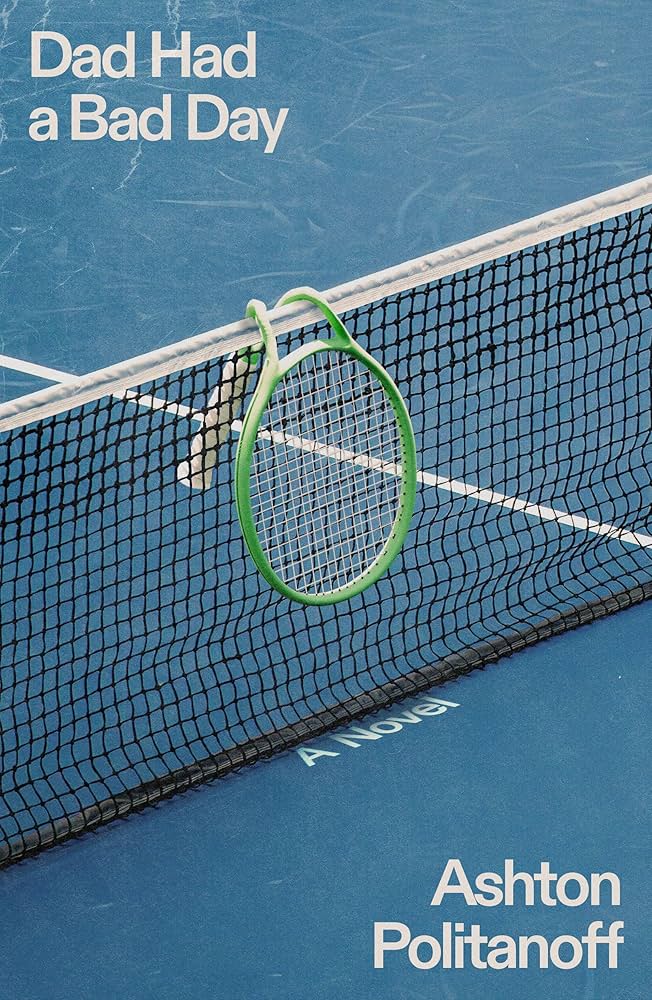
That story stayed in my mind while reading Ashton Politanoff’s severe and goofy Dad Had a Bad Day, a sendup of traditional masculinity and lineage that follows a rather pathetic father figure—Ned, out of a job and in the house with nothing to do, who finds a racquet buried in his garage one day while putzing around. His grim worldview—one of furloughs and smallness, told through clipped responses and matter-of-fact narration—explodes into color when he sees a father and son battling it out on the court, a brilliant full-page paragraph where one can feel Ned’s eyes widening, lit with a fire he was trying to find. “Over the next fifteen minutes,” he says, “the father shattered one racquet, sent two balls over the fence into the parking lot of a medical plaza, yelled fuck you presumably to himself, removed his bandana and replaced it with a hat, and ultimately stormed off the court without waiting for his son.”
It’s unclear whether he empathizes or pities the father, and doesn’t matter; his actions, the long swooping forehands and tumultuous serves, sends him reeling to occupy that space. At the club, which he pays for with his wife’s credit card, he starts to hit but realizes his true destiny is to lead a team of similarly disgruntled men to a championship victory. “I have found a new species of men in these halls,” he writes to his wife. “These are men of ritual, discipline, and refinement. My hope is that over time their good habits will rub off on me.”
That’s not what happens. Ned immerses himself further into his training regimen, the politics of managing a team (insecure men arguing they’d be better first in a line-up) and micro-health strategies such as taking ice baths while swigging Jose Cuervo. He starts listening to a ghostly voice that emerges when relaxing in the sauna and tries to procure some steroids once he realizes he’ll be slotted in the team: “Your husband is a stud, Loraine,” he writes. “Don’t you ever forget that.”
He’s haunted by the memories of childhood courts—his friend Roland was under the pressure of a demanding father and cancer-stricken mother, and Ned being pressured to play, his happiness notwithstanding. He even mauls his college coach after a drill led to a shoulder industry, removing him from the team. But justifying his newfound interest in the sport to strengthen his relationship to his son is laughable—he constantly neglects him, dropping him at random birthday parties or leaving him in the house alone to hit some more shots. When Ned does bring his boy to the court, he makes him cheat, distracting opponents right as they’re about to serve.
“He’s so young,” the sauna voice says. “He isn’t going to remember this. But you will. You will remember this season for the rest of your life…Sacrifices need to be made, Ned. This is about you right now.” Ned’s relationship (or lack thereof) with his son forms the backbone of Dad Had a Bad Day’s most chilling moments; they’re formative events that suggest the cycle of intergenerational sports-related trauma will continue.
Though Dad Had a Bad Day portrayed Ned as a can’t-help-it manchild in the beginning, the novel is also about the tangible violence men like him can harbor. In one instance, his son gets rowdy at a birthday party with another child, stuffing each other in headlocks pinning each other face-down on the couch. “The other father and I stood side-by-side,” Ned thinks. “Out of the corner of my eye, I saw the other father take a sip of his beer.” Ned does too.
In the dearth of “manosphere” books, Dad Had a Bad Day cuts through the noise. A bleak, often troubling look at what happens when we follow our worst impulses, Politanoff has created a man motivated by both pompousness and deep insecurity. “I had the feeling that I was in the presence of future greatness,” Ned once thinks. Who can blame him for wanting to see where it goes?
Dad Had a Bad Day is out now.

