

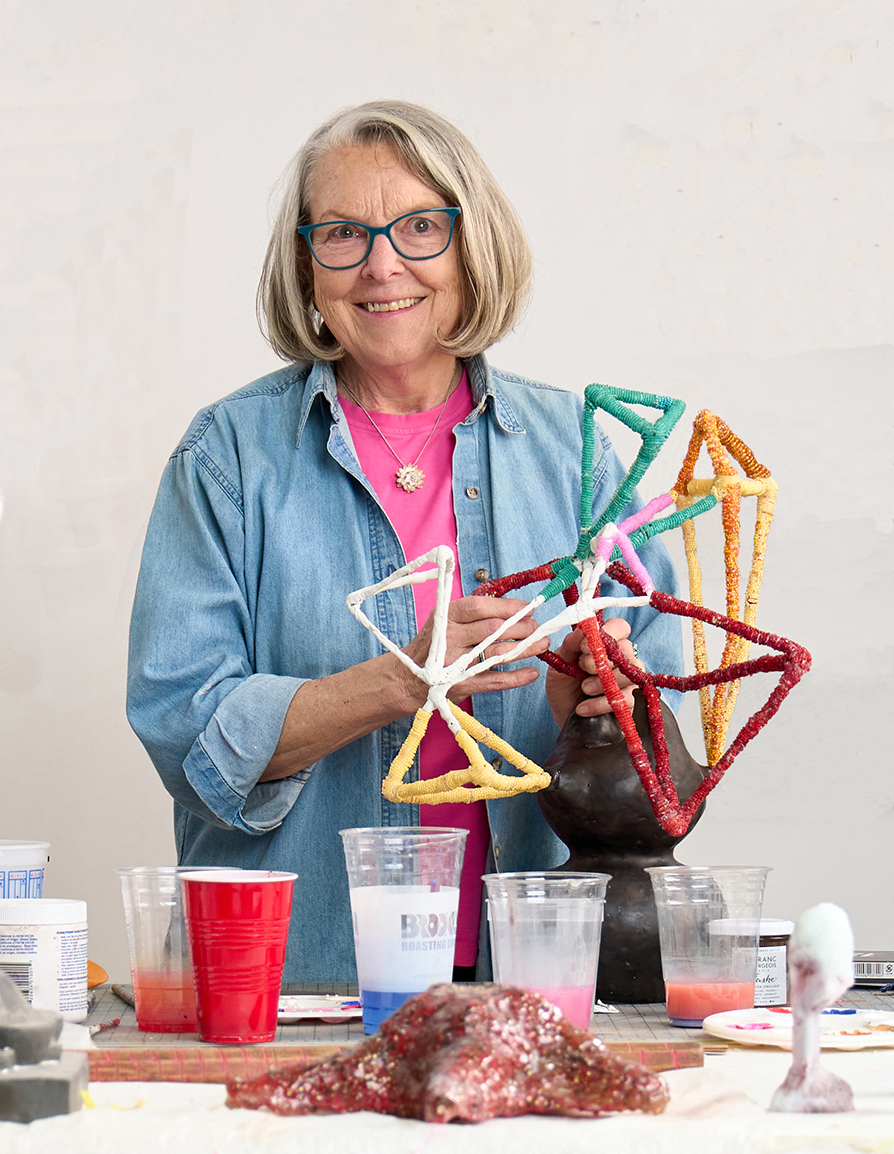
Nancy Bowen is a mixed media artist known for her eclectic mixtures of imagery and materials in both two and three dimensions.
Bowen has had solo shows in the United States and Europe including the Annina Nosei Gallery, Lesley Heller Gallery in NYC, Farideh Cadot Gallery in Paris, and the James Gallery in Houston. She has won awards from the NEA and NYFA and she received an Anonymous Was a Woman Award in 2017. She has had residencies at Yaddo, MacDowell, Jentel and the Dora Maar House among others. In 2023 she published a collaborative book with the poet Elizabeth Willis called Spectral Evidence: The Witch Book. She is a Professor Emerita of Sculpture at Purchase College, S.U.N.Y.
She is represented by Nunu Fine Art, NYC and Taipei, where her show “A to Z and the Bodies in Between” will be up from June 5 through July 25 in NYC.
Our Culture had the chance to talk to Nancy Bowen about a practice built from the ground up — ceramics layered with porcupine quills and coral, dictionaries dismantled and colour-coded and craft traditions put to new use.
When did you first realise that art was the path you wanted to dedicate your life to? Was there a specific moment, or did it come gradually?
Since I was a small child, I consistently made things with my hands but I did not necessarily identify them as art. I drew a lot but I also had many other interests and curiosities. I did not grow up with an awareness of art as a life possibility. In college during an architecture class critique, I was shamed by a teacher for what I thought was an incredibly creative response to a landscape design assignment. After verbally humiliating me and my project which I had created from a variety of carved green vegetables, he ended his tirade by saying I should go to the art department if I wanted to make things “like that”. I then dropped out of college and moved to Chicago to live with a friend and figure out what I wanted to do with my life. I took a ceramics class at the School of the Art Institute of Chicago and by the end of the semester, it turned out the grumpy architecture professor was right. I knew I had found my tribe and my true purpose in life.
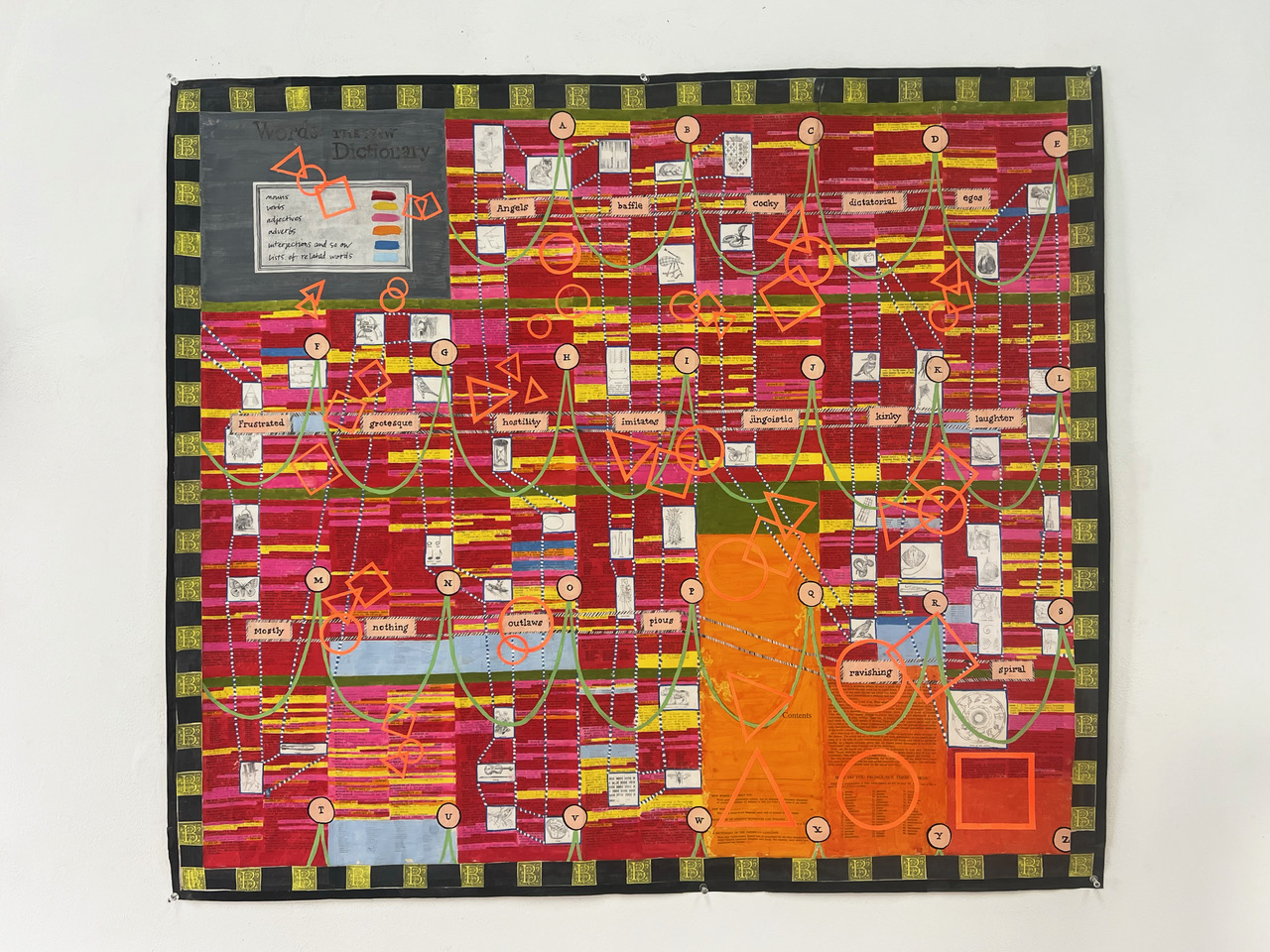
Since 2015, you’ve been working with early to mid-twentieth century dictionaries found in your parents’ home. What was it about finding those specific books that first sparked the idea, and what does it feel like to work with something personally inherited?
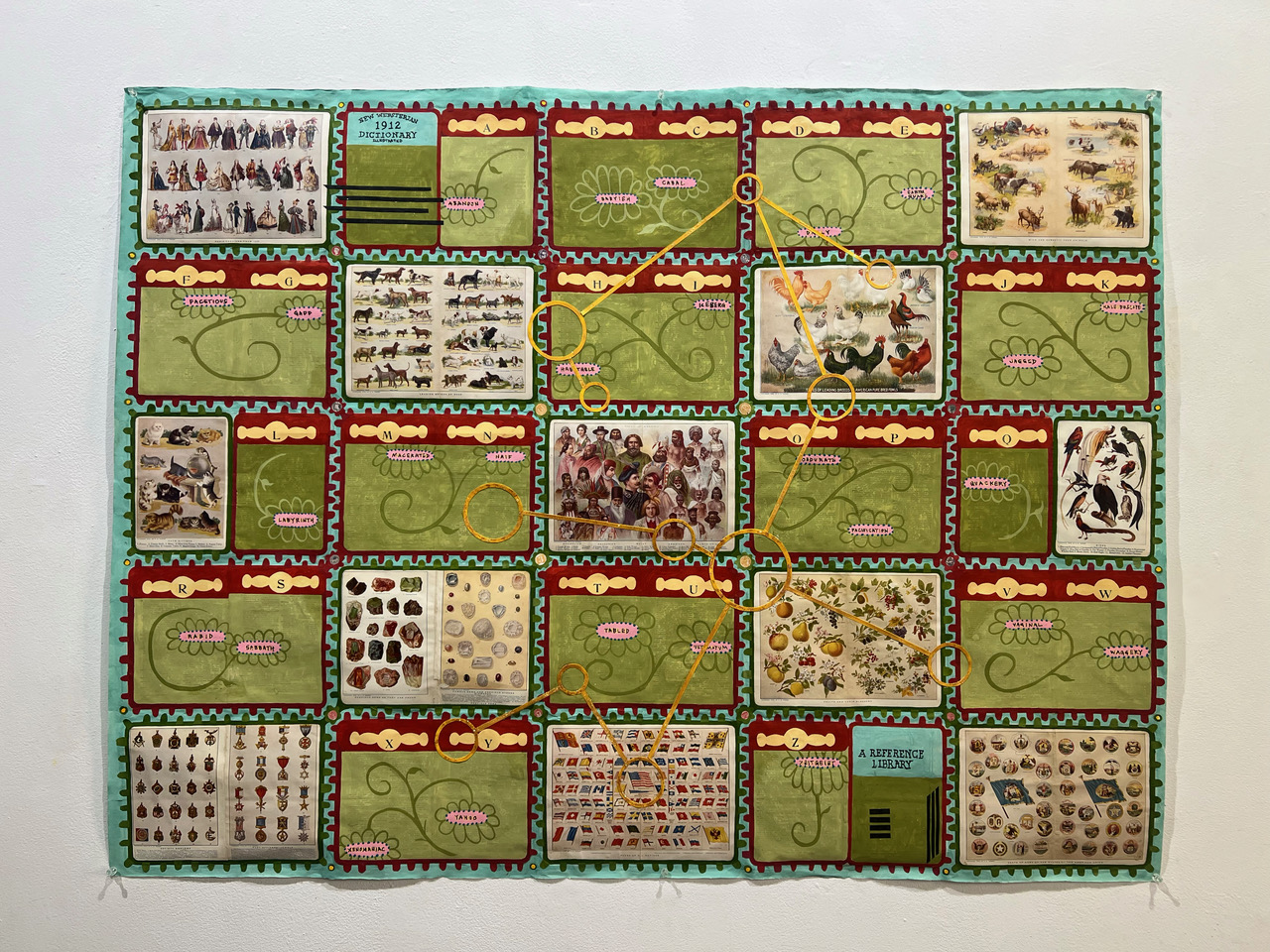
I have long been interested in working with different systems of information and I was particularly captivated by the beautiful engravings that illustrated these early twentieth century dictionaries. Also it was a bit of a practical decision — I tried giving the books away but nobody wants physical books, and I couldn’t bear to put them all in a dumpster. So I decided to use them for collages. Previously, I had made collages using reference books from my parents’ library in which I responded to their inherent patriarchal bias. It was fun and easy (sadly) to make visual incursions on sexist texts. I did not approach the dictionaries from an overtly feminist point of view. Instead I tried to visually upend the traditional hierarchical approach to presenting alphabetical information. I treated each dictionary differently but tried to create an experience that was more visual than textual. For instance, I would color-code the pages by nouns, verbs, adjectives and adverbs. This would create a pattern and a palette that I would then respond to with another set of rules like connecting each image to the next with a series of dots. Each layer of actions would add another type of logic and associations to the dictionary. These actions created a visual cacophony that a viewer could choose to decipher or simply enjoy. Finally, I would add a layer of koans or aphorisms to each collage. I chose words that were found on the page and combined them to make provocative phrases that often commented on the oppressive tactics of our current American government. I think of this as a way to use history to point out the ills of the present and point to a better future.
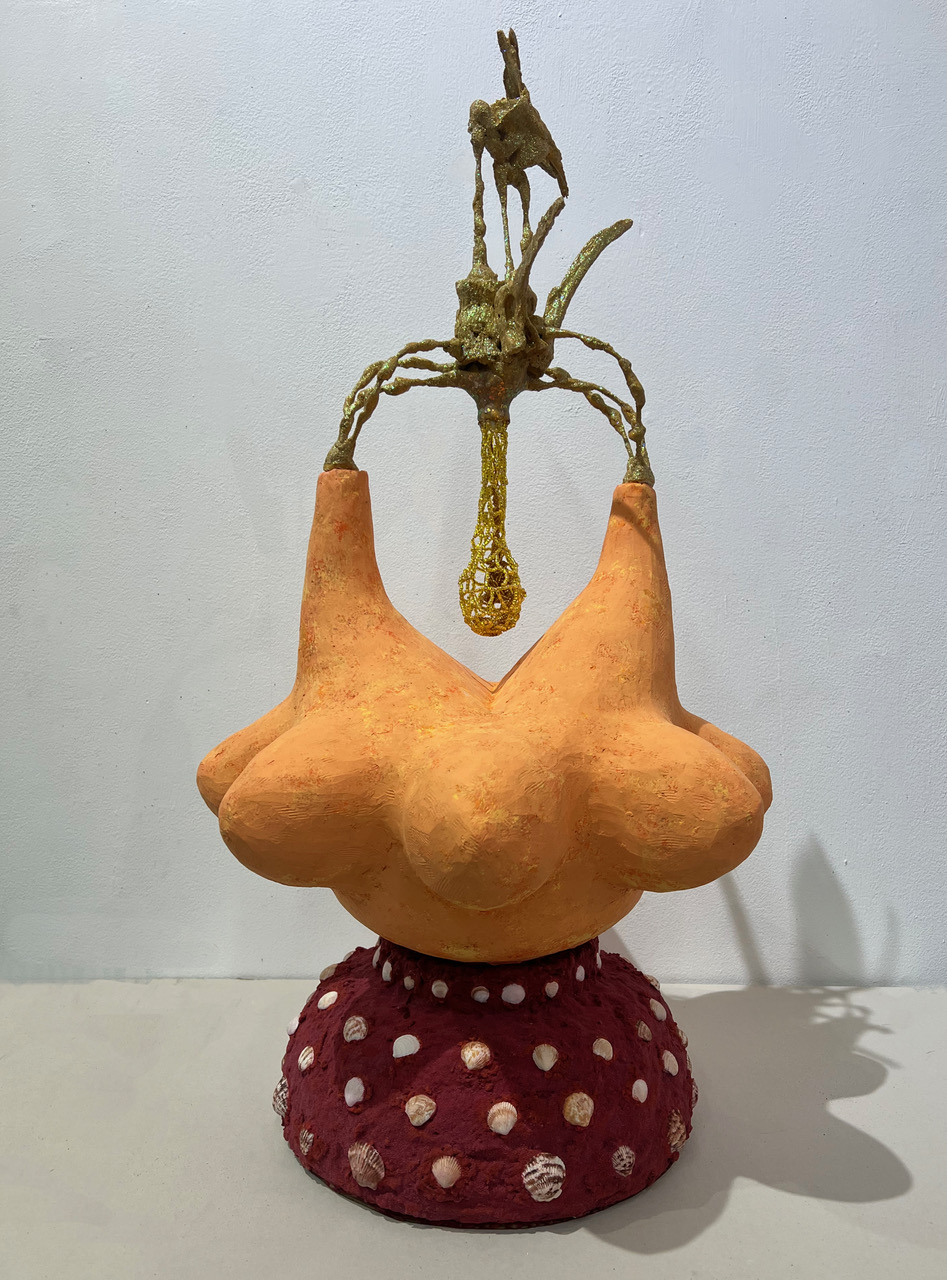
Works like Sentinel and From the Deep incorporate porcupine quills, coral and shells alongside ceramic. How do you decide which materials belong to a particular piece?
In this series, I usually start a sculpture by making an organic ceramic form that evokes a body fragment. I then work in a call and response fashion and using contrasting materials and forms. I do not have a predetermined image in my head. I do have a feeling or attitude or emotion that I want to convey. I add various materials or objects and I know it is right when I see it. In the case of the porcupine quills, I was thinking about that piece as having an elegant but prickly personality. While the pieces are resolutely abstract, when I am making choices about materials and forms I affectionately think of them as a group of women. So, in Sentinel the beaded rope sashes indicates a kind of elegance and the quills exude a prickly danger. Look but don’t touch! I want the pieces to exist in a kind of unfamiliar territory where the viewer can feel like they are seeing something they do not recognise but parts of it feel familiar. I was inspired to make From the Deep by the memory of an ancient terracotta Aphrodite sculpture I had seen years ago. The tiny goddess was emerging from a large terracotta shell. I remade my own version of her and decided to use real shells. I like the way the shells are both symbolic and indexical of place — the sea in this case. I also was interested in the way the patterns of the shells and the patterns of the rocks created an abstraction of landscape — the rocks being the shore and the shells being the water. While that may not be obvious to the viewer I think it works subliminally.
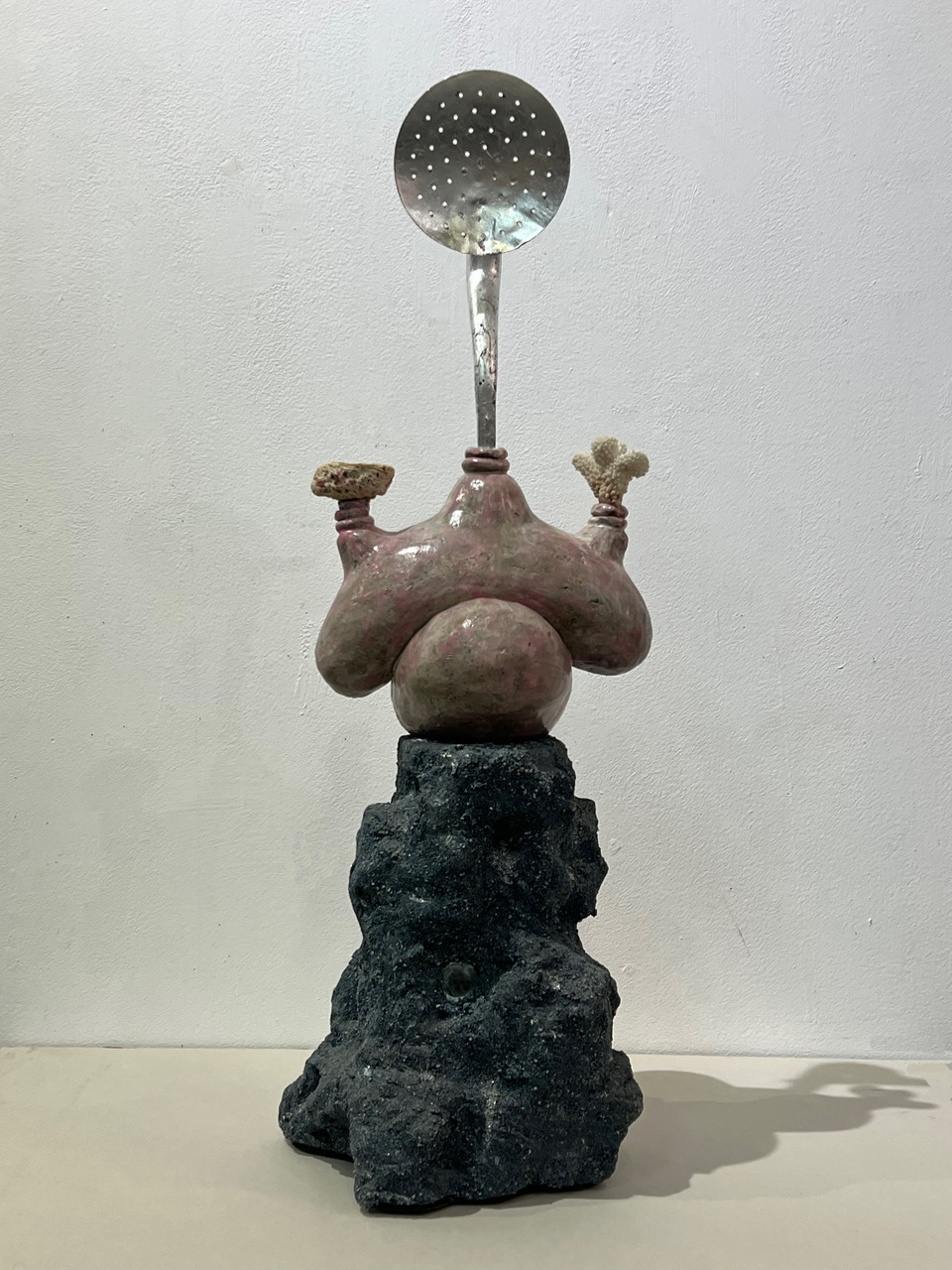
There’s a tension in your sculptures between the structural solidity of ceramic and the more delicate, organic quality of the handmade and found materials layered onto it. What does that tension mean to you in terms of how bodies — specifically female bodies — are understood?
The sculptures evoke a corporal experience without visually describing it. I am interested in setting up analogous situations that echo what it feels like to be in a female body which is not always an easy experience and is not the same for everyone. I think of the parts of the sculptures that are attached to the ceramic form almost as clothing. Sometimes the clothes function like jewellery and sometimes like armour. Again, I want to emphasize that I think of these sculptures as abstract pieces and what I am describing is an undercurrent that functions more on an unconscious level of understanding. The tensions and contrasts you mention give the pieces their formal energy and that is really important.
Your collages and sculptures are shown together as complementary bodies of work, yet they’re very different in form and process. Do they develop in conversation with each other, or do they tend to live in separate creative headspaces?
The sculptures and the collages do live in separate headspaces but they both share a desire to change up a familiar structure. And they are both made through additive processes. I also think my sense of colour and love of tactility shows through in both bodies of work. In the collages I am dealing with textual and linguistic problems and in the sculpture I am trying to create a more visceral experience. Those two activities draw from very different parts of my brain and consciousness. It has taken me a long time to be comfortable with the fact that I do have these two separate but complementary bodies of work. But I think that is one of the beauties of being an artist — I feel like we get to make our own rules.
Your work actively revives ornament and craft traditions that you’ve described as “often disappearing.” What draws you to those traditions, and do you see yourself as preserving them or transforming them into something new?
My interest in these traditions began with an early exposure to Pattern and Decoration from my Feminist teachers when I was a student. I was also really interested in non-Western art which led me to the sources of much of that pattern and decoration. At heart, I am a maker and I love to learn new skills. Over the years, I have learned to make mosaics, work with glass, do beadwork, make baskets and so on. Many of these traditional crafts are now being made by machines or not at all. In the past decade or so there has been somewhat of a revival of crafts like embroidery or basket-making spurred by Feminist and Indigenous artists.
I think it is important to keep the physical knowledge of making current and pass it along to the next generation. For years I was an educator and felt a very strong mission to teach young women in particular how to work with materials.
I have a personal anecdote in terms of my use of beads. I first learned to use beads from my grandmother who made beautiful beaded purses that were popular in Edwardian times. My grandmother was an incredibly creative woman who might have been an artist had she lived in an a more enlightened era. Her creativity manifested itself in the socially acceptable domestic crafts like making beaded purses, painted trays, and other domestic objects. She taught me how to make the beaded purses and when she died, I got her beads. However, one day I decided to try to use the beads as structural elements rather than decorative elements. I strung them on strong wire and wove them like a basket to create an open weave organic form. It was an interesting transformation of a traditional craft material into a new usage. I like to approach materials like science experiments where I don’t know what the outcome will be but I create something I haven’t seen before.
Is there a piece of art that you’ve felt particularly inspired by lately?
I took a trip to Cambodia last fall and I am still absorbing the impact of what I saw. The architectural ruins of Angkor Watt and the Khmer sculpture were mind blowing. Most of the sculpture is religious; the figures have an incredible gravitas and presence while exuding a mysterious spiritual energy. The decorative elements were also really gorgeous and perfectly integrated into the larger figural forms. The architectural sites were so complex and sophisticated and filled with symbolism in their arrangements. I have no idea how or if the experience will affect my own work but it is all still rambling around in my brain.

