

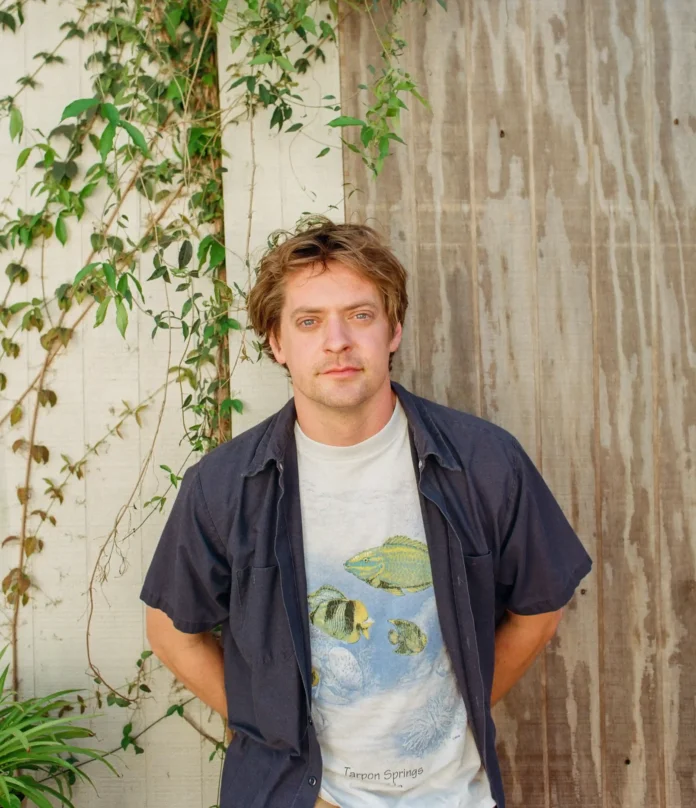
Thomas Dollbaum is a New Orleans-based singer-songwriter who grew up in Tampa, Florida. After studying at the University of New Orleans for his MFA in poetry, Dollbaum worked as a carpenter and started writing the songs that became his debut album, 2022’s Wellswood, which he followed up in September 2025 with the Drive All Night EP. Dollbaum’s fantastic new album, Birds of Paradise, was tracked in Water Valley, Mississippi in 2023 with producer Clay Jones and a band that featured guitarist Josh Halperm, bassist Nick Corson, and MJ Lenderman on drums, guitar, and backing vocals. In part because of Lenderman’s involvement, Dollbaum’s music is often associated with the Asheville, North Carolina scene that includes Wednesday, Colin Miller, and Fust, and Birds of Paradise, out today, eventually found a home in the Philadelphia-based label Dear Life Records. But many of the songs on the new album – propulsive, twangy, torch-like – spring from the setting of his childhood, driven to a magically placeless evocation of memory, empathy, and solitude. “What the living do is prowl around on their hands and knees/ Among the bodies we leave behind,” declares one of its characters; another is purely happy to be alive. Dollbaum is always somewhere in between, pooling the feelings together like they’re one and the same.
We caught up with Thomas Dollbaum for the latest edition of our Artist Spotlight series to talk about poetic inspiration, recording Birds of Paradise, working with MJ Lenderman, and more.
I read that part of the inspiration for your new single, ‘Pulverize’, was trying to drive across Louisiana overnight, which made me curious about the relationship between driving and music or inspiration more broadly for you.
I grew up in Florida, and you spend most of your time in a car, it feels like, just because everything’s pretty far away. A lot of stuff I think about is times where I’ve been traveling in the car. That song in particular is actually about driving across Florida, kind of, but I feel like a lot of my memory’s tied to trips in the car and driving; a lot of time to think, too. [laughs] I would say that the majority of time I’m listening to music is probably in the car, just because I don’t really listen at home as much as I’d like to. Sometimes I’ll put on records at the house, but a lot of times, I’m just listening in the car, so that’s the context I get a lot of music in.
How do you think that affects you?
I’m not really sure. Traveling is very intertwined with music to me; they’re kind of one and the same, like liminal spaces. Traveling is its own thing, and music feels that way sometimes.
What memories come to mind of sharing music with friends in the car?
Growing up, if we would drive somewhere, a lot of times we’d make mix CDs, before Spotify. In Florida, we would drive all over the place – wherever we were going, because everybody that I knew lived about a 20-to-30 minute drive minimal, you’re just constantly driving around. It’s just all highway, so basically, your space is on the highway that you’re living on. Even when I go back – because New Orleans is much smaller, it’s a pretty tight-knit city – and I’ll drive back, I’m like, “It can’t be that far, I used to go there all the time.” And it’s a 30-40 minute drive.
There are a couple of instances in Ashleigh Bryant Phillips’ bio that link your songs to short stories – ‘Big Boi’ to ‘Samaritans’ by Larry Brown, ‘Pulverize’ to ‘Time and Again’ by Breece D’J Pancake. I know that’s probably the writer’s connections more than your inspirations, but it made me wonder if short stories or other pieces of literature sometimes feed into your songwriting, or if you’re making some connections afterwards.
Yeah, sometimes. I’ll try to keep a few books of poetry or something around to pick through. It’s not directly related, but I try to read while I’m writing, because it just helps your brain to read. Not particularly any short stories or writing that informed the songs, but I do try to keep reading just to get into thinking in that way.
Thinking poetically?
Yeah. I’ll read some short stories, but I mostly try to read poetry, because I like it more, and it’s also quicker. My attention span’s gotten really bad lately, so it’s nice to go through 4 or 5 poems, and then you can put it down, and you got through something. It’s been hard for me to get through that much fiction recently.
Is it usually something that’s familiar to you and that you’ve read a few times, so that it gets your brain flowing?
Yeah, for sure. That’s what I’d try to do, especially if I’m stuck. Sometimes songs will come really quick, and sometimes it’ll take a long time. But instead of focusing on something, making your brain think about something else – when you come back to it, it can sometimes open up the ways to the song.
Do you remember any of the poetry collections you had lying around?
Yeah, my old professor has a book, Still Life. His name’s Jay Hopler. I was reading some Philip Levine, too, What Work Is. I can’t remember the other ones right off the top of my head, but I like those a lot. I keep those around.
Having the lyric sheet made me appreciate the poetic structure of your lyrics, like the line break in “And in the deep of the dark/ Thing that sparks your heart to bark out at the moon.” When you’re working on lyrics, do you sometimes disassociate the words from any idea of music or performance that might come later?
I definitely do focus on lyrics more. I usually get the melody line first, and then I try to fit it to the form of the lyrics. But it’s kind of a puzzle where you don’t want to just write anything that sounds like it’s gotta mean something, but if it’s too fitting to the lyrics, it can be kind of boring musically. It’s a balance of trying to figure out what works, because sometimes you can’t fit exactly what you want to say. Some people do that differently, but I like to just try to focus on the melody, and then make the lyrics kind of fit to it, or kind of work… work to that, if that makes sense. Yeah, that makes sense. It sounds like that’s still… Kind of at least something hanging around in your mind. It’s never completely words on a page.
I also thought it was funny that Jake Lenderman sings on that track, and he’s got a song called ‘Bark at the Moon’.
We did that before I’d heard his record, which is funny. We recorded this record maybe two and a half years ago now, so I hadn’t heard Manning Fireworks yet. He sent it to me right after we did this session. He was like, “I’m finishing up this record,” and sent it to me. And then I heard that, and I was like, “Damn.” Just a coincidence.
Tell me more about getting him involved in the process. I know you met around the time Boat Songs came out, and then he wore your shirt at his Tiny Desk concert. What was the back and forth like after that?
We met in North Carolina. He came to one of my shows pretty early, when my first record came out, and I think Boat Songs hadn’t been out yet. We just became pretty good friends, and then I liked a lot of his music, he liked mine, and we kept in touch. When you travel and tour, you just end up making friends with a bunch of people on the road. My guitar player on this record, Josh Halper, was also on Dear Life Records, so everybody was on that. Jake had me play the Boat Songs release show, and I came up to Asheville, so we hung out. I’d done the EP and I wanted to do a full-band record, and Josh was like, “It’d be cool if Jake played drums on it,” because I’d heard him do the Indigo de Souza record. I was like, “It’d just be fun to all hang.” That’s kind of how it happened. I had a fun week with them.
How did the collaboration make you think about harmonies differently? ‘Waterbirds’ is one that stood out to me in terms of your vocal chemistry.
He’s just a really great singer. He’s got a really good ear for melody. Basically, we got done with the session, and then we were listening back, and he was like, “Oh, I hear something on ‘Coyote’ I could do.” So he did the backing vocals on ‘Coyote’, and then I was like, “Do you want to do any more?” That was the only thing we really overdubbed, so he did those later, and I sent him those songs. His voice is great, and he has a great ear for melody and harmony.
You wrote the songs in three months, and the recording period was four days. What surprised you about funneling the writing into that sort of pressurized, collaborative environment?
It was super fun. Luckily, I just had a really good group of musicians, so it really was pretty seamless. Once I sent them the demos – I really only sent them phone recordings. The songs were done, basically. There were a couple things we worked out, but they just have really good ears about what to play, and it’s super fun and collaborative to talk about figuring it out, do a different take or try different things. But we didn’t really change too much. Every once in a while, something would change up, like for ‘Rabbits’, I think Jake was like, “We should do it a little faster.” But we spent the time mostly figuring the songs out and then recording them pretty fast. I have some of the old demos, and they’re pretty much the same – maybe just a different tempo, maybe the endings are a little different here or there, but that was basically it.
Apart from figuring the songs out, did you talk about them at all? How do you generally feel about discussing or sharing songs before they’re done?
That was pretty much unspoken. We didn’t really talk about the songs too much, honestly. Until a song is done, I don’t really like showing people songs. Unless I’m working on a song with somebody collaboratively, I just want to have my own space to figure out what I’m trying to do. If you show people stuff, they give suggestions or ideas, and I don’t really want that. [laughs] I don’t mind if it’s good suggestions, but I never really ask anybody about lyrics. It’s a very solo process, the writing.
It feels like with most of the songs, there’s a kernel of personal truth, and then you build these stories out of them. But I get the sense that those tracks that are most autobiographical, or with bigger kernels of truth, are rooted in your upbringing or youth in some way.
The way I thought about the record, it’s definitely in a setting of my youth. I don’t know how much of it’s really real – some of it is and some of it’s not, but it’s just written from that space that I know just from growing up. It’s just in that time period in my mind, but I don’t know if it’s specifically true to my life or something.
And I don’t think it really matters that much, but it is interesting to recognize that as a setting, a kind of familiar space that you can get imaginative around. That’s something I feel you set up with the opening track and the line “The older I get, the more I do magical thinking,” which is funny, because on the next song, there’s an instance of doing magical thinking as a kid.
Yeah, I wrote both those songs kind of at the same time, so they’re really tied. That’s kind of why I did them in that order. But I think that’s a good way to look at it, that’s kind of how I was framing it. I think that usually what’ll happen when I’m working on stuff is I have a framework I’m working the songs in, and then one or two will stick out as kind of the ones that frame the rest of the songs. Everything will kind of be very different, like I approach them differently, and then they work their way together. I wrote those first two first, but I’d been working on the other ones in a different way, and then they all came together. But everything’s always connected somehow in your brain.
Not to get too lyrical about it, but “Wish I could save us from the mundane” is another line that felt like part of the album’s framework — that emotional, empathetic voice that jumps out in different circumstances.
I don’t really think about it, but I try to keep some sort of empathy in all the things that I write. I guess it’s overall maybe a sentimental record, so I try to keep that in mind. I don’t really want to write too cynical or something.
Thinking about “I’ve only been screaming in the back of my head,” I’m curious what your relationship to your voice was like with this record.
Because we did it live, it definitely was a lot easier to push vocally. Sometimes when you’re recording and overdubbing and doing a vocal take, it’s just hard to get the energy of a full band like that. I think a lot of that translated, and it was a fun setting to sing pretty strongly, comparatively. Even with the EP, I did that mostly acoustic, and it’s just really hard to be in a room alone and be pushing. It’s a little more intimate when you’re just singing in headphones compared to a live performance.
This interview has been edited and condensed for clarity and length.
Thomas Dollbaum’s Birds of Paradise is out now via Dear Life Records.

