

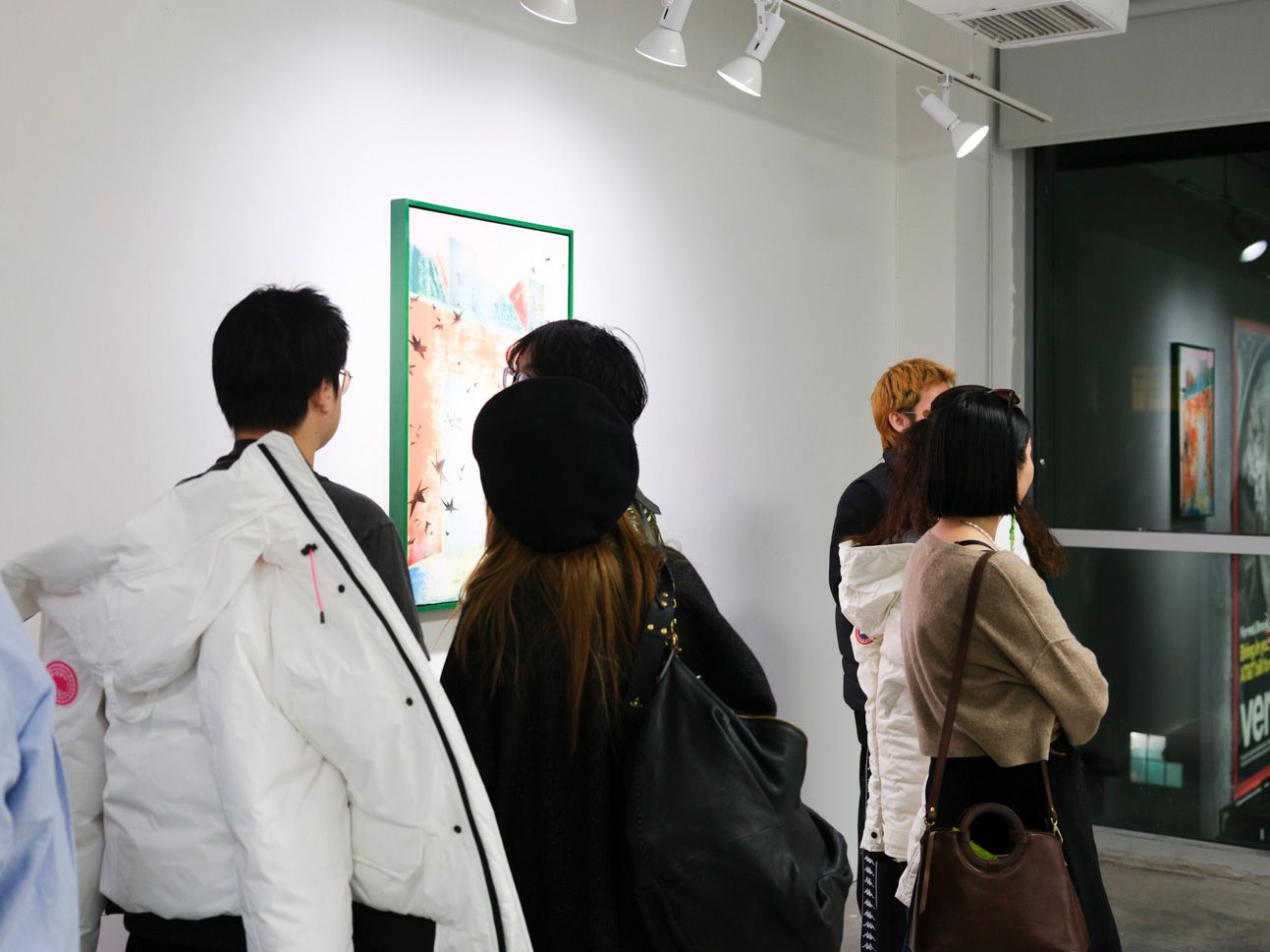
Earlier this year, photographer and curator Jingyi Yu served as the sole juror for New Year, New [Me]ntal Issues, a group exhibition at A Space Gallery that looked at the emotional weight surrounding contemporary creative life. The exhibition, which closed in late February, moved away from the idea of the new year as a clean reset. Instead, it focused on the feeling that many artists know well: the pressure keeps going. Deadlines return, financial stress lingers, and creative exhaustion does not suddenly disappear just because the calendar changes.
What made the exhibition notable was not simply its subject matter, but its tone. The works resisted dramatic narratives of collapse or recovery. Instead, the exhibition stayed with quieter feelings — the sense of being stuck, emotionally worn down, unable to fully move forward, yet still expected to continue producing. Across painting, sculpture, installation, and artist books, mental health appeared less as confession and more as something woven into the atmosphere of contemporary creative life itself.
Following the strong response to New Year, New [Me]ntal Issues, A Space Gallery now presents Not for Sale, a new exhibition curated by Jingyi Yu and Qi Ling, opening May 24. While the earlier exhibition stayed close to emotional exhaustion and creative burnout, Not for Sale looks more directly at the conditions surrounding contemporary creative life — the constant pressure to produce, stay visible, and turn artistic practice into something useful.
The exhibition begins with a question that feels increasingly difficult to avoid within contemporary art: what kinds of work survive when artists stop trying to make themselves useful?
Today, artists are often expected to function simultaneously as creators, marketers, public personalities, and content machines. Work is constantly asked to justify itself. Can it be exhibited? Posted? Sold? Turned into visibility? Even deeply personal artistic gestures are quickly absorbed into professional performance and self-branding. Under these conditions, creative practice can begin to feel inseparable from optimization itself.
Not for Sale pushes against that logic.
Built around an international open call that received nearly one hundred submissions from artists across the United States, China, Korea, and Europe, the exhibition centers work created outside strategic intention or commercial ambition. According to the curatorial statement, the exhibition is interested in “the work that simply saved you” — pieces made privately, impulsively, emotionally, or without any expectation of audience at all. The exhibition brings together artists working across disciplines, including London-based artist and animator Marian Obando, a graduate of the MA Character Animation program at Central Saint Martins. Obando’s work has been exhibited internationally at venues and festivals including Mall Galleries in London, Animafest Zagreb, Animation Block Party in New York, and the Holland Animation Film Festival, and her recent recognitions include the 2026 Aesthetica Art Prize Longlist and Jackson’s Art Prize Longlist.
The result is not an exhibition about polished achievement, but one shaped by emotional residue. Unfinished sketches, abandoned experiments, strange visual fragments, deeply personal gestures, and works considered “too weird,” “too unresolved,” or “too personal” for public circulation become central to the exhibition’s framework. Rather than treating those qualities as weaknesses, Yu and Ling position them as evidence of something increasingly difficult to preserve: honesty without performance.
Importantly, Not for Sale does not romanticize incompletion or rawness. The exhibition avoids the exaggerated anti-commercial rhetoric that often becomes its own kind of aesthetic posture. Its resistance feels quieter than that. The exhibition seems less interested in rejecting the art world altogether than in protecting certain fragile ways of making from being absorbed by it.
That restraint is part of what makes the project feel timely. In recent years, conversations surrounding burnout and creative exhaustion have become increasingly visible, particularly among younger artists navigating precarious economies and constant digital exposure. Yet even those conversations are often quickly turned back into content or another form of self-presentation. Not for Sale appears deeply aware of that tension.
Rather than turning vulnerability into spectacle, the exhibition creates space for uncertainty and contradiction to remain unresolved. Many artists have bodies of work that never enter public view precisely because they do not function neatly within institutional or commercial structures. Some works feel too emotionally exposed. Others feel directionless or impossible to explain. Not for Sale asks whether those works might reveal something essential precisely because they resist clarity and usefulness.
Across both exhibitions, Yu’s curatorial approach stays close to the emotional realities of contemporary creative life, especially the quiet exhaustion that comes from constantly needing to continue producing.
At a time when contemporary art increasingly overlaps with branding culture and self-performance, Not for Sale offers something slower and more difficult to quantify. Rather than treating art as evidence of success, the exhibition approaches creative practice as something personal, unstable, and at times necessary simply because it helps people keep going.
In that sense, the exhibition’s title feels less like a declaration than a form of protection.

