

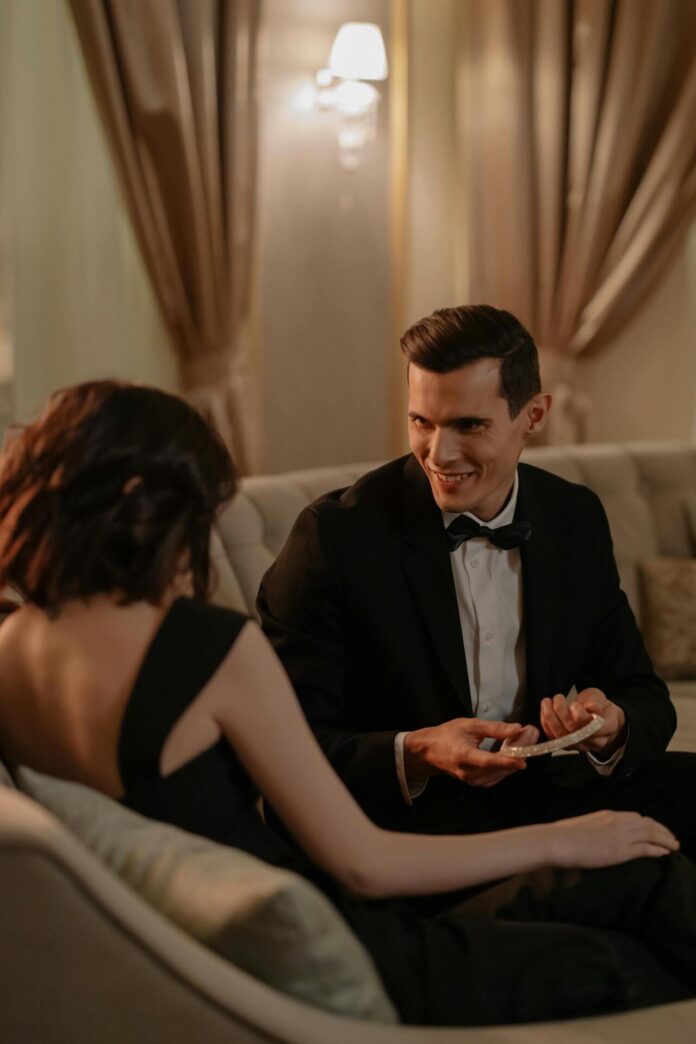
It has always been the case that the language of cinema is in visual shorthand to create power dynamics way before even a line of dialogue is uttered. Hollywood has used formal menswear as a symbol of institutional stability (or, sometimes, effortless heroism). Think of Cary Grant’s mid-century poise or James Bond’s immaculate MI6 uniform. It was a safe but fairly aspirational fantasy where a crisp fit meant moral clarity.
But filmmakers are twisting these classical codes on their head. High-end tailoring is no longer a just a lazy nod to luxury, but a psychological weapon used to deconstruct class and interrogate the very nature of masculine performance.
Saltburn & Succession: The modern antihero
In recent cinematic hits, formal attire has been less of a celebratory garment and more of an oppressive, or claustrophobic uniform. Emerald Fennell’s Saltburn uses black-tie dress codes to highlight the psychological tension between the aristocratic elite and the parasitic outsider. When Oliver Quick tries to assimilate into the Catton family estate, his interactions with formal evening wear are really what exposes his alienation. He is a boy playing dress-up in a space where everyone else was born wearing a cummerbund. It turns a celebratory dinner into a battlefield of social anxiety without saying a word.
Cinema has always weaponized this sense of hyper-formality, for good or bad. When a director strips a character of their casual wardrobe and places them in a sharp Tuxedo suit, it isn’t just about aesthetics, but an expression of class, expectation, status, and sometimes, masked intent. It can become the reason why we instantly trust a character or suspicious of them.
We see a similar tension play out in Christopher Nolan’s Oppenheimer. The transition from fluid, academic tweeds into high-waisted and rigid military and political tailoring is what mirrors J. Robert Oppenheimer’s entrapment within the bureaucratic machinery of the state. It is the visual metaphor for the story arc. The clothing becomes a cage for him, turning historical figures into tragic archetypes trapped by their own public images.
The slouchy, unstructured suits of his early physics days were to show freedom in an intellectual sense, that he could think outside the box. The cold formality of his later years shows a man compromised by his own creation. But depending on the arc, the opposite can be expressed, where characters grow into status and formality.
The subversion of the sartorial gaze in independent cinema
This cinematic change has been reflected in broader cultural skepticism towards the traditional power structures. For many, it’s a shame, and something we will see cycle back one day, perhaps. Directors like Ruben Östlund (Triangle of Sadness) and Mark Mylod (The Menu) use strict black-tie environments to stage satirical executions of the ultra-wealthy. In these, the immaculate lines that have been so carefully tailored are ruined by chaos and violence. A subversion.
And, even for those who wear suits in daily life, there is a certain satisfaction in watching a multi-millionaire struggle to maintain their dignity while their luxury evening wear gets slowly ruined throughout the scene. A guilty pleasure of turning structure on its head.
By subjecting the highest echelons of fashion to physical degradation, modern filmmakers can strip these garments of their power and expose the fragile vulnerability hidden beneath. But, as we grow accustomed to this play, we may see a cycling back to placing more status onto formal attire once again, especially as we have seen the peak of working from home in daily life.

