

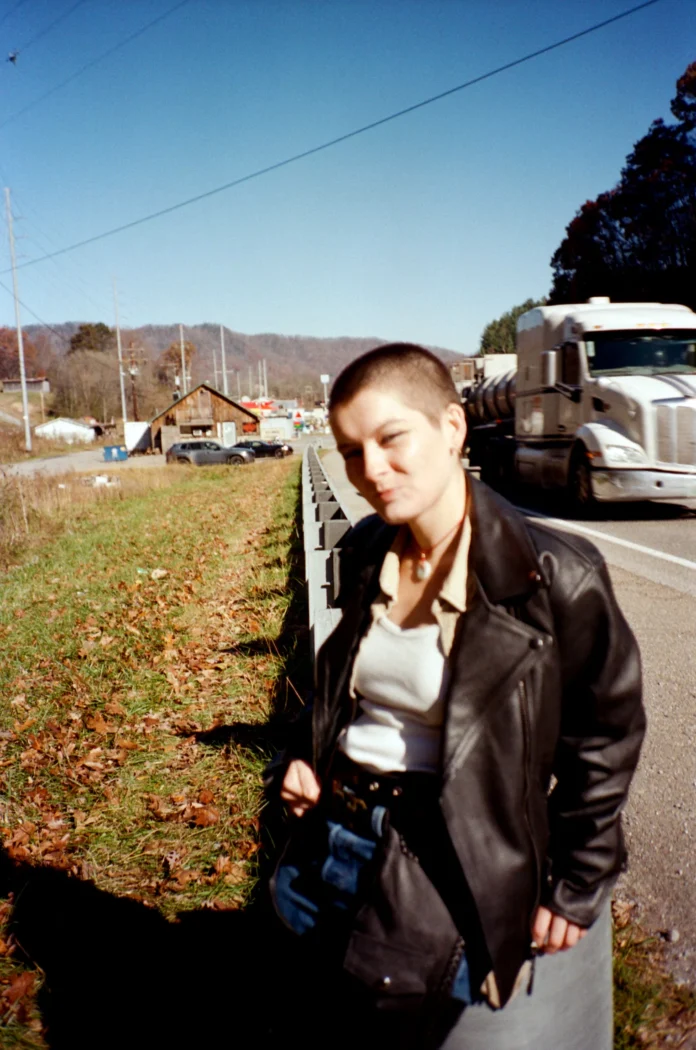
Zoh Amba is a musician, composer, and singer-songwriter who grew up in the mountain towns of Tennessee. They left Kingsport at seventeen, moving to San Franscisco first and then New York, where they built a reputation as one of the most exhilarating saxophonists in the avant-garde scene. At an early age, they played guitar and wrote songs but switched to alto saxophone after seeing a video of Charlie Parker, practicing out in the woods because their mother hated the instrument. They released their first record, O, Sun, in 2022, following it up with 2024’s O Life, O Light Vol. 1 and 2025’s Sun. Earlier this year, Amba joined Iggy Pop on saxophone at Coachella, a somewhat surprising move following the news that they would be switching to guitar and songwriting for Eyes Full, their Matador debut out this week. The blazing, heavenly abrasion of their instrumental work is anything but lost on the self-produced record, which features White on drums, Kevin Hyland on guitar, and a number of associates at Ashevile’s Drop of Sun, where it took shape. The title might as well be an inversion of the famous Shakespeare sonnet, putting it in alignment with Amba’s past work: The lover’s eyes are everything like the sun. Don’t be afraid to stare into them, Amba seems to implore.
We caught up with Zoh Amba for the latest edition of our Artist Spotlight series to talk about taking a break from the saxophone, being from the South, recording Eyes Full, and more.
You just finished a short run of dates opening for Folk Bitch Trio. What was it like? Did you focus on material from the new record?
It was really sweet. We had a great time together. I was playing solo, which I haven’t really done in a while, so it was really nice to play solo and meet a lot of new people. I did half new, half old. I felt like I could get away with it, because it’s not headlining, so I could kind of do whatever I wanted and get away with a lot.
There is such a full-band energy on this record, so it must have been interesting to pare it back down.
Yeah, it all started solo when I wrote everything. Everything was very solo-driven, and it’s weird playing with a band and then playing solo, for sure. I love playing with my babies, it just feels like you’re with your family. It was good, though. It gave me a lot more space to explore different fingerpicking shit that usually is harder to cut through with a band.
Eyes Full is framed as a return to your first instrument, the guitar, but there’s that track on Sun, ‘Champa Flower’, that feels like a precursor to the new record. Is there a thread in your mind between that track and the beginnings of this record?
I think when I made the Sun record, I was going through this thing where, I wouldn’t say I wasn’t wanting to play sax anymore, but I was definitely not having a great time with myself. All that music and that preparation came before that feeling came, so I was kind of trying to get through that chapter. Then we were in there, and I was like, “Here’s a little finger-picking thing, let’s just do this real quick.” I did put it on the record as a foreshadowing, if people were to catch it – I didn’t even know it was gonna happen when we made that record, but I was like,” Oh, feels like a subtle foreshadow here.” But that was just for something that was improvised in the moment real quick.
Was there a moment where you fully realized you wanted to go in that direction?
I think it was subtly happening and I was like, “This is weird, why would this happen to me right now?” Touring, grateful to get to play this music – but something inside of me was just really unhappy. Not to get into a huge conversation, but it’s really hard being a non-dude playing any type of music. Somehow playing the avant-garde world was not something for me. I’d take moving back here – I’m in Tennessee right now – and working anywhere over having to do some of that stuff and getting to protect the music as it is. It just wasn’t feeling good. I think God was trying to save me and was putting all these different other songs in my head, picking the guitar back up. That’s all I was doing, was playing guitar every day.
I think I felt like living a double life in my head, but it wasn’t a double life. It felt really strange to me, and then I kind of started seeing it morph into a more of a life I could understand, and I just was trusting it. It didn’t make much sense to me, still doesn’t make much sense to me. But I kind of say if you talk about magic too much, it ain’t so magical, so I don’t really want to understand why any of this stuff is happening. But I feel really grateful for it.
There was a huge turning point where it was one of the last saxophone shows I played with my band, and we were out in Spain – I don’t know which area of Spain, but it was the last day of this tour last year, and I remember I was so depressed on this tour. I remember we got up to play this last show, and this guy that was in the audience – this older, white, bald gentleman – yelled at me that my music was for drug addicts. It sure is, by the way. 100%, my music is for drug addicts. But having this guy in some suit screaming at me and heckling during the show, it triggered this animal in me, where I snapped. So I started been cussing at him, I acted like a fool, but I fucking snapped. I was crying on the stage, and people in the back were laughing. I was just like, “I’m done. Fuck this shit.” And everybody in the front row was so upset. I know the people in the front row genuinely came to see the show, but it was heartbreaking. I tried to come back out and play, and I couldn’t. I left, I went back to my hotel room at night, and I was like, “I can’t do this anymore.”
Then I got the call that Matador wanted to put out this music, literally that night. So I was like, “Alright, gonna give this a try and just do my best to get better and better and trust what’s happening.” And that’s all I’ve been trying to do. It was a really hard transition, for sure. It was really weird, but that’s alright. I’m looking forward to getting through the next few months and seeing it shape up, finding people that really love the songs, and just keep trying to be a great songwriter, an honest one, and a great guitar player – it’s my only goal in my life now. Working every day for it, for sure.
The saxophone stuff is halted. It’s not done, but it’s definitely at a halt right now. You know, I played with Iggy Pop recently with the saxophone, so I’m not throwing it away, but I’m pulling it out for things where I know it’s a really safe place. People are weird, but if you’re playing with a legend doing the same thing, people perceive it differently. It’s really interesting how that works.
For the kind of people in the front row who have spent time deeply with your records, I think Eyes Full will probably feel like a natural continuation of your work. Even in the way you lyrically center the sun, which comes up on nearly every song. It feels like exploring a different language for some of the same visceral sensations.
Oh, that’s a beautiful statement. I think I just keep hearing everybody separating it that it’s starting to get to me, too. In my mind I don’t feel it’s very separated. I think also, me talking about the sun is just a more neutral way of me talking about God and being happy to be alive type of thing. In my heart, with the writing, it feels like just one soul – it’s not like I split my heart in half, split my brain in half. So it’s all the same thing. Everything I was trying to do with the saxophone music is everything I’m trying to do in this.
I think when I was younger, I had a really difficult time using words and understanding those things, and something happened in the past few years where I got really curious about wording, and I started reading a lot of devotional books, actually. How monks would talk about life and view the world, just how beautiful it was, and I’d never thought about that – I was like, “That’s so precious.” It completely changed my way of seeing the universe and seeing things. I guess when it just felt like the door was kind of briefly closing for this chapter, I was like, “I’m still the same person, so what am I gonna write about?” I was really obsessed with ideas of God, and not in a Christian sense necessarily.
Being from the South and where I come from, which is a really tough place for people, I kind of morphed these two aspects of where I think my head had been: where I come from and this new way of seeing life and things. And then, being really obsessed with the guitar and different tunings and fingerpicking things, it all came together somehow. I think I got to this age where when you’re younger, if you come from a really damaged home life, incarceration, and drug abuse – I had so much faith in things being fixed, trying to heal things, and I’ve tried everything I could. When I couldn’t do that there was only one other way that you’re either gonna be upset, which everyone has a right to be upset if you come from that. But the anger and being upset wasn’t helping me anymore, so then I was trying to understand why would these people make these decisions to choose drugs over a child, or what the incarceration system does to families – I just started looking at it like it’s not these people’s faults for making these choices, and it has nothing to do with me.
‘Southern Soul’, the first verse is literally about my mother choosing this thing, but understanding that, despite looking strong and holding a certain image, I have no idea what she’s going through behind closed doors. Just trying to greet it with grace and say, “I can’t be what I can’t see,” meaning I’ll never be these things that she is. But I’ll be the tears running down her cheek, which is the aspect of just pure love, a deeper love. That’s kind of what the record was for me.
It also made me think about emotional repression and the consequences of staying silent, which I’m curious about in relation to how you use your voice on this record – whether there’s a different sort of release to singing these songs in a performance and recording context.
I think the silence thing is a huge part of the South, of people just cycling and moving and not talking about certain things, not acknowledging certain things. That’s definitely a subject in a lot of the record. ‘OCD’ is about a little boy – I don’t know if it’s still going on, but when I was a kid, everybody’s kids would be put on all these medicines and would be taken to these hospitals and stuff as a kid to behave right. And then if you look at them when they get older, all these people, especially the young men in this town, they all end up working at the same place in these factories. My brother, even – that song’s about twin brother, and how mental health plays this role, and you’re not allowed to speak about it – it’s not like you’re not allowed to, but there’s definitely this not welcoming aspect to it. It’s a big unraveling; it’s complicated. But ‘OCD’ is definitely like that. ‘Weed Eating’ is definitely a bit like that.
I was listening to you talk about learning to play music as a form of notating energy in a kind of non-traditional way. I’m curious how your perspective on that has been affected by bringing it to a singer-songwriter context.
I feel like it’s the same thing, I’m still not notating none of these songs. Unless the guitar’s in standard tuning, I could never tell you what chords these are, I have no idea. There’s 20-something songs that I’ve written in the past year – not even a year, six months – and I have no idea how to write any of this stuff out so to me it’s magical in that sense. On the saxophone, there’s only so many buttons to push down; it’s not that complicated, but the guitar is a little trickier for me, there’s still a lot of unknown. I would love to know what I’m doing – I mean, I do, I remember it, but I don’t notate things. The lyrics, I write them down on a piece of paper, but it still feels like the same experience. I think the creation around it was the same as other things, just kind of inverted experiences.
With that in mind, is it important to have players around you that can tune into whatever you’re playing without having to really talk about it? How was that communication like with Kevin Hyland and Jim White?
Mostly with Kevin, because he has to play another string instrument versus drums – I think when we first started playing together, we just played so much together in the park, duo acoustic. When we started playing more in a rehearsal room, where we had amps and stuff, I don’t think I told him the tuning, I think he just has a really amazing ear. I remember before, he’d come over to my apartment and we’d play songs. We’d try to cover Michael Chapman songs, the song called ‘I’m Sober Now’. He could just listen to it and do it. He never went to school for music and he has such a great ear. He has a beautiful heart and a beautiful mind, he’s like my brother. When we play, we don’t really talk too much. I don’t tell him what to do, he just finds his way in it, and we try different things. I’ll say, “Hey, I really like what you did there.” I never say I don’t like something; I just try to nurture what I know he wants to do and be. It’s such a blessing that he wants to play my songs with me, because he’s a great songwriter himself. We’re gonna have a lot of practices coming up this next month for this Courtney [Barnett] run. We’re really trying to get better every day. He’s my best friend; I was just talking to him a second ago.
I’ve spoken to a lot of musicians who have recorded at Asheville’s Drop of Sun, and there’s times when you can hear the studio as a kind of character on the record. ‘Dead End Street’ is one that stands out to me.
I mean, I love Wednesday‘s band so much. I was like, “All these babies have been here.” Colin [Miller] from MJ [Lenderman]’s band was there, and he played on ‘Odd Jobs’. Colin plays drums on that song, and it was funny, because he was downstairs working in the studio, and we met, and I said, “You should come upstairs.” So he came upstairs, and we played a bit. And then also Landon George, who plays bass in MJ’s band, he overdubbed some bass on three or four songs. ‘Another Time’, ‘Thousand Years’, ‘Eyes Full’. I thought it was really sweet, but I didn’t think too much about it. Lawson [Alderson] and Adam [McDaniel], who was part of the studio session we did, they were the sweetest people ever. So I was more just like, “Wow, we are in such good hands right now.”
One thing that caught my ear in an older interview you did was an anecdote about looking at someone’s eyes and being moved to tears. That feels very much in line with the motif on this record of eyes as the portal to a deep emotional world.
I think when I was a kid, I had this problem where I looked in people’s eyes, I’d feel so overwhelmed and cry. As I’ve gotten older, my relationship with it has changed, but I don’t know – you meet some people, and you look in their eyes, and you’re like, “Wow, I’ve been waiting to meet you my whole life.” I definitely feel like that with my band – they’re not just great musicians, but they’re amazing people. All my best friends, I feel that in their whole thing.
This interview has been edited and condensed for clarity and length.

