

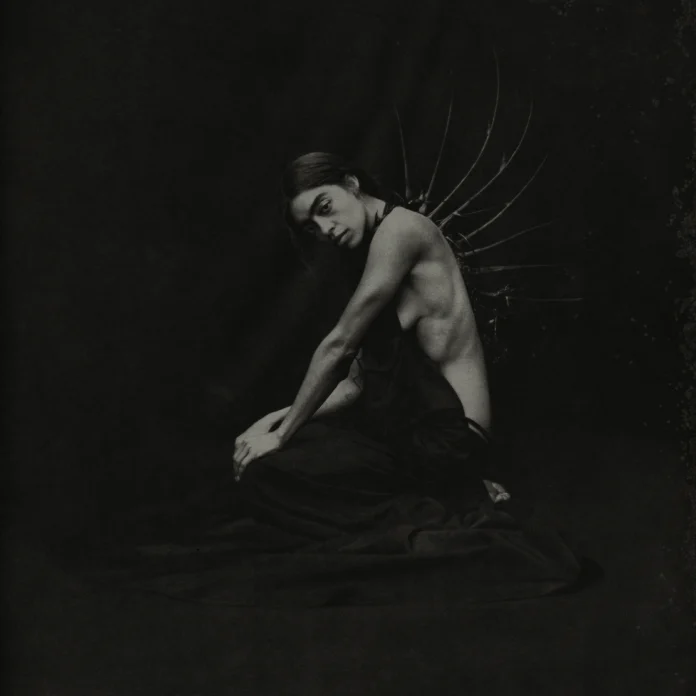
Though Kelsey Lu has kept busy since 2019’s Blood, returning to their musical identity feels like a process of homecoming. After scoring award-winning films, working across galleries, and collaborating with musicians ranging from Beverly Glenn-Copeland to Jamie xx, Lu discovered that going back to songwriting meant having to sit with uncertainty, slowness, and a lack of resolution. “While many things can serve as beautiful guides,” they recently said, “I believe that, at our core, we are made from beauty and love. Being able to return to that source feels deeply important, especially now.” Those qualities spill out of So Help Me God with painstaking precision, but even as a classically trained cellist (and therefore perfectionist), Lu is forced to resist giving them any kind of linear structure, instead gliding from “burning desire” to “volcanic gaseous tremblings” with a distinctly emotional logic. Jack Antonoff, Yves Rothman, Kim Gordon, Sampha, and more contributed to the record, but Lu never lets you forget where it’s all coming from.
1. Reaper
Ever since Church, Kelsey Lu has made a habit of opening their records with a lengthy track that puts their hybridist ambitions on full display. The billowing haze of ‘Reaper’ is no exception; the eight-minute song is most impressive in finding an equilibrium among not only Lu’s musical instincts but those of their esteemed collaborators. As soft instrumentation builds the song up, there are echoes of Clairo’s Sling in Antonoff’s production, and if ‘A&W’ is any indication, you’d have to guess that the (admittedly way more muted) drum machine was his idea. But those flourishes wonderfully sway alongside Rothman’s own drum programming and synths, while Kamasi Washington’s saxophone essentially duets with Lu’s ethereal voice; Kim Gordon’s contribution is almost imperceptible, but still a big flex. The vocal production alone is ingenious, oscillating in temperature as the word “you” takes on different shapes throughout the song’s final stretch.
2. Portrait of a Lady on Fire
You could sum up Celine Sciamma’s film of the same name with the two words that open the song: “burning desire.” Lu wonders aloud if the yearning is reciprocated, but Lu’s cello taps into the unspoken depths of it while Spencer Zahn’s bow bass fills out the low end. Their voice grows from a languorous simmer to nerve-fried intensity, exploring every crevice of the phrase “only for you.”
3. What Can I Do
Lu inhabits the spectral realm of want a little longer, piling up atmospheric synths while grounding them, through beautifully mixed acoustic guitars, in something pastoral and domestic. “When we are alone/ I feel I can call this home,” Lu sings, “But I wouldn’t ever tell you so/ I’d hope you’d just read between the lines.” On ‘What Can I Do’, that subtext couldn’t be closer to the foreground.
4. Running to Pain
The first time Lu lets go of their cello on So Help Me God turns out to be its biggest release, as much of a perfect pop song in the context of the album as it was in isolation. Antonoff’s melodic touch couldn’t be more prominent, though more beguiling is the way it matches the aching fluidity of Lu’s vocals, embracing the pain they mourned on the opener. A lover may take it all away, but the tears on your face stream down as strange proof of bodily autonomy.
5. Comfort
The track alternates between lilting verses and a radiant chorus that seems to fly too close to the sun; or, as Lu eventually puts it, “in the cradle of fire” that’s mirrored by Sam Stewart’s electric guitar. Though they sing of “too many voices in my head,” they’re not filtered or layered as theatrically as other songs; instead, they’re subsumed by the swirl of instrumentation, including strings, percussion, and brass parts from Casey MQ.
6. American Sonnet
As Lu’s piano grieves, trembles, and squeaks over delicate piano, you could imagine this as a brief instrumental interlude dividing the album in half. Instead, it becomes a centerpiece, unraveling a poem by Wanda Coleman (who gets half the credit) into a spine-tingling performance: writhing, nature-bound, and unmistakably Björkish. The eerie details in the background gradually gain mass, giving way to a drum beat that comes courtesy of – who else? – Jack Antonoff.
7. 852
There’s a stark contrast between the poetic abstraction of ‘American Sonnet’ and the directness of ‘852’, which sits on the other side – emotionally, at least – of ‘What Can I Do’. The narrator’s selfless, all-consuming devotion overshadowed any hint of uncertainty about the relationship, leaving a dark void they can only crumble towards. “I love to hang on to the pain,” Lu reminds us, stretching the final word to its very extreme as a hushed groove echoes in the distance over Zahn’s rippling piano.
8. Only the Lonely
Lu projects some of the blame outward on ‘Only the Lonely’, declaring, “I disagree with the way that you loved me/ I must’ve known that you wasn’t a homie.” Ari Baptiste’s frenetic programming distracts from the core of the song, though, making it feel slightly undercooked.
9. Better Than That
A late-album highlight, ‘Better Than That’ reinstates the stately balladry of ‘American Sonnet’ before veering in a much lighter but no less sublime direction. Over a finger-snapping beat, Lu’s vocal feels unburdened, following their inner voice as it becomes almost interchangeable with that of Sampha, a kinship that can be traced back to their cover of Joni Mitchell’s ‘River’. “What’s better than rest?” Lu asks. It feels like the perfect time for it.
10. Cutting Off the Head of the Ghost
Yet So Help Me God doesn’t lay its head to rest without drunkenly soaring one more time; or bringing Antonoff back into the fold, for that matter. His electric guitar adds heft to the song, as does [checks notes] an Italian children’s choir. The titular line makes for a punchy chorus that might be the most defiant moment in Lu’s discography. “This is the place where all the lives are planted in my eyes,” that Wanda Coleman begins; here, for a moment at least, that place is New York. But life drips through So Help Me God wherever you take it, and through its eyes every home blurs, like a choir, into one.

