

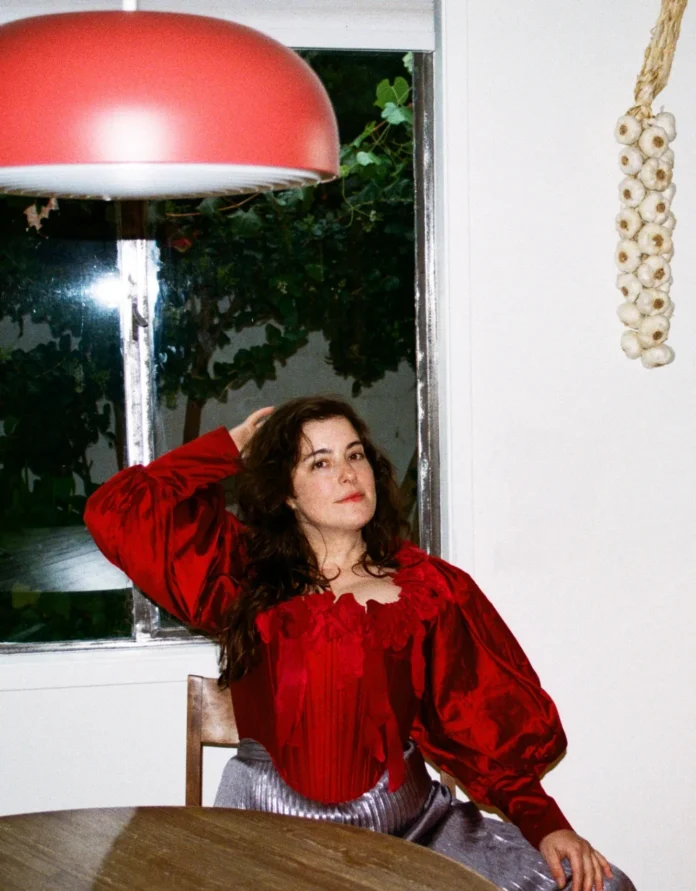
Sari Lightman’s musical output has evolved through various incarnations. With her twin sister Romy, she’s maintained a presence in the Canadian music scene under the monikers Tasseomancy, Lightman & Lightman, and most recently Lightman Sisters, while their striking harmonies have provided backing for the likes of Austra and Jennifer Castle. Since their last joint effort, Lightman has relocated to Los Angeles, sharing a neighborhood with her close friend Meg Duffy (Hand Habits, Perfume Genius), who produced her debut solo album, The Way I See You. Mixed by Philip Weinrobe, the record features bassist Pat Kelly, synthesist Aaron Otheim, percussionist Jesse Quebbeman-Turley, and drummer Evan Cartwright, an ensemble that only helps Lightman heighten the songs’ conversational intimacy. While maintaining a voyeuristic approach to songwriting, they loosen the stranglehold of reality by imagining dialogues between contemporary writers, female mystics, and, of course, sisters, joining their voices like a Greek chorus. For all its preponderance of characters, it’s nothing if not an internal reckoning: “The road inside me folds and I’m warm again,” Lightman sings on the final track, ‘Soon Came the Evening’. Like a sunset, you can feel the light’s affection comforting you a little while after the record’s over.
We caught up with Sari Lightman for the latest edition of our Artist Spotlight series to talk about her relationship to place, working with Meg Duffy, family, and more.
I’m speaking to you from Greece, so I wanted to begin by asking you about ‘Rose is in Greece’ and your relationship to the country.
Greece is in the trilogy of my most revered places I’ve ever been to. The first time I ever went to Greece, I just felt so blown away. There’s so many cities and countries that one can travel to at this point, and they feel more homogenized – maybe you have really high expectations, and then you get somewhere, and you’re a little bit let down. Just the amount of life that is existing every day, especially in Athens – I don’t even know how to describe it, it feels like you’re multiple people all at once. There’s so much contemporary art and culture, there’s beautiful cafes, and everyone’s lounging and talking, and then you just come upon this incredible, eroding ruin that’s been there for thousands of years. I don’t really feel like there’s a lot of cities that are able to integrate that kind of ancient past and also display such a vision for the future as well. Obviously, there’s a lot of intention and planning in the way that tourists maybe navigate the city, but if you’re just wandering around, it’s just breathtaking to come upon all these ruins and evidence of humanity. There’s this book that I really like, have you heard of the Outline trilogy?
I’ve read the first one, yeah.
I remember the way she describes walking around Athens in the summer really resonated with me. I’ve been to some of the islands – I was actually supposed to play on one of them this summer, in Sifnos. It was a tour planned with my sister who, unfortunately, is stuck in the States at the moment with visa issues. Rose is my sister Romy, and she spent many months on the island of Folegandros. We have a Greek friend who lives there seasonally for work, and she introduced my sister to the islands. I remember Romy calling me on the phone before I’d ever been to Greece, and she said, “My DNA is changing, being here.” [laughs] She existed a little bit differently than most tourists do; she’s not so into the sun, so she would rise in the evening and go out walking with her guitar. People thought she was either vampiric or unwell, but we’ve been there together a few times now.
I wanted to bring up that line in particular. Do you think a place can have that deep an effect on you personally? Has California done that to you in some way?
Absolutely. I don’t know what’s happening to literal DNA in your body, but I do think that as human beings, we are so malleable. We change so much with the climate, who we’re around, and wherever we are inevitably ends up shaping us and our experience profoundly. Being in California, particularly where I am right now, it’s a really quiet, spacious mountain town. When people think about Los Angeles, they think about the hot concrete, the city, and the parties. For me, I think a lot about how it’s a city where people are really mired in solitude. Even if you live in the city, it’s so spread out and inaccessible in a lot of ways, and it does feel like when people congregate, instead of meeting in a center, they kind of go outwards to a hike or the mountains. That kind of daily interaction with the same tree you see every day on your walk, the same crows hanging out – it really changes the way time moves. It is a seasonal place, but we don’t have the same conventional deep winter of being inside and introspective. This is how people gain their introspectiveness in LA, by accessing nature. It’s really needed here, and it has shaped the way I exist day-to-day.
When I was living in Montreal, my existence was far more nocturnal. I always thought about that Leonard Cohen quote where he said that the first act of rebellion is turning the night into day, which is very evident in a city like Montreal: you have this really vibrant, 24-hour life, people are going to the diners, people are going to after-parties at 3am. Here, because of the strong solar connection of needing to be outside, people are in bed by 9pm. If you’re existing more with the sun and living this solar reality, it profoundly changes your perspective. It’s not a binary thing of optimism versus pessimism – I was very happy in Montreal and loved that kind of existence – but it just doesn’t exist here as much. The person I am now, versus the person I was before I moved to California – different guy. I also had the transformation of motherhood, which I think actually does physically change your DNA, living life looking through somebody else’s perspective all the time. There are many ways that our physical and relational realities really change us.
You were talking about the summer, and I remember Meg telling me about the spring in LA, and how there’s this magical window where everything comes alive in a unique way. I’m curious if you can speak to that and how it’s affected you.
I do think there is something, because we don’t have a traditional four-season climate – we do, but it’s less overt than in other places. So the spring really brings about this respite because of the rains. We go from being in a panicked drought to, all of a sudden, the return of the water. I think about T.S. Eliot’s The Waste Land and the return of the Fisher King when I first moved here – this return of fertility and lushness that makes this collective sigh of relief. The springtime here is very euphoric because the green is what everybody covets; everybody goes wild for these green pastures. It brings these days where you can really be outside all day, and it’s a very unique season that feels nostalgic because it’s such a special time.
Meg and I would go for lots of long walks. We used to live in the same neighborhood, and that was the seed of our friendship and working together – going on these daily long morning walks and talking about life, particularly walks in the springtime. Being in LA in the spring is something that, even right now as we’re entering into the summer, I’m already feeling a grief for that time. Everyone’s got different constitutions, but summer feels more like a lizard existence. You have to be a lot more stationary because there are many times of the day where it’s simply unpleasant, or not even safe, to be out in the sun. So the spring provides so much freedom because of this euphoric, glorious weather.
You have to surrender to it.
Yeah, you have to surrender to it here. And the interesting thing, not to get too deep into the geopolitical situation, but I do feel like right now, California is at the peak of its infamy – who knows what’s gonna happen after this, with climate change? Everyone’s driving around in their cars and acting like nothing is changing, but with the fires we’ve seen in the past few years – I had a lot of friends who lost their homes last year to the fires – we are seeing this change and we have to accept it. It’s also not just conditional to being in LA. When I go back to Canada in the summer, there’s smoke coming from the fires in the north. Right now, more than any other time, you can really feel how temporary this relief is, and that makes it even more special.
Was it clear from the beginning that Meg would come on board as a producer on the record?
I think I always had it in my mind that I wanted to just make this record with Meg. Meg is such an incredible guitar player, of course, but over the years, they’ve also really honed this intuitive and now very learned set of skills as a producer. I think when we initially started doing this record, it was one of their first forays into production and they learned a lot, but they’re just such a focused, intense worker that I knew they would thrive in a producer’s role. Because I trust Meg so much, I also wanted my voice to come across. I felt like if it was just the two of us going back and forth, my voice would ring out really clearly. As my friend, and also just as a producer, I knew they were just a sensitive and really thoughtful musician. I wanted it to be this flow back and forth between us, like when we go on our walks, or even the way our friendship is – it’s very easygoing. There was no strife. We have a very soft and easygoing rapport, and I wanted that to come out on the record.
In the statement about ‘Give it all Up’, which is a new version of a track from Sister Smile, you said that Meg had suggested stripping it back. I’m curious if that was in the earlier stages of the process and maybe influenced the direction you took with other songs.
I feel like my intention for the record was to keep things as sparse as possible. My influences for the record were these older folk records, like Bridget St. John. The way that I play involves a lot of finger-picking, and it’s funny because even strumming isn’t something that I necessarily would intuitively do – that was definitely Meg’s influence. For this particular song, I think this came later, and I think it really works. It’s a a very meditative song, and when I wrote it, I never envisioned it being played like this. But now when I perform it with my sister in our ensemble, we do it the way that I did it on the record, and it’s really effective. The song is supposed to be an interview, this back-and-forth rapport, and it allows so much more space to make sense of the lyrical intention. By removing a lot of the layers that could potentially be involved with the composition, it feels like you can really focus on the play, and the song feels a bit like a play to me.
Did that approach lead you to discovering an aspect of your songwriting that you felt was obscured or harder to access before?
The way these songs came out is more revealing of the way that I write, because when I do write, I just write on an acoustic nylon-string guitar. I’m used to being with my sister and my other bandmate, Evan [Cartwright], in various other projects that I’ve done, where I’ve written a song and the end result is something very unrecognizable – not in a horrifying way, just that it’s so collaborative it becomes its own entity, and I see it as something that’s not necessarily mine anymore. It becomes something else by the end. Whereas I felt these songs with Meg felt so much more of my interior, because Meg was really leaning into my arrangements. These songs weren’t necessarily hyper-polished; they were left in a more rough, unobscured form. Of course, I hear Meg’s influence, and their beautiful musicality and compositions have merged with mine, but the pipeline from the beginning and the intention of the song to the end result feels a lot more reflective of what I was thinking about at the beginning.
Because there is a cast of players aside from Meg and yourself that play on the record, including Evan, how did you go about guiding the arrangements in a way that preserved that subtlety?
I think that’s really where Meg’s role came in. Going back to Leonard Cohen, because I was leaning into these traditional folk records; there’s one Leonard Cohen record that I really love called New Skin for the Old Ceremony. I love how the arrangements come in and out in such subtle ways, just adding a color here and there. I think Meg understood that it wasn’t going to be like, “This song’s gonna be recorded with a band.” It felt like the songs were already more or less completed, and then we had additional players coming in and out. Meg did those arrangements and let the other players know what we were going for. Because the record is so sparse, when there’s a touch of a bass or somebody playing a bongo, it feels really thrilling and exciting even though it’s quiet. This was a very different method than how I’ve usually worked, which is from the ground up, beginning with the percussion or traditional elements of composition.
It’s interesting to me how ‘Give it all Up’, along with ‘Etty’, are not just reshaped but recontextualized on the record. They serve to extend this imagined conversation between Etty Hillesum and Jeanine Deckers that was a thread on Sister Smile. Etty Hillesum and Jeanine Deckers. How have these figures lingered in your mind?
The messages of those songs and those ideas feel more relevant now than ever before. With all the turmoil of our governments, reading Etty Hillesum was like a balm – I read her diary and her writing from the 1940s, and it was ominous because she was talking about regimes and people losing their freedoms, their lives. But it was also inspiring to read the work of a brilliant friend; her ideas felt so contemporary and bending towards love. She was really talking a lot about her own relationships and her existence as this figure that wanted to emanate love and be “the thinking heart” of the concentration camp she was living in. It was moving to see these singular artists – and Jeanine Deckers, the Singing Nun, was also a creative person whose ideas were forged in faith and devotion.
Neither of them were incredibly celebrated, but it was beautiful to look back and see what these singular artists did at that time, how they were reacting to these systems of evil. That is an ongoing conversation I want to keep looking back on and writing songs about. I wanted to bring them into this different context because the messages of their work feel so pertinent. I don’t think I’m quite done with it all yet. We are existing in a time where the general population is so distraught, with great reason, because we are living in such dire, chaotic times. But this isn’t an exceptional time of violence and systems of evil taking away people’s liberties, and ;ooking back into history offers a kind of salvation and a bit of a guidebook on how to be. I found it comforting for these voices and spiritual people to be women, especially in a period of time when women’s voices and thoughts weren’t necessarily revered or even considered.
Those songs are also paired together in the tracklist, following another pair of songs linked through the theme of sisterhood, ‘The Day of the Just Cause’ and ‘Girl Bitten by a Lizard’. Why was it important to have them sit together in the tracklist?
On this record, I was trying to explore different interior themes – some are lived experiences and relationships, and some are imagined relationships with characters or people whose work I’ve been deep into. In this case, it was very personal. I named ‘The Day of the Just Cause’ after a funny book my sister really likes called The Secret Language of Birthdays. It’s like, you look at your day and it tells you all about your noble traits and the things you need to work on. Our day was the Day of the Just Cause, which is all about speaking your truth. The song is about us trying to forge our own identities and paths as very conjoined people. We’ve been intertwined our whole lives and we’re very close. People always ask what it’s like to be a twin, and I don’t know anything else,but it is an intensely beautiful and at times fraught relationship that is so interconnected. It’s finding our way apart and together, and apart and together. My sister and I are very close – she lives here, and our children were actually born on the same day, three years apart. So we have the Day of the Just Cause, the next generation.
The other song, ‘Girl Bitten by a Lizard’, was about my sister-in-law who was in and out of our lives a lot at the time. She really struggled with her mental health and addiction. That song was supposed to be from my perspective; I was simultaneously horrified, concerned, and really curious about what her interior world looked like at the time. Unfortunately, she passed away recently, a few months ago this year. I had changed her name in the song because I was so convinced she would recover, hear the song, and be pissed off that I wrote a song about her. [laughs] She didn’t make it, but I would have really loved for her to hear it. Listening back retrospectively, it is a song that honors her spirit. I talk about how she would always tell me that as a kid growing up by the ocean, she was part of the water and would fly down to it. She had all these fantastical ideas of herself being connected to the water, so it’s nice to think about that now when I go to the ocean and think about her.
You were talking about motherhood earlier, and a line that stuck out to me as a brief glimpse of that in ‘The Prize’, which has this verse about “deep longing.” It connects to the idea of voyeurism that you’ve talked about pervading the record, but it also feels twofold – recognizing a longing for motherhood, but also for being a kid.
That song is about life and all the potential paths you can take; I almost envision that song as being on an epic road trip where you can turn off here or turn off there. The idea of collecting your prize wasn’t meant to be cynical, but it’s about what you choose to do with your life, or what consequences, choices, and circumstances will fall on you. I was being a little cheeky about it, but the part in the song about deep longing was very sincere. I would glance at these fleeting, intimate moments of motherhood and childhood as an observer and be like, “Is that somewhere I could fit? Is that what I want to do?”
I don’t think motherhood is a prize at all, but there are these foundational elements of being alive – do you want to be a parent, do you want to fall in love and have a beautiful love affair, what do you want to do in your life? What is going to come to you? When you are thinking about it as an observer, a voyeur, and ruminating on everything, it’s a very different experience from actually existing within it. Something like motherhood is very conceptual until you are in it. At the time I wrote the song, I wasn’t a mother, so I wondered what it would be like. I saw this beautiful moment of a mother and child and wondered: Is she tired? Is she happy? Is she satisfied? Am I gonna be happy or satisfied in this decision or this path? All of it is so conceptual because you can never feel the somatic feeling of something until you’re really living it. This song is less about being in something and more about the conception of what things could be.
A lot of times, when it comes to other people in our lives, even siblings, it feels like what they want in life is concrete compared to our abstract, internal questioning. I’m thinking of the line, “You want a house in nature, I want our natures to agree.”
Yeah, absolutely. Even what you think somebody wants, or what you think you want, isn’t even necessarily how it is. The role of the voyeur, even with these songs, it doesn’t leave room for the other person to speak or say what they want like they would in a novel or a play. The songs are about being interrelational and being in these personal dynamics, but the role of the voyeur is to make assumptions, and it’s not necessarily a truth. These songs aren’t necessarily embedded in deep truths; they are ideas, thoughts, and questions more than they are about finding solace in some sort of foundational reality where I’m a part of it. It’s more about being outside of it and what it looks like to write from the outside.
I wanted to tie that into the vocals and multitracking them on this record. How was thinking about harmonies different this time around?
For me, making songs is so much about harmony because I’ve sung with my sister since forever, so when I write songs, I’m always writing counter-melodies to go with the main melody. I like using the voice as an instrument; it’s the instrument I feel the most at ease, playful, and fluid with. Instead of being like, “I want to rip a bassoon solo here,” it’s exciting to say, “Okay, this song is going to be mostly voice and acoustic guitar.” There will be some flourishes, but what can I do just with my voice to make it feel like another instrumental line in the composition? It was really fun to do this record and add in parts using my voice as a little walking melody that I heard. The counter-melodies and the harmonies are just as crucial to lift the main melody line. This is just how my brain works as an ensemble player. Speaking of Greece, it felt sometimes like being part of the Greek chorus, and I liked that. I sometimes envisioned the different voicings telling different parts of the story. Because there were these layers, it felt like the other voice was reiterating and strengthening the character’s main idea.
This interview has been edited and condensed for clarity and length.
Sari Lightman’s The Way I Saw You is out June 26 via Night Bloom.

