

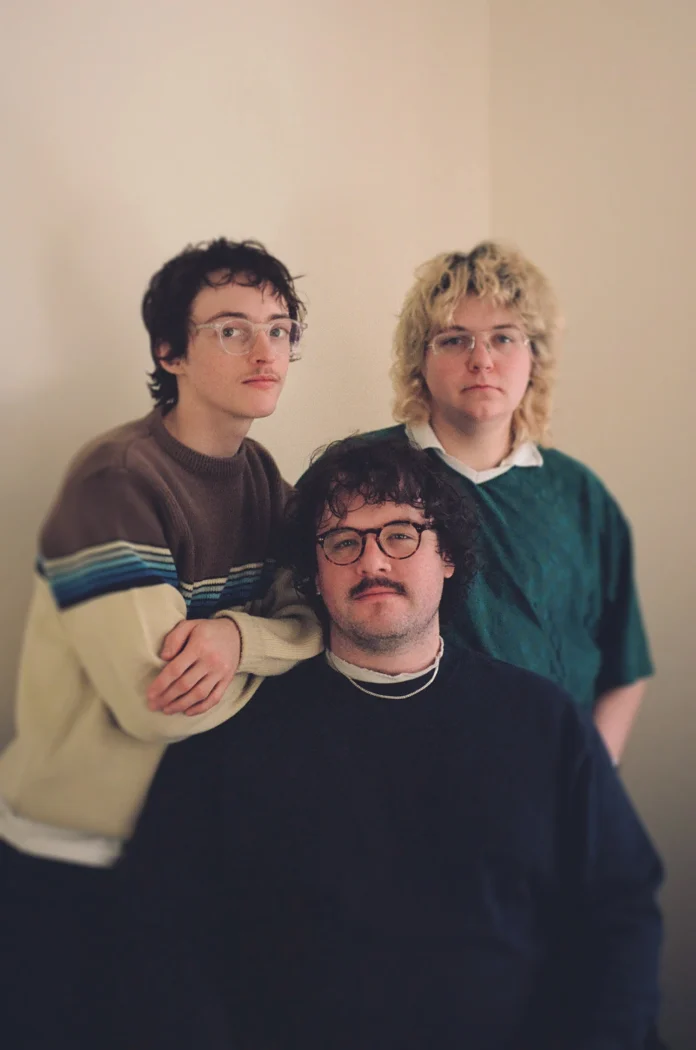
knitting is a Montreal band composed of frontperson Mischa Dempsey, guitarist/engineer Sarah Harris, bassist Piper Curtis, and drummer Andy Mulcair. Though conceived as a homespun experiment to be heard by a few friends, Dempsey’s self-titled tape, uploaded on Bandcamp in May 2021, quickly pushed knitting past its solo project origins, introducing a grunge-slacker fusion the quartet would refine on their debut album, Some Kind of Heaven. For their second LP, they chose not to book time at a studio and instead built out Dempsey’s liminal, existential songs gradually and at times laboriously, with Harris helming the engineering as they split sessions between Montreal and St. John’s. Spontaneous and experimental as it often was, the process has the effect of not only streamlining their sound but, as the record progresses, unclouding Dempsey’s fraught lyrics; “I’m trying everything to reach/ Another version of me beneath/ Layers of static and latency,” they sing on ‘Sunrise’, yet spend most of the record peeling them off. By the final track, a single layer of guitar and synth accompanies them. Listening to knitting with your eyes closed, the repressed self becomes easily accessible and unalone, ready to unfurl.
We caught up with knitting for the latest edition of our Artist Spotlight series to talk about their earlist musical memories, making Souvenir, time capsules, and more.
Souvenir begins with ‘I Want to Remember Everything’, so I was wondering if you could maybe start by sharing some of your earliest memories of music resonating with you in a particular way.
Mischa Dempsey: Yeah, totally. My parents both really like listening to music. They lived in Toronto in the ’80s and ’90s, where there was a lot of really good stuff going on, and my dad was always making mixtapes of punk songs. Then he would put on, like, a classical song, just mishmash things up a lot. But we listened to a lot of punk and punk-adjacent stuff, specifically English punk from the ’70s and ’80s. One of my earliest memories of listening to songs in the car was the band Shonen Knife from Japan – they have a lot of child-appropriate songs, because they’re always singing songs about, like, an animal. They have a song called ‘Flying Jelly Attack’, so I remember that was on a cassette that we had in the car when I was a really little kid, and it’s awesome.
Sarah Harris: I think my musical influence was probably from my uncle, my mom’s youngest brother, because he’s quite a bit younger than her, closer to my age. He used to babysit us and had a bunch of CDs that I really liked, a lot of early 2000s alternative, and also a lot of David Bowie. Those two things really resonated with me. I’m talking Cake, Eels, POTUS, The Rise and Fall of Ziggy Stardust and the Spiders from Mars.
Was there a world of music you started discovering on your own at one point, that felt private or separate from what your family was listening to?
MD: I have a really clear memory of going and downloading probably most of The Beatles’ discography track by track using YouTube to MP3 when I was, like, 13 or something. The Beatles were playing in my house as a kid growing up, but a select number of songs, so that was funny. And then definitely got into LimeWire, thanks to my dad showing me how to use LimeWire, which was awesome. Downloading tracks there, and then I think later, like when I was maybe more in my early teens, just trying to see what was free on Bandcamp, or whatever the free songs or the $1 songs you could get on iTunes. I remember – and this is probably where my attention span got absolutely shot – I would listen to about 10 seconds of a song, decide if I liked it or not, and want to download it or buy it with my iTunes gift card.SH: Buying a song with iTunes was sick, but I used to only buy pop on iTunes. My iTunes library is, like, 2008, 2009 pop hits. I’m talking the best songs ever made. And then for more obscure music, my friend’s dad had a really baller iTunes library, so I would take my iPod over to their house and fill it up with whatever I wanted from his library because it was this huge thing. And I had a friend in high school who used to give USB sticks with files to each other, so I discovered a lot of music that way.
Mischa, what were the songs you were purchasing on iTunes with your gift card?
MD: I have pretty clear memories of seeing the Broken Social Scene album cover with the buildings on it [the self-titled LP] on iTunes, and by my 10-second metric, being like, “I don’t want to buy this, unfortunately.” But it’s funny to have that album cover in my memory. I don’t actually remember what I bought. I might have bought a couple of songs by the band Metric around that time. I was gonna say I could check, but it’s probably all on my parents’ computer still.
There’s a lot of reappreciation for bands like Broken Social Scene and Metric, especially as inspirations for how musical collectives work. Do you remember getting curious about how bands like that work?
SH: For me, I wouldn’t say those kinds of bands were inspirational in that way, but I’m just gonna bring the convo to the film School of Rock. We’ve talked about this a lot in our friend group – Mischa and other friends a similar age to us – all share that after watching School of Rock, all we could think about was being in a rock band. That’s probably the main thing that really tipped the scales for me wanting to be in a rock band. Just watching that movie over and over again with my siblings, and I used to make my brother jam with me. He liked it, but he didn’t like it as much as me.
MD: I definitely feel that. Similarly, a movie also got me really motivated. I actually went to a rock camp for girls when I was like 11, and they did a movie screening of a documentary about one of the first rock camps in Oregon. It was run by a bunch of the people who did a lot of the alternative and indie rock in the ’90s on the West Coast, like Sleater-Kinney. I don’t remember who else was there, but it was a lot of people who were in that scene around that time. So, I saw that movie and really desperately wanted to go to Rock Camp.
When you started jamming with others, how much stock did you put in the idea of being in a band as teenagers? How did that change over time?
MD: I feel like as soon as I knew I wanted to be in a band, I knew that’s what I wanted to do with my life. It sounds funny, and maybe I didn’t know why I wanted it to be a career, but it was all-consuming and I wanted to go all-in pretty much as soon as I started because it was just really awesome. I always liked playing music as a kid. I played in school bands and stuff, and there’s something really satisfying about linking up with other people and playing music together. It just does something crazy to my brain thinking about playing in a band.
SH: Yeah, similar for me. It’s pretty much all I wanted to do. I would always write songs with friends at parties in high school and have a laugh. Most of my social life was playing music. If my younger self or the teenager who knew what I was doing now, it would be a pretty happy moment. But now, I look at what I’m doing as an adult, and I’m just like, “Hmm.” [laughs] But we go on, and we love it.
What were you thinking, Mischa?
MD: If I’m actually being real about how much I knew about stuff when I was a kid, if I knew that we were in a band and we were going on tour and all this stuff, I’d be like, “That’s amazing!” But seeing it from our point of view now, where probably 50% of what I do is just sit and reply to emails and apply for grants – but you don’t see that kind of stuff as a kid.
SH: You’re like, “Whatever, I don’t even know what an email is.
MD: “My mom will drive me, who cares?”
Another song that harks back to your younger self is ‘Gift Horse’, which references this time capsule that you found in your parents’ house. Had you forgotten about it when you found it?
MD: I think it was actually the last idea for lyrics that I came up with – not necessarily the last lyrics that I finished, because a lot of them we finished in the studio together. But it was the last idea I had for a song, and I was looking for something to fit in with other themes on the album. I was home at Christmas and had already been thinking about what other perspectives I could explore. My mom recently gutted my childhood bedroom and turned it into her walk-in closet, which looks awesome. I’m glad she did that, it’s a way better use of her space, but she dumped a pile of my stuff in one of the other spare bedrooms, and it was there. It’s not even a beautiful time capsule – it’s literally a plastic ice cream container with a piece of tape on the top of it. But I remember making it because there was a kids’ magazine that was like, “Make a time capsule!” There was a sheet that you could pull out and fill everything out on, and then a list of items to put inside of it. I think I put it away in 2008 or 2009. They said, “Do not open until 2014,” and I was like, that day is never gonna happen, that is so far away, there’s no way that much time will pass. I kept peeking in because I couldn’t wait sometimes.
SH: And then you forgot about it till 2026.
MD: [laughs] Yeah, literally.
Sarah, did you have one of those?
SH: Not formally, but I am, unfortunately, sort of a hoarder. I have a chest at my parents’ house that’s full of mementos and stuff from when I was younger, stuff I wouldn’t keep now. Like, if my band name was on a T-shirt, I have a bunch of those T-shirts that are child-sized, and I would never wear. Just various little bits of junk.
After putting out and touring Some Kind of Heaven, did you take any kind of break to recalibrate before going into the new record?
MD: There’s usually a small period of recalibration over the winter holidays, usually because there’s around a month or two that we don’t really jam or play shows between December and January. We toured in November of that year, and then we did some shows in December, and then, yeah, took a break. So I feel like there is some natural pause, but then pretty much right after that, we got right back into writing songs.
SH: It kind of feels like we did a lot of touring for Some Kind of Heaven, but we really didn’t. We did a US tour, a Europe tour, and a few Canadian festivals, because we did so much touring before that record even came out, just on the legs of the self-released tape that Mischa did before the full band came together. And now we’re kind of resetting the structure of how we operate and being a little bit more intentional with timing as we grow the project. There’s a lot of administrative stuff that goes down to get the album out, so I feel like that’s naturally a time to break from the creative stuff, but we got back to it pretty soon.
I know that a lot of the songs come to life in the jam space, or even on the way to the jam space. Given your schedules, how do you make the most of being there?
MD: We had really limited time to jam for this album. Sarah lives in St. John’s, Newfoundland for part of the year, so we did maybe three jams with all of us before she went back, and that definitely influenced the direction of a lot of the songs. And then even between when she left and when we went to record, there was still only about three months, and we were aiming to get twelve songs together for that time. Specifically for writing, we were trying to be intentional about the time that we took and the time that we spent in the space. We mostly focused on Andy, our drummer’s parts, because that was the part that we absolutely had to get done first. We mostly tried to nail down the structures and the feelings of the songs before we actually fully fleshed them out. But I don’t know if we necessarily have a very unique working process; I just think that we’re all being pulled in different directions and do as much as we can with the time that we have, trying to make our different schedules work together.
SH: I feel like we weren’t necessarily ready to start making the next record, but we knew that we wanted to. Working with that impulse, we just started pushing it into being, even though, like Mischa said, we weren’t all in the same place. I think that’s a decently common way of working as a working band – doing some stuff remotely, or a mismash. The intention was just to be there and do it.
Ready emotionally or creatively?
SH: I mean, Mischa did a lot of the pre-writing alone. So I feel like that was one particular creative space that you can speak to. And then, once we got into the process of recording for this particular record, I feel like a lot of it was, like I said, just showing up and starting to do the work. Then you find creativity within being there, but a lot of the time, it did feel like a bit of a slog, to be honest. But then once we got into the groove, there were moments of spontaneous creativity that resulted in some nice stuff. I think the lesson from this one for me, at least, was just put it in the calendar and get there.
MD: I think when we say we weren’t necessarily ready, we just did not have enough time to prepare before we went into the studio. Which ended up creating pockets of creativity, but it definitely did mean that our point of entry of getting to those places was a little bit slower, because we were also still kind of figuring stuff out as we were going. But I’m also kind of a perfectionist and feel anxious or worried about not being ready enough sometimes, even if I’m showing up to the studio and having no lyrics for a song. That happened a couple of times.
I definitely felt like I was trying to grasp straws or things out of thin air a little bit when I was writing for this record. I was being pulled in a lot of directions, is maybe a better way of saying it, because we were also booking stuff in Europe, trying to apply for funding for that, trying to write this record, and do all this stuff. It was also a lesson in not trying to take on too many different things at once, or trying to find ways to delegate tasks or plan. But at the same time, it was also just good to kind of just get it done, because if you are waiting for the right time to start a project, you’re always putting it off instead of just seizing the time that you do actually have and can actually make work on a project.
SH: It kind of came together once we got the deadline from our record label. We finally figured out the release date, and then they were like, “We have to have everything by this date.” And then we were just like, “Okay, we can work with that.” The whole reason we were able to work on it so much without being prepared before we went into the studio is because we did everything at my studio in Montreal, where we could just have as much time as we wanted to do as much work as we wanted. It was weeks and weeks of working on it bit by bit, putting together something that we were happy with and proud of, whereas the last record was more just like, “We booked a studio and made a record!”
MD: It was definitely a lot harder, or a lot more work, to get it done.
SH: A quote from my favorite experimental musician and thinker, Brian Eno: “Inspiration has to find you working.”
I feel like the record benefits a lot from that, texturally and in terms of the experimentation. Sarah, how did engineering the record afford you a different perspective on the album and maybe the band as a whole? Apart from the skills and experience you gained, were you able to zoom out a little bit?
SH: Probably one of the things I’m most proud of on this record is the drum sound. I think the drums sound really good, because first of all, Andy, our drummer, got really into tuning his drums and changing the heads, making them sound exactly how he wants them to sound. And he hits the drums a certain way – really hard. Then I mic’d them up with microphones that were really nice, which we were using at this studio we rented for a couple of days with my friend James Benoit, who co-engineered those sessions. If we weren’t happy with the way something was sounding, there wasn’t tension with another engineer or someone else in the room. I was just like, “No, I’m not stoked with how this sounds, we’re gonna move that mic a little bit, or tune the drum a little.” Just taking care of every little thing as it comes up without feeling tension with another engineer or feeling like you’re overstepping on someone else’s role. I think it’s super helpful in terms of having creative autonomy over the project.
In terms of the rest of the production, we used a few techniques and instruments I’ve been using in my studio to make other kinds of music. There’s a synthesizer we used a bunch called the Yamaha Motif; we used the piano sounds on that keyboard for at least ‘Sequel’, and maybe a couple of other songs. I feel like Mischa and I got into a groove of working together where I could potentially play a role of encouraging or potentially ordering them to do something, just to kind of force it out. At one point, I got pretty picky with it and just started editing everything in a very strict way – not to get rid of the human nuances, but just to tighten up all the recording that we got. I feel like we were all really happy with the result, and there’s no way to be happy with a result better than to just do it yourself and not be afraid to try something, click undo if it doesn’t work, and just go on impulse in a flow state.
I read that there was a part of ‘Here Comes’ that was written, and then you came up with the rest of it on the spot. Do you have that “throw it at the wall and see what sticks” kind of attitude to working together?
MD: It’s like that thing in The Artist’s Way where you have to quiet your inner censor so that you can actually pursue the ideas that come to you instead of shooting them down, actually following up on them. I don’t know if necessarily all of the ideas that I came up with were good ideas; some of them definitely died before they even made it to the studio, and then some of them died afterwards. But I think, especially with the timeline of being like, “Okay, we have to write twelve songs, and we’re gonna record in July, and it’s March right now,” I was almost like, “I have to follow most of these leads as far as they can go and just see what happens with them.” I wouldn’t say it was necessarily a hugely impulsive writing process, but definitely tried to be less precious with the songs.
Do you feel like you’re both less precious when there is someone else around as opposed to being alone?
SH: I think the pressure of having someone else there makes me want to come up with something that I would be happy with if that was the final thing, more than if I was alone where you could get into a habit of just being like, “This is just a draft,” and move on before you find it to be acceptable as the final product. Whereas when we were working together, the two of us, like when I did my guitar parts, for the vast majority, Mischa was just sitting there watching me. [laughs] I would get onto something, and then once it started to get a bit more developed, we’d start to talk about how to finalize it. By the end of the stint of working on that part, we have something we’re both happy with, then we can move on. Whereas if I was alone, I might just fuck around for the whole song and just do ideas, but not a final product.
MD: But I think that’s kind of the nice thing about working together: one person can throw something at the wall, and the other person maybe will hear something different than you’re hearing in what you’re doing. You have a little bit more room to do something that can be a bit more random without also having to edit yourself at the same time.
SH: Or if there’s a happy accident that you see as a mistake, the other person might be like, “Actually, that’s sick, let’s move forward with that.”
Do you mind sharing one thing that inspires you about each other, be it musically or as friends?
SH: Yeah, I’ll go first. I think Mischa has an insatiable drive to do the music, do the shows, do everything – and it definitely is what keeps the band moving in a forward direction. Just having passion to keep the project moving forward. I think it’s why we’re here today.
MD: I think Sarah has really good powers of discernment and editing, and just the ability to make decisions and think about things in a bigger picture way, like why we would make certain decisions. I really respect and appreciate that big picture thinking and almost having a taste of which direction things should go in.
This interview has been edited and condensed for clarity and length.
knitting’s Souvenir is out now via Mint Records.

