

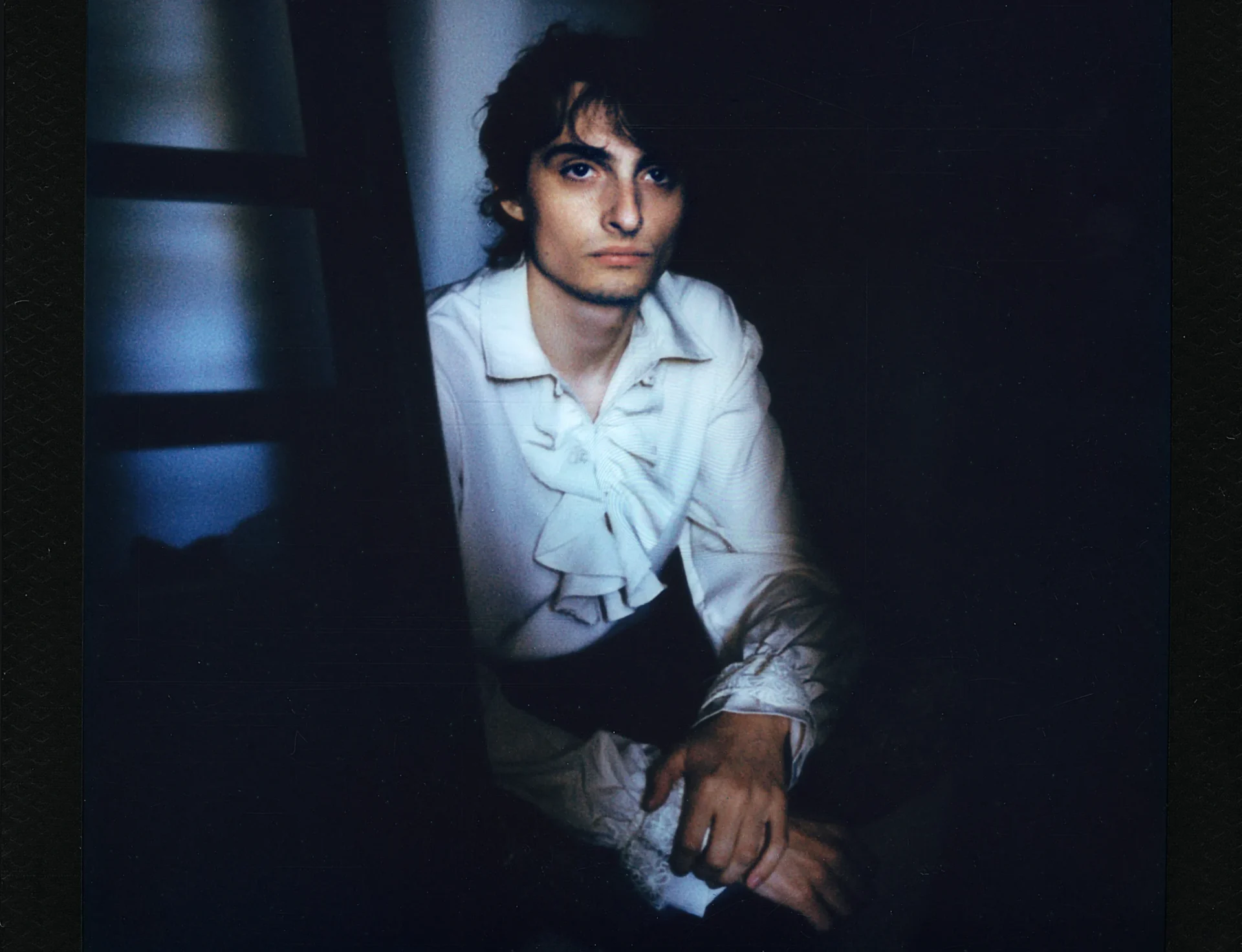
For Finn Wolfhard, it’s been good to focus on the music. Despite a persistently busy schedule – not to mention international – he still follows the pace of his favorite independent artists when it comes to writing and releasing records. In the span of a year that has included wrapping up his decade-long run in Stranger Things, Wolfhard has put out two solo albums, Happy Birthday and the recently-unveiled Fire From the Hip, whose title alludes to the spontaneous energy with which it sprung following a fall 2025 tour. Though still very much active in the film industry, he’s taken on a couple of music-related projects in recent years, from starring in and contributing original folk-rock songs to Jesse Eisenberg’s 2022 feature directorial debut, When You Finish Saving the World, to currently working on a Replacements biopic with his father Eric. In the past decade, he’s also gone from playing a younger version of PUP frontman Stefan Babcock to directing a clip for Atlanta’s Lunar Vacation to, just this year, helming the first-ever official video for George Harrison’s ‘Give Me Love (Give Me Peace on Earth)’. The new album’s cover may be framed as a duel between Wolfhard’s conflicting impulses, but as creative fuel – and with a little help from his friends – they’ve produced his most confident and vibrant collection yet.
We caught up with Finn Wolfhard to talk about recording his new album, working with members of the Slaps and Twin Peaks, loyalty in friendships, and more.
I’ve had the pleasure of interviewing many of your musical peers and collaborators, including Lunar Vacation, the Slaps, and Lifeguard. I realized that all these bands, except for Lunar Vacation, have only put out one official studio record so far, so I’m curious who it was you maybe talked or looked up to when it came to thinking about a sophomore album. Were concerned at all with what you wanted it to represent, given the quick turnaround?
As far as the fast turnaround went, it ended up working out so well. I’m so lucky that it’s coming out as fast as it is, because I don’t know if I’ll ever get that again. I had this record sort of ready, or at least all the demos, by the time that Happy Birthday came out. It was one of those things where we had to wait such a long time between recording Happy Birthday and releasing, where we were underneath planning the recording of this one. We had feelers out there already for vinyl and just getting people ready for it earlier on. I’m a huge fan of people being able to release their records in the way that they want. I have a few friends that are doing it that way, like Kai from Lifeguard with his band Sharp Pins, he’s on K Records. It seems like they have a really cool momentum and way of releasing stuff. Slaps, they’re independent, they’re great, they put out music sort of like whenever they can and have been doing it all by themselves for a long time. Twin Peaks is another band that I’m close to and that are legends. A long time ago, they had the Sweet ‘17 singles, where they would put out two singles, and then by the end of the year, they had a huge record. They would compile all the songs together and just put it out. I love that.
It can be really tough, especially with music, where people write a record and it’s so personal, but then they start to write other stuff, they start to experience life in different ways, and maybe that record isn’t as much at the forefront of their minds. They’re not feeling the same things that they were when they were writing that record. Sometimes, the luxury is being able to just do it when it’s on the top of your mind and and go out and tour it.
Fire From the Hip was tracked in February, and you finished the last tour in October. What was the energy those live shows left you with? Did you have the time to take pause and reflect on how it maybe had affected you?
It felt really good to play these to play the songs off Happy Birthday and some of these new songs on the October leg in Europe with the Slaps guys and Gep [Repasky] from Lunar Vacation, who now, sadly, can’t be on tour with me for this tour, because they’re pursuing Lunar full time. But we just had the best time. It was one of those things where we were playing two or three songs from Fire From the Hip on that tour, and it felt very good to play them live. The way that we were playing it live, it felt like we should just take this, whatever we have right now, and just put it into a record. I remember walking in London with the Slaps guys and saying to them, “I think I want to do another record. I think we should just go and do one.” And they were like, “Yeah, man, let’s do it.”
I remember we were in an Uber, and I was like, “What do you guys think about Fire From the Hip?” And they’re like, “That’s a cool saying.” I was like, “Yeah, it’s kind of impulsive, and it just makes sense.” When it came to the art, I was like, “Oh, Fire From the Hip, maybe it’s like a duel.” This idea of, I constantly I feel at odds with myself, where I’m fighting between someone who’s confident and then also super worried all the time. And what if it was like a Barry Lyndon recreation where it’s that duel, but it’s me doing myself. It all just came together very seamlessly and fast. It was special to have the guys and my band with me and just to bounce ideas off them and talk through it with them. And I was lucky to have Gep on the record a lot; she came for the last three days. I basically was like, “All right, let’s go through every song and have them sing on it.”
With the cover art, how did all the different layers come together from the moment you came up with the idea?
We had my friend Hudson [McNeese] and Louis [Nicely], who are a photographer-videographer duo, and they were there the whole process, shooting 16mm and photos. The idea was, we were just going to shoot the cover on-site, at the studio. It was freezing cold; you would literally go outside and your nose hair would freeze. My idea was to shoot it on large format. Louis had a large format camera, so we went out, we shot it, and it was so cold that the metal slide they were using was getting stuck, and there were only a few options. We actually shot more, but it was so cold that the camera froze up. I was really happy with the photos, but I felt like there was a lot of negative space with the rock wall behind, and it’s still very much featured on the vinyl. When you open it up, it’s a die cut, so when you open it up, it’s just this little window of me pointing the gun at me, but when you take it out of the sleeve, it shows more of the whole photo.
I just wanted a little more of a pop of colour, so when I was mixing here in Vancouver with Cadien [Lake James] and Andrew [Humphrey], I was like, “I gotta figure out this record cover. It’s very close, but I don’t know. I think it needs something.” Cadien has a background in design, and he does all the Twin Peaks covers. He was like, “Just throw it into Photoshop, let’s fuck around with it.” Immediately, he’s like, “Oh, what about pink? That’s its own very specific vibe, and it would be a very striking vinyl.” And I was like, “What if it was this old English font? What if we use mediaeval writing to offset it a little bit and make it a bit weird?” And then my friend Grant Prettyman, he did the layout, so it was a big group effort.
Happy Birthday was a collaborative process with Kai, but given the focused studio time you had recording this album, did it feel collaborative in a different way?
To me, why I make music is because it’s collaborative and you’re sharing something together. At the same time, on Happy Birthday, me and Kai co-produced it, so I would defer to Kai if there were production things that I wasn’t sure about. He’s so fucking talented and I loved his production so much. When we were touring, I was talking to the backing band, to the Slaps guys and to Gep, and the resounding thing was that if we make another record, I should produce it. And I was like, “I don’t know. I don’t know if I have the confidence to do it.” And they were all like, “Dude, you’re already basically producing and directing the live show. You’re doing that now. You do all that, you produce all the demos by yourself. Why would you not do that?” And I was like, “Yeah, I guess.” I don’t know why I thought I couldn’t do it.” But I guess it makes sense that I did and it was really fun. I feel like it was a muscle that I got so much better at, and I really knew what I wanted when it came to the sound of the record. Especially the drum sound — I think me and Josh from the Slaps, and Andrew, my partner in crime throughout the whole process, we spent the first few days on the drum sound.
For me, the big challenge was the balance between knowing what I wanted for the record as a solo record, and also, I want people to be able to play the parts that they want to play. I want people to be able to express themselves in the way they want, but sometimes those are not mutually. Sometimes, someone wanting to play a part that they really like, in my head that’s a cool part, but it’s not right for the song. The whole point of music is being able to play in the way that you want, but at a certain point, it’s what the song needs. It’s not what you want to play. And that’s what was so great about everyone, they were there to serve the song. They would always be so cool about me being like, “All right, let’s try something else.” I was just getting used to that and trying to put up the boundary of, “OK, we’re all a band, but also, it’s a solo record and in the end, it’s up to me.”
I’m curious about one part that might have been an example of someone coming up with an instrumental section on the spot. It’s the dreamy outro on ‘Nice to Meet You Again’ — what I love about is that you don’t really feel the meaning of “again” until that final minute.
Yeah, that was fully Cadien and Clay [Frankel]. They played on the record with me for a few songs, and it was really special because their ideas were amazing. It was the first time they’d both been in the studio together since Twin Peaks had technically broken up. They were still friends after the band had broken up — they were still really close friends and brothers in so many ways, but they had never, I think, fully played music together. ‘Nice to Meet You Again’ was the first time. For me and the other guys, we grew up on Twin Peaks, they’re heroes of ours. To see them just firing back and forth — there was a moment where, it was funny, I walk into this live room, and I look at Clay and he’s got his guitar and he goes, “All right, what’s the vibe of the song?” And I go, “It’s the Faces. It’s Ooh La La.” And he goes, “Say no more.”
And then I went into the other room and we jammed it out a few times. We all played it live, and everyone’s singing backup, it was a great vibe. At a certain point, Cadien and Clay were like, “And what if we did this?” At this point, I had lost creative control, but in the best possible way, where I did not want to interrupt their mind meld. It was one of those things where I had no idea what they were talking about. Everyone was just watching it happen. Cadien was like, “Finn, are you good with that?” And I was like, “Honestly, I have no idea what the fuck you guys are talking about. But yes, let’s do it.” And that’s the best part of the song, to me. I’m glad I didn’t say anything, because it would have been insane if I did. They really elevated things. That’s what’s great about collaborating with people that you respect, they bring their own juice into the song.
And the magic — I’ve had this line from the record stuck in my head: “We come to this place for the magic/ And isn’t it tragic/ To see the sausage get made.” Obviously, you’re talking about the movies in a specific context, but it sounds like the magic of music-making maybe isn’t taken away so easily when you can have moments like that.
100%. That’s my big goal in being in these really tricky but creative industries — it’s very easy to get jaded, and to me, it’s always about finding those moments. I’m really lucky that I’ve been able to find it over and over again.
You’ve talked about going for a more hi-fi sound with this record. More than an aesthetic decision or way of shifting things up, was it also a matter of confidence, not only in terms of production but vulnerability? ‘Trail’, for example, could have been recorded with a lo-fi, muffled sort of intimacy, but the feelings are amplified in that way.
A big reason why I didn’t end up going with a more lo-fi recording style is because I think that these songs lent themselves to a more lush production quality. It just depends on the song, but for this specific record, I really wanted the songs to be able to be really open, compressed, and have a lot of breathing room. That song specifically, the guitar sound of it, I was looking a lot to the song by The Replacements called ‘Skyway’. It’s this really pristine, beautiful, acoustic guitar, but it’s also weirdly compressed. A fou-track always sounds great, but I’m glad tried it on a grander scale with the 24-track reel-to-reel, just because we also had more people. It would have been easier probably to just get an eight-track Tascam, set it up, and just do eight tracks. But this was great, because you still had this feeling of imperfection and analogue, but also you’re allowing the songs to sound beautiful at the same time. I love lo-fi, but it was nice testing the hi-fi tape out.
Taking a look at the official tracklist, I realized ‘The Climb (Not That One)’ is the final track – it was earlier in my promo stream. It almost homes in on the idea of loyalty in friendship, which is a big theme on the record. I feel like young people worry all the time about making friends, but I wonder what music has maybe taught you about keeping them.
For sure. It’s weird, music is such a vulnerable thing — you think it’s not, until it is. And with music and playing music with other people, I feel like, it’s everything you’re not saying. There’s so much unsaid. You’re expressing yourself — and sometimes it’s not enough, expressing yourself through music — and it’s been a great outlet to communicate with people. Even a tour and being with the Slaps guys, you’re with each other every day, you have to be honest with each other and be able to support each other. And, in a lot of ways, like, be patient with each other, because everyone is going through their own thing.
‘The Climb’ is not at all about anyone in music. ‘The Climb’ is about a childhood friend that I’m since not in contact with. There’s the last lyric about being a loyal friend: “To you I’m not, to me I am.” It’s this idea of: you can only give someone so much, and so much of your patience or support, and if someone’s not taking it, that’s up to them. If you gave it all you got and you really tried, that’s really all you can do and all you can give someone. I think that’s the most important part of friendship: being able to show up, being there for someone who’s maybe still figuring things out. And if it’s not being reciprocated, things naturally start to run their course; that’s just how friendships work.
And then they come back — that’s what’s amazing about friendships. I’m pretty lucky that I haven’t had a lot of crazy drama with friends, but it’s really interesting, the amount of friends that I have that I was once super close with, and then, for whatever reason, we just fell out of touch. We didn’t have anything in common or there was a mini falling out, and four years later, we’re friends again. It’s a really odd thing, because with friendships, you know someone so deeply, it’s like you know someone more than anything. I started making music to make friends, also. You connect to people through this, so it’s definitely a huge theme in what I try to write.
This interview has been edited and condensed for clarity and length.
Finn Wolfhard’s Fire From the Hip is out now via Night Shift Productions.

