

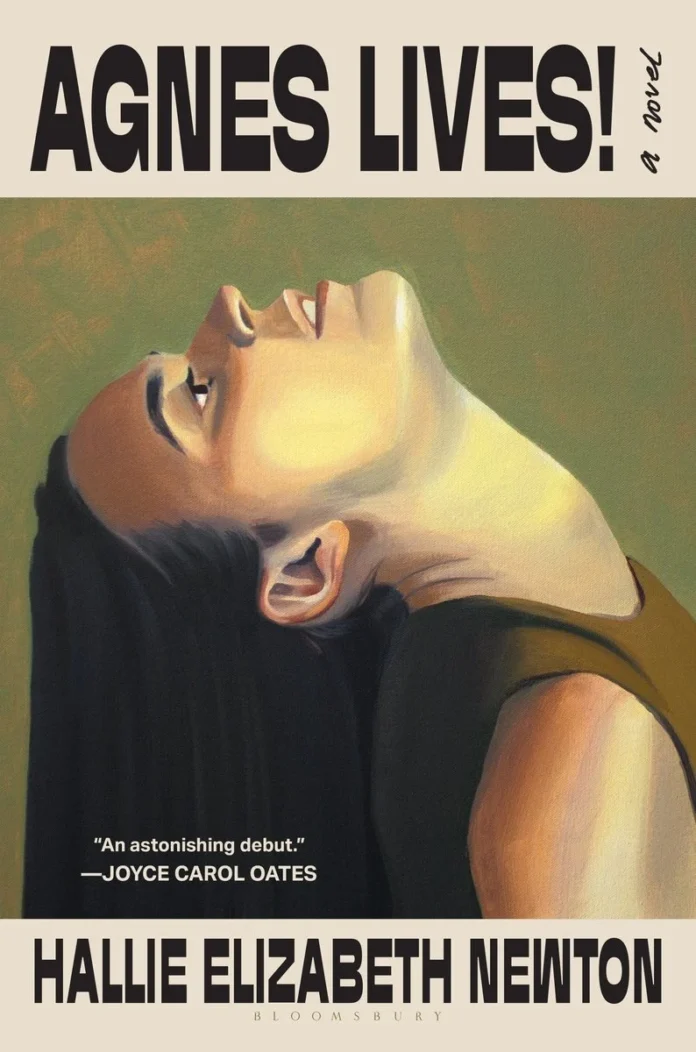
“At an early age,” Agnes Maurer thinks near the end of Agnes Lives!, “we were taught to negotiate with our status.” She remembers that growing up, when patronizing a high-end cafe, it doesn’t matter if the bakery next door technically isn’t connected to the restaurant, if you really want it. One must simply ask the waitress, politely but firmly, to go get it. She’ll oblige.
Agnes, the high-octane narrator of Hallie Elizabeth Newton’s disorienting debut novel, is catty, name-dropping, and bends the world to the reality she wants, even while absolutely nothing is going her way. She’s narcissistic and flighty, basing her worth on getting over 11 Instagram likes and what her boyfriend thinks of her. Once, Leonard Cohen told her she’s pretty. The novel is an uninterrupted stream of consciousness broken only by her speech; we don’t hear from anyone else, mirroring her pretentious phasing-out of anyone she deems beneath her. Agnes Lives! is ambitious and risky—her voice is somewhere between Valerie Cherish’s unabashed desire for the spotlight and Marnie Michaels’ relentless desperation—and yet it’s one of the most riotously funny novels of the year.
“Babe, so the movie? I’ll be doing errands all day but I’ll wait for your text. I love you. Love you. Big day. Love you. Will you say it back? Go to sleep.”
Sweating it out during a SoulCycle class at 6:30am one September morning in 2014, she realizes that she’ll do anything for someone to kill her. This sort of idea is at first mention a little juvenile—her first ask to the barista has the cadence of the Tumblr-seeped self-lacerating humor that we’re trying to move on from—until you realize that she’s dead-serious, and tries robustly to get the job done. She snatches a knife from the desk of her (“self-made and big-boned”) boss and is promptly fired, she buys a gun from a girl in a Carly Rae Jepsen shirt and wanders the hallway of a shady building to buy cocaine, overhearing “a conversation in Chinese that I imagine involves a multigenerational family’s meeting about a problematic child not doing his homework.” As her day stretches into the night, her methods get more drastic and unhinged.
Just by the pummeling nature of her thoughts, the book makes it quite clear why Agnes wants to die—it isn’t a one-off joke, thankfully. Her mind zips from topic to topic—sometimes feeling unsubtly quirky, but most often working in her favor, depicting a troubled woman, or a woman who simply is faced with the world as it is. Agnes’ darkest thoughts are on display, unsavory and brash. She spears Obama for not acknowledging Black Lives Matter or the fact that it’s the year of the crystal, but what bothers her most is the casual tan suit he wore during an ISIS briefing. “What the fuck was he thinking?” she asks. She’s burdened by life, and her interior monologue is shaped by the pacing and freneticism of someone with nothing to lose. I think of Meg Stalter speaking to a confused Stephen Colbert about her London experience: “You’ll be eating breakfast, and you’ll go, ‘Get me outta here!’” Agnes’s scream is concealed, but barely.
She’s a model at Whorl magazine (which reserves a spot for her on their “cultural council”), and a girlfriend to indie filmmaker Nathan Gray, a despondent, apathetic man who couldn’t care less about her. She snatches up movie tickets for at least five different timeslots for whichever works best for him, and he doesn’t even get back to her on time to see any of them, despite her prodding. “He likes me in turtlenecks and white undies, serving him takeout in bed on a tray,” which is a skateboard. She brings him back coffee and cleans the apartment naked for him, remembering the time he said she was “controlling his life” by installing a medicine cabinet in the bathroom. Nevertheless, she remains faithful to “my brilliant man,” delivering a danish to his bedside, “his hair in a swirl of intellect, his lips pursed in a cupid’s bow of wit.” Leaving for work, she inflicts a barrage: “Babe, so the movie? I’ll be doing errands all day but I’ll wait for your text. I love you. Love you. Big day. Love you. Will you say it back? Go to sleep.”
Agnes Lives! is often hilarious, but the narration goes from a joke to an affecting moment with overwhelming dexterity. She says to two separate men, as a bonus for killing her, that they’re able to do anything they want to her after she dies—her body is their thank-you gift. And it’s clear she gets more from Nathan than he does her—“I’m going to meet my partner, Nathan Gray, at the movies”—but her desire to be her own kind of artist is wholly unexplored. “I wanted to make things with people, with men,” she thinks. “Movies with men, our own kind of baby.”
At times reliant on shock value and gore (Agnes succumbs to the muck of what New York City has done to her in its last third), the novel really could have gone sideways. An overly ambitious dilemma, an impossible narrator, an unwieldy structure—it’s a miracle Agnes Lives! reflects Newton’s talent so well, in repeatedly brilliant flashes. Take this half-visible conversation with the gun-seller, whose dog has social anxiety: “He needs to get used to strangers. We’re in New York. I personally like strangers. I’m busy, too. Good luck to you too.” Many chats with sales clerks, editors and longtime exes rely on the same subtle cleverness, wry language tricks from an irresistible sense of humor. Agnes Lives! is more than meets the eye—both a serrated knife and a child’s play cutlery utensil.
Agnes Lives! is out now.

