

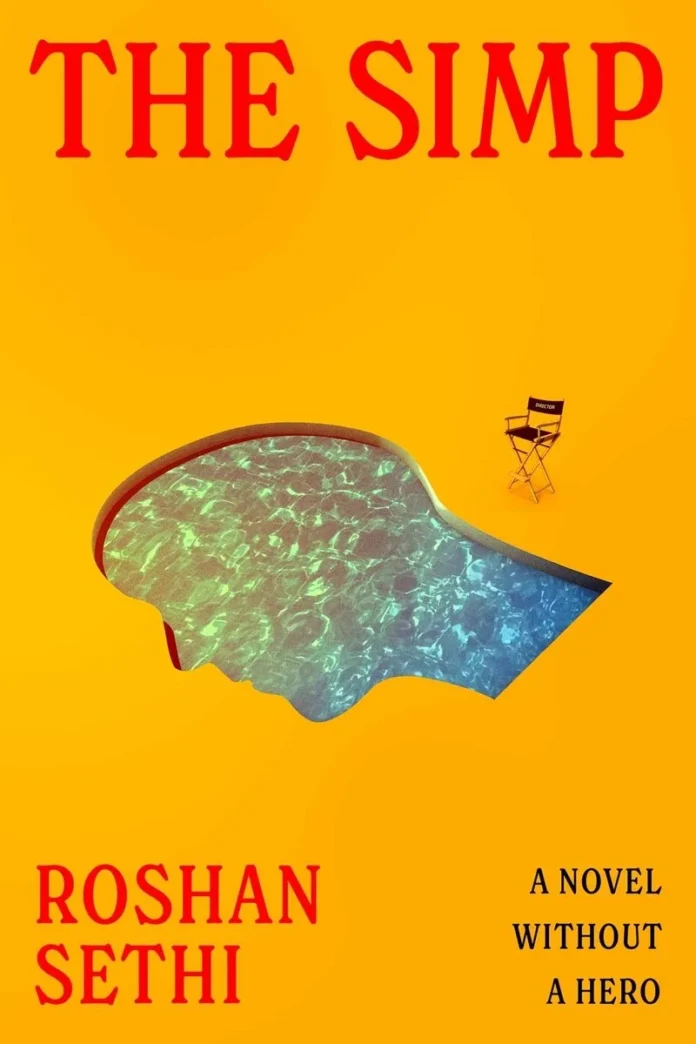
How much would you debase yourself for the job of your dreams? What about something barely covering minimum wage? Or if there’s the promise of stardom, intuited only by its proximity? Once, when working as a server at a restaurant, I sneezed nearby our owner, who told me, “Don’t forget to wash your hands,” as if I was five.
This is the least of Raj’s troubles, who in film director Roshan Sethi’s unsubtle but propulsive debut novel The Simp, fakes his way to be an assistant to a “Hollywood Family,” an unhappy pair of demanding screenwriters who toil away on their next scripts in separate rooms. On a trip to Big Bear, Jim, who covers his uncouth comments under the guise of “satire,” has Raj move his desk countless times, only to admonish him for his (and other staff’s) heavy footfalls in the kitchen below. Anna is somewhat of a kinder presence, but is disarmed by Raj’s earnestness. “I am currently living my ancestor’s wildest dreams,” he says during their first interview. “My grandmother was an illiterate villager.”
Raj, who grew up in India but moved to Los Angeles, is enamored by the concept of the Vanity Fair, immortalized by William Makepeace Thackeray’s 19th-century novel of the same name and referenced extensively in The Simp (its subtitles, “A Novel Without A Hero,” are even the same). He has the desire to be an actor, and with the urging of an older coach-turned-friend, believes he has what it takes to make it far. Raj even writes a blog, Actors for Actors, where he pretends to be knowledgeable, providing entertainment updates and celebrity profiles on people like Timothée Chalamet. But with no real experience other than an ice cream scooper, his resume for the Hollywood Family is filled with lies. After much back-and-forth, he gets the job.
The novel takes place in 2021, where the good tides of Black Lives Matter and sweeping racial reform has subsided (albeit anachronistically, though. By my memory, most of the Biden era was awash in the joy and political correctness of Woke 1.0, and receded only when the 2024 election got dangerously close). A white couple he meets at a BLM protest tries to do everything in their power to get him a job, promising that he’s got star quality. When her husband asks what DEI is, she defines it as “helping diverse people out,” and “kindness.” But this rose-colored view of minorities is double-edged; not only are they patting themselves on the backs for uplifting someone less fortunate, but they’re manipulating Raj to think his chances are greater than they are. And maybe in the early days, he had a shot at landing a movie in Hollywood, but as time goes on, these dreams seem more farfetched as diversity standards recede. Raj gave up his life and his family to come to America; shouldn’t this count for something? Is he really just a mediocre actor that happens to be Indian?
These questions are thornier and more interesting than what the novel spends most of its time on, which is the power dynamic between two white Hollywood elites and their brown assistant. Anna takes issue with this at first, foreseeing its awkward optics, but after Raj proves his own competence, she settles into an easy rhythm with him. And, really, it’s not as if he’s tasked with grunt work—he usually sits at the kitchen table with his laptop and schedules appointments. Jim, however, who hurls slurs with abandon, nicknames him “Maharajah” and one day slams Raj’s fingers in his laptop, both pains and enamors Raj, who masturbates while thinking of him sometimes. Their relationship, in which Raj is both willing and employed to remain, isn’t easy to define.
But it doesn’t take long for cracks to emerge. Pissed off one day, Raj leaks the initial job listing—a bevy of demanding tasks with a $45,000 salary—setting the internet aflame with accusations of slavery and abuse inflicted by this “Hollywood Couple” who seem to resemble Jim and Anna. This reads strange to Raj, since they treat him well enough, and anyway, he’s so close to his dreams of becoming a real actor, so he can take a little humiliation on the chin. He almost relishes his role as “The Simp,” which Jim has taken to calling him. (He defends his employers on article comments about the job). Nevertheless, the media swirl around the leaked advertisement worries Jim and Anna—have they really been perpetrating their own microcosm of white supremacy? Also, will we still be invited to the Oscars?
Things certainly get uncomfortable, but The Simp never really turns up the heat as searing satires of class and race like Parasite or White Lotus do—Raj is never seriously taken advantage of, and neither are Jim and Anna racist overlords. Anna emerges with her screenplay that’s suspiciously informed by Raj’s presence in the house, and Jim swipes it from her despite her wanting a directorial debut, but things end more or less how some of these Hollywood stories go—not as explosive as the glamor would suggest, but not as friendly as PR makes it out to be, either. The Simp is a calm book for how dynamic some of its ideas are—one wishes Raj would really grab the reins and tear the house apart from the inside. Maybe he’s internalized his submissiveness enough to fear the aftermath.
The Simp: A Novel Without A Hero is out now.

