

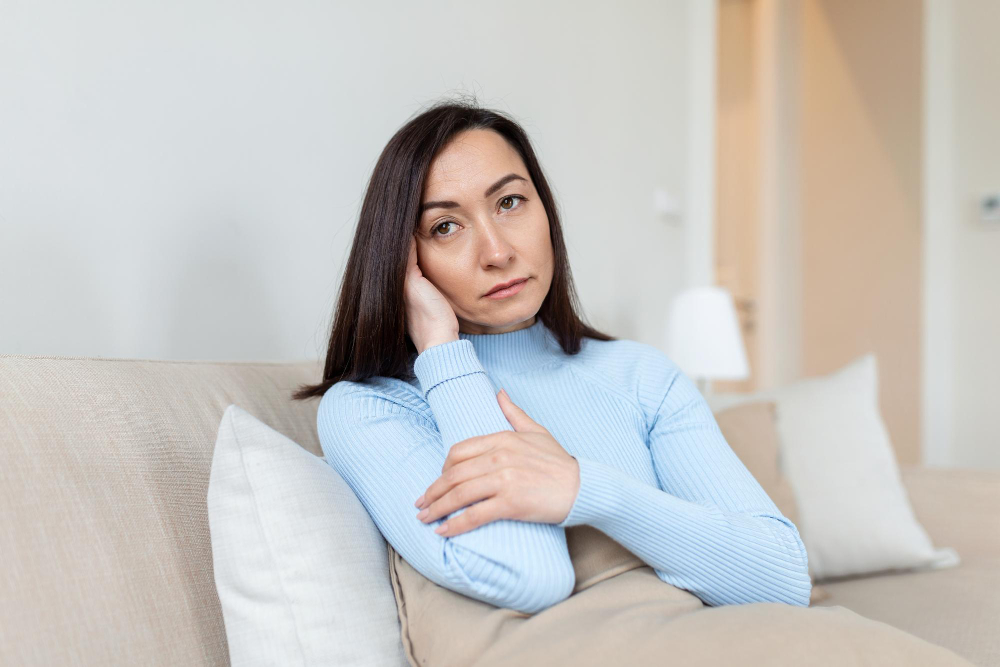
Perimeno…what? It sounds suspiciously like menopause, and menopause is something that happens to older women. Women with grown kids. Women who complain about hot flashes. Your mom.
Not you.
You’re just here because you figured this might be useful information to tuck away for the future. We’ve been taught to picture “the change” as one very specific thing: hot flashes. You don’t have hot flashes, and that’s exactly why so many women miss it.
So you’re staring at the ceiling at 3 a.m., bursting into tears over absolutely nothing, or wondering why sex now requires a pep talk and a lubricant. You don’t think, “Perimenopause.” You think, “What the hell is wrong with me?”
And that’s the trick perimenopause plays on you. It doesn’t show up wearing a name tag. It shows up dressed as stress. Or burnout. Or, “I guess this is what my 30s look like now.”
Here’s the part nobody sees coming: all of this can start up to ten years before menopause ever arrives.
NONE OF THIS LOOKS RELATED.
One day your ears won’t stop itching. A few months later your heart starts doing little gymnastics in the grocery store. You wake up at 3 a.m. for absolutely no reason. Wine suddenly hates you. Your eyes feel like sandpaper. Your anxiety is through the roof. Sex hurts. None of it seems connected.
Oh, honey. It is.
YOUR HORMONES HAVE LEFT THE BUILDING.
Here’s the thing: your hormones don’t just control your cycle. They help run your brain, your sleep, your muscles, your mood, your libido, and a surprising number of the things you’ve been blaming on “getting older.”
These three hormones have been quietly working behind the scenes your entire adult life:
Estrogen: The Multitasker
Most of us think of estrogen as a reproductive hormone. In reality, it has receptors throughout your body, helping regulate your heart, skin, joints, bladder, eyes, and much more. During perimenopause, estrogen doesn’t simply decline—it rises, crashes, rebounds, and zigzags unpredictably. That’s why those weird “mystery symptoms” can feel like they’re coming out of nowhere.
Progesterone: The Peacekeeper
If estrogen is the roller coaster, progesterone is the seatbelt. It helps you sleep, keeps anxiety from grabbing the steering wheel, and reminds your nervous system that everything is probably fine. The catch? Progesterone is often one of the first hormones to start disappearing during perimenopause. Goodbye progesterone…hello 3 a.m., racing thoughts, and wondering why you’ve suddenly become so damn edgy.
Testosterone: The Go-Getter
Surprise! Women make testosterone too. In fact, women actually have more testosterone than estrogen circulating in their bodies—it just gets talked about a whole lot less.
Before you picture bodybuilders and beards…no, Becky. We’re talking about the testosterone that’s been quietly helping you maintain muscle, bone density, energy, motivation, and your sex drive your entire adult life. Women only need a fraction of the testosterone men do, but that tiny amount makes a huge difference. Without it, you can feel like an entirely different person.
“Fine. I’ll Just Get My Hormones Tested.”
Not so fast. That sounds like the obvious answer, right? We can test cholesterol. We can test blood sugar. We can test your thyroid. Surely there’s a blood test that tells you whether you’re in perimenopause. Unfortunately, hormones don’t work that way.
Estrogen and progesterone don’t decline in a straight line. They fluctuate. Constantly. A blood test tells you what your hormones were doing at the exact moment your blood was drawn. That’s it.
Then you run into another problem.
Women’s hormonal health has never been treated like a priority. Most doctors receive very little formal education on it, which explains why so many women spend years hearing some version of, “Your labs are normal.”
ARE YOU PREGNANT?
If you’re a woman, you’ve probably had some version of this conversation in a doctor’s office multiple times.
“I’m exhausted.”
Are you pregnant?
“My joints hurt.”
Could you be pregnant?
“I’m nauseous.”
Any chance you’re pregnant?
For decades, women’s hormones have been viewed primarily through the lens of reproduction. If you aren’t trying to get pregnant, good luck getting anyone interested in the rest of the conversation.
SO…WHAT DO I DO NOW?
The good news is that women are finally talking about perimenopause, and medicine is slowly catching up.
More clinicians are recognizing that perimenopause isn’t diagnosed by a single blood test. They’re listening to symptoms instead. Sleep changes. Hair loss. Anxiety. Brain fog. Cycle changes. Vaginal dryness. Low libido. Weight gain. It’s the pattern that tells the story.
Finding one of those clinicians can still take some work. Unfortunately, most of us take a very expensive detour first.
We convince ourselves the answer has to be a magic supplement. Maybe it’s cutting carbs. Maybe it’s eating more protein. Maybe it’s eating less protein. Maybe it’s seed oils. Maybe it’s cortisol. Instagram is overflowing with “health coaches” who have apparently solved women’s hormones for the low, low price of $49.99.
It’s true that lifestyle changes can absolutely help. Getting enough sleep, lifting weights, eating nutritious food, drinking less alcohol, and managing stress all have real benefits. They’re worth doing, whether you’re 25 or 55.
The problem is that eventually many women realize they aren’t dealing with a lifestyle problem.
They’re dealing with changing hormones.
THE ELEPHANT IN THE ROOM: HRT
Let’s get this out of the way: everyone has an opinion about HRT, but there’s only so much magnesium, meditation, and positive thinking can do when the problem is your hormones.
For decades, many women were taught to fear hormone replacement therapy. Somewhere along the way, “HRT causes breast cancer” became accepted wisdom, even though the science turned out to be far more nuanced than that.
Today, the conversation looks very different. We know far more than we did twenty years ago, and the recommendations have changed with the evidence. HRT isn’t the right choice for everyone—women with estrogen-dependent cancers, for example, have different considerations—but for millions of women, it’s become one of the safest and most effective treatments for the symptoms of perimenopause and menopause.
That starts to make a lot more sense once you realize estrogen was never just the hormone that gave you periods. It’s been protecting your bones, supporting your cardiovascular system, maintaining the tissues of your vagina and bladder, and influencing your brain for your entire adult life. Progesterone has been quietly helping you sleep and calming your nervous system. Testosterone has been supporting your muscle mass, energy, motivation, and libido.
And here’s a statistic that may stop you in your tracks: women lose roughly 30% of their skin collagen during the first five years after menopause. Suddenly, a lifetime spent slathering on SPF, buying expensive skincare, and doing everything we were told doesn’t seem quite so simple anymore. We’ve spent years trying to fix our skin from the outside while almost nobody explained what was changing underneath it.
That’s the point of hormone replacement therapy. It’s not about turning back the clock or pretending you’re 21 again. It’s about replacing hormones your body has gradually stopped producing and giving your brain and body some of the support they’ve been missing.
Spend five minutes talking to women who’ve found the right treatment, and you’ll hear the same sentence again and again:
“I wish I’d done this sooner.”
ONE LAST THING.
You aren’t alone. You deserve to understand what’s happening inside your own body. And you deserve to know you aren’t the only woman who’s ever wondered, “What the hell is wrong with me?”
Whether you decide to change nothing or change everything, at least now you know there’s another possibility.
Maybe it isn’t stress.
Maybe it isn’t burnout.
Maybe it’s perimenopause.
WANT TO LEARN MORE?
If this article left you wanting to know more, you’re in exactly the right place. Most of us were never taught much about perimenopause in the first place. Fortunately, that’s finally starting to change. Here’s where to go next.
BOOKS
- • The New Menopause — Dr. Mary Claire Haver
- • The Menopause Brain — Dr. Lisa Mosconi
- • Estrogen Matters — Dr. Avrum Bluming & Carol Tavris, PhD
- • The Hormone Balance Bible — Dr. Shawn Tassone
PODCASTS
- • The Dr. Louise Newson Podcast
- • unPAUSED with Dr. Mary Claire Haver
EXPERTS WORTH FOLLOWING
- • Dr. Lisa Mosconi
- • Dr. Vonda Wright
- • Dr. Mary Claire Haver
- • Davey Maher

