

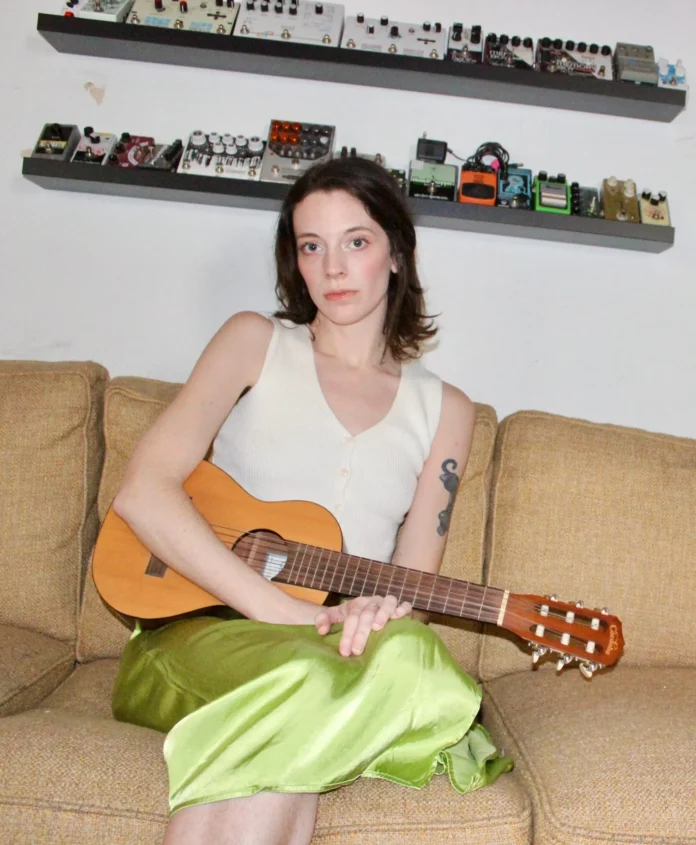
Mallory Hawk is a singer-songwriter and multi-instrumentalist who grew up in Fayetteville, North Carolina. After moving to New York City in 2017, she cut her teeth in a range of indie rock bands, contributing bass and vocals to Customer, joining Trace Mountains, and touring as the bassist for Dublin’s M(h)aol. If you’ve listened to more than one of these groups, you won’t be surprised by the stylistic versatility of her debut album, Chinook, which soars through everything from post-punk to dance-punk, post-grunge to indie-folk, in a casual way that affirms it’s all just rock music to Hawk. Following the 2024 double single ‘All Your Troubles / Run Until They Catch You’, a chronic illness flare-up led to her moving back with her parents to save money for more studio time. Recorded with producer Sam Acchione at Philadelphia’s Headroom Studios, Chinook naturally finds common ground not only between the masculine and feminine-coded alt-rock of Hawk’s youth, but the different strains of underground music she would go on to discover; at the same, it wrestles with the loneliness of the big city while reexamining her relationship with her military hometown. You can feel the places that have left their mark on the record, tangled like its rage and melancholy, a double-negative collision that makes space for extreme joy.
We caught up with Mallory Hawk for this edition of our Artist Spotlight interview series to talk about growing up in Fayetteville, making her debut album, channeling anger, and more.
What memories come to mind when you think about growing up in Fayetteville? Did moving back and writing Chinook change your perception of it in a palpable way?
Yeah, it really became a rediscovery of who I was growing up, and how much of that person is still inside me, how different I am. As soon as I graduated high school, I went to college, and I never really came back. When I lived there, not just in the town, but in my childhood room, it was very palpable. My old clothes were in there, my old books, my old journals – I was able to really immerse myself into this teenage version that I had kind of neglected in a weird way. I really had grown into someone else, and revisiting that connected these dots with the adult that I’ve become, the way that I treat sexuality and religion and just my identity in general.
I very unexpectedly started writing about those things. The track ‘Low Rise’ on the album, I was in my childhood room, and I put on an old pair of my jeans that I wore in high school, and it was a really transformative experience. I thought about my suppressed sexuality when I was a teenager, and I moved to New York, and some of those chains got broken off. It was an unexpected part of the record. I spent a long time recording it over many months of sessions, and I was just expecting to write songs about my current life and what was on my mind, not really expecting to really dig into my childhood trauma. [laughs] But I did, and it was a cool journey I went on. I learned a lot about myself.
The instrumental at the end of ‘Low Rise’ is one of my favorite parts of the record, and I’m curious if this angstier sound is harking back to some of the stuff you were listening to as a teenager.
Yeah, I think it was intentional after I started writing the song and realizing what it was about. I had the lyrics and the chord progression before I had the solo, and I had been playing over that and singing for a while. I was listening to a lot of Alice in Chains and Pearl Jam, all those kinds of radio grunge bands that really evolved me when I was quite young. The first time I ever tuned my guitar down a half step was because of Alice in Chains, and that’s what led to me even writing that song, ‘Low Rise’. So there was kind of a direct correlation there, but yes, I wanted that solo to be messy and angry, and slightly liberated. It was not supposed to be perfect; it was supposed to be quite emotional, and I wanted everything to kind of feel like it was trapped in a cage, and I was trying to get out of that cage. That’s where it came from, the kind of squealing of it all.
What surprised you about what you found among all the books and diaries in your old room?
It’s funny – when I went back to my childhood room, I had so many Sylvia Plath books. Not just The Bell Jar, but I had her journals, I had her poetry, and all these other third-party biographies. I had kind of forgotten how much of an impact that she had on me – I mean, I was very depressed when I was young. I started taking medication when I was 13 or 14, and I was really immersed in these really dark, sad-girl memoirs. I don’t really engage with a ton of that now. I love memoirs, but I kind of stepped out of that world.
I think that also played into the real angst of it. I looked at my bookshelf, and I realized how dark it was, and a lot of it was just women finding their independence. That was also quite unexpected, and it was faced directly in my bedroom. There’s a song called ‘Superhighway’, which wasn’t really inspired by Sylvia Plath, but I named it ‘Superhighway’ because I was going through her journals, and I had seen that I had annotated and marked that up – there was a line about a superhighway that I just loved when I was a teenager, and when I looked back at it as an adult, I was like, “I still love that, so I’m gonna use it.”
For you, what was the musical equivalent of reading Sylvia Plath?
I had a very notable grunge phase. Obviously, that was such a masculine time and culture; it’s such a masculine form of music. When you think of grunge, you very rarely think of a woman. I was really diving back into a lot of that ’90s alternative, because then when I think of ’90s alternative rock radio, women were really leading the charge there for quite a while, even though it was quite hard to get airplay. You had Sarah McLachlan, you had Natalie Merchant, Shawn Colvin – you had so many of these hits by these women who were making rock music, and it was their version of rock music. And it was sometimes quite soft and quite gay, you know? As much as I realize that, yeah, some of that more masculine nu metal had an effect on me, some of that lesbian alternative music also had a huge effect on me. I felt like I was somewhere in between, and I wanted to discover who that part of myself was.
I’m curious about when you landed on the album title. Was it a memory that unlocked something about the record for you, or was it something you had in mind before working on it?
The record was pretty much done when I was searching for the title, and my dad had said something to me about the Chinook flying over, and he always remarks about helicopters flying over. He was like, “That’s the only helicopter that can collide with itself.” I thought that that was quite poetic and quite self-destructive, and I immediately latched onto that and thought that it was quite representative of myself. They’re rescue helicopters who lift a lot of weight, and there’s a lot of that on the record, too, just holding this feminine weight. It was such commonplace chat in my household growing up with my family, to talk about these military aircrafts. My dad was a small arms repairman, so we would talk about guns and these things that I realized, “Oh, other households are not talking about helicopters all the time, they’re not talking about all this military gear, they’re not hearing cannons go off in the distance.” That stuff was very commonplace for me, which is quite obviously strange.
I’d hear a cannon go off in the backyard and wouldn’t think anything of it. I’ve been hearing it since I could hear. But then I talk to other people, and I’m like, “Oh, you didn’t have cannons going off in your backyard? Oh, you can’t name multiple helicopters, and you don’t speak in military abbreviations?” When you move to New York City and you’re hanging out with a bunch of people who are your age, nobody’s fucking talking about military gear. [laughs] It’s quite a dive back into that stuff. It was not any kind of gradual thing. It was just like, “Oh, I’m back here, I’m in military land now.”
How did moving away from Fayetteville affect your relationship to songwriting specifically? Given that you played in a variety of bands, how did time and place influence how you wrote songs for yourself?
It’s really an ongoing thing. I’ve realized that because I didn’t feel like I fit in where I grew up, it didn’t feel like home, I have perpetually tried to find what home feels like to me and where I really belong. It’s not something I feel like I have figured out yet. I don’t know if I’ll ever figure it out, but that’s something that really contributes to my songwriting. I think when I go to a new place – I went to the UK for the first time last year, and when I came home, I immediately wrote a song about it. It’s just that the more perspective you get on the world, the softer you become, the more open you are. I really wish that everybody had the opportunity to do that, especially these people that are locked away in my military town who live in a bubble and only know their world. I think if they were exposed to different parts of the world, it would change them for the better. It changed me for the better to travel everywhere; it made me braver and kinder.
Despite some of its stereotypes, I met some of the most supportive people in the world in New York City who wanted to uplift me, who told me that I could get on a stage, and who told me that I did have the talent to be in their band. I think if I stayed in my hometown, I never would have confronted those things. I never would have taken the swings that I’ve taken in my life and in my art, so it’s a huge part of who I am and my songwriting. I tend to just keep moving, which is kind of inconvenient, but I do just like to explore. I like where it takes my brain and my body, and I like how it makes me feel. I don’t think that’s gonna change. It’s expensive to travel, but it really is fulfilling in so many ways for me.
Do you feel like it also makes you kinder to the place where you’re from, and to the people that are still there?
Yeah, 100%. I have such a deep appreciation for North Carolina and my upbringing. I’m very thankful for it, and for the people there. In the same way that I praise the perspective that I’ve gotten from other places, I also really praise the perspective that I got from where I grew up. I think America is just fascinating. There are just so many pockets of culture here, and I think we all flock to cities because that’s just how we are as little human creatures. But I think there’s so much of America that we’re not utilizing, I guess, in the best way. There’s a part of me that’s just like, “I wish I could bring a rock music culture for young people in my hometown, then I would live there.”
I have to go to places that serve me, but that’s almost like the dream for me. Part of why I moved back, I was wanting to reclaim that part and bring what I learned to the town, but then I realized, “I’m just one person, and this town is much bigger than me, the culture is so much bigger than me.” But I do think it’s sweet that I feel empowered enough to want to do that. I’m always so deeply attached to the cities, the people I meet there – meeting a common stranger in any town varies so much, and it’s so fascinating.
When you moved back, did you start writing songs right away? I know some songs date back to your time in New York.
I want to say that I kind of dug back into my vault of demos just to see what was there and to see if maybe I could bloom some of those into a recording-ready demo. But I think I also just started writing. I had left New York, I had all this new spare time that I wasn’t used to, and I just remember really wanting to devote that to writing. So I spent a lot of nights in Logic playing around, writing the guitar parts, and just making sure things felt how I wanted. But I’ve learned that when I have a deadline or a studio day approaching, I have a form of procrastination where I will just write an entirely new song instead of maybe doing that last 20% on a demo that’s giving me trouble. [laughs[ I kind of am just like, “Well, what if I just wrote a totally new thing?” because that feels more fun and exciting to me.
There were a couple of times where it would be a week until we were in the studio, and I’d be like, “Oh, just kidding,” and I would send a new song to Sam, who produced the record with me. I’d be like, “Wait, what about this one? I think it might be better.” But it’s hard to tell because when you’re fresh off of a song, you kind of get a high from it. You’re just like, “I think this is one of the greatest things I’ve ever written,” so I kind of need other people to be like, “It’s not as good as that demo,” or “It is.” But I would say probably four or five songs on the record I wasn’t expecting to be on the record – I just wrote them while I was recording because I was just inspired and excited about recording at all.
How did your collaborative relationship with Sam develop during that time of trading demos back and forth?
Sam has always been a friend that I can really go deep with on music. I think we both kind of have this encyclopedic knowledge, and it’s very fun to talk about music with him because he knows the people who played this guitar on this thing, and I’m that way, too. My family’s that way, too. We’re quite annoying when we’re together, just talking about various musicians. I’m sure if other people had to sit in on it, they’d be like, “Shut up.” But I had that rapport with Sam. I met him when I had a band called Customer in New York. When we were recording for Customer, I just randomly met Sam, and we immediately were just going crazy on music. I was like, “I think this guy gets my sound,” and we maintained a friendship through that.
I just wanted to make a rock record. Rock music is really what’s forever to me, and I wasn’t really setting out to do any particular type of indie sound or anything like that. I just was like, “I make rock music, I want to make rock music,” and I knew that Sam was the right person for that job. He is such a supportive, professional, and productive friend. You can really rely on him. So I started sending him my demos, and I really appreciated his perspective. He has more of the music theory technical knowledge that I lack a little bit, so I also knew that he could fill in the gaps for me there. I was able to say, “I want this to sound like I’m in a starlit cavern,” and he’d be like, “Okay, I know how to make that a reality.”
In the beginning, I was really sending him nearly finished demos, and I think that maybe I was producing them a little too much, and I needed to give him some space to produce. I’m glad that as it went on, I started to leave more space for him. Like, the palette on ‘Four O’Clocks’, I was like, “Okay, we’re making another rock song,” and he was like, “No, we’re putting French horn on this,” and I was like, “Whoa.” It really inspired me and unlocked new things that I wouldn’t have done, so I was very grateful to have another ear around. I get very in my head with the writing, and it’s nice to have someone around who can kind of objectively tell you what it sounds like.
That’s Tree Palmedo on ‘Four O’Clocks’, right? It’s a beautiful part.
Yeah, he added some flugelhorn, which I had never heard of, and I’m a big fan now. I was like, “That’s not gonna be the last time I use a flugelhorn.”
To get an idea, what kind of musicians were you annoying about in your family?
Well, we were big Frank Zappa people, which is kind of a controversial topic. A lot of people hate Zappa, so that’s kind of funny. My family also really loves The Church, so we talk about The Church a lot, and there’s a lot of new wave. I remember even in the early days, my friends in high school or middle school would come over, and me and my family were naming every member of Third Eye Blind. Everyone was like, “Why do you know the drummer’s name in Third Eye Blind?” I’m like, “I don’t know, no one’s ever asked us that before.” Me and my family just kind of work that way. You’ll see a certain guitarist, and you’ll be like, “Oh, they also played in this band, and they also played in this band, and they were in that KEXP session, but they weren’t in that performance.”
Some people are like, “Why do you care about this stuff?” I realized after meeting a lot of other people, “Oh, not everyone really gives a shit about every member of every band and all of that Wikipedia history.” But every member of my family is like that, and we have to know about every member of the band. We have to know all the context. I will always be that way, and I don’t know why I know the first and last names of all these people, but it’s burned in my brain.
I definitely don’t know the drummer of Third Eye Blind. I don’t think I can even bring to mind the singer’s name.
Brad Hargreaves is the drummer, and Stephen Jenkins is the singer.
I’m sure that is correct information.
I love that band, but there’s no reason why I need to know everything about them.
One name I recognized in the credits is Margo Schultz, who painted the cover for Chinook, and she was in Wednesday when I interviewed that band. I also know she did the painting for Rat Saw God. What’s the story behind this cover?
Margo is so talented. She just started painting a few years ago. The Rat Saw God cover – those are some of her first public pieces, and I’ve seen her journey, I’ve watched her get so much better at this. I knew the vision I had in my head for the cover – I just knew that I wanted it to be a painting, and I knew that I wanted her to be the one to do it. I sat on the idea for so many months before I even asked her. I had almost built it up because I was just like, “If she says no, I don’t really know what I’m gonna do,” because to me, this was the only path forward. It was also very important to me to highlight both North Carolina and Philly, and really keep it to that. I want people to know that they can hire her to make an amazing piece of art. I think she’s a total professional.
It was cool because she got to drop the painting off at my house, and it’s huge. She was on her way to do a painting program, and she spent the last six weeks or something working on her craft. I think she’s only gonna get better, and I’m really honored that she did that at all. She does bodies really well, and I knew that I wanted to be shirtless, so I felt like I could trust her to really do it properly.
The line “I soften, then harden” on ‘Caretaker’ made me think about the contrast between softness and anger on the record, even between that song and ‘Four O’Clocks’. Do you feel like that duality is representative of how you write or you react to things?
Yeah, I think it’s something that I learned listening back to my record. I do think I write from these two different extremes of the spectrum: being a really, really tender person, and also being a really, really angry person. In my day-to-day life, I don’t think people know me as an angry person. I’m quite laid back, and I think people see me more as the tender person, or even kind of a bubbly person. But my rage is very real, and I get very fired up about politics, my identity, how hard I work, and how I’m not really rewarded for that often. Having that put directly in front of my face when listening to the record was quite alarming. I did realize how angry I was, but it also kind of made me tender, because I’m quite glad that I have this outlet. I’m glad that I can write a punk song, and I’m glad that I can kind of yell about being a woman, because I don’t really know how else to express it, and I don’t think the people in my life just want to hear me yell about it all the time.
I don’t ever really write a song in the middle, writing a song just for the hell of it or writing kind of a funny song. I don’t think I’ve ever written a cute, funny song in my life. [laughs] It’s either sad or mad. I don’t know if it’ll stay that way, but as my songwriting progresses, it’s still burning at those ends. But it is very present, and I learned that when I listened to the record.
It sounds like your collaborators also hear it, thinking about Craig Hendrix’s drums on ‘Caretaker’ or Logan Roth’s synths on ‘Superhighway’. Those songs sound like they were particularly shaped by their playing.
Yeah, totally. I really trust them, Logan and Greg. I was able to go on tour with them when I was playing bass in Trace Mountains. You obviously just become so bonded with people, and you get to know each other on such an intense level, both just as a musician and as a person, and touring is so amazing for that. They’re two of the best musicians I know, and Sam too. They do know me, and it was so comforting. ‘Superhighway’ especially is quite new-wavy. When I first wrote it, my early demo was not that far off, but it just sounded like an elementary version of that world. I’m not a synth player, so I was adding some stuff on my original demo. I eventually just started manipulating my voice to create synthy sounds. But I was able to say, “Hey Logan, this is the world that I want it to be in. I want this to be a high-speed-neon-lights-at night feeling.” And he was like, “Got it,” and just played some of the most amazing synth ever.
What did you learn about releasing anger without pushing yourself past your limits while making this record?
Yeah, it’s hard, because I think in the moment, it doesn’t feel healthy. I remember writing ‘Caretaker’ and ‘D’Anger’. The room that I wrote music in in New York was tiny, it wasn’t even really a room, it was almost like a closet. It was so cramped, and New York is so cramped. I was quite frantic, and it was very real on a physical level and a mental level. It’s quite a comical image: just holding a mic and screaming into my demo. But it just had to be done. And immediately after, you feel pretty good. You feel like you’ve let something out. But listening back to the demo, you’re kind of like, “Am I okay? Have I gotten it out? Is that enough?”
Also, playing those songs on stage – I played ‘Caretaker’ on tour, I’ve played it to a backing track, I’ve played it to no backing track, and it’s really quite raw and awkward, which I had to kind of learn to get over, because I think that that is the point. When I’m seeing live music, I want to just see it for what it is. But sometimes it’s hard to go out there when you’re not in the mood, and you’re like, “Oh, I gotta tap back into that really pissed-off version of myself that I really worked hard to get away from.” I really worked hard to overcome that, and that’s a very funny thing about playing live music.
Another song where you tap into that is ‘Felicity’. I’m curious what the thinking was behind choosing that word as opposed to any other synonym, and whether that had any clear meaning to you.
Yeah, I actually put a lot of thought into that. I think the word felicity is so cool and underutilized. I think it really means this extreme happiness, and when I’m in the pits of extreme loneliness, sometimes I’m shooting for that. I’m just like, “Why don’t I deserve the felicity? Why can’t I get there?” I really did want it to feel like a step above just feeling okay, feeling happy and satisfied. I was like, “No, I don’t want to feel satisfied – I want to feel felicity.” Because if I can feel the extreme low-low, why don’t I deserve to feel the really high-high? I was like, “We need to use this word more often.” I just think it’s fabulous, and it really perfectly captured what I was looking for.
I like that song a lot. That was a real turning point for me making the record. I was like, “Okay, I think I’m actually starting to sound like what I wanted to sound like in my head,” and I was able to really write about loneliness in a way that felt true to myself. That song really kicked off my confidence for the record. It was a moment where I was like, “Oh, I can do this, and I can make this dark rock music that is in my soul.”
I’m assuming you also wrote it in New York?
I actually wrote it a week before I left New York. My room was mostly in boxes at that point. It’s quite specifically about the New York loneliness that I was feeling, and that had led me to leave. I was playing my final show in New York before I left, and I was kind of like, “I’m gonna finish this song before the show so that I can play it.” And that’s what I did. Over a span of one or two days, I played that drum machine loop over and over and over until that song was real.
I have one last question that’s inspired by a line in the last song, ‘Rabbit Hole’. Do you remember the last time you took a good mental picture of something?
When I was in London a couple weeks ago, there was a heat wave – that European heat wave that was quite gnarly. My last day in London, I was lying in a park, I was by myself, and everybody was in the park because it was the coolest place to be at that point in the day. I was wearing this silk skirt that I brought. There were really only a couple items of clothing that I could wear that were cool enough for the heat wave, so I had been cycling through these same clothes day in and day out, and I was quite tired of it. But I was lying in Clissold Park by myself, the sun was really shining on my silky skirt, and the temperature went down about five degrees. I just felt really attached to the earth, and I felt grateful to just see people frolicking around me of all ages. It was a seemingly ordinary moment, one of those waves of gratitude where I was like, “I’m not gonna forget this one.”
This interview has been edited and condensed for clarity and length.
Mallory Hawk’s Chinook is out now.

