


ChatGPT popularized advanced chatbots around 2022. Now, data says that around 987 million people use AI chatbots. Both businesses and developers understand that it‘s part of the rising customer expectations. But getting a chatbot can easily turn into three browser tabs, a half-read API doc, and a Slack message asking if anyone on the team knows Python. This is where AI tools for building chatbots prove their value.
These AI tools provide smarter ways to build conversational experiences without spending months coding every interaction. Some help non-technical users launch support bots in hours. Others give developers complete control over conversation logic and integrations. Expand your horizons by discovering the smartest AI tools for building chatbots highlighted in this guide.
Top Five Best AI Tools for Building Chatbots
Botpress
Botpress combines visual workflow design with large language models. Developers can choose between a visual development environment and a fully managed service. The Botpress Studio gives developers the tools to build conversational assistants. Developers with a budget and no time can opt for Built by Botpress to let teams handle the end-to-end process. Either way, users get chatbots or agents that can manage complex workflows. Not just simple question-and-answer exchanges.
Key Features:
- Building chatbots for customer support, lead generation, and product recommendation
- Instagram, Messenger, Slack, Teams, Telegram, and WhatsApp integration
- Knowledge Bases for customizing RAG
Pricing:
- Free Package
- Plus Package – $189 per month
- Team Package – $939 per month
- Enterprise Package – Custom Pricing
Real Use Case:
An e-commerce brand operating on Etsy or Amazon can benefit from Botpress’s chatbots. It can help a brand run product recommendation flows that pull live inventory data. This can also escalate tasks to a human agent as soon as a customer mentions a return.
Voiceflow
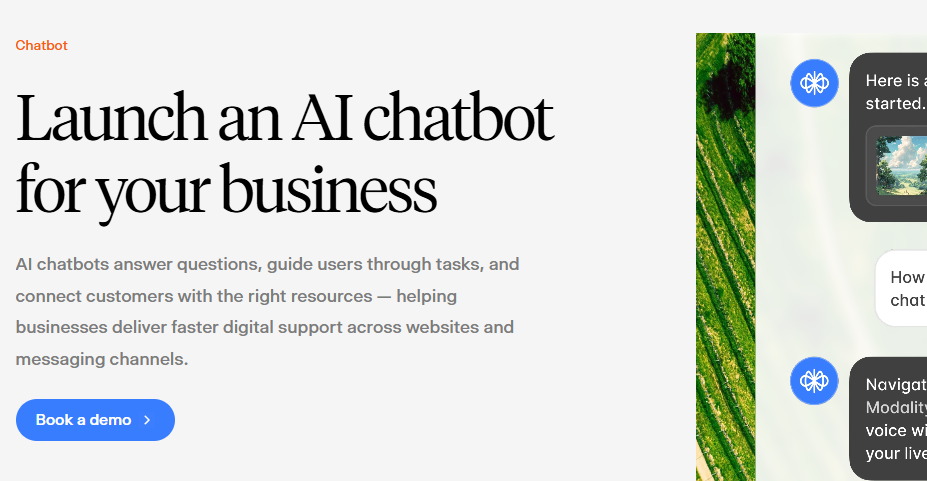
Nailing customer interactions is what Voiceflow’s offerings help with. It focuses on designing, testing, and launching conversational experiences. No extensive coding knowledge required. Teams can visually map interactions, connect chatbots to knowledge bases and external services, and deploy assistants across multiple channels. This way, chatbots are sure to guide users, answer questions, and handle workflows. With Voiceflow, it’s easier to build AI assistants instead of relying on scripted conversations.
Key Features:
- Making chatbots for faster and more intuitive digital support
- Multi-channel support and deployment across web, phone, and mobile
- Handles customer support, lead generation, onboarding, and product assistance
Pricing:
- Free Trial
- Agencies & Partners Package – Custom Pricing
- Businesses Package – Custom Pricing
Real Use Case:
Voiceflow helps car-sharing marketplaces like Turo achieve top-notch customer support. The company used the platform to switch from a traditional chatbot to an advanced, multilingual AI chatbot. It improves their satisfaction rate and response rate.
Flowise
Flowise is an open-source visual builder for creating LLM applications and AI chatbots. Writing Python here is not necessary. Developers can connect models, vector databases, APIs, memory, and retrieval pipelines. All within a drag-and-drop interface. Its Chatflow features let users build chatbots and single-agent systems. These support knowledge retrieval and tool calling. Flowise even comes with a feedback loop. This allows humans to review chains of tasks performed by agents.
Key Features:
- APIs, SDKs, and Embedded Chat for extending applications
- Creating chatbots with RAG from various data sources
- Complete control over AI workflows
Pricing:
- Free Package
- Starter Package – $35 per month
- Pro Package – $65 per month
- Enterprise Package – Custom Pricing
Real Use Case:
Software companies can build an internal chatbot trained on engineering documentation with Flowise. This would enable developers to quickly retrieve API references, coding standards, and deployment guides.
Chatbase
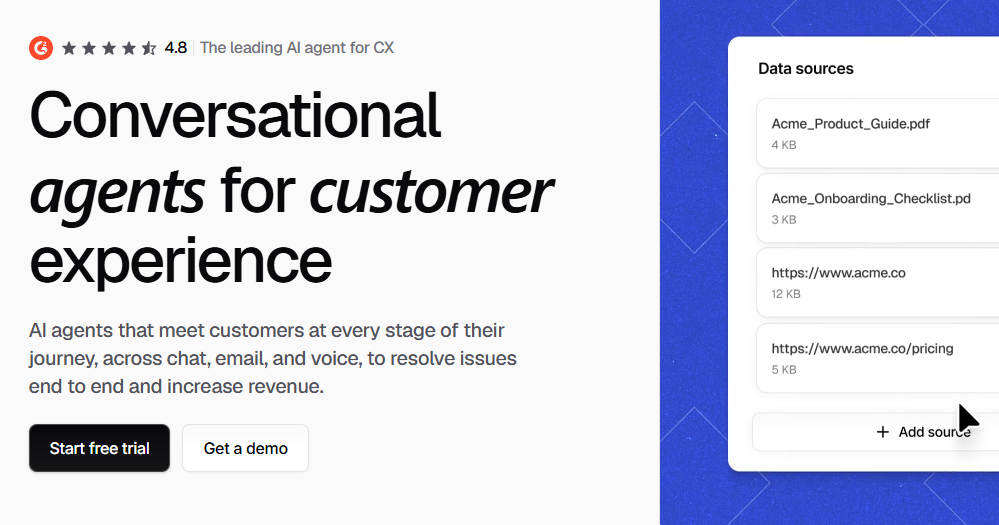
A no-code builder that turns existing content into deployable conversational AI agents. Advanced chatbots that handle customer support for resolving issues and boosting revenue. That’s the premise of Chatbase. Users can upload PDFs, website content, product documentation, or help center articles. This equips the tool with the knowledge and data to answer business-specific questions. Not just generic AI responses. Plus, deployment across websites requires very little setup.
Key Features:
- Training chatbots using plain language
- Scenario testing to ensure accuracy, consistency, and edge case handling
- Offstage agent for reviewing escalations and refining instructions
Pricing:
- Free Package
- Hobby Package – $40 per month
- Standard Package – $150 per month
- Pro Package – $500 per month
- Enterprise Package – Custom Pricing
Real Use Case:
Chatbase assisted Buy Now, Pay Later provider Aplazo in enhancing merchant acquisition. With Chatbase’s open-ended chat support, the company integrated an AI assistant into its landing page. Explaining the value proposition. Answering questions. Qualifying leads.
Rasa
Rasa creates reliable AI chatbots and agents. And it’s an established open-source conversational AI platform. Using an open developer framework with a coding copilot, developers can control how the AI assistants reason, respond, and perform. Its newer CALM engine lets an LLM interpret what a user means. All while the code still defines exactly what the agent is allowed to do next. What’s more, Rasa has a built-in studio for optimizing experiences and monitoring performances.
Key Features:
- Multi-agent orchestration
- Building chatbots through code or visually
- Dedicated omnichannel, voice, and IVR capabilities
Pricing:
- Free Edition
- Pro Package – Custom Pricing
- Business Package – Custom Pricing
Real Use Case:
Telecommunications company Swisscom used Rasa to optimize LLM usage. Not only did it help cut operational costs by 50%, but it also significantly enhanced customer satisfaction.
Elfsight AI Chatbot
AI Chatbot by Elfsight takes a website-first approach. Instead of asking teams to design complex workflows or operate a broader support platform, it focuses on adding a trained AI assistant directly to an existing website. Setup can start with a site URL, and the Knowledge Base can be expanded with web pages, files, images, Q&A, text blocks, and business information. Built-in Skills can collect contacts, show contextual Action Buttons, send follow-up messages, and offer configured routes to a real person.
Key Features:
- Training from website and business content, with Knowledge Gaps for unanswered questions
- Action Buttons, Collect Contacts, Follow-up Messages, and Contact a Human
- Floating or embedded layouts, page/device visibility controls, themes, Custom CSS, and Custom JS
Pricing:
- Free Package
- Basic Package – $4 per month, billed yearly
- Pro Package – $8 per month, billed yearly
- Premium Package – $16 per month, billed yearly
Real Use Case:
A SaaS company can place Elfsight on product, pricing, and help pages to answer questions from its own documentation, collect contact details from high-intent visitors, and show contextual buttons that guide them to demos, pricing, or contact routes. Knowledge Gaps reveal questions the bot could not answer so the team can improve coverage over time.
Choosing the Leading AI Tools for Building Chatbots in 2026
Modern AI tools for building chatbots are far from those scripted “Press 1 for support” experiences. Businesses and developers now need options that answer complex questions, find information, qualify leads, and complete multi-step tasks.
So which one do you actually pick? It depends on how much patience you’ve got and who’s building it. Botpress offers powerful enterprise automation. Voiceflow makes conversation design simple. Flowise gives developers visual control over modern LLM workflows. Chatbase quickly transforms existing content into an intelligent support assistant. Rasa provides flexibility for organizations that need complete control over conversational AI.
Pick based on that, not the logo you’ve heard of most. Doing so makes sure you end up with the one that makes it much easier to make useful, scalable, and capable chatbots.

