


Flashcards are simple. One side has a question or a word. The other has the answer. But everyone who has made them manually knows the struggle. Students spend hours turning lecture notes, textbook chapters, and presentation slides into question-and-answer cards. Manual flashcard-making eats more study time than it saves. But nobody needs to settle for the tedious process (unless you deliberately want to). Why? Because AI tools for making flashcards changed that equation.
In fact, a modern survey revealed that 60.1% of students prefer digital flashcards. This handful of AI tools now reads your notes and turns them into a ready-to-review deck. Not in hours, but in minutes. But you already know about Quizlet. So here are five options worth adding to your list.
Top Five Best AI Tools for Making Flashcards
RemNote
RemNote started as a note-taking app and later added a powerful flashcard maker. PDFs. PowerPoint files. Typed notes. Its AI can generate question-answer pairs pulled straight from a user’s material at speed. No app switching needed. Students with different learning styles will also benefit from RemNote’s diverse flashcard formats. But one of its biggest strengths is the built-in spaced repetition. The tool schedules reviews based on what a learner is likely to forget.
Key Features:
- AI-powered explanation on every flashcard
- Automatically generating flashcards directly from notes
- Flashcard review and custom instructions support
Pricing:
- Free Package
- Pro Package – $10 per month
- Pro with AI Package – $20 per month
Real Use Case:
Tests in medical courses are challenging to say the least. But with RemNote, students can upload lecture slides and generate cards about any topic. Exam preparation would then be easier because they can return to the source material whenever a concept needs more context.
Revisely
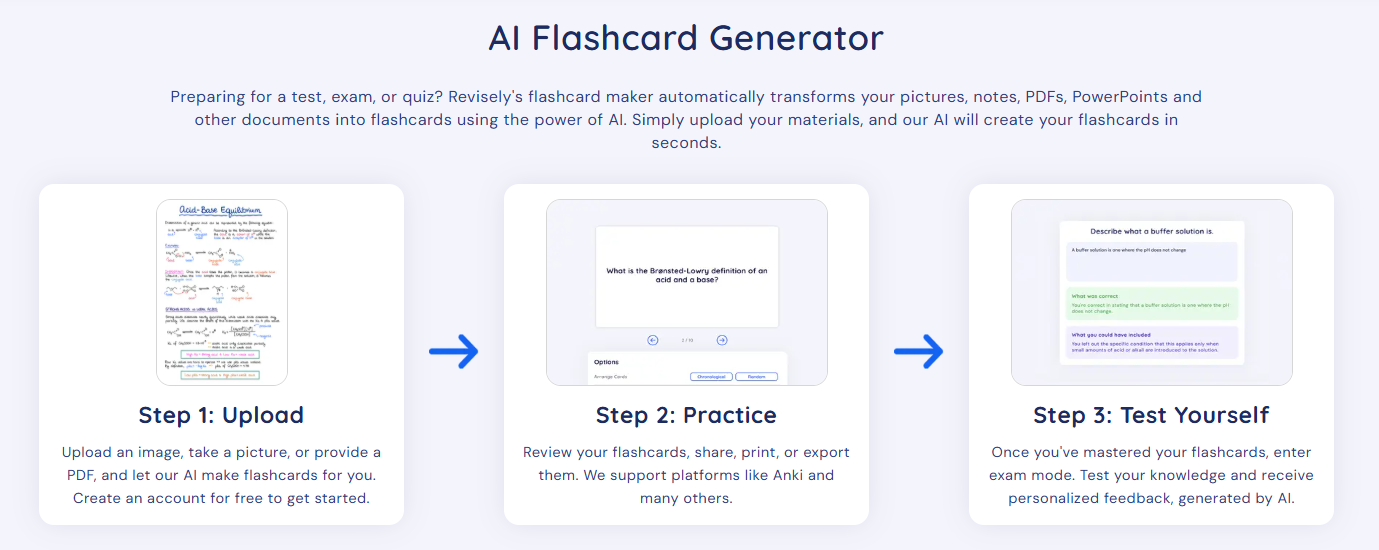
One of three core features of Revisely is its reliable AI tool for making flashcards. For ultimate convenience, this platform supports PDFs, PowerPoint presentations, and any other document type. Just upload the file, and users get an editable deck back almost immediately. Many applaud Revisely for what comes after generating them. Students can enter exam mode. Here, they can test their knowledge and get insightful feedback based on their performance.
Key Features:
- Export options, including Anki
- Supports single-sided and double-sided approaches for flashcard printing
- Personalized feedback for progressive learning
Pricing:
- Free Package
- Annual Package – $2.99 per month (billed annually)
- Monthly Package – $6.99 per month
Real Use Case:
Revisely allows online students to paste a video link instead of rewatching it to take notes. It makes a summary and a deck of flashcards from the key points. Students walk away with a reviewable deck. Not an hour of raw video they’d have to rewatch.
Gizmo
Gizmo focuses on making flashcard creation almost effortless. Like other AI tools for making flashcards, users can quickly produce study decks by uploading a PDF, PowerPoint, photos, or a YouTube video. What sets it apart is its approach. Gizmo leans into gamification. The flashcards are wrapped in streaks, hearts, and leaderboards. And that’s part of why it’s a good pick. Its real innovation isn’t card quality. It’s making users build a daily habit through game mechanics.
Key Features:
- Making study decks based on spaced repetition and active recall methods
- Shareable flashcards for group studies
- Magic Import for multiple types of study material
Pricing:
- Free Package
- Ultra – Annual Package – $12.49 per month
- Ultra – Monthly Package – $24.99 per month
Real Use Case:
High schoolers who prefer studying in pairs can use Gizmo. Students can let Gizmo transcribe a lecture and turn it into flashcards instantly. Then, they can challenge their study partners in a review battle before the exam.
Knowt
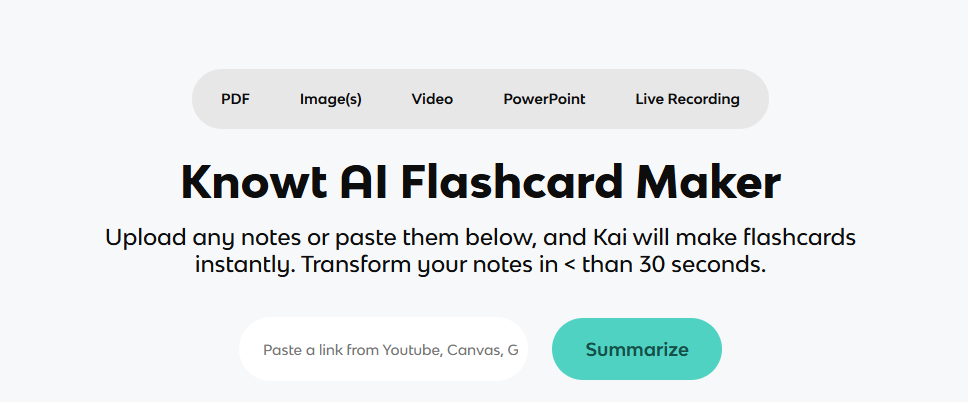
Among AI tools for making flashcards, Knowt specifically positions itself as the top Quizlet alternative. For starters, it’s packed with AI tools for notetaking and summarizing PDFs and videos. This allows users to identify key notes quickly. Using an active recall method, its AI then creates organized, interactive flashcards. There’s even a library that contains ready-made flashcards. Customization is also available. Students can add more information, integrate an image, and rephrase questions.
Key Features:
- AI chatbot for customizing flashcards
- Dedicated space-repetition mode for effective learning
- Large collection of existing study resources
Pricing:
- Free Package
- Pro Package – $12 per month
- Team Package – $39 per month
- Enterprise Package – Custom Pricing
Real Use Case:
Knowt can help students looking to transfer from Quizlet. Using a browser extension, they can import their whole study decks into Knowt. Then, they can generate new flashcards from recorded lectures without re-typing anything.
Brainscape
Brainscape takes a more adaptive approach to flashcards. At its core, it’s capable of generating flashcards from any source material. Users can also customize their flashcards. Adding images. Formatting texts. Integrating GIFs. It even comes with a library of flashcards. All made by experts, from publishers to educators. It stands out for its confidence-based repetition system. Brainscape adjusts reviews according to how well the learner knows each card. Low-confidence cards resurface. Cards users know well fade out.
Key Features:
- AI-generated flashcards
- Progress tracking and analytics
- Strong emphasis on long-term retention
Pricing:
- Free Package
- Pro Package – $19.99 per month
- Enterprise Package – Custom Pricing
Real Use Case:
Law students can upload case notes and generate cards covering complex topics. Brainscape can then prioritize cards that they consistently struggle to remember.
Choosing the Best AI Tools for Making Flashcards in 2026
One effective way to up your study habits is to take advantage of smart platforms that streamline tedious work. With AI tools for creating flashcards, students can hand over their study material and get testable cards in minutes.
When choosing, consider a tool that offers image support, customization, note-taking, and spaced repetition. But among these suggested options, there’s no one-size-fits-all winner. RemNote fits dense, connected material. Revisely wins on raw generation speed. Gizmo and Knowt suit anyone who needs the habit-forming push of gamification or a free daily driver. Brainscape emphasizes adaptive review.
Remember that automatically generated cards aren’t useful if half contain unnecessary details. So review the AI’s output, remove weak cards, and keep the questions focused.

