

The beguiling power of Nick Hakim’s music lies, in part, in its malleability. On ‘Soft Wet Clay’, towards the end of the singer-songwriter’s latest album I Can See, you can hear the demo that he made on cassette fold into the version that came together at the fabled Sonic Ranch in the Texas border town of Tornillo. The intimate bedroom recordings, disarmingly atmospheric and vulnerable, took full shape there, as well as various studios in New York City, with longtime collaborator Andrew Sarlo co-producing. Though Hakim’s last album was 2022’s Cometa, these songs stretch back further, moulded and remoulded as he contended with the end of a record deal and the dissolution of a relationship, all while contributing to records by Adrianne Lenker, Miley Cyrus, and more. Without pretending to know the answers, or revealing all his tricks, Hakim trusts there’s magic in reconciling all the versions of himself that show up in the process, offering them a pliable voice within an open-ended yet contained sonic landscape.
We caught up with Nick Hakim to talk about West Texas, sobriety, the piano, and other inspirations behind I Can See.
West Texas
What was unique about not just the studio that you were working out of, Sonic Ranch, but the landscape and environment more broadly that fed into the record?
We started the record with the band in West Texas at the studio Sonic Ranch. I think a combination of things affected all of us so much. It was lockdown in July or August 2020; all of us had spent months in isolation. I invited some of my closest collaborators to come to the studio. Andrew Sarlo recommended we go there to work, and we figured it out. I was on a label at the time, so there was a resource to even make it happen and fully cover the costs of this phase of it. We were there for three and a half weeks, and every single day we were up until whenever we felt tired.
We were on the border with Mexico, which really felt heavy. There’s a part of that element of being in another place of extremities – this really beautiful space, but in close proximity to desperation. You’re in the thick of it, and technically in Mexico. In my opinion, Mexico is Texas and California – that’s all Mexico. Obviously, it’s the U.S., but that is indigenous Mexican land, and I always think about that when I’m there. I think there’s also the weight of being in the desert. I’ve never spent that much time in a desert environment, and the extremity of it being so hot and cooling down during the day.
West Texas, this certain area, being isolated in an environment where you could literally see the most stars at night that I’ve ever been able to see – it feels like you are actually just in the middle of nowhere. The way that time moves, the lack of needing to be on our phones – I barely used my phone – we were so focused. There were 10 to 12 people throughout almost a month, friends and the band, and it really felt like we were just celebrating each other, enjoying each other’s company. We ate every meal together, and it felt like recalibration in a time when everyone was so afraid. It was risky being there in West Texas with 12 people coming from different parts of the country, but no one got sick, and everyone was fine at the end of the day. There’s a song on the record, ‘7 Days’, that literally reminds me of that area outside of Sonic Ranch.
Sobriety
‘7 Days’ is also a song where you directly sing about sobriety. Having had some distance from it, can you see more clearly how it affected the journey of the record itself in a way you maybe weren’t so conscious of while making it?
It took an adjustment. I got sick for like a week when I first stopped drinking. It almost felt like a reset. I think when you’re navigating sober, when you’re navigating at zero, it’s literally an energy thing, where your body’s almost thanking you for not putting substances in after a while, and I had three months of recalibration of getting used to this feeling of not doing my pattern. I’ve gone through so many phases of working on this record, and I feel like whenever I would get frustrated, or anytime I would get in a hole, I would just be like, “Alright, I’m gonna go to this store, grab something to drink, and maybe this’ll help, maybe it’ll help me relax.”
It just took a while, but a big part of what I needed was someone to press record for me. Usually, I record myself by myself. I’m a private person when it comes to doing my vocals. I don’t really like to be around people, and I really don’t like it when people are like, “Can you just sing on this real quick?” I’m just like, “Mmm… I don’t need to.” Like, yes, I could, and I usually will, but I like to be by myself when I’m doing it. It helps me think. I’m also the type of person that doesn’t ask for help, and I think having someone record you is the bare minimum of something that, as when you’re doing a task like vocals, it can be so helpful to have. So I kind of hired a lot of my friends to help me record.
How did you get to that realization and actually reach out?
I think just being honest with where I’m at. I think I was in a moment of really trying to push through, and I was struggling in a lot of ways, but I was also just trying to finish something and make it the best that it could be. There are so many people that helped me record myself, or just pressed record at my studio and came through and were just like, “Alright, get in there, you’re not looking at the computer, you’re just focusing on your vocal.” I got to this place because it was just something that I just knew that I needed. And I did a lot of vocals by myself on this record, too. ‘You Can Make It’, that song I did by myself, and there are a few others.
‘7 Days’ also has that lyric: “I don’t need no liquor, don’t need no cocaine.” A lot of the lyrics were brainstormed and written with my mentor, friend, Arto Lindsay, and a really dear friend of mine, Julian Pratt from Show Me the Body. Julian and I write a lot of music together. We have like 15 songs together that we’re working on for another thing, but he just kind of chimed in on some vocals. And Arto had this poem that I used as a foundation for the first verse. Julian also helped with some of the lyrics on ‘Endlessly Waiting’ as well.
Before we got into the inspirations, you said something about there being a childlike aspect to sobriety. How did you notice that seeping into the record?
I think I have a lot of duality in how I express myself, and I think I’ve always had a very amplified way of expressing excitement, almost to a point where I used to not be able to even control it when I was younger. And because of that, I was put in special education, I was medicated for 10 years every day. But I’ve always had this really playful side of myself that a lot of my close friends know. Close people of mine know how silly, goofy, playful, and energetic I can be. There’s this part of me that I don’t really know how to show, and then it developed into me drinking and doing other shit that amplified that, but it was almost like a fake, not very present way of being. In sobriety, I’ve felt like my excitement just comes out in ways that are real joy – not dopamine-fueled joy, or masked by anything. Which also means high highs and low lows, but it’s learning how to navigate that.
One reason I say it feels childlike is when you’re a kid, you’re not drinking, you’re just exploring. I started drinking at a young age, at 13. I had a near-death experience when I was 15 years old with alcohol poisoning, so I’ve had a lot of issues surrounding this for a long time. I don’t know if it’s the best comparison to be like, “I feel like a little kid,” but it’s more like this pure joy that I wasn’t able to find when I wasn’t sober; I would seek it and numb myself. The cycle of trying to not do it with anything in your system is challenging, but when you tap into it, it feels pure – more of an interesting place than just going into it numb.
I’m not gonna lie, this shit is not easy. I don’t know how I’ve done this for this long, but I’m definitely grateful. I’m fighting the feelings every day – I still feel cravings, but I’m definitely happier, more honest with myself and the people around me, and just more present. It’s not perfect. Learning how to deal with these feelings is a real challenge. There are a lot of layers to why somebody enters these spaces of wanting to numb and not be present. To completely take that away is worth it, but you always have a little voice that says a lot of fucked-up things. I think music has helped me try to maintain an internal peace, and this record has been so therapeutic for me in trying to better myself. Even the title song, ‘I Can See’, sounds like a sobriety album. [laughs] It’s an internal joke for me, because I made the demo for that song when I was so inebriated I don’t even remember making it. I was a functioning person, but my point is that it started in a place of being intoxicated on a regular basis.
On top of whatever the meaning is behind it, it came at a time when I was really tapped into this feeling that was a throughline throughout the record. I made the demos for these songs within a week before going to Sonic Ranch; it’s interesting that a lot of the music from this record is from this week where I recorded everything on cassette by myself in full chaos. I made 30 compositions in a week. I was just so eager and honestly desperate to get something out of my system. It wasn’t just because of COVID; I had just gotten out of a long relationship, I had just moved out of a studio that I was kind of living in, I had put everything into storage – it was a big change in my life. I just had a moment of feeling extreme focus in a moment of turmoil. Which didn’t even feel like I was doing anything productive – it just felt like I was moving.
Community
You produced the record with Andrew, and there’s a whole community of artists credited not just as musicians, but collectively as engineers of the record. Seeing them collectively credited in that way suggests they’ve shaped the record in a particular way. But it also sounds like this community is extra-musical in the sense of guiding you through the process and helping you stay grounded.
First and foremost, my younger brother, Danny, wrote the music for ‘Barii’, and we replayed it in the studio with him. He has written a song on my last three records, including this one. `He’s my earliest collaborator. I recite lyrics about him on ‘River Rising’ and ‘Real Here Now’. I don’t know what I would do without him; he’s a North Star to my life. I just adore him, and I’ve always been very protective of him. We’ve been very close forever. Having him involved always helps me feel centered. Danny is the reason I got into music. When I started studying music and shaping my sound, I met a lot of the people who are playing on this record. I met them when I was 19 or 20, when I was a very shy person.
I didn’t have the desire to be front-facing, but I just wanted to make music with people I connected with. It wasn’t to be successful or for any external thing; I just wanted to craft this thing. A lot of the musicians playing on this were on my first project – at least three of them. Throughout the years, these are people who have played all over my records and toured with me. I’ve been through a lot with them and known them for a long time. I feel like I wouldn’t be the musician I am without being around them, because all of them are so incredible at what they do. I feel better when I’m around them, I learn when I’m around them, and I see how they approach things – even their posture. That’s how I learned music: watching better people do it. I’m a self-taught musician. I learn a lot from them, even just watching their body language when they play their instruments.
Bringing him up again, having people like Arto in my life – I learned about his music when I was very young, and I’ve developed a friendship with him to a point where I’ve helped him record a lot of his music. All the people listed as engineers, but especially June [McDoom], Evan [Wright], Leon [Kelly], and Benjamin [Julia]. Benjamin helped me record the vocals for ‘I Can See’; he just pressed record. He’s always like, “I didn’t really do anything,” and I’m like, “You did. You did a lot.” Leon was probably the most involved in terms of being in New York and coming to the studio at 11:00pm and us staying there. And then Evan and June helped me record the vocals for ‘Barii’. The communal aspect is obviously far deeper than just the engineers and the people that played on it, but I do think it’s important to recognize the people that helped shape this record – even if you just show up for a little bit, it means a lot.
Recording without a computer
It sets everything into a performance. It’s not a highly edited comp of a performance; it’s real human people playing throughout the song. This AI shit started to really come out while I was finishing this record, and I was just like, “Anything could be AI.” It almost felt like I was trying to do things to make them feel almost – ‘I Can See’ is something where someone could probably think it’s an AI-generated song, but it’s just a pitch-tape technique that you do on tape. You just record really slow, and then you bring it back up. It’s an extreme choice, but it’s…
A human choice.
Yeah, exactly. The reason I wanted to talk about this is I think it’s important to understand that the beginnings of this record were made on six cassette tracks. My demos are all on cassette. For this record, I had an MPC, a microphone going to an effect, an upright piano, and my guitar. You can hear the MPC2000XL rhythms on basically every song, even if they’re small. On ‘I Can See’, the beginning is just my demo that I made at home, and then you hear the band come in. On ‘Know My Name’, the nylon guitars, the hi-hatty drums, the vocals at the end are all from my demo, no computer. Thankfully, it was on a machine that has direct outs, so any channel recorded in can be recorded out, and you can get each individual file. It’s not like you just have two channels of everything. I was trying to blend bounces of the two-track, but then I realized that I could get all the stems.
When we went to Sonic Ranch – obviously, we had Pro Tools open, but we were recording everything on tape. All the takes were recorded as a performance. Some of the versions of the instrumentals recorded at Sonic Ranch were twice as long as they are on the record, which is insane because a lot of these songs are very long. And then we blended the two. The way that this record was mixed in 2025, we mixed it back in the same room that we recorded in 2020, and we set it up so that we didn’t use a computer screen to mix. We just ran it to tape and bounced down to tape – we did a completely analog mix. We didn’t look at the screen. We were just reacting to how it felt and the speakers that we were familiar with. Andrew and I mixed it together this way, using an actual house as an effect. We set up an echo chamber in a house in Texas at the studio called the Echo House. I was actually considering naming my album Echo House after it.
I would say recording without a computer forces you to get out of this visual representation of waveforms. I’m such a visual person that I’ll look at waveforms and see whether they’re small or big, and it’ll affect me. It’s almost like I have to not look at it and really listen, because when there’s a visual thing set to it, it can be confusing. I do that all the time; if I’m mixing or working on something, I usually have to reprint it down to a new track so that I can actually see what the waveform is. Doing these mixes like this was necessary for the music. It wouldn’t have felt right if we were just in Pro Tools doing it the way that we’ve done basically everything else.
It’s not even just about tape, because you can do the same concepts on a computer; you don’t need to record to tape. There’s limitations, and there are sonic things that happen that are really interesting. It almost creates a life and a character of its own like that. Every machine is different, old, and has different wear and technical flaws and characteristics that are amazing. It’s really like you’re bringing another person into the room. Recording without a computer is a big part of the process of making this record – but I will say a lot of stuff was done on the computer as well, to be fair. It was a real blend.
Calligraphic musical notation
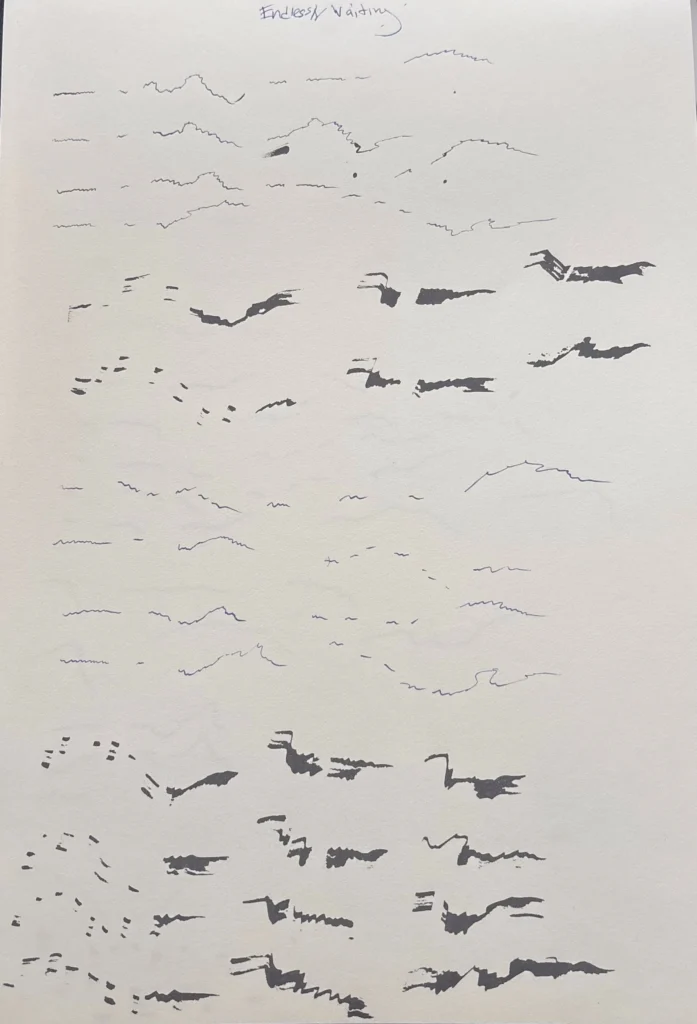
That’s an interesting thing to bring up after you mentioned being a visual person, but being distracted by waveforms. And it’s also part of the record’s art direction with the calligraphy that was done by Evan McGraw.
A while ago, without any prompt or anyone telling me to do it this way, I started to make notation for each song. When I was at the point where I was like, “I need to finish this record,” I started to make all of these musical notations, and it’s the shape of the melody. I have actual scans of each of them, and some versions I had taped all over my walls. And then somebody was telling me, “You know, there’s Tibetan monk musical notation that looks like this.” I was like, “I had no idea.” I also sent it to Arto, and Arto was like, “Oh, this looks like music notation to me.” Which is a joke, because he doesn’t really think about music in that way – it’s all about shapes and concepts. I feel like, subconsciously, being around him helped me think like this. But I also think my relationship between visual arts and music helped me understand the shapes, and it almost made me feel grounded. It helped me when I was trying to fit lyrics into some of the shapes of these things. I was trying a lot of things to really reframe my perspective.
Then a friend of mine showed me this incredible calligraphy artist named Evan McGraw. Evan’s work really inspires me. He did the typography for the back cover of the vinyl for my record. I feel like this approach makes me feel inspired with my relationship to visual arts and to music.
Reconnecting with family in South America
I hadn’t been to South America in 16 years before I went. The first time I went back – I’ve been maybe four times now since six years ago – I felt so happy in so many ways to be back and to see everyone. I have a big family, I have family in Chile and I have family in Peru. My family in Chile is a lot bigger than my family in Peru. But I grew up in DC; I’m a first-generation American. I have this cultural upbringing with little pieces of my family that were brought to the States, but I was never fully immersed in this giant family that I have in that way. We did go when I was growing up sometimes, so it’s not like I was a stranger to it, but there was a 16-year gap of going back. Right after I finished touring Cometa in Europe, I was in London for three weeks, and then I went to South America for three weeks.
My grandmother is my only living grandparent – now she’s 99. Just being with her, being able to touch her hands, talk with her, and her still being able to remember me… It felt really beautiful. That was on my Chilean side. On my Peruvian side, on the Hakim side – I feel like this is a common thing, but the more you talk with relatives, the more you learn about your family. I learned that my dad’s first cousin, who he grew up with in Peru, was in this really famous hardcore punk band from Lima called Narcosis. He’s the guitar player in the band, his name is Fernando Vial. Their one album is known to be the most bootlegged album in Peruvian rock history. It’s so cool to me that we’re related. I found his record a year later in a record shop in Portland, Oregon, and I was like, “That’s my uncle.”
Reconnecting with the piano
My reconnection with piano is interesting because that’s what I started playing as a self-taught musician. I was learning everything by ear, and the whole time that I’ve toured, I always played guitar. I have my vocabulary, I have my thing on guitar, but I’ve always kind of written on piano. It’s been a big part of my understanding of music; I literally have a piano right next to my bed, right there. I wake up, and I’m just looking at it. I’ve always had a connection with the piano, but I always felt really shy to play in front of people. Throughout the past seven years, I’ve really found my rhythm and my feeling on it in a different way than I ever had before.
Andrew Sarlo, he’s always told me, “Man, you should just tour with just you and an upright piano.” He’s like, “There’s something in how you perform your songs by yourself, and your way that you play…” Honestly, he’s been very encouraging. And then Adrienne calls me to play piano on her record, Bright Future. Adrienne’s songs are amazing, and me having the ability to change keys with her – where on guitar it would be almost like just switching a capo or a fret, on piano it’s a whole other world. And this is another record that’s recorded on tape, no headphones. I learned a lot from her, and from recording with her – that was after we started this process for I Can See – but also touring with her with an upright piano every night, and then opening with just piano and vocals.
I’m just so obsessed with piano. I love sitting down and not even knowing what I’m playing – I know what I’m playing, but I’ve always maintained this kind of mystery. I have a certain vocabulary on the instrument, but I am very self-taught. I like being able to have my own approach. The only thing that I suffer is technique, because I feel like my hands kind of get fucked up sometimes. But it doesn’t matter, I don’t care about technique, it’s just something that’s happened. I have a really strong connection with writing on piano; I’m just sitting down with it. I feel like it’s a companion, and on this record, it’s the first time that I’ve really shown that. There are songs on my other records that are piano-based, but I think I’ve always tried to make more guitar-y kind of stuff. It is the center of where I started, and re-embracing it feels good.
This interview has been edited and condensed for clarity and length.
Nick Hakim’s I Can See is out now via Earseed/Stem.

