

Ask Alisa Kobyliatskaia where a music video starts and she won’t mention a treatment, a reference deck, or even a camera. She’ll tell you to get in the car. A new song goes on repeat, she and longtime collaborator Isaac Dominguez drive with no real agenda, and they start talking — about a feeling, a place, a color, whatever the track begins to suggest. Somewhere between the first listen and the tenth, the song starts collecting images. A street suddenly feels like a location. Someone’s outfit becomes a character. A building they pass can change the entire idea.
Kobyliatskaia compares it to being a teenager with headphones on, staring out the car window and instinctively turning whatever you see into a music video. The difference now is that she gets to make it real. Her creative practice spans directing, creative direction, and producing, but the instinct behind it remains remarkably simple: find the visual world of a song first, then figure out how to bring it to life.
The process begins loosely. Kobyliatskaia and Isaac Dominguez are not necessarily searching the lyrics for a plot, nor trying to decide immediately what happens in the first shot or the last. The first task is to understand the emotional and aesthetic territory of the song.
Once that begins to take shape, however, their first concrete decision is often the same.
“Location,” Kobyliatskaia says. “It’s one of the most important characters in every music video.”
For Boy Beverly’s I Can Wait, the location did more than support the concept. It created it.
During the development of the video, Kobyliatskaia and Isaac Dominguez found a dark, ornate church with a distinctly Americana Gothic quality, and the idea began forming around the space.
“Noah has this very LA-boy look and energy,” she says. “Putting him in the middle of this beautiful, dark, almost spooky church completely shifted something in my brain.”
What interested her was the contradiction. The contemporary artist and the old-world setting seemed to belong to different visual languages, and placing them together immediately created tension.
That instinct appears repeatedly in Kobyliatskaia’s creative collaborations. An artist against a location. Something polished beside something severe. Beauty interrupted by an element that feels slightly wrong.
“Tension creates intrigue,” she says. “Tension creates conflict, and conflict creates story.”
For Kobyliatskaia, visual development and storytelling are difficult to separate. A location does not have to explain anything narratively in order to change what an artist means inside the frame.
That way of thinking extends beyond music videos. In her narrative directing, including the short film Boloto, Kobyliatskaia approaches image, space, performance, and atmosphere as parts of the same world rather than separate creative decisions.
“I don’t really see wardrobe and production design separately,” she says. “It’s all one complicated visual system.”
A costume can alter the meaning of a location; a prop can change how the wardrobe reads; the right car can complete an entire visual idea. Rather than treating those elements as finishing touches, Kobyliatskaia sees them as part of the concept itself.
For Kir Medvedev’s Feels Like Summer, Kobyliatskaia and Isaac Dominguez explored a world informed by Old Hollywood aesthetics — an idea that emerged through the creative development rather than one dictated literally by the song. Styling, attitude, and a vintage car gradually began to reinforce the same visual language.
It is representative of how Kobyliatskaia thinks about music videos more broadly. She is not looking for a single “correct” visual translation of a track. Creative direction can introduce something the music never explicitly asks for and make that new world feel as though it had always belonged there.
Minimalism, unsurprisingly, is rarely the destination.
“I hate minimalism,” she says with a laugh. “Everything I touch ends up becoming a little more detailed.”
The remark is blunt, but it points to something consistent in her visual instincts. Kobyliatskaia pays close attention to the information surrounding the performer — clothes, textures, objects, background, architecture, small visual interruptions that can make an otherwise simple frame feel inhabited.
That density is particularly suited to music videos, where image does not have to behave according to the same rules as narrative film.
“A music video doesn’t owe anyone a perfect three-act story,” she says. “Its first responsibility is to create the mood and build the aesthetic world of the song.”
The distinction matters. Music videos can move through fragments, repetitions, visual associations, or an image that exists simply because it feels right. Continuity and character development may still matter, but they do not have to be the organizing principle.
The same flexibility applies to the camera.
Long before filming begins, Kobyliatskaia and Isaac Dominguez already have a sense of the rhythm a particular song might require. Some of their collaborations have generated hundreds of short, quick takes — deliberately chaotic material intended to create energy through accumulation. Others have been conceived around as few as eight shots.
“You can’t approach every song with the same camera language,” Kobyliatskaia says. “Some need to feel messy and fast. Some become stronger when you take almost everything away.”
Kobyliatskaia and Isaac Dominguez develop that language collaboratively. She describes the exchange as essentially fifty-fifty, shaped by years of creative collaboration and a familiarity that allows ideas to move back and forth easily.
Once they are on set, their attention naturally moves in different directions.
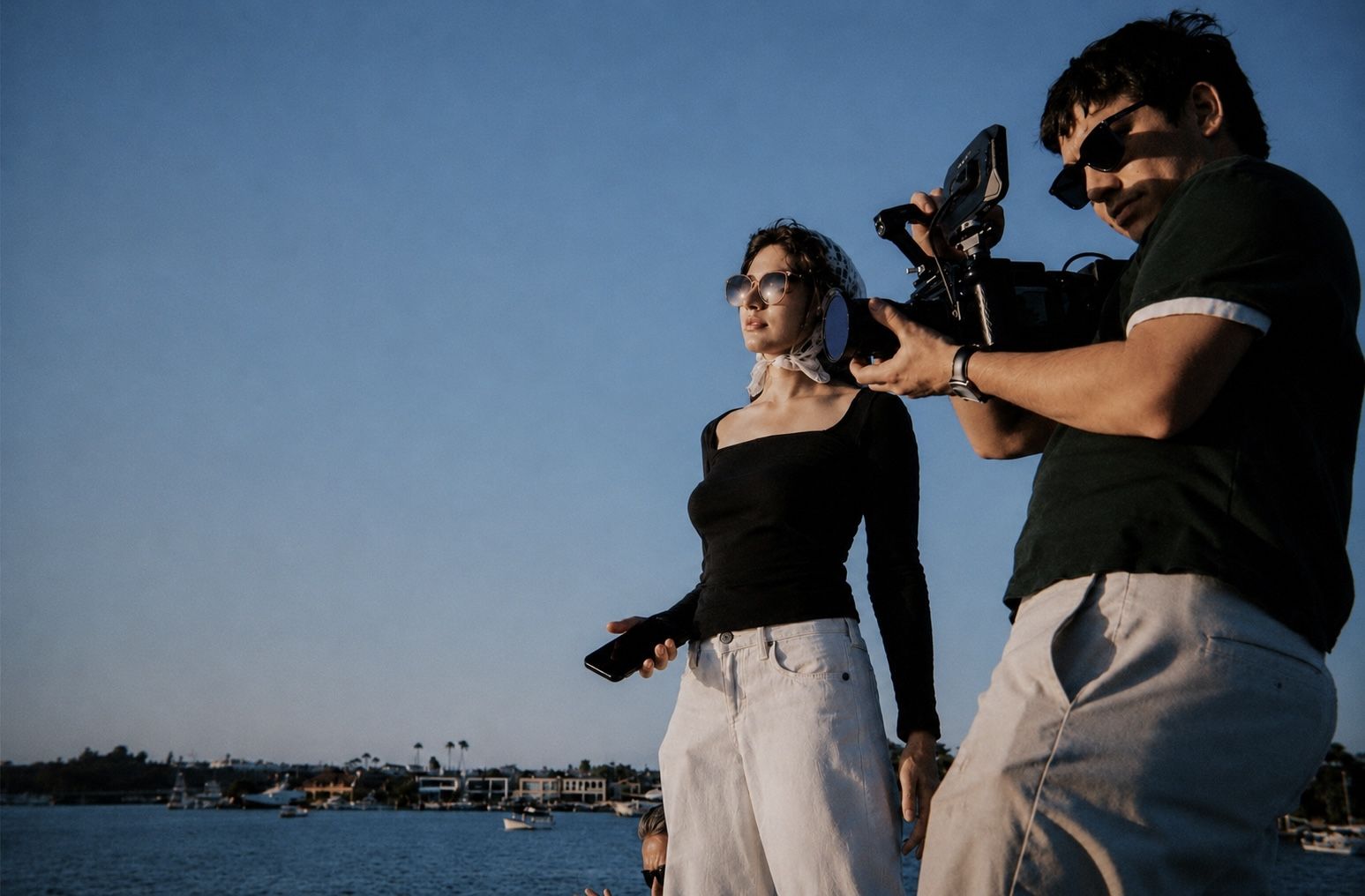
“Before we step on set, we develop everything together,” she says. “Once we’re there, Isaac is focused on the camera side, and I do the talking.”
The phrase sounds deceptively casual.
In practice, “the talking” can mean guiding an artist through a performance, communicating with the people around the set, adjusting an idea, protecting the atmosphere of the space, responding to whatever changes in the moment, or simply making sure that what is happening around the camera never overwhelms the person standing in front of it.
Musicians do not necessarily arrive in front of a camera with performance for the lens as their primary craft.
“A big part of the process for me is helping the artist feel confident in front of the camera,” Kobyliatskaia says. “You have to approach every artist differently. Most of the time, I’m not trying to turn them into another person. I’m trying to bring out the artistic persona that is already there.”
The approach changes from person to person.
Some performers prefer an intimate environment with very little attention around them. Others respond to scale and enjoy the feeling of something larger happening around them. Some want precise notes; others want someone closer to an advisor.
“Some artists prefer to keep it very low-key. Some like to feel grand. Some are open to a lot of direction, and some need me more as an advisor,” she says. “But with every one of them, you need to establish a safe space.”
Kobyliatskaia becomes particularly careful when the conversation turns toward artists who have been visibly shy or self-conscious during a collaboration. She declines to identify anyone.
“You get access to something very fragile sometimes,” she says. “If an artist lets me see the self-conscious or shy side of them, they deserve to know that I’m going to protect it. That trust is part of why they have me there.”
It is a revealing boundary. The finished image is public; the vulnerability required to create it does not have to be.
That protection extends beyond performance.
Music-video sets can be chaotic. Time runs short. Locations become complicated. A setup takes longer than expected. Something changes unexpectedly, and several people may be trying to solve it at once.
For Kobyliatskaia, protecting the artist from that instability is part of creating the environment around the performance. The person in front of the camera should be able to enter the space without carrying every complication unfolding around them.
“The artist doesn’t need to carry every problem happening around them,” she says. “They still have to step in front of the camera and give you something. A big part of the process for me is making sure the space still feels safe and controlled enough for them to do that.”
The creative partnership between Kobyliatskaia and Isaac Dominguez helps create that separation. Years of artistic collaboration allow them to develop an idea together and then focus on different parts of it once filming begins.
It also reflects the larger logic behind Kobyliatskaia’s approach to music videos: the world may be designed carefully, but it exists to serve the person who eventually steps inside it.
A beautiful location, the right wardrobe, the perfect object in the background — none of it matters very much if the artist looks as though they have been dropped into somebody else’s idea.
That balance between construction and instinct is part of what keeps Kobyliatskaia returning to the form.
Narrative filmmaking operates on another scale. Kobyliatskaia’s directing work, including Boloto, asks for a different kind of patience: a film can take months, sometimes years, to develop, and every visual or performance decision carries more weight. Experimentation still exists, but it arrives surrounded by more infrastructure.
Music videos give her a faster, more playful relationship with image.
“My work is heavily driven by aesthetics, and music videos give me room to explore that instinct more freely,” Kobyliatskaia says. “With a film, you can spend months or years developing it, and every decision carries a different weight. With music videos, I can experiment. I can follow an image because it excites me, play with something, build a world around one idea and see where it takes us.”
For her, that freedom is almost childlike — not because the work is less serious, but because it allows an idea to exist for a moment before anyone asks it to justify itself.
“There’s something about being able to play that I really need creatively,” she says. “You can build an entire world because one image feels right and then find out what else belongs inside it.”
Which brings the process back, in a way, to the car.
Before the crew, before the wardrobe racks and locations, before an artist has to find confidence in front of a lens, there is still that first drive: the same song playing again and again while the world outside starts attaching itself to it.
Only now, when a building suddenly looks like a location or a passing image refuses to leave her head, Kobyliatskaia does not have to leave it in the daydream.
She can turn the car around.

