

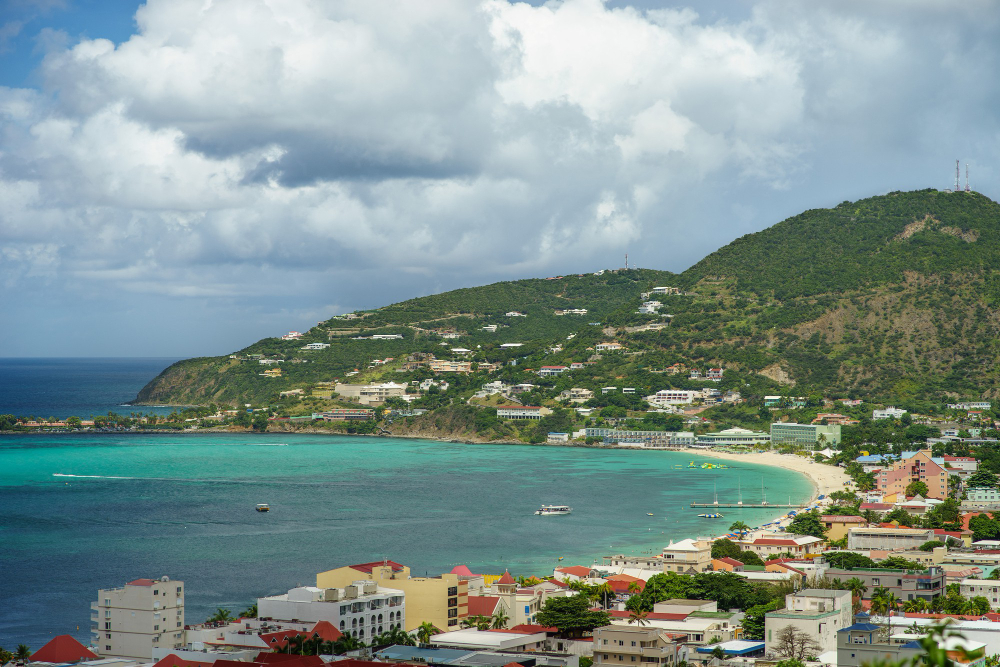
There is a small monument on a quiet road near the middle of Sint Maarten. It is easy to miss. A stone marker notes that in 1648, France and the Netherlands agreed to share the island, and that the arrangement has held, more or less, ever since. There is no fence, no checkpoint, no passport control. You cross from one country to another between a hardware store and a bakery, and the only reliable sign that you have done it is that the road signs switch language and the speed limits switch from miles to kilometers.
Thirty-seven square miles, two nations, two languages, two currencies, and a genuinely different culture on each side of an invisible line. It is one of the strangest and most rewarding cultural experiments in the Caribbean, and you can experience the whole of it in an afternoon’s drive.
The line that language draws
Start on the Dutch side, in Philipsburg, and the register is Anglo-Caribbean and commercial. English is the working language, the US dollar is king, and the rhythm is the cruise ship: duty-free shops, boardwalk bars, a certain cheerful hustle. It feels closer to the American Caribbean, because in many ways it is. Most flights land here, and the Dutch side has always been the island’s front door.
Cross to the French side and the whole thing softens into something continental. Marigot, the French capital, has a morning market that could be lifted from a small town in the south of France, except the produce is mangoes and the cheese arrived by boat. People greet you with bonjour and mean it. Lunch is long. The euro is the currency, though dollars are accepted with a shrug and a poor exchange rate. The French side does not perform for visitors in the same way the Dutch side does, which is exactly why people fall for it.
Neither side is more authentic than the other. They are two authentic things sharing one small piece of land, and the pleasure is in the switching.
Two kitchens, one island
Food is where the divide is most delicious. The Dutch side gives you the lolo, the open-air barbecue shacks, best experienced in Grand Case on the French side, admittedly, where a row of them serve grilled snapper, ribs, and johnnycakes on paper plates for a fraction of restaurant prices. This is the island’s soul food: Creole, smoky, unfussy, and often better than anything with a tablecloth.
The French side answers with actual restaurants, and Grand Case has for years billed itself, not unreasonably, as the gastronomic capital of the Caribbean. You can eat a serious French meal a hundred yards from a lolo, and the right way to spend a week here is to refuse to choose between them.
The dividing line even runs through the drinks. Order a Heineken and a Guavaberry rum on the Dutch side. Order a rosé and a ti-punch on the French side. Both are correct.
A culture built on movement
What makes the island cohere, despite the split, is that the people move across the line constantly and always have. Families live on one side and work on the other. Children are schooled in one language and play in another. The local culture is genuinely bilingual and genuinely mixed, layered on a deep Afro-Caribbean foundation with Dutch, French, and more recently a strong Latin American and Indian presence stitched in.
That mixing is the real attraction for anyone who travels to understand a place rather than just to lie on its beaches. You can hear four languages in one grocery store. You can watch a French-side wedding and a Dutch-side carnival in the same week. The border is not a wall between two cultures. It is a seam where they meet, and the seam is the most interesting part.
Seeing both sides properly
The mistake most visitors make is basing themselves entirely on one side and treating the other as a day trip. The island rewards the opposite approach: stay somewhere central, and treat the whole of it as your neighborhood.
That is easier than it sounds, because the island is small. The most exclusive residential areas, the gated enclave of Terres Basses on the French side among them, sit within a twenty-minute drive of both capitals. This is where the island’s luxury villa rentals in Sint Maarten come into their own: private houses positioned precisely for this, close enough to Marigot’s market for morning croissants, close enough to the Dutch side for a late flight or a night out. The point of a base here is not to pick a side. It is to make crossing the line effortless enough that you stop noticing you are doing it.
Spend a week that way and the border stops being a curiosity and becomes the whole texture of the trip. You will find yourself with a favorite bakery in one country and a favorite beach bar in another, separated by a five-minute drive and 375 years of a treaty that somehow still holds.

