

I often wonder about the quiet lives of influencers, what the people whose SEO captions and sticky smiles turn into when the camera turns off. Do they solemnly pick up the trash they’ve littered during an Amazon unboxing? Who scrubs the pans after each cooking video? And as a matter of fact, turn the camera around so people can see the less-than-savory areas of the home, or the room one is filming in. It’s a plastic life, heavily edited and featured, where you’re unable to distinguish between what you’re doing for content and what you’re doing for life. Or is there a difference?
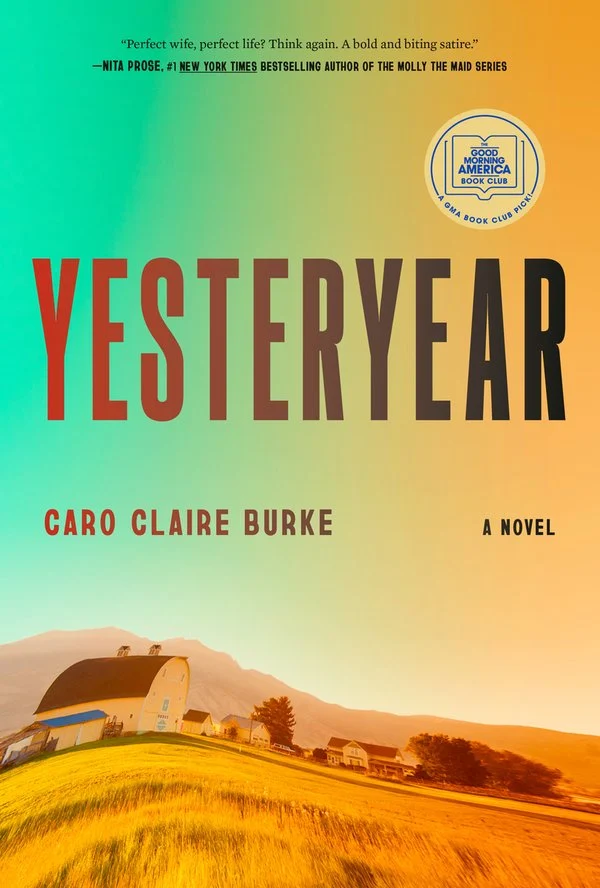
This is the dilemma Natalie Heller Mills, the snarky and paranoid protagonist of Yesteryear, finds herself in. Actually, it’s worse—she’s a traditional influencer who lives on Idaho’s Yesteryear Ranch, who is the picture-perfect mama to six littles, who assist her in videos and show off their Target hauls cutely, but when the camera turns off, are basically as foreign to Natalie as a stranger. Junebug, the youngest, is continually forgotten, recalling Kate Berlant’s metafictional character of herself as a broadly famous actress, struggling to recall her children’s names. Natalie is damned to a life of hell, providing the following: her body, to be a good Christian wife for her doltish husband, Caleb, the son of an established political star, care for her children (when the nannies, who are coldly called as such, aren’t with them) and content to her hungry viewers. Her lightly cluttered kitchen must seem authentic, but not too much so, lest hordes of trolls come to bite (Natalie refers to them as the “Angry Women” who project their dissatisfaction with their own life onto her). If this isn’t enough, one day, she wakes up dropped into the year 1855 onto a real farm where her hands actually have to get dirty scrubbing the laundry and milking the cows. Be careful what you wish for, indeed.
Frightened and cold, Natalie attempts to escape only to get her foot mangled in a bear trap, then resigns herself to whatever fate she must endure. Her children, roughly the same age but all with different names and temperaments, guide her in this new realm of manual labor, and she most often relies on Mary, a randomly stern sixteen-year-old, effectively the matriarch after Natalie has been complaining and running away so much. Caleb is gruffer than before, and treats the demands of the farm seriously. As if to fully submerge her in the antiquated life, he smacks her the first time she runs away. “A good wife doesn’t speak to her husband that way,” he says after she snarls at her.
The novel alternates between the present (well, past) and Natalie’s coming-of-age as a college girl who finds a home in the Christian club. There, she meets Caleb, and quickly realizes he doesn’t have the dreams of his father, or really, any dreams at all. One day after he’s applying to jobs sluggishly she suggests—what about that crazy idea we had on our first date to own a farm? With his father’s funds, they can afford a tract of land, and it’s less a realization of their dreams than a way to keep Caleb occupied and out of the way. Natalie, basically paid to raise his children, is left to her own devices.
Yesteryear is clearly eager to touch on many things—politicization of masculinity, religious fanaticism, the influencer/mother divide, trappings of tradition—and it’s excusable, sometimes, when it does so inelegantly. A jobless Caleb spends all day listening to conspiracy-addled podcasts run by bearded men warning of societal feminization that he labels, without help, the “Manosphere,” that now-ubiquitous term that really only popped up after the 2024 election. Doug’s nativist presidential stump speech, and the fanbase he cultivates, are awfully Trumpian—“CIVIL WAR IS COMING,” one T-shirt on a spectator reads. These clunky, transparent grasps at mirroring reality are forgivable for a novelist who has a lot of things on her mind, but other errors are less so, like when Natalie’s assistant is noted as nineteen on one page, two pages later as twenty, or when she requests a “nonfat oat milk cappuccino,” which combines two separate milks. Nitpicky errors aside, you know what Burke is trying to tell you, but that doesn’t mean it’s not worth listening to.
But the book’s fiercest commentary comes from its prickliest subject. For a novel so blisteringly massive—an instant bestseller, a movie adaptation starring Anne Hathaway in the works a year before the novel’s release—Yesteryear is surprisingly critical of Christianity. Natalie is bound to the word of God, which provides a balm and a torture as she navigates the ancient life. (Like her real life, too.) Unable to find an answer as to why she was dropped in this nightmare, she determines the whole thing is actually a test from God to determine if she’s a good follower, to keep her docile and accepting when Old Caleb, virtually a stranger, says it’s time to make another child. Her delusions are pitiful, and it’s only with Yesteryear’s continual bruise-poking that you get the parallels that both of her lives are relying on the same out-of-reach goal. Through Him, all things are possible, she tells herself.
This acerbic line of thinking gives Yesteryear a welcome, snappy radicalism. In an interview with The New Yorker, Burke said that she had gone down two separate rabbit holes, one of researching tradwives and influencers and one Marxist bender (brought on by her husband, sort of the opposite of a conspiracy-driven Caleb.) Fascinating dual influences notwithstanding, the book’s ideas tumble toward a lousy ending, a letdown of the 400 previous pages (but, with everything in the sky, it’s difficult to bring them all down gently). Natalie never quite gets the difference between fantasy and reality together. And Yesteryear is a riotous thriller that’s eager and willing to speak about What It Means To Be Alive Today. Like the novel itself, it’s an overwhelming jumble, but has its moments.
Yesteryear is out now.

