

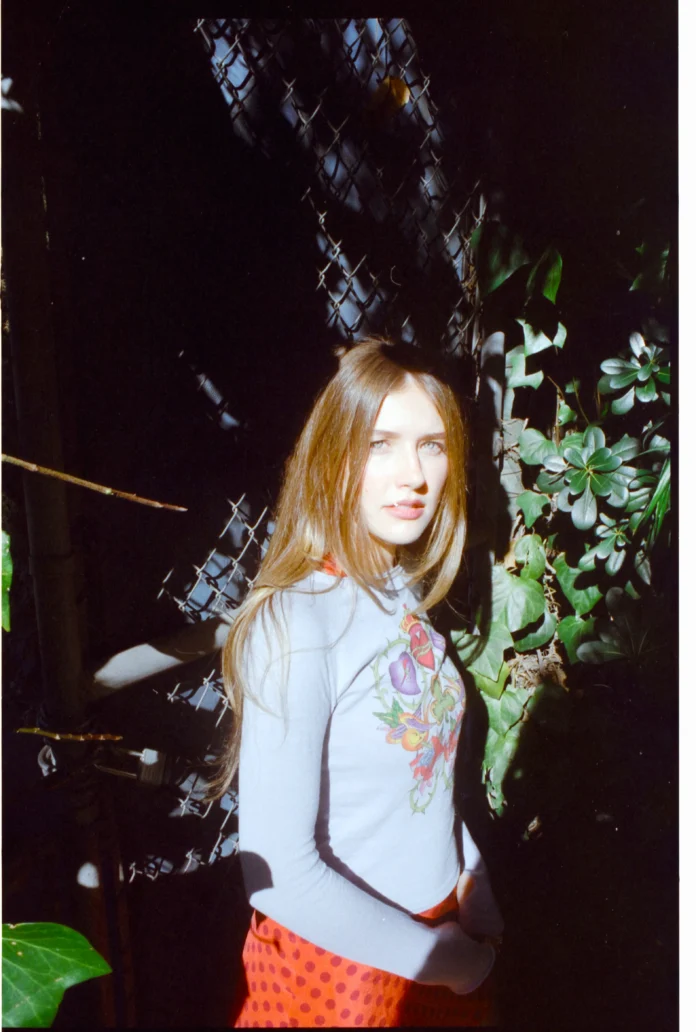
Hannah Cole is a Nashville-based artist who grew up in Covington, Louisiana. When she was six years old, her parents noticed she was musically inclined and enrolled her in piano lessons. While the support of a few elders was crucial to her musical upbringing in a small town, Cole was introduced to a competitive new world upon moving to Nashville, where she attended a songwriting program at Belmont University. She met people who grew up seeing way more bands than her, even played in them, including her longtime collaborator and partner Josef Kuhn. Following a series of EPs, beginning with 2022’s Cradle, the pair wrote and recorded Cole’s debut album, Switchbacks, at their home studio over the last two years. Even as an amalgamation of influences that includes Bully, Alex G, and Cocteau Twins – not to mention the heavier shoegaze bands the record’s mixer Sonny Diperri has worked with, from My Bloody Valentine to Julie – it conjures a well-defined, multidimensional sound most artists don’t arrive at until several LPs into their career, each song dynamically peppered with distinctive details. On Switchbacks, Cole peers into the future while treasuring the ecstatic moments of creativity on which it may depend, acknowledging that the promise of success is as fuzzy as memory itself.
We caught up with Hannah Cole for this edition of our Artist Spotlight interview series to talk about her earliest musical memories, the making of Switchbacks, going backwards to move forward, and more.
I was listening back to Cradle, and I realized enough time has passed since that EP that there’s a whole new Phoebe Bridgers album to be listening to while “laying face down” in bed, as you sing on ‘Guard Dog’. That record feels really joyful, not “ironically optimistic,” and I feel like you could say the same about Switchbacks, for all its heaviness.
Thank you, that makes me really happy. That’s really what I wanted, because when I’m writing music, I think about, “How do you capture the complexities of life – the fact that two things can be true at once?” That’s always something I’m trying to capture, this 360 view of something, because no thing is just one-sided; no thing is this black-and-white experience. I think with Switchbacks, there was this element of me trying to see the beauty in kind of an ugly thing.
When you think back on previous attempts at songwriting, do you feel like you were leaning more towards one side?
Yeah, for sure. Right now, I’m 25, about to be 26, and I feel like my brain is just now developed or almost fully developed. [laughs] I feel as though I see life in that not-so-black-and-white way. When I started putting out music, I was so young – even though it was just six years ago – and I don’t think I was as mature as I am now. But I look back and think that at that age, that’s kind of how you see the world. Someone hurts you, and you just hate them and think they’re a horrible person and evil, or this bad thing happens to you, and suddenly your whole life is horrible and nothing is going right. Or on the opposite end, you love someone, and you’re only in love, and it’s perfect.
It’s fun to actually have captured those things when I was younger, because that’s how you think when you’re growing up in your early 20s or late teens. Now, my eyes are just open to the world a little bit more. I’ve experienced different social dynamics and understood that if I am this person who can experience the pendulum swing of my life, my emotions, the way I feel about people, and the way people feel about me… it sounds obvious, but sometimes we get so in our own heads that we forget everyone else is just like us. All of us have this very complex world within us, and it’s important to be able to recognize that in yourself and other people.
Part of why I wanted to bring up ‘Guard Dog’, even though it’s an old song, is because you sing about wanting to hold your younger self. I feel like that’s a good segue into talking about the new record, because there was a moment in the process where you started watching videos of yourself as a kid playing piano and singing. Could you talk about the kind of memories and feelings that were unlocked?
There are so many layers to it. With ‘Guard Dog’, it’s interesting because in that song I talk about going back and wanting to hold my younger self, console her, and be like, “It’s okay, I know something now that I didn’t know back then.” On Switchbacks, it’s this thing of, “Oh wow, I knew so much back then, or I had so much confidence back then that I actually am lacking now.” There’s this sense of confidence you have as a kid that you lose a little bit, when you become an adult – when you take the rose-colored glasses off and either see the world for what it is or feel judgment or outside eyes on you for things that you’re supposed to be creative and free with. Music obviously is that thing for me where, when I was a kid, there’s videos of me at piano recitals, just getting up and singing so loud. [laughs] I’m not some child prodigy or anything, but it was just so funny because I was looking at these videos and I was like, “Wow, I look like I’m having so much fun.”
I’m so lucky that I had a piano teacher who was very encouraging of me writing and being very free and creative on the piano. I wasn’t one of those kids that could read all the sheet music and play all the classical music. It wasn’t natural for me, but I think my piano teacher saw a side of me that needed to break free of something. She was like, “You know what? I’m gonna teach you chords, and we’re gonna teach you songs that you hear on the radio, you can write songs. You can just have a little bit more creative freedom.” I thought about that, too, when making the record – not only just performing without fear, but also creating without fear.
When I was making this record, especially before I had more of a team and everything was on the up, things were looking pretty bleak for a second. I was like, “Is this even worth it? Am I really meant to be doing this? Are people really gonna hear this?” In Nashville, too, there’s so many people doing music, and you go on social media now, it almost feels like everyone is posting videos of them singing and doing music. I’m like, “Who cares about what I have to say?” [laughs] In asking myself those questions and experiencing all of those thoughts, I was like, “Oh, maybe this is the perspective people are curious about.”
I feel like there’s a thread on the record of having to go backwards in order to go forwards. On the record, it’s more so a memory from a few years ago of making music in this cabin in Asheville with my partner – making music just for fun, having a really fun time, and not being worried about being commercially successful, just doing it because it’s fun. I learned on this record that you often have to go back into memories or the past in order to go forward.
How long were you taking lessons? I know you started playing when you were six, but I’m curious how things developed until you moved to Nashville.
I did not grow up in a musical family at all. I really just started taking lessons because my neighbor took piano lessons and I thought she was super cool. And I always loved music. My mom likes to tell me that when I was in the womb, she would play music and I would [mimes fetal punching movements]. I loved to dance; my favorite song was ‘Hey Ya!’ by Outkast. So they knew I was musically inclined, but they were like, “What should we do about this?” When my neighbor was taking piano lessons, I was like, “Okay, that’s gotta be me.”
I really didn’t love it at first. I think I just have a thing about not loving when people tell me what to do [laughs] or that I have to do something. Being told you have to do this creative thing just feels contradictory to me. Even from a young age, I was like, “Okay, this is supposed to be fun – why do I have homework? Why do I have homework for music?” Obviously, to learn anything you need to practice, and I did practice, but I didn’t necessarily enjoy it. I would sit there with my piano teacher and just be like, “I don’t know if this is for me.”
I got a microphone for maybe my tenth birthday. Years had gone by, and I think somewhere in between there I had stopped taking lessons, but knew enough to play around here and there. Then I started watching videos on YouTube and learning by ear how to play songs that I liked on the radio or on CDs my parents had. I think my parents were like, “Oh, she’s pretty good at singing,” so they called my piano teacher back up, and we started doing lessons again. She was like, “I really hear potential in you, and I want to teach you chords. I’m not gonna make you read sheet music. You’re gonna learn chords. You can do whatever you want. I’m gonna sing with you, and we’re gonna do this in a completely different way.” We would sing together, and I learned how to harmonize.
I didn’t grow up playing in bands. I played with a couple of other piano students before, but I would only do recitals two times a year. I won some local singing competition – keep in mind, I’m from Covington, Louisiana, which is a small town outside of New Orleans. Are there the best singers in the world there? Maybe not, so maybe I didn’t have the toughest competition in the world, but I won this singing competition when I was 12. The prize was that I got to write a song and have it recorded, and then it was gonna be played on the radio. That was my first actual song that I wrote, and then I just fell in love with writing songs, of course. After that, I was going through the awkward teenage years, and I was like, “I’m not gonna do this for real. No one I know in Louisiana has done this.” It was so unfamiliar to me that I didn’t even know you could go to a city where people write songs for their job every day. I didn’t know that.
I actually went to a studio once to try to get singing lessons, and this guy, I don’t know if he thought I was not very good or something, but he said, “I don’t know if you’re ready to record stuff” – which, he was correct, I was a kid! But he said, “Are you familiar with the recording process at all?” I said no, not at all. That was my first introduction to Pro Tools and a DAW in general. I knew about GarageBand, but seeing how it looked in a studio, I thought it was really cool that this guy was like, “You should have an introduction to this.” I really fell in love with that side of music as well.
Later on in high school, I ended up getting a little Scarlett interface. I didn’t really know what to do. I was watching a lot of videos, my dad was trying to help me – he knows nothing about music at all – I’m like, “What is this thing? How do I use it?” My dad was like, “I don’t know, I’m pretty sure this is what you’re supposed to have.” [laughs] That was fun to figure out in high school. I would just record covers and songs that I’d written on GarageBand, and that was my introduction to recording.
It wasn’t until I toured Belmont University, where I ended up going to college, that I saw there was a songwriting program. There was also music business, and I was like, “Oh, this is my thing, I should probably do this.” But I was still kind of unsure. I auditioned for the program and got in. From there, I just wrote a bunch of songs, went to class, met a lot of people, and was exposed to a lot of different types of music in college that I was just not really exposed to in high school. I didn’t even play with a band until I was 21.
When you were getting into recording and songwriting by yourself, do you remember craving being in a band at the time? Or was it more so later on, when you met other people that grew up in places with bigger music scenes, that you wondered what that might have been like?
Yeah, I think it really wasn’t until I was exposed to that in college that I was like, “That is something I want to do.” It wasn’t even until I first played with a band that I was like, “This is so awesome, and I don’t like being alone on stage.” Especially with the band I have now – people that I really trust, who are always so prepared, so kind, and so excited about the music – that’s when it feels the best to play with a band. In Nashville, everyone plays in each other’s bands, so sometimes it’s hard to land on people who want to play with you, like your music a lot, and want to experience that. I feel like so many people I know have so many years on me in terms of performing with a band and playing live or playing shows in general. I feel like I’ve just now gotten the hang of it, honestly. It takes a really long time to feel comfortable, and I still don’t feel all the way comfortable.
When you realized that it was a viable career path and that it was possible, were you set on following it no matter what?
I think it truly goes back and forth. There are moments when I have so much confidence that this is what I am absolutely meant to do. At my core, I’m like, “I know that I’m good at this,” and I feel that from other people, too. But there’s always that questioning in my mind every now and then. In music, there are so many high highs and low lows that it’s kind of impossible for me personally to have this consistent thought of, “I am a thousand percent meant to be doing this.” There are days that I feel that, and then there are days that I don’t. Going into college, I probably had a little bit more blind optimism, like, “I’m gonna be fine, this is gonna be easy!” [laughs]
“Ironically optimistic”?
Yeah, exactly! I was just like, “I’m great.” Of course, looking back, I’m like, “Wow, those are some of the worst songs I’ve ever written.” Thank God they have you writing so much in college – you get all of the horrible songs out of the way. But at my core, I know that music is always gonna be the thing that makes me the happiest, so in that case, I’m meant to do it. But I can’t say for sure – just because I’m meant to be doing it doesn’t mean that it’s gonna happen for me. That’s kind of where my head is at.
Do you feel like you got more out of the business or songwriting lessons in college? What was it like trying to balance those things?
With the songwriting thing, I know a lot of people leave a program being like, “Okay, that was a waste.” But for me, it really was the repetition of writing so much, and then finally having a teacher be like, “Okay, I think this song is a perfect song,” where I felt like, “Oh, I’ve cracked this code.” Or just learning little lessons over time – like in a song, maybe you should show instead of tell, use specific imagery, don’t use cliché phrases. Little rules like that were really helpful, along with the sheer repetition of writing so much. Having the music business background gave me a good general awareness, although I do think you really don’t know until you’re actually experiencing the industry firsthand. Meeting so many people that also did music really helped me a lot.
Jos and I met in audio engineering class, and we became friends and shared this bond over music that we really liked. I think meeting other people that I could see were kind of on the same level as me, in terms of either what we were making at the time or what we liked, you kind of see the people that you know you’re gonna work with. There’s a lot that I don’t love about living in an entertainment city or a music city, but there are pros and cons to almost everyone doing the same thing as you – to know that you’re always meeting at least a couple people that are at the same point in their musical journey as you that you can rise together with: that’s the goal.
How do you feel like that experience changed your relationship to your hometown?
I really love my hometown. I love Louisiana. I love New Orleans. I know I grew up a little bit outside of New Orleans, but I was always in New Orleans, and I think what’s cool about a city like that is that there is music everywhere, but not everyone is trying to do it as a career. When I’m walking down the streets of New Orleans and I see people playing drums on the street or playing trumpet, you can hear jazz bands playing in restaurants and bars – seeing people do something that is so joyful and just makes them happy is really inspiring. I think Nashville isn’t even the most uppity, entertainment-buzzy place. LA is probably a little bit more intense when it comes to that, or maybe New York. But Nashville can still feel a little bit competitive, or a little bit inauthentic or network-y. I think that I’m so lucky to have grown up in a place that wasn’t like that at all. Being here makes me appreciate my hometown so much, but also, I couldn’t imagine being there forever. I don’t think that music as a career could work from there. But going back there feels like this break from the music industry scene.
Tying this to record, there’s a lyrical juxtaposition between ‘MMA’ and ‘Give’, where you sing about cutting and pasting magazines into a poster, and then actually seeing yourself in a poster – the difference between idolizing to projecting, in a way.
I’m so glad that you pointed that out, because actually, that connection between those lyrics is something I hadn’t even really thought about until a couple months ago. I was talking about it with Jos, and I was like, “Oh!” Sometimes you’ll write songs, and your brain will think of things or make connections before you even try to. With ‘MMA’, that lyric was me showing almost this manifestation of something – I think back to making vision boards with my sisters, cutting up magazines, putting them on a poster board, and kind of planning out this vision for your future, your dreams, and your goals. And with ‘Give’ being like, “I actually see myself on this poster.” I see myself; I can see myself becoming the thing I’ve always wanted to be, and I’m getting closer to that. I see myself doing that, but there’s still this barrier there, not only in terms of reaching the goal, but seeing my real self; remembering that me on a poster isn’t necessarily me. There’s still that barrier between me – the real me – and this kind of star, I guess.
Was there a kind of vision board for Switchbacks, when you were starting to conceptualize it?
Honestly, not at first. I think it’s actually quite helpful to do that when it comes to music making. I did that more so on the visual side of things, which I think reflects the music very well in terms of this almost fever-dream type of visual. I feel like ‘MMA’ was the first song that we made that set the standard for the rest of the record. Even that crazy snare or the jingle bells – I think that was the first song where I realized that I wanted each song on the record to have at least a couple of distinguishable elements. So that was kind of the vision that I didn’t fully realize until making probably ‘MMA’.
You talked about seeing your real self, which I think also relates to this theme of how you’re perceived or misperceived externally in the scene. ‘Mechanical Bull’ is a song that really wrestles with that.
Especially with what we did production-wise, I did want that song to feel almost like I was being muffled a little bit. Even with the image of a mechanical bull: not only is it alluding to Western/Nashville culture, but also I think there’s an interesting perspective shift in that song where I’m like, “I don’t wanna be the bull. I’m gonna ride the bull. I’m gonna grab the bull by the horns,” which is a thing, but then you realize it’s mechanical, and there’s someone else that’s actually controlling this behind the scenes. Sometimes, no matter what you do, how hard you try, or how much control you think you have, a lot of times you just are not in control of the way that people see you.
As a woman in the music industry, that’s just the personal experience I’ve had, where there’s a lot of accepting and moving on, which kind of sucks. There’s a lot of, “Damn, I have to accept that that person thinks that about me.” This person doesn’t think that I write my own songs, or they don’t think that I play any instruments, or they don’t think that I’m an equal to my partner who also does music. But I have to put that energy back into the music, let the music speak for itself, and accept that – it’s weird, you can accept something and also advocate for yourself and rebel against something. I wanted to portray this complexity of doing the same thing as my partner, having the same job and same career, but being perceived by men in the industry as “the girl” or “the girlfriend,” which has happened multiple times.
The word “muffled” feels true for that kind of acceptance, too. Your voice being effected on that song speaks to this point that you’re getting across, but it also comes into contrast with a song like ‘Mosquito Hawk’, where your voice is really clean and unfiltered. You really tap into that almost childlike purity that we were talking about. You’re playing the piano, you’re stretching the song out, and it’s this almost contained picture of two musicians creating.
I remember that song being one of the first ones that I wrote for the record, actually. But we didn’t land on the full production or anything until much later. I want to say it was one of the last ones that we ended up finishing. I really wanted to make something with that song where people had to stop and slow down for a second. For myself, where I was at in life was that I needed to kind of stop and remember this beautiful moment that made me fall in love with music again, and understand the connection between romance and music, and how there is this kind of love story with anything that you’re passionate about. What’s interesting to me about the record is that a lot of the songs can be listened to almost as relationship songs. You can go back and be like, “Oh, that sounds like it could be about a toxic relationship,” like in ‘MMA’, never knowing when to leave. I started to realize the connection between my personal romantic relationship and my relationship to music, and how with anything that you’re in love with, or anyone that you’re in love with, you have to accept the changes and the peaks and valleys of a person or of the thing that you love the most.
With ‘Mosquito Hawk’, I wanted to make this beautiful, slowcore anthem for myself. I think what’s super beautiful about that song is the reverse tape that you hear in the beginning, and also before the last chorus there’s this intentional reverse tape sound, because it’s supposed to signify me going backwards into this memory.
There’s almost this cycle of falling in and out of love with music, from the moment you started playing piano to this memory of making music in Asheville. What do you see as the common thread there? Is it the same story that’s bound to happen over and over again, or does it keep changing in some way?
I think that this falling in and out of love with music is something everyone can relate to in whatever they are passionate about. I think that’s a common theme of life. There’s this constant death and rebirth, almost. That is how it feels a lot of the time to do music, and to pursue success in general, but especially in music. I think you can experience this as a kid: that eerily beautiful feeling of being really nervous going on a stage, performing, feeling a dopamine rush and like it’s the happiest you’ve ever been, and then coming off stage and experiencing the emptiness.
I think you can see that across not only this record, but across any artist’s journey. You constantly have to reinvent or change your way of thinking, but also experience this trippy feeling – for me personally, an example is I opened for this band called Silversun Pickups last year. Those were the biggest shows I’ve played, I think. I remember going on stage and being like, “Wow, this is awesome,” this high of people telling you you’re awesome, telling you you’re special, and clapping for you. You try to soak in those moments, and then I go home and it’s like, “Okay, time to do my laundry, go babysit, go grocery shopping” – doing things that are good, but the normal things start to feel like, “Where’s that rush of excitement?” It can also can be this long phase where it’s like, “Ugh, I feel like I’m so bad at this, and no one’s ever gonna care” for months at a time. Then you have three months of rolling out an album, and you feel all the exciting things. There’s just this huge pendulum swing when it comes to the way that I feel about making music.
I think the record makes the slowing-down part sound equally beautiful and joyful in some ways. I think about the opening title track that slows down and then picks itself up, almost like a car losing speed while driving up a mountain range. That’s the feeling, but you’re still soaking in the beautiful view.
I really appreciate you picking up on these details, because it is so intentional. Even pairing that with words like “I’m ready to go home.” It’s like, I’m ready to feel that feeling of being home, back to a time that was simple, joyful, and slow.
Could you single out a memory of making this record that felt really joyful or encapsulates it in some way?
In general, it’s so nice being in kind of a bubble with my partner and collaborator, Jos. What’s interesting about this time around making this record was that it was actually quite challenging. We’re very close, and we’re very honest. Sometimes when you’re honest, even if you say it in the most graceful way, it still can be like, “Oh!” [laughs] I want to say making ‘Give’ was pretty euphoric. I remember us putting the microphone out in the hallway, and Jos and I did these crazy, funny background vocals for the song – making this weird voice, I don’t even know what you’d call it. I was trying to sing in my deepest man voice, and we were singing together.
We went back into the studio, and our friend Henry was playing guitar, and I just remember cracking up laughing and having so much fun. Jos says something in the beginning of ‘Give’ – I don’t know if you can hear, there’s a little bit of talking in the beginning. You shouldn’t be able to hear what he’s saying, but he says something about his fingers being sweaty or something, and we kept it on the track. That would be crazy to make it clear, but it’s like a personal inside joke that we included in the record.
It took so long that the memory’s a little blurry, but one thing that stood out to me in general was the way that Jos is such a selfless collaborator – someone who really wants to make an artist shine, and their voice shine, and their ideas shine. I’m really grateful that Jos is not a selfish collaborator or producer by any means. I think there are a lot of people or producers in the music industry that take the reins and don’t let them go. This was one of the first times where I felt like I was confident enough to voice my ideas across the whole record, and he just accepted all of them fully and was like, “This record’s gonna sound like you.” I couldn’t do it without Jos, but I think he would say the same thing about me. Having it be such a collaborative process was not only so beautiful for regaining my own confidence in myself, but making something so special with someone you love so much is also just a really awesome thing.
This interview has been edited and condensed for clarity and length.
Hannah Cole’s Switchbacks is out now via Tight Knit.

