

When we think of marking the skin, we may envisage a tattoo with the name of a loved one or an aphorism written across the arm, but the concept of tattooing dates back to some of the earliest humans whose mummified remains we’ve discovered, stretching thousands of years to the last Ice Age.
Likewise, when we think of wearing animal products such as leather, it feels divorced from the animal it comes from. However, our earliest ancestors used animals’ hides and skins for protection, comfort and warmth. It’s these two technologies that stretch back beyond the dawn of civilisation that Bilge Yildiz combines in her artworks.
By tattooing on animal leather, she creates surreal scenes that probe our psyches, examining universal concepts such as the passage of time, facing our fears, and the regular rebirths we undergo as we evolve as individuals. By using a technique associated with permanence on a material that itself carries the memories of a life lived, these works carry more weight than they would if painted on canvas.
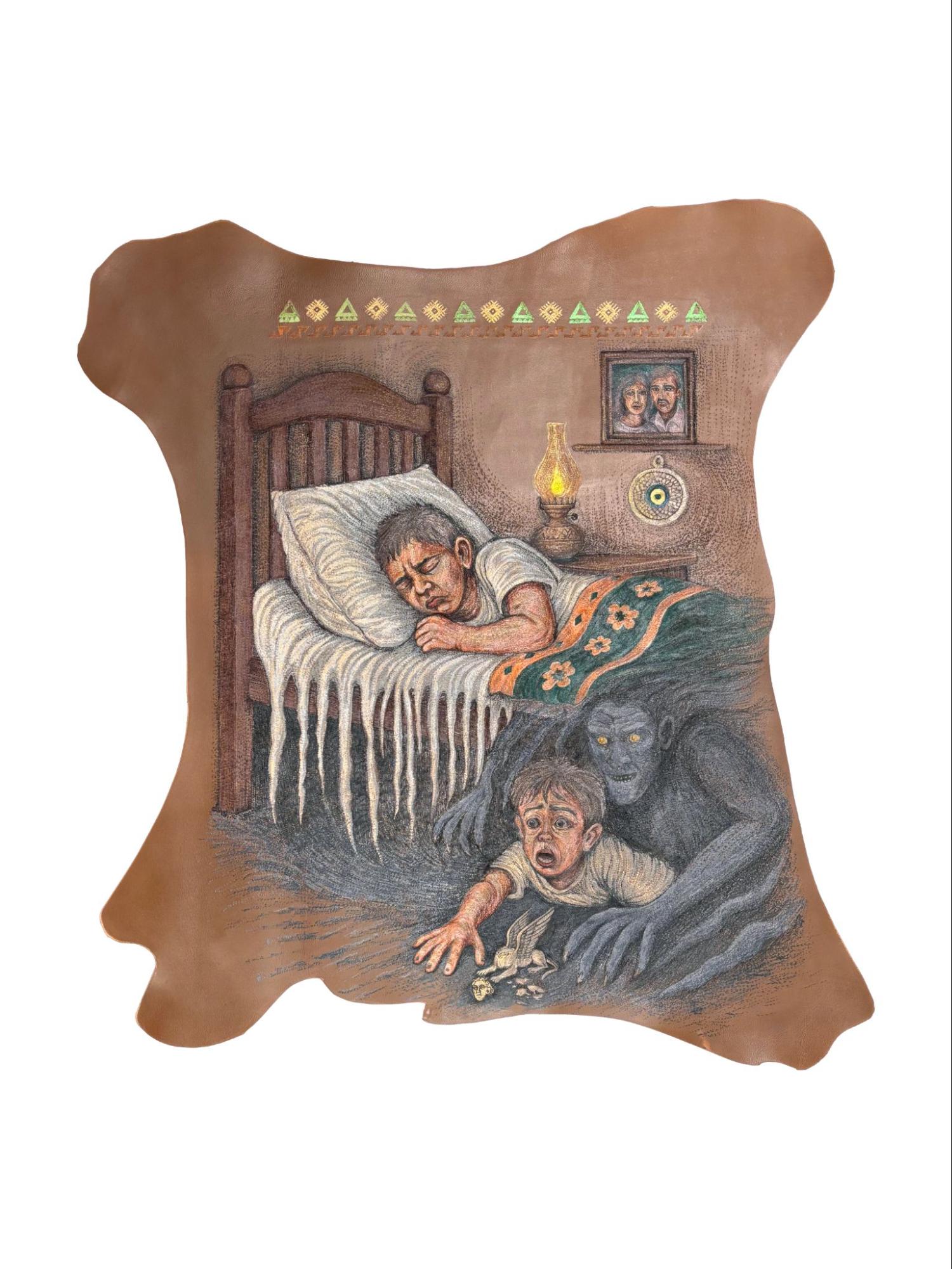
We carry forward dreams and fears from childhood, and we can see this in the works ‘Little Princess’ and ‘Oedipus Nightmare’. In the former, a little girl playing with a toy plane dreams of becoming a pilot, while the latter is much darker: a young boy has a nightmare as a demonic creature emerges from the dark to drag him away from his toys. It feels like a manifestation of growing up, as life sweeps us away from our childhood naivete, and the worries of the world and the act of forging a life for ourselves feel terrifying.
This carries forward in the work ‘Black Mirror’, where we see references to history, with the accusing men reminding me of the witch trials of the Middle Ages, and contemporary references to smartphones keeping their hold on us, here imagined as a chain. The dark imagery reminds me of Henry Fuseli’s The Nightmare, where an Incubus sits atop a sleeping woman.
The surreal scene of ‘Fruits of Time’, where an older woman sees her younger self in the mirror, brings to mind ‘The Two Fridas’ by Frida Kahlo, where she incorporated two versions of herself, and as that referred to two identities at one time, this imagines the same across a lifespan.
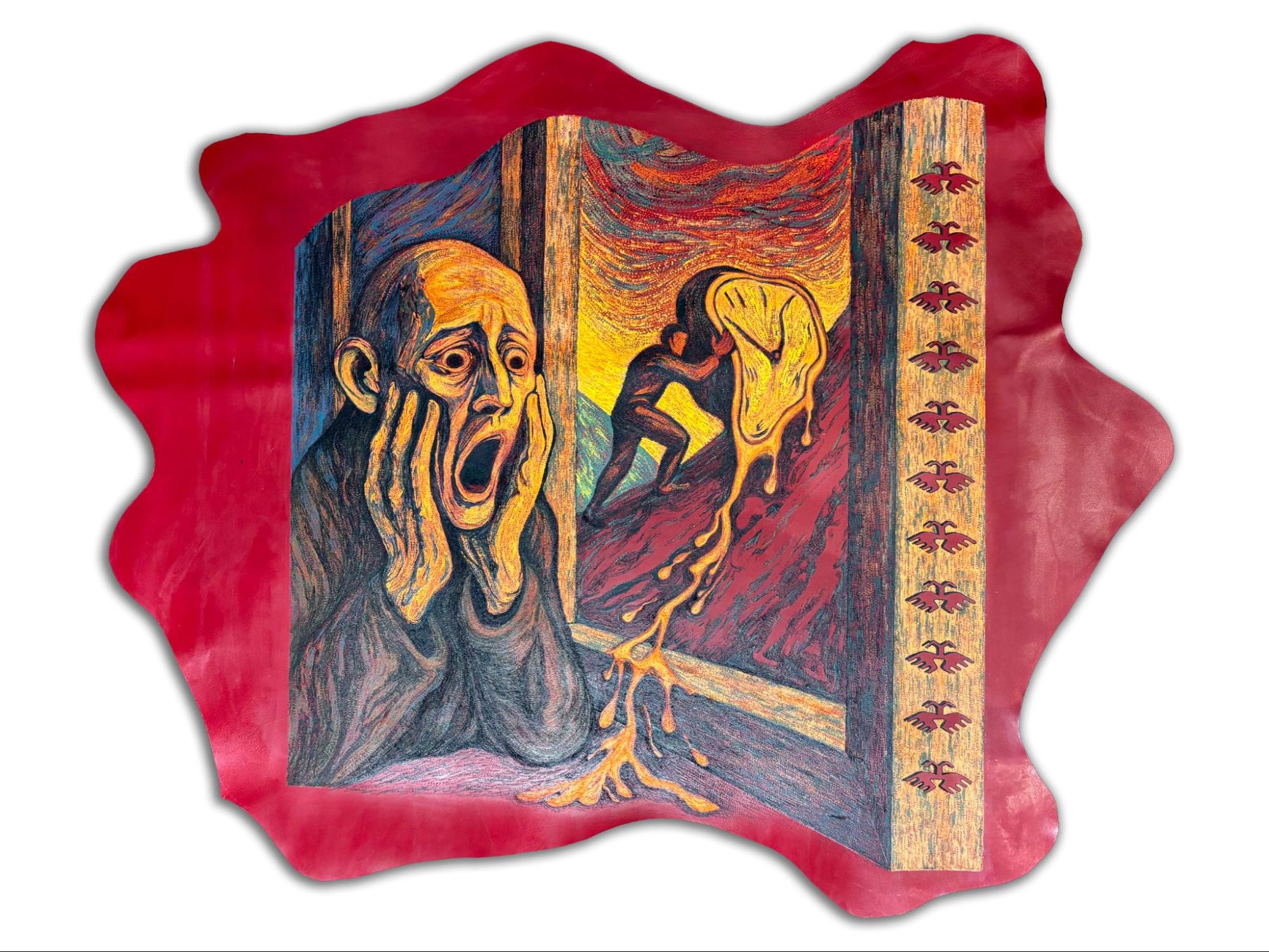
One of the darkest works is ‘Catastrophe’, in which a screaming man indoors evokes Edvard Munch’s masterpiece ‘The Scream’ and Francis Bacon’s screaming Pope. The melting clock outside evokes Salvador Dalí’s work, which also addresses memory and the passage of time. In Yildiz’s work, the man attempting to push a melting clock up a hill feels like an allusion to the myth of Sisyphus trying to repeatedly push a boulder uphill. Just as we all may try to hold back time, but will ultimately fail, as famously, time waits for nobody.
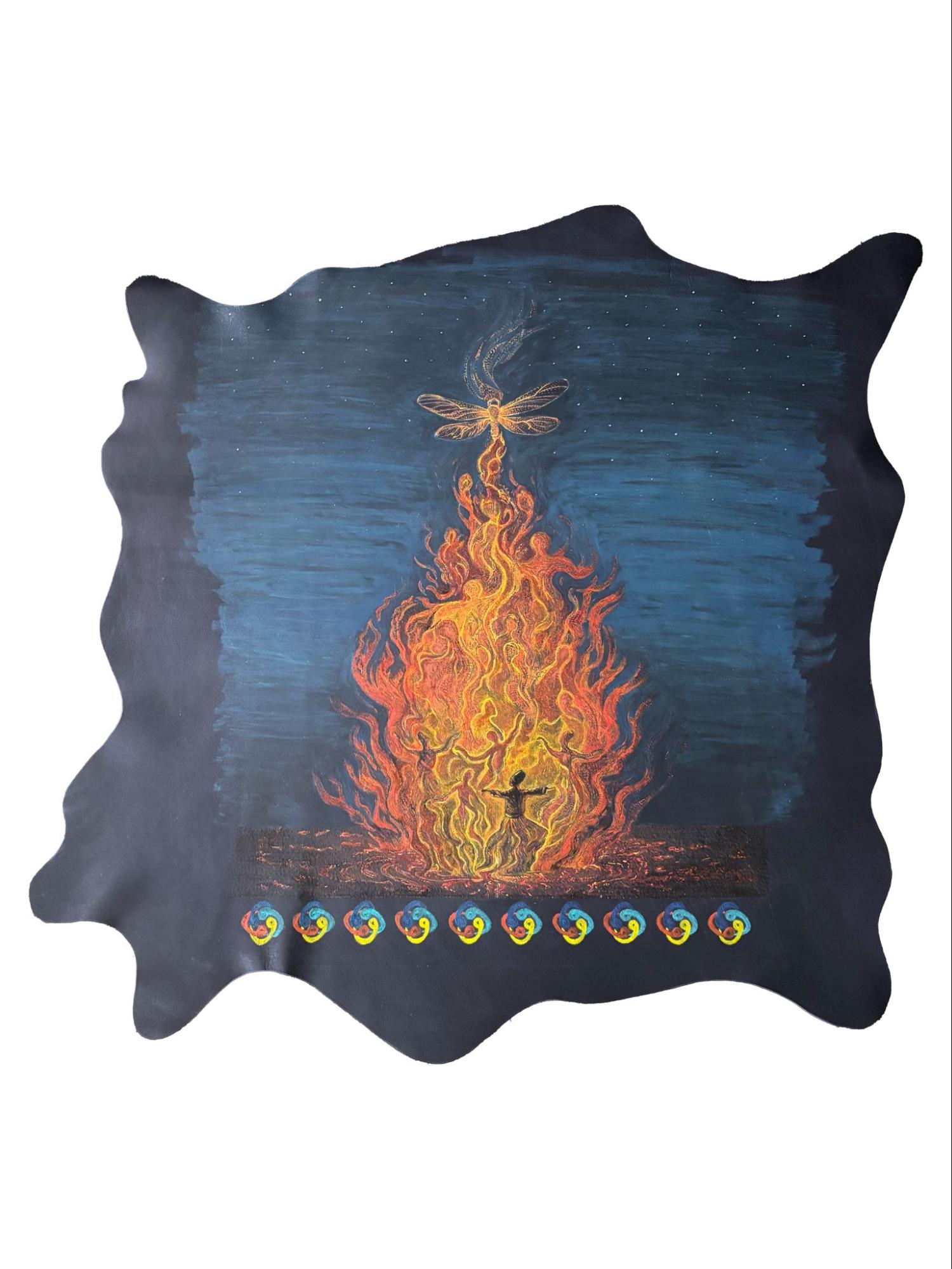
In her London selection, it was natural for her presentation to end on the fiery rebirth of ‘Be…’. It’s a marker for how we all change throughout life, but also symbolic of the artist’s journey working with leather accessories and footwear, and in the design industry before gravitating towards art.
Bilge Yildiz presents unsettling and dreamlike visions in her artwork, and through them she asks us to accept that scary moments are part of being alive, that we must pass through times and events that disturb us to find out who we are and what our place in the world will be. Combining these themes with her unique medium is what sets her apart from other artists who may cover similar themes but would never think to tattoo them onto animal leather.
More information about Bilge Yildiz’s practice can be found on her Instagram.

