

A club photograph from 2008 announces itself before you read the caption. Bleached faces. Black background. Someone’s arm blurred across the corner of the frame. The flash did all of it.
For two decades, that hard, direct burst was how a night out looked afterward, and photographers built careers on it. Then it stopped being compulsory. Scroll through nightlife photography now, and the pictures are warmer, murkier, tinted whatever color the room happened to be.
Same subject: a crowded bar at 1 am. What changed is where the light comes from, and the reasons are half technical and half a shift in what we want to remember.
Why Direct Flash Defined an Era of Nightlife Photography
Nan Goldin’s The Ballad of Sexual Dependency is where it all starts. The 126 images ran as a slideshow before Aperture published them as a book in 1986, and every one of them is flash-lit.
Goldin has said she had no real knowledge of light at the time because she lived by night. The pictures are unflattering and close, and they are honest because of that rather than despite it.
Mark Hunter launched The Cobrasnake in 2004 and turned the same tool into a nightly document, uploading hundreds of unedited flash photos the morning after a party.
Nobody had much choice. Film stock and early digital sensors could not record a dim room without help, so the flash was the price of admission. It did something social too. A flash announces the photograph. Everyone within a few meters knows a picture just happened, and they adjust. The flash lit the party and took part in it.
How Cameras Learned to Shoot Low Light Without Flash
The technical shift is easy to date. Early digital SLRs turned to much above ISO 1600, so shooting a dark venue without flash meant accepting a file you could not use. Sensor design improved through the 2010s, and a current full-frame body handles ISO 6400 with detail intact, often far higher.
Fast primes also got cheaper. An f/1.8 lens gathers roughly four times the light of a kit zoom at its widest setting, which is the difference between a usable frame and a wasted one. Mirrorless added the part that matters most in a dark room: the viewfinder shows the actual exposure before you commit.
None of it made low light photography free. High ISO still costs color depth and fine detail. What changed is that the cost stopped reading as failure. Grain became texture. A soft, noisy frame signals that someone was in the room rather than staging it afterward.
How Venue Lighting Became the Photographer’s Palette
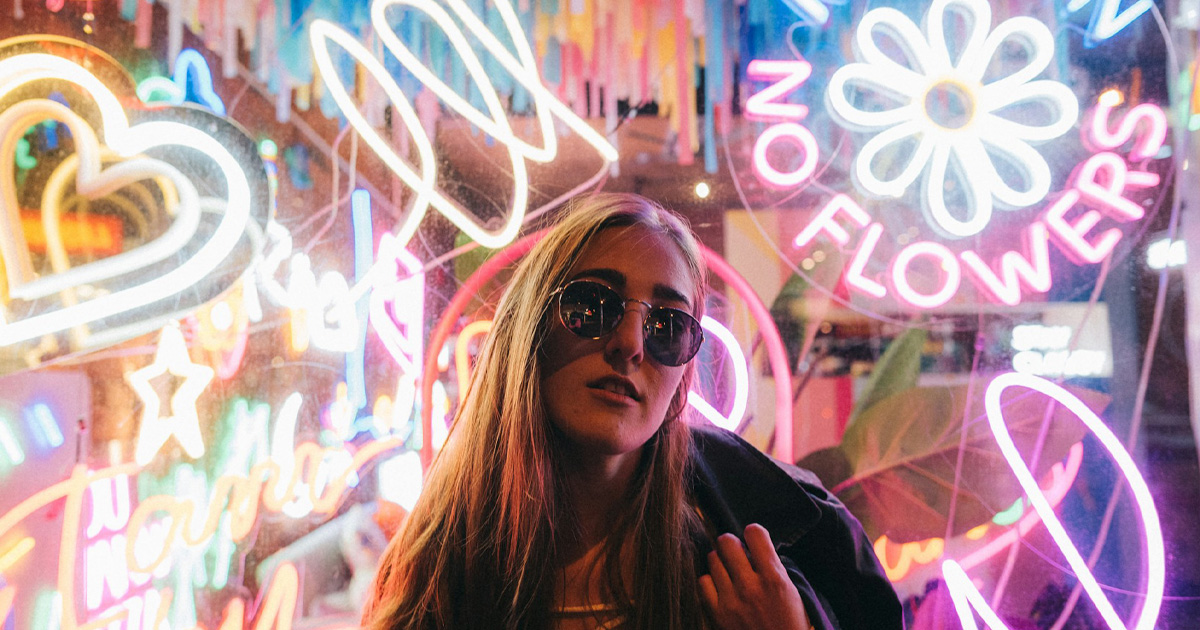
While cameras were learning to see in the dark, the dark was getting more colorful. Bars, clubs, and restaurants moved to LED through the 2010s. US Department of Energy figures put LEDs at 8% of installed lighting units in 2015 and roughly half by 2020, making saturated color cheap to install and run. Wash lights, strips under bar counters and LED neon signs mounted behind the till put continuous coloured light into the room at roughly the height a photographer needs it.
That handed available light photography something it never had: a coloured key light, already positioned, already part of the scene. The photograph inherits the room’s identity. It is why a picture from a particular bar is often recognizable without anyone naming it.
Continuous light changes the mechanics too. Flash freezes motion whether you want it to or not. Ambient light hands that decision back through shutter speed, so a raised glass can be sharp or smeared.
Reading Color Cast Before You Raise the Camera
Mixed sources are the real challenge in a venue, and they explain why so many nightlife photos come back with off skin tones. One room can hold four color temperatures at once, and no white balance setting can correct them all.
How the common sources behave on camera:
- Filament and tungsten bulbs, around 2700K. Warm and forgiving, with a color rendering index close to 100, the easiest light in any venue.
- Glass neon. Gas discharge emits in narrow bands rather than across a spread, so saturated tubes clip early. Only the red-orange ones are actually neon; other colors come from argon, krypton, mercury, and phosphor coatings, which is why some glass photographs far more easily than the rest.
- LED strip and LED neon. Steadier and broader in output, so much easier to balance. Fixtures switching below roughly 1 kHz will show up as banding at fast shutter speeds. Above about 2 kHz, it rarely appears at all.
- Sodium street lamps through the window. The low-pressure type sits at a single orange wavelength. The high-pressure type is broader but scores around 20 on the color rendering index. Neither is fixable in editing.
- Phone screens. Small, cold, and held close to the face. A fill light nobody planned for.
The color rendering index, the 0 to 100 scale for how honestly a source shows color, covers most of the rest. One catch: the headline figure averages eight test colors and leaves out R9, the saturated red that governs skin tones. A fixture can score 90 and still make a face look wrong.
Venue owners pick their colors for reasons that have nothing to do with cameras, drawing on established thinking about how specific colors shape a room’s mood. Photographers borrow that work whether or not they mean to.
Rooms Are Being Lit for the Camera Now
The loop has closed. Venues install lighting knowing the room will be photographed constantly, which is why so much signage now sits at seated head height against a clear wall. Listening bars have gone the other way on purpose, keeping levels low so the space resists being flattened into content.
Private events got there first. Illuminated lettering at weddings and private parties exists partly because somebody worked out that a warm source behind the dance floor does more for the photographs than any uplighting.
Flash never actually died, which is the part most accounts of this get wrong. It stopped being compulsory, then came back as a deliberate choice. The indie sleaze revival of the early 2020s put direct flash back in rotation as a style, though Vice has argued the revival is more echo chamber than real scene. Flash is now a decision, not a default.
There is a trade-off underneath this that photographers still argue about. Flash gave you consistency: you brought the light with you, and a difficult room could not ruin the shoot. Working with whatever the venue provides means accepting that a badly lit bar will produce badly lit pictures, no matter what camera you own.
What you get back is why the shift stuck. A flash tells the room a photograph is being taken. The room’s own light announces nothing, which is why the pictures look closer to how the night actually felt.

