

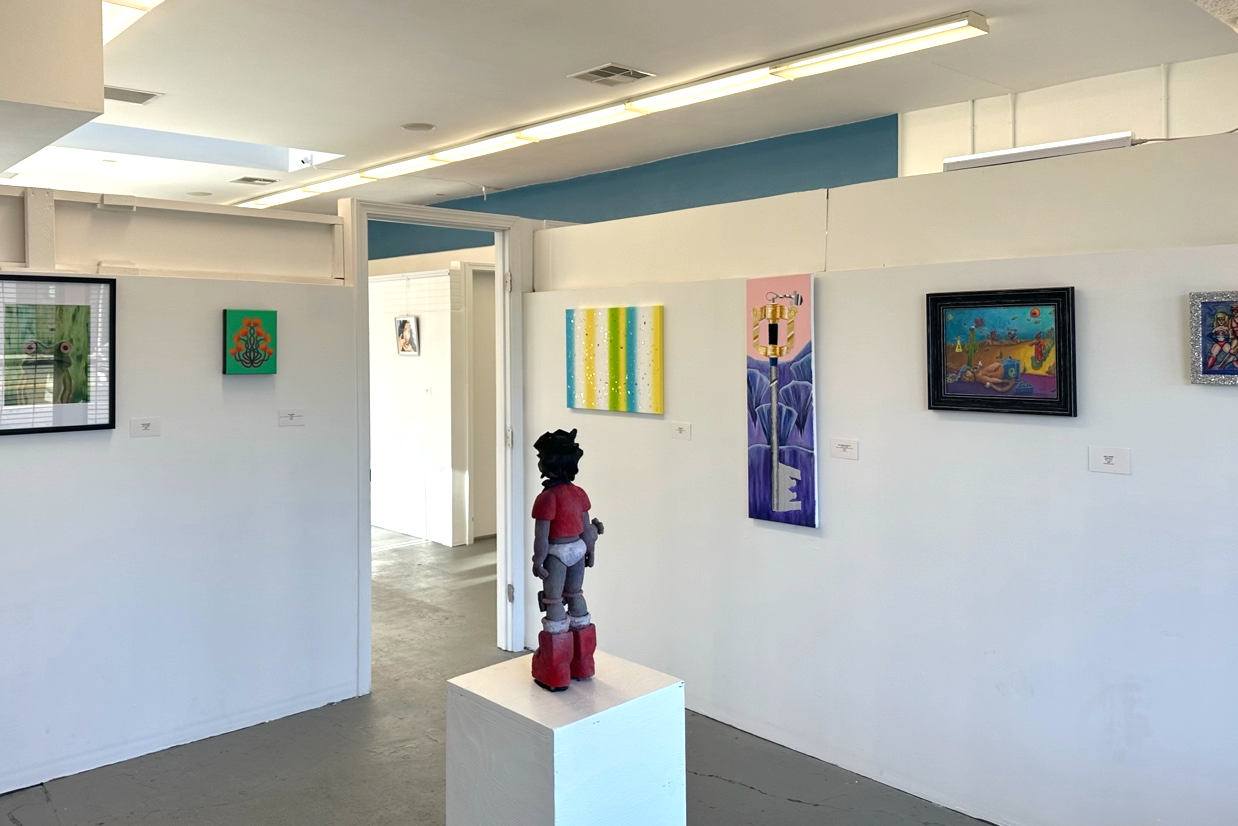
On September 4, 2026, The Awakening Magazine: Volume 8 Exhibition opened at Chapter 30 Studios in Oxnard, California, bringing together a selection of artists featured in the magazine’s eighth volume. The month-long exhibition presents works across diverse media and artistic practices, exploring how personal experiences shape perceptions of memory, identity, and emotion. Together, the works offer distinct perspectives on the relationship between individual experience and broader questions of human connection.
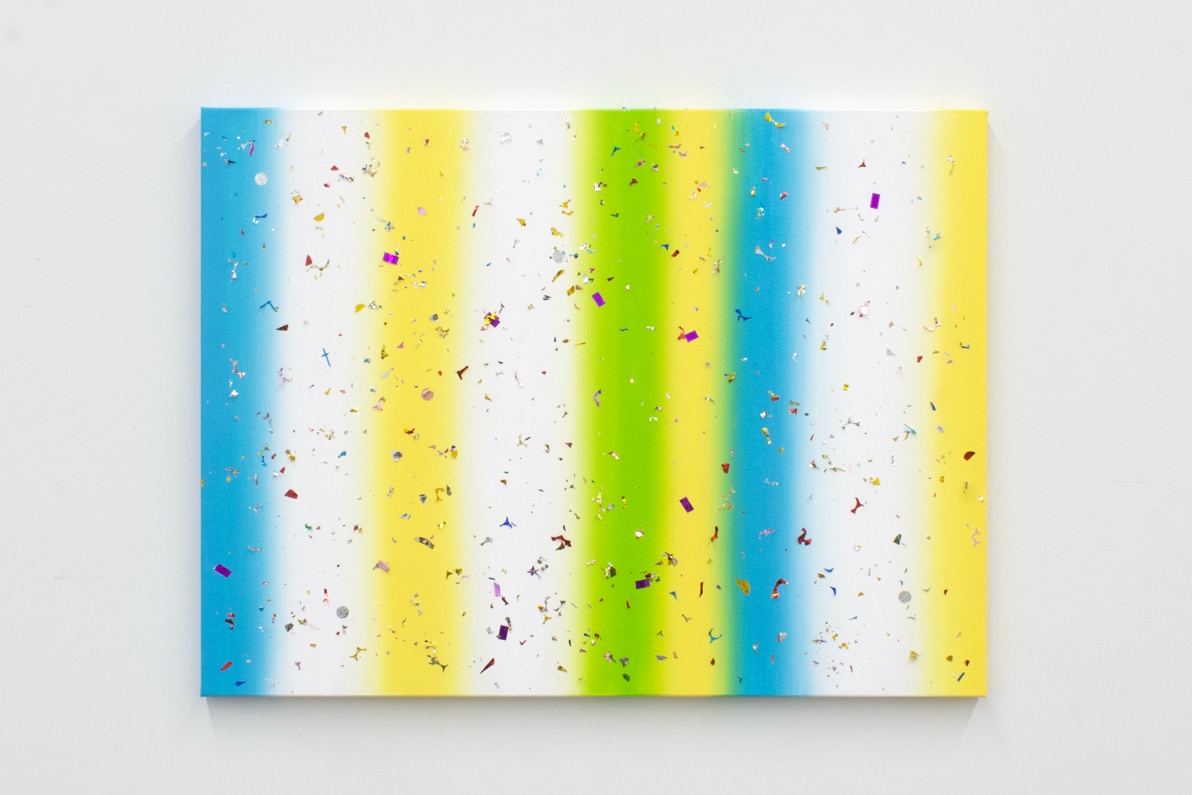
Among the works on view is Beach Day, a 2026 mixed-media painting by interdisciplinary artist Zengjie Chai. Made with acrylic and confetti on canvas, the work draws from time Chai spent at Los Angeles beaches with his partner. Its composition begins with an ordinary object from those outings: a beach mat patterned in blue, yellow, and green.
Chai loosens the mat’s stripes into vertical fields of color that hover between landscape and atmosphere. The mat remains the visual source, though its identity recedes as the softened bands take on a more atmospheric role. They reconstruct something less concrete: the sensation of being near the coast. Color, rhythm, brightness, and spatial ambiguity take the place of a recognizable shoreline or identifiable Los Angeles landmark.
That distance from literal description gives the painting room to operate before its autobiographical source is known. The colors register first as an environment rather than an illustration of a specific place. Learning where they came from adds intimacy to the work without closing down the viewer’s own associations.
Confetti introduces a second visual register. Seen up close, the fragments catch and redirect light across the painted surface, producing a flicker that recalls sunlight moving on water. Their physical presence interrupts the smoother gradients beneath them, giving the canvas a changing texture as the viewer’s position shifts. Chai has associated confetti in his broader practice with joy, celebration, and the immediacy of the present moment.
Here, the material does more than reinforce the painting’s brightness. Confetti usually belongs to a brief moment of celebration, yet in Beach Day it is fixed permanently to the canvas. That tension gives the surface an undertow: pleasure is made visible, but so is its instability. The effect is especially resonant within a work shaped by queer intimacy and by the uncertainty that can accompany diasporic experience.
That relationship between autobiographical experience and formal transformation extends across Chai’s broader practice. Originally from Hangzhou, China, he studied media at the University of California, San Diego and later completed an MFA in Art at California Institute of the Arts. His work spans performance, video, installation, and painting, often drawing on lived experience to examine intimacy, identity, and social structure.
The gradients in Beach Day connect the painting to an established element of that practice. In earlier works, Chai has used gradient fields to suggest “in-between” spaces formed across Chinese and American geographies and cultural contexts. In Beach Day, that ambiguity remains, but the addition of confetti shifts the emotional register.
From a short distance, the painting reads first through color. The blue, yellow, and green bands carry the familiarity of summer and the coast, while the confetti initially registers almost as reflected light. Only on closer inspection does the contrast between painted gradient and attached material become more pronounced. That shift between immediate recognition and slower looking is one of the work’s more convincing qualities: the image appears simple at first, then gradually reveals how carefully its atmosphere has been constructed.
Beach Day also extends Chai’s continuing examination of Los Angeles, a subject that appeared in his solo exhibition We Will Always Have Los Angeles earlier in 2026. In that body of work, the city became a framework for thinking through intimacy, belonging, personal history, and emotional attachment. Here, Los Angeles appears indirectly, carried through a beach mat, a repeated routine, a relationship, and the sensory residue of time spent near the coast.
That indirectness suits the painting. Chai does not attempt to summarize Los Angeles or turn a private memory into a fixed symbol. Instead, he reduces the experience to color, material, light, and rhythm, allowing the painting to retain the specificity of its source without becoming illustrative. The balance is strongest when the autobiographical and formal elements remain equally active: the memory gives the work emotional precision, while the visual restraint prevents that memory from dictating a single reading.
Within The Awakening Magazine: Volume 8 Exhibition, the painting’s modest scale and familiar materials stand in contrast to the tension created between softened gradients and reflective fragments. Its surface becomes less settled the longer it is viewed. Intimacy, pleasure, uncertainty, and impermanence remain present together, without resolving into a single message.
The painting ultimately depends less on narrative explanation than on the viewer’s changing encounter with its surface. A beach mat becomes color; confetti becomes both celebration and interruption; a remembered afternoon on the Los Angeles coast is held in the shifting relationship between painted surface, reflected light, and material.

