

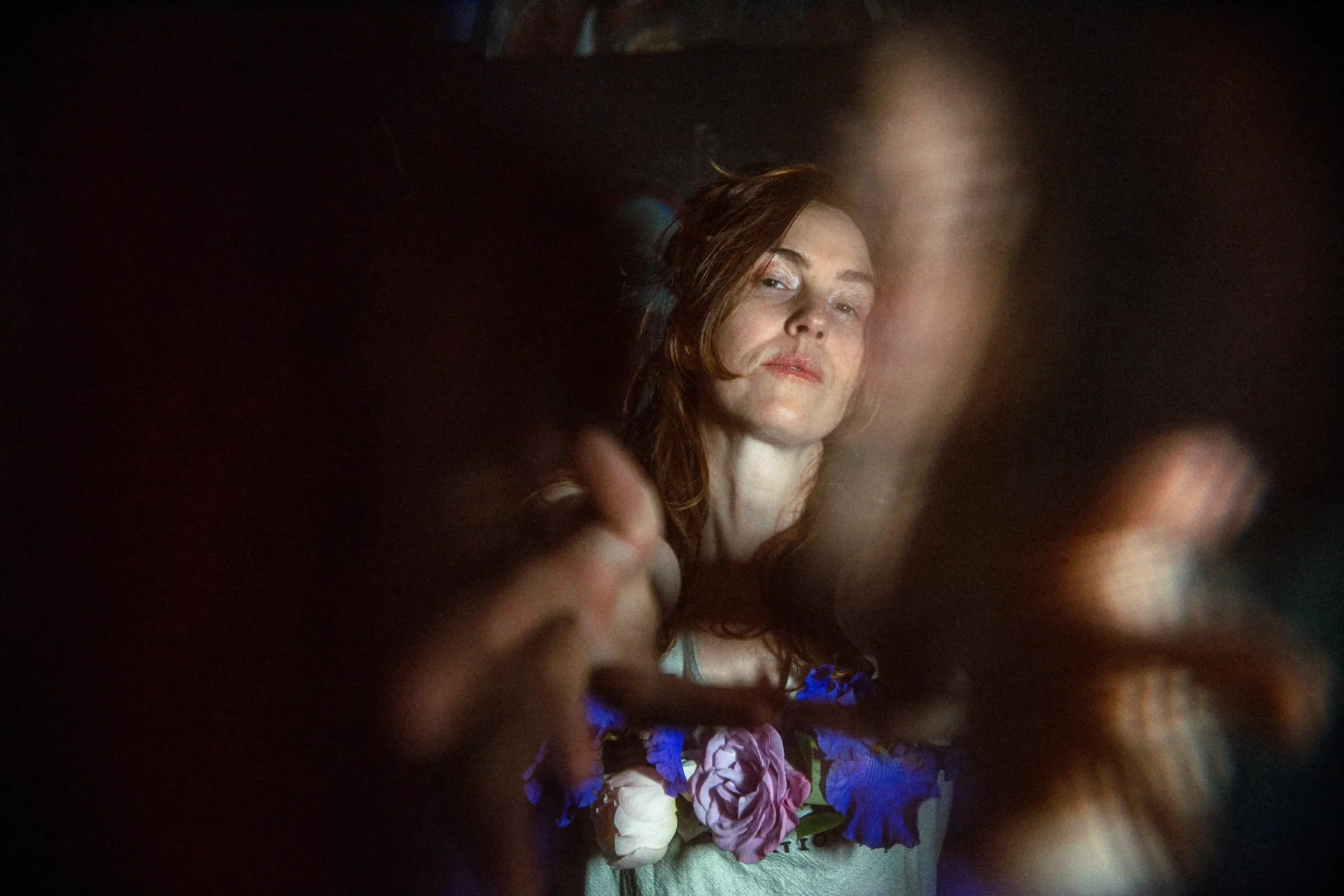
“What will we live for beyond the valley of the shadow of the fear of all men?” That’s final question on the last track of Emma Ruth Rundle’s new album, These Killing Times, and hushed as ‘Oceans of Time’ may sound, it certainly doesn’t resign itself to a life of solitude. Joined by Marissa Nadler, Baroness’ Gina Gleason, and Tera Melos’ Nick Reinhart on vocals, it’s an uncertain yet lovingly understated resolution to an album that’s far more communal and less introspective than 2021’s Engine of Hell. Doomful and devastating though it often feels, it’s worlds removed from any kind of isolationist perspective; Rundle widens not only her sonic palette but her non-musical reference points, moving across centuries through nods to Macbeth and Gone Girl while hammering down on the same themes of perpetual violence, patriarchal systems, and longing for redemption. These Killing Times succeeds not in colouring outside our bleak reality, or even imagining a path through it, but consolidating every possible reaction to the darkness – fear, yes, but also anger, unification, and even hope – as part of the same towering whole.
We caught up with Emma Ruth Rundle to talk about the Tori Amos, MTV Unplugged sessions, Orlando, and other inspirations behind These Killing Times.
The news
From the moment the record opens with ‘Powerless’, “the leviathan that has been the news for the last two years,” as you put it, is something that looms large over the record. But even with the title, I feel like you’re foregrounding it just by using the word “killing,” which is a lot more pointed and visceral than “strange” or “uncertain.
Yeah, I think that it implies unintentional violence that we’re witnessing, and I think that’s on so many levels. Another thing I was thinking a lot about was just the Anthropocene as the time that we’re living in from a climate perspective, but in a conflict of power, and political – the thing is none of it can be fully separated. It’s all related, right? There is so much killing on such a huge scale going on right now, both in violent, immediate incidents of terror and war, and then there’s a slow killing that’s happening. I think to say “uncertain” would be way too soft. There is an uncertainty that comes with it, but I think that to say “uncertain” would leave the violence out of it. And the violence that’s happening is really impossible to ignore.
In general, slow news is less newsworthy, whether things gradually get better or worse, though it’s usually the latter.
The climate is a good example of that. Human beings like to perceive things that happen, or take seriously something that doesn’t have an immediate and imminent threat or effect on them directly. It’s too far removed from an immediate experience. Maybe for some people somewhere – obviously, the people in Nepal have just had a direct experience of what that was like. Or the people in LA two years ago when the whole city was on fire. I feel like I would be remiss to not talk about Gaza. It’s very frustrating to live in a country that is funding a genocide, and it just seems like no amount of protest or nonviolent action really seems to have an effect on that. I don’t know how it is there, but we see these clips of the most awful, horrendous crimes against humanity, like children being blown to smithereens, and then the next thing is, like, Sydney Sweeney being sexy. My friend actually has a project called Storefront Church, and he wrote a song specifically about that cognitive dissonance of media.
I feel like whatever is happening right now is the beginning, or the continuation of something that has become stronger recently, and is gaining some kind of intense power. Watching the AfD just win two states in Germany, I’m like, “We’ve got to strap in.” We’ve got to start doing something, and I think it’s really hard to think about how we can do anything as individuals, so it’s important to maintain our humanity through all this, because it’s so dehumanizing and demoralizing, all the stuff that’s going on globally. Doing whatever we can to be of service to people in our direct vicinity.
‘Human Kindness’.
Yeah.
Are you more aware, or even feel less in control of, how that social consciousness bleeds into your songwriting?
I wouldn’t say that my music in the past has been overtly political, necessarily. I think that there have been political issues that I’ve always been passionate about, especially women’s health issues and rights, that have always been something that I’ve been active around on some level since I was a teenager. But my last record was really introspective and inward-facing. I just think that the time for that, for me, wouldn’t feel right – there’s no room. It’s time to stop thinking about ourselves, I think is what I’m saying, and think about what’s going on, and what kind of world we want to live in, and what can I do as a musician.
I wanted to write a hopeful record. I really love instrumental music, ambient music, I love jazz, I love the transcendent states I feel, and the hope and the beauty that we also share as humans through that kind of music. I really wanted to sit down and write a record that would give people space like that, but I realized that that’s not my strength. I think my strength is facing some of the darkness that comes with the human experience, and speaking to the issues of the moment was all I could think about. Turning to my art as a place to deal with my personal reactions to it – my anger, specifically. But also thinking about, if I do have any kind of platform or an opportunity to go on tour, for instance, how can I make that experience of people gathering, which is in a real place, in the physical world, one that’s different and more of an opportunity for community building, for people to make friends, perhaps find resources for their communities?
Going to shows as a young person, there was an alternative narrative to society. It was like, “Okay, not all of it is for me, but that kind of punk ethos and that otherness – this is it. I want to be here.” And then music becomes a job, obviously capitalism exists, so how can we bring that punkness and that realness in this moment? Because I think that’s what we need. I need that. I’m just going to talk for me. [laughs] I need that. And I don’t think I’m unique, I think I’m just a regular person. I think other people need that, too.
‘90s MTV Unplugged sessions
That was definitely a gateway to the punk world for me. Sonically, I hear the influence of those Alice in Chains on Nirvana records especially on a few tracks on These Killing Times. They feel like a reference point for how an acoustic song can still feel and sound heavy, even communal, without necessarily being loud.
Part of it was, during the Engine of Hell era, I got really into playing the classical guitar. On Dark Horses and Marked for Death, I’d been playing electric guitars. When I started playing solo, I had been playing acoustic guitars more with Some Heavy Ocean, and just struggled with the tones. I could never get the acoutic guitar to not be feeding back and be problematic. The classical guitar has this frequency range that’s so full. I play in these drop tunings, and because I was playing alone for so long without a band, the classical guitar takes up a frequency spectrum that’s more rich and full than an electric guitar. Which is totally counterintuitive, right? Because we think electric guitar is loud, but it has this sweetness and this rich bass, and this harp-like quality to it, and when you do strumming or fingerpicking on it, it’s enough on its own.
Because I fell so in love with that particular guitar, I wanted to figure out a way to integrate some of that instrumentation, the more acoustic approach, into a full band setting. And it’s like, well, where has that been done? I love the sound of those Unplugged sessions. Not that the sound of the Unplugged sessions made it fully onto the record, but obviously ‘Catherine Wheel’ sounds a lot like Alice in Chains, and that’s totally cool. I was like, “Is this too much?” And then I was like, “Just lean into it, who cares?” It’ll be interesting to figure out how that works live. With the loud electric guitars and the classical guitar, it should be definitely a challenge for my front-of-house person. But I don’t see why we can’t try. Willie Nelson’s made it work his whole life, so.
Especially Nirvana Unplugged, whenever that record came out, my mom was listening to that a lot in the car. We went driving all the time, and it’s such a special album. It’s always affected me. You have that era when you’re young, I’d say between the ages of 10 and 14, where you kind of form this identity, and you’re going through puberty, and the way music hits your brain as your whole adult biology is coming online – it just stays there forever. And because we don’t really live in a world where at least I didn’t come from a traditional mentorship – it’s not like you are suddenly the student of so-and-so for your whole life, and then you become their prodigy – our music teachers were whoever was on the radio when we were kids.
The guitar solo on The Smashing Pumpkins’ ‘Soma’
Which brings us to Siamese Dream.
That record has awesome guitar tones and amazing guitar playing. I loved Jimi Hendrix as a kid, and as I’ve gotten older, I can definitely hear the Jimi Hendrix influence on Billy Corgan. But that record, Siamese Dream, I think it’s probably still in my top 5. It always will be. It has insane guitar tones, and just great textures and layers. But that solo is so good, it just takes you to a place. And where that solo influenced the record was actually in the song ‘Human Kindness’. My friend Nick Reinhardt came in. Nick and I are the same age, we’ve known each other for years, and we never had an opportunity to play together, but we have a lot of the same favorite records. So every now and then, Nick and I will just text about some crazy random record that we’re both obsessed with. And so he came in, and I knew that he would completely understand.
When I write music, some of my music is very repetitive, or it’s not like – I was just listening to Magma yesterday, where every 3 bars is a different thing. They’re very traditional songs. There’s not even key modulations, it’s just very basic, really. So I think my strength is dynamic shifts. That’s what I like to think about, and some of that comes from having played in post-rock bands where it’s loud, quiet, loud, and how that can be emotionally impactful. A guitar solo is very effective at leveling something up emotionally. So Nick played the solo in ‘Human Kindness’, and when he came in, I mentioned the Smashing Pumpkins song ‘Soma’. He knew exactly what I was talking about, and he played that solo.
I wrote the record knowing a full band would be there, and specifically thinking about where a guitar lead or a solo could come in to lift things. On some of the other records, I’ve played the solos, or with Thou, but I wanted to have room for my friends to come play with me. I thought, “I’m going to get the best guitar player I know that I’ve always wanted to play with to come hang, and he’s just going to sit down, know exactly what I’m talking about, and do something awesome.” And he did.
The Sensual World by Kate Bush
I believe that’s another record you’ve named as one of your favorites.
I love the production on that record, and how many different places it goes. Again, I think there’s really cool guitar playing on that record. I think David Gilmour even plays guitar on a song on that record. I think Kate Bush also has this way of being whimsical, and she sings about heavy subjects. I mean, there’s a song on that record that kind of foreshadows all of the weird tech stuff and social media where she sings about her computer. Thinking about that whimsy and just being free to be unabashedly who you are, even if it’s a little strange, that there comes this levity with that. Especially in the song ‘Anvil’, the bridge is super Kate Bush in my mind. We brought hand drums in and some other textural elements that fall outside of rock and roll instrumentation – something uplifting, something magical.
Where else did you feel that levity in making the record?
Definitely in making the videos. Making videos, there was a lot of levity in that. It was so fun and playful, especially ‘God’s Picture’. Most of the photos for this record were taken by my friend Mason [Rose], who is my best friend, and there’s a lot of love between us. We get really into making art and making beautiful things. Just getting to take a break from all the heavy stuff and getting into kind of worldbuilding and referencing different visual things – it’s my way of playing, and to have friends that you get to do that with is the best. I feel like in the video for ‘Enough’, there’s so much unhinged silliness. My best friend Blake [Armstrong], who did the makeup for the video, he’s the goblin character. And we just got to be weird, queer, silly people without anyone telling us that we look stupid or something.
Boys for Pele by Tori Amos
I included it because it is just one of those super formative albums, and I really learned to sing to Tori Amos. Her influence in my music is really obvious and present. That record especially has really heavy subject matter, but it’s so lush, and she’s so witty. She’s so brilliant about the way she talks about things in her lyrics. The artwork for that record is pretty intense. She’s sitting on the porch, suckling a pig and has got a gun. When you’re a young girl and you’re looking for how you’re going to move through the world, she was such an important role model for me to be wild, unhinged, brilliant, and authentic. I really don’t think there’s any other music that sounds like her in that way, and I have a lot of respect for her. She was also very active in the ’90s and 2000s with RAINN.
Did you find yourself remembering that version of yourself that was first drawn to Tori Amos’s music and felt seen as a young girl?
For sure. With all these touchstone albums we’re talking about, I hold them so dear to my heart because they’re all the albums that made me want to pick up an instrument and spend hours and hours trying to figure out how to play. I think in the face of any kind of despair or apathy, it’s nice to have those things as magical items to be inspired about: Where did this start? What was the feeling of that inspiration when you’re young, and why did I start doing this?
More specifically with Tori Amos, thinking about it lyrically, there’s also the idea of magic – the sense of whimsy and fantasy, but also on that record, the concept of the divine, and how she wields, twists, and challenges it. In some ways, I feel like These Killing Times aligns with that. I don’t know if it sounds like a stretch.
I think that’s justified and reasonable. In the Western world, we’re living against the backdrop of Christianity. Whether or not you were raised in a church, it is the background of our civilization and our society. So many Christian ideas have been at the base formation, at least here in the United States. Human beings need stories, and I think myths are very powerful tools for allegory and for understanding the human experience. It’s just the most accessible one to talk about because we all have experience with it, and it indirectly or directly informs and shapes our society.
Here, we have the rise of Christian nationalism, which enters it more fully into the picture. On the song ‘Enough’, I’m singing about Elijah, who went up into heaven by a whirlwind, but that was also very inspired by ‘The Man Who Sold the World’, the David Bowie song, and also ‘God’s Picture’ was inspired by ‘Blackstar’. David Bowie, I really love. But the concept of ‘The Man Who Sold the World’, which again goes back to the Unplugged record – that was the first time I heard that song – the idea that somebody could own the world when I was a little kid was such a strange, sci-fi side thing. But then here we are, faced with Elon Musk crashing rockets into the moon, buying elections as the richest man on Earth. It’s a madness, and is now a reality that we live in. So, in my version of the telling of Elijah, I kind of imagine that this storied and glorified figure, someone like Elon Musk. We’re describing his crimes against humanity, and I’m singing about my personal experience of living under patriarchy and in a violent, colonial, imperialist, modern capitalist hellscape, and then in the middle of the song, imagining that where there’s the heavy riff, ancient and vengeful gods come down and rip this guy into shreds. And I have a very powerful image of it in my mind, and Patrick’s saxophone represents the voice of that primordial chaos that comes and rights the wrongs and restores balance to the world.
I’m interested in the ways you kind of invoke the opposite of living in a hellscape, some idea of heaven or uplift – thinking of “God give us more/ Not hegemony, not disorder” as a kind of appeal to the divine.
Well, I think that there’s the beauty of the world that just exists, and I think music is one of the greatest beauties that we do. In the song ‘God’s Picture’, there’s a whole instrumental verse that I wrote because there was this meandering, beautiful piano, and I knew Patrick would come play. I think those things are ineffable. They’re beyond words. And that’s one thing we love about music, right? That it carries so much beauty and emotion and all of the full spectrum without needing language to convey any ideas. It’s just this kind of universal feeling, so I think the music, in that way, in those moments, provides that reprieve. In that song, that prayer that is the chorus, I read this book, Lapvona [by Ottessa Moshfegh]. It’s really good. It’s also very dark. I kind of imagine that that’s the voice of just regular people, a prayer for something more, and not this.
The film Orlando
These visual inspirations are so important to me, and if I can get excited about something that may seem disconnected from a song, then it gives me mental energy and interest to carry on with other aspects of making the record. I wrote ‘God’s Picture’ first, and I had this idea for what I wanted the video to be, and so that is hugely inspired by Orlando in terms of the gender stuff and playing with that. The film Orlando is beautiful and magical. I’m a huge fan of the aesthetic of that film, and the self-discovery of a person going through 400 years, changing genders, experiencing the world and love in all of its different forms. I think it’s a beautiful commentary on all of those things.
I’m a big film nerd, and the way that it was shot – there’s an amazing scene and song at the end where she’s in the field with her kid, and under the tree looking up, which is almost campy but very gay in a way that I love. This angel is flying and singing this song that they wrote just for this film, which is such a great song. It has this odd confluence of some kind of really reverent and spiritual experience combined with this human journey, and this expression of gender journey as well that just resonates with me on all these complex levels. So much so that I went out and found some golden wings, and we brought some of the little references into the video. I think whatever gets you excited, just chase those things. It doesn’t have to mean you’re going to write a whole song about Orlando, but if some piece of that can give you energy to write about what you’re doing, or inform the visual world – anything to just keep it moving.
The Bosch painting The Extraction of the Stone of Madness
I went on this intense fixation on that painting, and then all of Bosch’s paintings a year or so ago. I go through this research phase where I’m just looking for things that are interesting to me and inspiring, and Bosch has long been really beloved in the metal scene because I think there are just these really gratuitous scenes of chaos and debauchery. I became interested in the paintings from his perspective, and not as them glorifying these scenarios, but as a really harsh and vitriolic criticism of society. If you start to think about it through this deeply cynical and critical lens, a very judgmental and harsh lens, I see all the paintings differently.
But particularly The Extraction of the Stone of Madness – there’s this societal structure that can emerge if you look at it, and you could kind of replace the characters. So, in the painting, there’s a man, and he looks kind of like an idiot; his posture is very relaxed, and he’s a bit of a rotund person. He’s kind of slouched, and he’s got his fingers crossed, he’s idle, and you can see that Bosch intentionally painted this man as an idiot. He obviously looked down on this person. And I think he did have a harsh criticism of everyone in the painting as a way of looking at society in his time. I think that painting is still so relevant, so if you replace the seated man as the masses and the people around him – it could be a religious figure and a politician, and the Secretary of War, and how they are manipulating this person’s mind, they’re manipulating this person’s body.
And he is blissful. He’s just in a blissful state while they’re cutting open his head. You could put an iPhone in this guy’s hand and throw Amazon and whatever around. You could rearrange the characters in this painting to just represent the sum of what’s going on. You could have Palantir here being one of the people. It’s interesting to me to see across time how power and the people interact, and that there are representations from so long ago of an idleness there.
I was also just fascinated by the whole concept of trepanation, like the drilling of a hole in the head. I have chronic migraines, and sometimes I feel an instinct to want to drill a hole in my own skull. I get into these esoteric ideas about not being able to understand my physical condition. I’ve been to every doctor – they cannot, they don’t really understand what migraine is, and I’m like, “Wow, what if this is actually a demon that lives in my nervous system? If you drill a hole, will it escape?” All of these things drew me to this painting. And not to say that I believe that there’s a demon living in my skull, but it’s definitely some type of thing I think is interesting to think about. But that is why that painting especially became a fixation, and then I recreated the painting in my own style, and it’s in the album artwork.
This interview has been edited and condensed for clarity and length.
Emma Ruth Rundle’s These Killing Times is out now via Errant Child.

