

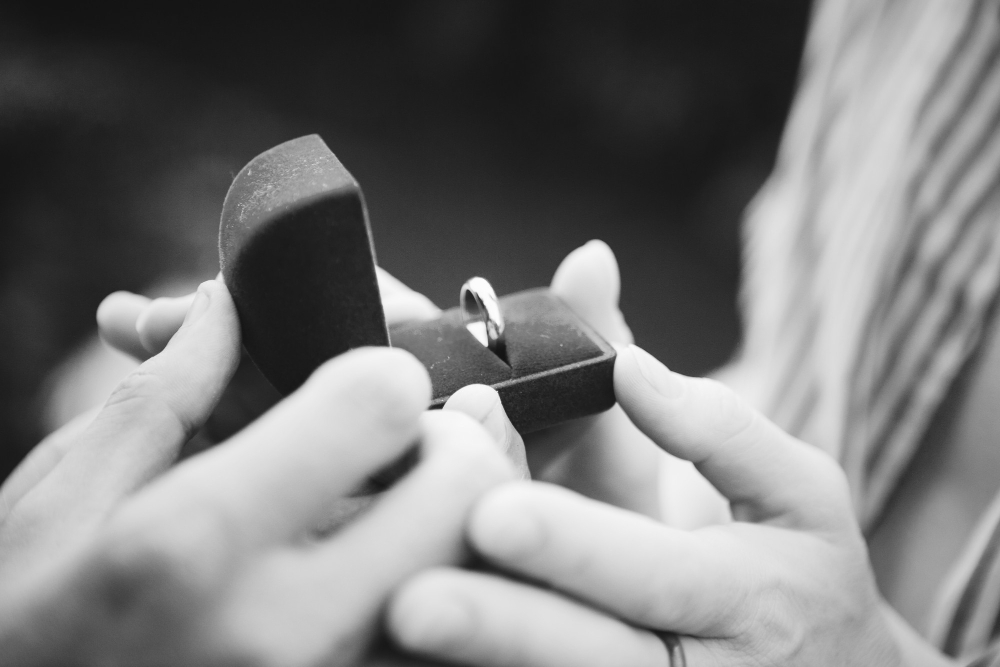
Engagement rings are unusual objects culturally. They are mass-market and deeply personal at once, they are bought by people with no expertise from people with a great deal, and their design has tracked the last hundred years of technology, economics and advertising with remarkable precision.
Look at a row of rings from 1915 to now and you can read the century off them. Here is what each period was doing, and why.
Edwardian and Belle Epoque roughly 1900 to 1915
The defining technical development was platinum.
Until the early twentieth century, fine jewellery was made in gold and silver. Silver was used for diamond settings because its whiteness flattered the stones, and it tarnished and wore. When platinum became workable at scale, jewellers had a white metal that was enormously strong, which meant they could use far less of it.
The result was garland style: lacework, filigree, millegrain edges, and settings so fine the metal nearly disappears. Bows, ribbons, laurel wreaths. Diamonds set in what look like threads.
Stones of the period were old mine and old European cuts, cut by hand and by eye before electric-powered precision. They are chunkier, with small tables, high crowns and large open culets, and they behave completely differently from modern stones. Rather than the rapid white sparkle of a contemporary brilliant, they produce slow, broad flashes and noticeably more fire. Under candlelight, which is what they were cut for, they are extraordinary.
Art Deco roughly 1920 to 1935
The most influential period in engagement ring design, and the one that still sells most strongly as a revival.
The name comes from the 1925 Exposition Internationale des Arts Decoratifs in Paris, and the aesthetic shift was from organic to geometric. Where Edwardian jewellery curled, Deco squared off. Step cuts, emerald and Asscher, came forward because their broad flat facets suited an architectural sensibility. Baguettes were used as structural lines. Calibre-cut coloured stones, sapphire, onyx and ruby shaped precisely to fit a channel, gave hard colour contrast.
Symmetry, repetition and contrast. It looked like the buildings going up at the time, which was the point.
It has also aged better than anything else on this list, which is why a large proportion of what jewellers are asked to make now is Deco or Deco-influenced.
Retro roughly 1935 to 1950
Two forces reshaped design, and both were material rather than aesthetic.
Platinum was designated a strategic material during the Second World War and withdrawn from jewellery use. Makers moved to yellow and rose gold, and the look changed accordingly: bolder, heavier, more sculptural, with large curves and less fine detail.
Stones were also scarcer and smaller, so design compensated with metal. Rose gold, achieved by increasing the copper in the alloy, became characteristic of the period and has come back repeatedly since.
The De Beers era 1947 onward
The single largest influence on what people believe about engagement rings was not a designer. It was a copywriter.
The phrase “a diamond is forever” was written for De Beers by the N. W. Ayer agency in 1947, and the campaign it anchored did something few marketing efforts achieve. It did not sell a brand. It established a social norm: that an engagement should involve a diamond, that the diamond should be substantial, and that it should never be resold.
The guidance on spending, which evolved into the two months salary rule, came from the same source. It is repeated to this day as though it were tradition. It was a brief.
The 1950s solitaire, a single round stone raised on claws so light passes beneath it, became the default and largely remains it.
The 1960s and 70s
Loosening. Yellow gold returned to dominance, textures became rougher, and coloured stones re-entered the conversation seriously.
Modernist and studio jewellery pushed against the showroom solitaire with asymmetry, hammered finishes and organic forms. Cluster settings, several stones arranged as a flower or a spray, were everywhere and now read strongly as of their time.
1981 and its very long shadow
A single ring changed the market. When Lady Diana Spencer was photographed with a large oval blue sapphire surrounded by diamonds, demand for sapphire engagement rings moved immediately and has never fully subsided. Its reappearance a generation later on Catherine Middleton restarted the cycle.
It remains the clearest demonstration of how this market works. Design moves in response to individual visible objects far more than to trends in the abstract.
The 1990s
Sharper, cleaner, more angular. The princess cut, a square modified brilliant, suited the decade’s taste for precision and offered more carat weight per dollar than a round, because less of the rough crystal is lost in cutting.
Tension settings, where the stone appears suspended between two ends of a band, arrived and looked genuinely new. Channel-set shoulders were ubiquitous.
The 2000s
The halo returned, having originated in the Deco period, and dominated. Ringing a centre stone with small diamonds makes it read substantially larger, and in a decade with a strong appetite for visible scale that was compelling value engineering.
White gold became the default metal, cheaper than platinum and, after rhodium plating, visually similar. The maintenance implication, that the plating wears and needs periodic redoing, was rarely mentioned at the point of sale and still often is not.
The 2010s
Two developments mattered.
Rose gold returned properly, driven by fashion and by photography, since warm metal flatters a wide range of skin tones on camera.
And elongated shapes took over. Ovals, pears and elongated cushions look larger than their carat weight because of their outline, and they photograph beautifully, which by this point was a genuine design criterion rather than an afterthought.
Social platforms began to function as the primary distribution channel for design ideas, replacing the showroom window and the magazine.
The 2020s
The current period is defined less by a dominant style than by fragmentation, which is itself the story.
Individuality over trend. The most common brief a jeweller now receives is a request for something nobody else has. That has pushed the market toward commissioning rather than selecting, and it has made custom made engagement rings a mainstream option rather than a luxury one. Studios like Stelios Jewellers that design and make in-house report that the majority of what they produce now starts from a conversation rather than a catalogue.
Toi et moi and other historical revivals. Two-stone designs from the eighteenth century, east-west settings, bezels, and a general return to lower profiles.
Coloured stones as centre stones, not accents. Sapphire, spinel, and Australian parti sapphires in particular.
Vintage and antique as a first choice, driven partly by taste and partly by a preference for objects that already exist.
And the largest change of all, which is not aesthetic at all.
How cutting changed which changed everything
Running underneath the whole century is a technical story that rarely gets told alongside the aesthetic one.
Before electrification, diamonds were cut by hand and judged by eye. Old mine cuts are squarish with rounded corners, old European cuts are round, and both have small tables, tall crowns, deep pavilions and an open culet that reads as a small dark window at the centre when you look straight down. They were optimised, consciously or not, for candlelight and gaslight, which is low, warm and flickering. Under those conditions they produce enormous fire.
In 1919 a young engineer named Marcel Tolkowsky published a mathematical analysis of how light travels through a diamond and calculated the proportions that would return the most of it through the top. His numbers underpin the modern round brilliant, and the industry has been refining rather than replacing them for a century.
The consequence is that a diamond cut in 1910 and one cut in 2026 are different optical instruments. The modern stone is measurably brighter under electric and daylight conditions. The antique stone is more characterful under low warm light. Neither is better, and people who choose antique stones almost always do so having seen the difference rather than having read about it.
This also explains a common disappointment. Buyers who fall in love with the look of a vintage ring in a photograph, and then commission a reproduction set with a modern brilliant, frequently find it does not look right. The setting is correct and the stone is from a different century.
The material change underneath
Two developments in the last eighteen months have altered the economics of the whole category.
Laboratory-grown diamond prices have collapsed. Manufacturing capacity expanded enormously, average prices fell 20 to 30 per cent against 2024 alone, and some categories are down more than 90 per cent from their peak. Above one carat, lab-grown stones now commonly sell at 5 to 10 per cent of a natural equivalent.
And in late 2025 the Gemological Institute of America stopped applying its D to Z colour scale and flawless to included clarity scale to laboratory-grown diamonds, assigning them instead one of two descriptive categories, premium or standard.
The design consequence is already visible. When the centre stone costs a fraction of what it did, budget moves into the setting, and settings have become more elaborate, more architectural and more individual as a direct result. The proportion of a ring’s cost sitting in the workmanship rather than the stone is the highest it has been since the Deco period, and the design language is responding accordingly.
It is a reasonable bet that historians will look back at the 2020s as a period when the decorative arts of ring-making revived because the raw material got cheap. That has happened before. It is roughly what happened to silver in the nineteenth century when electroplating arrived.
Why so much of it comes back
There is a mechanism behind the revival cycle and it is worth naming, because it explains the timing.
Roughly seventy years is the distance at which a style stops being your parents’ taste, which is embarrassing, and becomes your great-grandparents’ taste, which is romantic. Nobody in 1975 wanted an Art Deco ring, because Deco was what elderly relatives wore. By 2000 the people who remembered it as contemporary were largely gone, and it became heritage instead.
The same arithmetic is now arriving for the 1950s and 60s. Cluster settings and yellow gold, both thoroughly unfashionable twenty years ago, are being asked for again.
There is a second mechanism too, specific to this category. Engagement rings are inherited, so every generation encounters actual physical examples of what its ancestors wore, in a way that does not happen with furniture or clothing. A grandmother’s ring is a design brief handed down, and resetting one of those stones into a contemporary setting is now among the most common commissions a jeweller receives.
The Australian thread
One genuinely Australian contribution runs through the last four decades.
The Argyle mine in Western Australia produced more than 90 per cent of the world’s pink diamonds from the 1980s until it closed permanently in November 2020. Rio Tinto’s final tender of remaining inventory concluded in October 2025, making 2026 the first year in which every Argyle pink changing hands comes from the secondary market.
For a period, Australian design had access to a colour palette nowhere else could rely on, and a distinct local tradition of pink diamond work developed around it. That material is now finite, which has turned a regional specialty into something closer to a historical category.
What the century shows
Looking across it, three patterns hold.
Technology drives design more than taste does. Platinum enabled Edwardian lacework. Wartime restriction produced Retro gold. Precision cutting produced the modern brilliant. Cheap lab-grown stones are producing elaborate settings right now.
Advertising can create tradition. Most of what people believe is customary about engagement rings dates from a 1947 campaign.
Nothing disappears permanently. Deco geometry, Edwardian millegrain, Victorian toi et moi, rose gold, coloured centre stones. Every one has returned at least once, usually about seventy years after it left.
Which suggests that whatever feels inescapably contemporary right now will look thoroughly dated by 2045 and delightful again around 2090.
This article is general information only. Diamond prices and grading standards change. Confirm current specifications and certification with your jeweller.

