

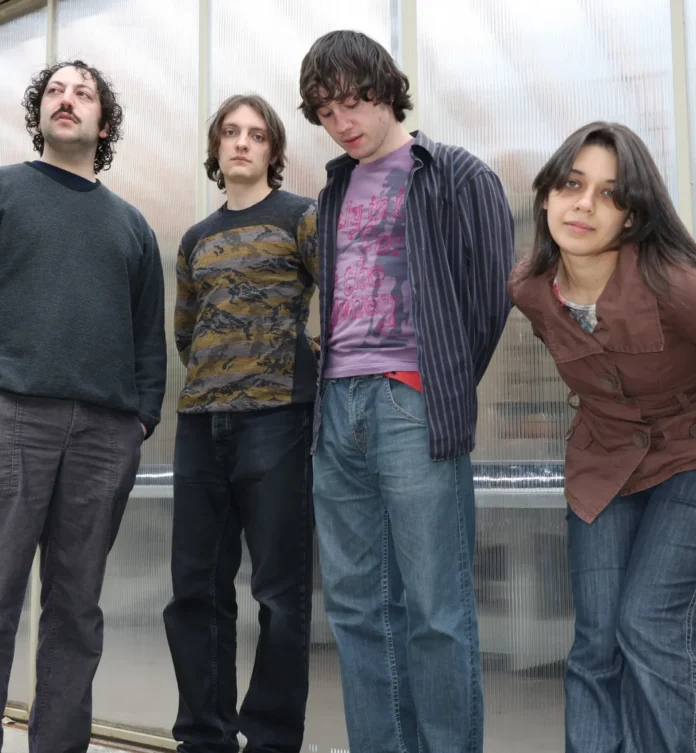
Starcleaner Reunion is an NYC-based band composed of vocalist and tambourine player Jo Roman, guitarists Pat Drummond and Neil Torman, and bassist Adam Kenter. All four members grew up in the small town of town of Springfield, New Jersey, meeting in high school and playing together in various configurations, though it wasn’t until Drummond moved to New York from Montreal that Starcleaner Reunion solidified. Taking their name from a 1970s children’s book about magical beings returning light to the sky, the group honed their spacey, kaleidoscopic indie rock style on a couple of EPs, 2023’s Club Estrella and 2024’s Café Life, before getting to work on their debut LP. The songs on the self-produced Umbrella are by turns jittery, hazy, and whimsical, showcasing a band whose converging taste opens up the imagination rather than leading to predictable songforms. There is more than a touch of nostalgia in a lot of Roman’s lyrics: “I seem to be wanting the same old song,” she sings on the opening ‘Theme’, but Starcleaner Reunion have a way of twisting and reshaping familiar textures into new, uncanny territory.
We caught up with Starcleaner Reunion for this edition of our Artist Spotlight interview series to talk about growing up in Springfield, their group dynamic, bootleg live recordings, and more.
I often speak to musicians who start playing in bands in middle school and high school, but it’s rare to interview a band that actually grew up playing together. Could you share some early memories of getting to know each other and your love of music through that connection?
Neil Torman: We all are from a pretty small town, where you eventually know anyone who’s interested in music. We all became connected through that in varying ways. Pat and I had the same guitar teacher; Adam and I became friends at a certain point, and we all had a band together. We were just so close and grew up in parallel that, playing with other people, you just appreciate that connection even more.
Jo Roman: I’m the youngest out of all these guys, so I kind of met everyone through the years in high school. I met Adam first, because we were in marching band together. [laughs] But I guess I didn’t expect to be in my first band in high school with Adam and Neil. I was looking for members to fill up my first band with our other friends that had a project. Adam was our drummer and Neil was our guitarist then, and then we started working together for almost seven years with that project. I knew Pat through high school, too, but I feel like my first collaboration with him was when he had his own side projects in Montreal. I got to sing on something with his project, and that was really cool. And then we just came to be. So I feel like it happened in increments from 2012 up to when we started Starcleaner. We’ve always been in the same bubble, we always talk to each other, and we’re always doing things together – hitting up each other for going to shows and stuff like that.
Adam Kenter: I remember Pat was in a band before we were even really close. I remember seeing them play at the St. James Fair.
Pat Drummond: Adam and Neil were listening to cooler music, and I was younger than them, so I wasn’t listening to the coolest music yet, and I was playing in this band, and we sucked. And then I met them, and I was like, “This band I’m playing in is so bad, we have to start a new thing.” So I started hanging out with Adam and Neil. And it was great. We just had such similar tastes. We just wanted to explore and listen to all kinds of music. We gravitated towards krautrock, psych pop, and older stuff, and then we’d go to Adam’s garage and jam, and write music, and play a DIY show in New Jersey.
AK: It was so seamless. I can’t believe it took that long for the three of us to even start playing together. This was before we started the project with Jo, the three of us.
PD: Yeah, that was our first band, and that kind of broke up when I went to college, so then the three of them started playing with Jo.
JR: They taught me all that music, and then I shared my tastes, and then we blossomed. [laughs]
AK: We were doing Pavement and New Order covers and stuff like that. Very entry-level alternative music, just getting into that stuff. It was really fun. We still have five songs we recorded that we never did anything with, but they’re still on my computer.
Do you remember the first DIY show the four of you played together?
JR: We played at the Red House in Boonton. Adam actually showed us videos of that, and Pat, you were playing keyboard in that, which is so crazy.
PD: I know. We had the Nord on stage.
AK: All of our friends and family from New Jersey came in the torrential downpour.
JR: Oh my god, yeah, it was a rainy day.
PD: They had a board of all the bands, and it said Starcleaner Reunion, and people were like, “Oh, Starcleaner’s back together?”
NT: It took us a while to sort of defeat that. People were like, “Were you a band before…?”
JR: We got that for a whole year, I feel like. Every show was like, “What’s the reunion?”
I just realized, it was pouring rain on your first show, and your first full-length is called Umbrella.
JR: Oh my god!
NT: I actually completely forgot that it was raining that day until just now. I like that connection.
AK: Yeah, we didn’t think anyone was gonna come. Boonton is a random-ass town in New Jersey, 30 or 40 minutes west of where we were all living – this town on a huge hill.
Which makes me want to ask, do you feel like you have similar memories and associations with the small town you grew up in? Especially now, having toured together and traveled together, is your upbringing something that comes up in conversation?
AK: I feel like it’s implemented in our lives every day. We’re always talking about Springfield in any fashion, whether it’s a funny story or something like that.
JR: Yeah, I feel like we have a conversation like that every other week, even with other Springfield friends. We’re reminiscing about old stores that used to exist in our town, just walking around.
NT: It’s funny, because every time somebody who isn’t from there comes to hang out with us there, they’re just like, “This looks like nothing. This is anywhere in the USA.”
JR: Every time we have a guest in the van, we’re like, “We’re gonna give you the tour of Springfield right now, because we’re here right now.” We’re driving around, we’re like, “That’s the street that our friend lives on, and that’s the street that we live on.” It’s really fun. It’s like a shared experience, a deep-rooted connection to this random town in New Jersey. Yeah.
AK: Our parents all still live there. We’re constantly there.
Is there a recent or favorite Springfield story that really paints a picture for you?
JR: Adam, I remember we were talking about Libby’s, because that was this pharmacy and ice cream place that was on Mountain Ave, and I used to get grasshopper and mint ice cream from there all the time when I was a kid. We were all just like, “Oh my god, Libby’s!”
AK: Bro, we’d be buying Webkinz there.
NT: Springfield is kind of split into two parts in a way. We all lived in the basin, but then there was a part of the town that was very separate, but still in the town, that was on a hill, and it was called The Top.
JR: Oh my god, The Top!
NT: It was just up this 5–10 minute drive up this road with no street lights into the forest., and I remember I had a good friend who lived up there. I was over at her house all the time, and a lot of times, I would be walking down in the middle of the night with no street lights or anything, just wandering back home. I was thinking about that recently.
AK: Her backyard was where I got stoned for the first time. [laughter]
NT: Yeah, mine too. I was debating whether to go there, but walking down this hill, stoned as fuck, cars coming back and forth – that’s a core memory.
AK: Being stoned for the third time, walking to her basement, and they’re playing the animated Pink Floyd: The Wall movie. Standing like two feet from the television screen.
That reminds me of the music video for ‘Never Out or Even’.
AK: That was filmed right next to where we’re talking about.
What made this configuration of the band stick for you? Was it just a matter of time, or do you feel like there’s also something about your dynamic as a group that made it work?
NT: When you have such a long-standing history with someone, you know people really well, you develop a mutual taste, where you spend so many years sort of showing each other music. I think that it creates this bond where you don’t really even want to make music with anyone else, because you feel like you’re starting from scratch. It just makes writing feel really good, because you have this trust of knowing the other person is going to play the best thing. Everybody’s going to play exactly what it needs, and it creates this really nice synergy.
AK: We have a huge Venn diagram of musical interests, and the center is way larger than the sides. Almost all completely overlapping.
JR: But I feel like over time, when we started working on this project together, it all started sitting into place. And we were like, “Oh, we should write more things, because it’s working, it’s really working.” It’s just been like that ever since.
AK: Even now, when we find new music to be inspired by, I feel like we’re all on the same page.
JR: It’s very natural. It’s, like, freakishly natural. [laughs]
I’d love to talk about how that trust extends to also the artist that you’ve been working with since the EPs, Paul Descamps, and having that visual throughline.
NT: It’s funny, I don’t think there was ever an intended through-line, it sort of just became that way when we kept using him. The first thing we ever decided as a band, literally day one – or even day zero, before we had a name or any music – we were all unanimously like, “This guy’s art is so cool, we should see if he’s interested in making some art for our nascent musical project.” He was really down and really friendly. We were like, “This is so cool, it feels so fresh.” It’s cartoonish and colorful, and it was just not something we’d seen much of. In a lot of music in our realm of indie rock, it there’s a lot of tropes or similarities in visuals that all felt like they were blending into each other, and it felt like it’d be cool to have something that doesn’t feel like it’s indie rock art. Like, he does a lot of art for French rappers – in addition to it just being something we really liked looking at, in terms of musical context, it felt really different.
JR: In relation to the LP too, I feel like he puts so much attention to detail in his work where you just want to keep staring at it, because you’re just finding something new every time you look in there. He does a lot of texture play and fun color balance and stuff like that. I feel like with the art that he made for us for this LP, it parallels the attention to detail that we put into making our tracks, because we just overloaded our songs with textures and different sounds. When I look at the album cover now and listen to the songs that we recorded, there’s so much detail and texture in both things. It’s always made sense to have him do our work, because he always surprises us with these crazy details that we usually never really ask for. We’re always like, “Here’s the album, draw something around that, you’re always doing a really great job.” And he’ll send us something crazy, and we’re like, “Damn, he did a good job!”
NT: On the part about it being a throughline, I think that it exponentially gets even cooler when a band just has the same art style throughout, because I feel like it’s really bold, having an overarching world or whatever. When you stack it up in a discography layout, it all looks really cohesive.
You mentioned it came before even the name, and I’m curious if you remember the moment you decided on Starcleaner Reunion. Did you just stumble upon that old children’s book, or were you thinking about it for a while?
NT: I was the one who came across that book, and it was one of those things where it instantly struck me as a cool band name. We had a huge note of different band name potentials, and we were going back and forth for a bit, but that was always in the running. That show we were talking about before at the Red House – the first show we ever played – I think literally that day we were still figuring out what band name to do. They were even messaging us, “What even is your band name?” And we ended up deciding on something else, but when we got to that show, they had written Starcleaner Reunion on the board – I guess we had told them that at one point, but we had changed it since then. But then they wrote that, so we were like, “I guess we’re just this now.” But not in a disappointed way, because we were obviously happy about it. It was just funny because we couldn’t decide, and that was what made the final decision for us.
PD: We were so close to being called Motobike.
AK: I thought we were gonna be called Earthworks.
NT: I thought it was Decollage, dude.
PD: Nah, we could not have been Decollage.
JR: I’m glad the venue decided for us this name. [laughs]
Adam, you mentioned you still have some early demos on your computer, and you recently showed a video of your first performance. Do you tend to keep a record of everything band-related?
AK: Yeah, I try to save a lot of stuff to a hard drive or Google Drive. I wish I saved more stuff, but anytime someone would give us a show recording, I’ll save it. We have the entire recording from our first show on MP3, with some iPhone videos that friends have sent. There’s an iPhone video of us doing a Carole King cover.
NT: The one time we ever did a cover.
JR: I tend to save a lot of stuff, too. I have a lot of random videos and photos and stuff just also on my Google Drive and hard drive.
You talked about some bands you were getting into collectively – was part of that digging into their back catalog of live recordings and bootlegs?
JR: I feel like when I get into new music, bands, or artists, or whatever, I like watching their older live performances just to see how they play their songs live.
NT: Yeah. I like this band, Les Rallizes Dénudés, which is this noise rock band from Japan, and their discography is zero studio recordings, it’s all live bootlegs. Just really fun to go through, because they play it differently every time, and it’s like, sometimes it’s so blown out from the noise that it creates this shrieking wall. I like that aspect, I like hearing the live sound, because for them, that is their discography.
JR: It’s fun to dig for that stuff, too. I feel like when I started listening to Stereolab a long time ago, I was really involved in a Stereolab Facebook fan group. Before the newest compilations had come out of their songs, people were posting untitled things, being like, “There’s this demo I just found online,” and I’d be like, “Oh my god, guys, I just found a demo on the Facebook group,” and we’d listen to it. And now it’s on the compilations. AK: Bootleg rarities compilations, and now they’re all official.
JR: Remember I made a bootleg album for the Facebook group, and I posted it online? I was like, “Enjoy guys, I found every single link to every song and made it into an album for you, and I made a bootleg album cover for it.” It’s fun to collect like that.
NT: When you get really into a band, you just want to hear every scrap. You just can’t get enough. It’s a good feeling.
Maybe those Starcleaner recordings will come to light in that way in the future.
NT: Yeah, we’ll upload them in 30 years.
AK:.On a tour two years ago, we made all these cassette tapes that were just a bunch of home demos, just songs we jammed on together. It was that, in addition to our first EP and singles. We made 50 of them, and I think we sold maybe 15 or 20, and the rest all disappeared. We don’t know what happened to them.
NT: I thought we sold all 50 of them.
AK: No, we made two batches – the first batch, we sold all of them. I’m waiting for someone to upload those songs, eventually.
Neil, you said before that starting a new band would feel like starting from scratch. I wonder if there was a tiny bit of that when it came to starting work on your first album, where anything is possible. What was your collective mood in the summer of 2025, when you had just finished your biggest tour and got back into the studio?
NT: I think it was mostly positive, because we got off that tour, and we were all talking in the tour van, like, “Yeah, it’s probably time to make a record.” Most of the songs were written already – it wasn’t like we were writing them in the studio, really. So we had a list of things to record, and we knew that that was the next thing to do. We just jumped into the studio, aka Adam’s garage in Springfield, we just knew what we wanted to do, and we were sort of experimenting along the way.
AK: We were kind of caught in a whirlwind after we signed with TBA; we just kept playing shows, which was amazing, but we knew we needed to start working on this album, and we were playing half of the album songs live at that point. We’re like, “When can we start recording?” because we’d just been playing these songs for so long already.
JR: I think closer to the end of tour, we were in the car picking dates to meet up to start recording. We were already thinking about how to make the most of our time back at home – all of us having to go back to work after touring for five weeks, getting our life back together again. But we made it happen, we were so excited.
NT: Pat and I just bunkered down at Adam’s parents’ house for days at a time and just relaxed, day-to-day tracking stuff.
JR: And I’d come for two days and record all my vocals.
NT: I think we started recording a little bit before that tour, in the winter, but we aborted the sessions and started fresh. Which is to say, we kind of knew even before the tour that’s what we were trying to do.
AK: I was living in Jersey still, so they would come a couple days over the weekend or something and hang out, and we would record for the weekend. Some days, Neil and Pat would be at my house, and I would have to go to work for a couple hours, and I’d come home, and they’d still be recording. It was really fun to work around and keep at it. After we finished recording, we’d just play Call of Duty.
NR: I just watch, I don’t play that stuff.
AK: I got Neil addicted to it when we were living together in Montclair.
NT: It’s a really mindless dopamine injector.
AK: There was a four-month period where both of us were unemployed.
NT: So we called that work. We’re like, “Gotta clock into the office.”
AK: We’d wake up, we’d meet in the living room, and we’d clock into Call of Duty for six hours.
NT: But it’s cool, because it’s the kind of game you could play music behind, so we would rock all kinds of records and play COD all day.
I guess that’s a way of soaking in influences as well at the same time.
AK: Listening to The Kinks while using a sniper rifle.
NT: Like the most whimsical music while murdering.
JR: Can’t relate.
Listening to the album, there’s a variety of additional instrumentation that feels evenly peppered throughout the record, but I’m curious how much of the horns, the violin, or the clarinet were written into the songs.
JR: We had the foundation of some of the songs, and before the recording process, every time we played these songs live, I literally turned to these guys and was like, “I literally can hear a violin in this part, we need to make that work when we start recording.” For other songs, I’d hear other specific things, and I would remember recording quick voice memos to not forget, like me singing a violin part into the voice memo. And then for others, we just had our friends experiment and try something new, because we were very interested in what instrument they had to offer. For example, Tallulah and her aluminum cello for ‘Never Odd or Even’, at the end – we just wanted that instrument in that song. We were like, “Let’s just experiment together,” and we spent a couple hours recording with her in her studio, and it was just sounding crazy.
AK: We definitely wanted to just include our friends on the album.
JR: Which song did Drew play on again?
NT: Drew played clarinet on ‘Docking in Oslo’.
JR: I loved that.
NT: It almost always starts with a guitar part or a bass riff, and once we have the skeletal structure of the song, that’s when the other instruments come in. It comes a little bit later in the song process as opposed to being there at the start.
The interplay between the guitars, and between the bass and the percussion, feels really intricate – but the thing, I think, that stands out is that it’s not really segmented in that conventional way; it moves between different configurations. How are you conscious of these dynamics playing out when you’re working out a song?
JR: I definitely am always aware of how instruments can sound with my vocals. If I’m doing vocal-heavy parts of a song, if I do have an idea for the balance of an instrument behind my vocals, I feel like I’m always thinking hard about how to fit that in to make it work.
NT: A very early influence was Television – that kind of thing where it’s more impressionistic playing as opposed to stacking things in a rhythm vs. lead kind of way. But then also stuff where Pat and I could both be playing chords, and then Adam’s doing the lead riff on bass. That’s just the kind of stuff we’ve always been drawn to – that feels like a very baseline impulse of writing for us.
PD: I think that it’s something that I’m aware of, but we don’t have to force it. It comes really naturally, and I think that kind of comes from how long we’ve been playing with each other. We know how to write together so that it becomes more interesting than, “Here’s your rhythm, here’s your lead, here’s your bass part.”
AK: I just try to make it the most fun for myself as a bass player. I feel like a lot of bands don’t capitalize on bass as an instrument. They kind of just use it as a space filler on the EQ. But I guess it’s also the role of the bassist to not overplay and not take up too much space, so I feel like I’m trying to find that line where it’s coming up with parts that are really fun for me to play, while also not just being crazy.
JR: I love when you’re crazy, though. I love Adam’s basslines in our songs. They’re so good!
NT: I feel like it really adds to it. Multiple people have been like, “Adam is the secret weapon in the band.” He’s always going low-key crazy on the bass, in the most tasteful way.
JR: I feel like the way that he plays bass makes our band very distinctive and unique. Obviously there’s catchy vocal melodies, and you gravitate towards the crazy guitars just playing with each other, but I feel like the basslines really stay. I find myself singing the basslines because they’re just so catchy. NT: I love playing more simplistic chords and just having the bass be the lead line. I think that’s one of the most interesting configurations.
AK: You can’t just play the root notes, that’s boring.
Part of it is the notes you’re playing, the bassline itself, but I will say what draws me, too, is the tone and fluidity of textures across songs and even instruments.
AK: I guess we’re all pretty nerdy about the tonal qualities of our instruments. We spend a lot of time fucking around with what we like. For bass, a lot of the time during shows, there’s too much of a farty noise, so I would end up cutting a lot of the mids. I looked it up on Google, just to see what people were saying, and there was a Reddit post that was like, “What are the biggest mistakes you learned as a bassist?” And the top comment was like, “You should never cut the mids on your bass.” I was like, “This guy’s got it all wrong.”
NT: We break the rules of convention in this band – and on a gear level.
This interview has been edited and condensed for clarity and length.
Starcleaner Reunion’s Umbrella is out now via Take Care Records.

