

Keisuke Kinoshita’s 1948 melodrama Woman opens with a chorus of dance hall performers professing through song a desire to fall madly in love. Among the dancers is a former salesgirl named Toshiko (Mitsuko Mito), whose criminal boyfriend Tadashi (Eitaro Ozawa) shows up backstage, instructs her to meet him the next day, and marches off with a newly gained limp. The picture ends on a nearly identical note, with the same revue company performing the same number. However, there’s a crucial difference. Before going on stage, Toshiko meets with her cohorts to issue the following advice: “You can’t fall for someone just because he loves you. If he’s a bad person, you must despise him whatever the situation.” Between these bookends is the day that prompted her to make her declaration, a day wherein she underwent the pain necessary to escape the man who’d long brought misery into her life.
Woman was Kinoshita’s ninth directorial effort and his fifth in the postwar era. Like many Japanese pictures of its age, it’s headed by characters responding to the social conditions that spawned from their country’s devastation. At the time of the picture’s release, 2-4% of Japanese lived in “temporary housing” typically comprised of scrap lumber, sheets of metal, and marsh reed screens. Food shortage and unemployment had metastasized, and crime (organized and not) was endemic to the point that a magazine editorial quipped, “The Only People Not Living Illegally Are Those in Jail.” Woman takes this historic framework and sets within it a two-person story—Toshiko’s lover is a war veteran with a history of theft and extortion—and places heavy emphasis on character psychology.
The story, written and directed by Kinoshita, is told almost entirely from Toshiko’s perspective and takes time cluing both her and the viewer into the drama. While on the train to meet Tadashi, our heroine glimpses a fellow passenger’s newspaper and—upon it—a headline regarding a robbery. Thinking nothing of it, she disembarks at Okayama Station and encounters two of her lover’s associates. But it’s not until she rendezvouses with Tadashi and observes the manner in which he studies a copy of the aforementioned news story—about how a wealthy family and two house servants were robbed at knifepoint—that she realizes he’s committed his most barbarous crime yet. We also learn that, in the past, Tadashi persuaded Toshiko to leave her store job and work in a dance hall, and that he’s regularly depended on her for money.
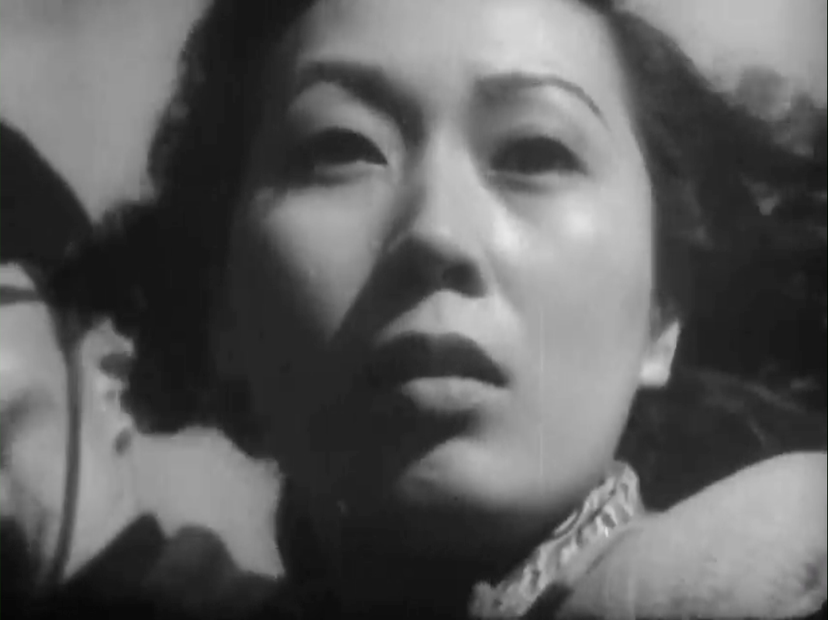
Toshiko gives up her initial plea to end the relationship when the conman insists he can change. Tadashi breaks into the spiel of a man claiming to have been betrayed by society: how he began life as a child like any other; how he was misled into fighting in a war; how he came to feel his country rejected him. But even though Toshiko falls for his speech and promises, director Kinoshita reveals to us—but not to her—that it’s an act. In close-ups, we see Tadashi pause mid-speech to thrust quick sideways glances at his girlfriend, gauging the success of his manipulation. The viewer realizes Tadashi is an immoral person using the war and postwar conditions to excuse crimes he’s not ashamed of. (Incidentally, my only reservation with this scene is that Kinoshita doesn’t round out the postwar theme by attributing Tadashi’s limp to a war injury; instead, it’s implied to be the result of having been shot by a policeman. At the same time, I wonder if the director made this choice simply to avoid repeating himself, as he’d already depicted a disabled veteran in 1946’s The Girl I Loved.)
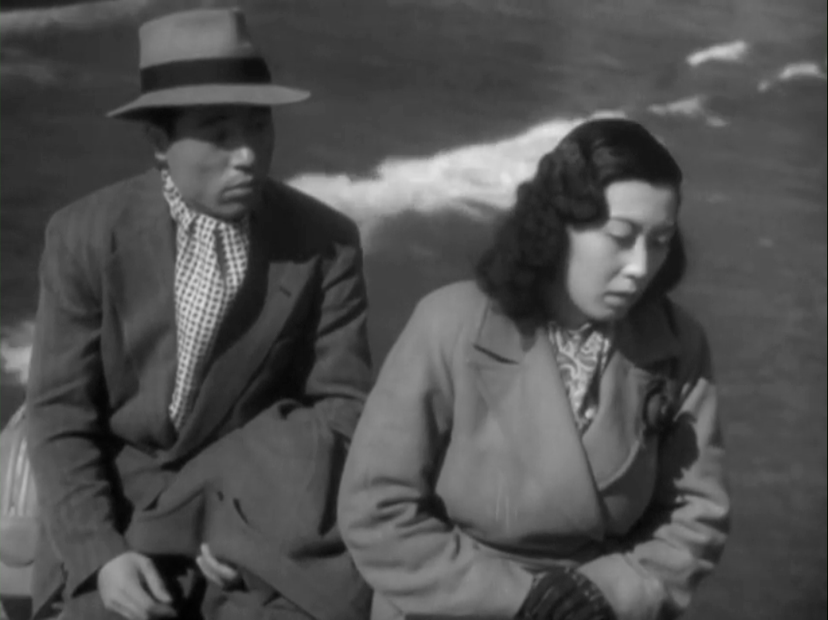
Only after the couple reaches the seaside community of Atami does Toshiko see through Tadashi’s lies, which culminates in him threatening to stab her. Despite the blade pointed in her direction, Toshiko verbally lashes out. “You’re a pickpocket, a thief, and a liar.” “You’re trying to manipulate my feelings.” Claustrophobically taut shots of Toshiko showcase her eyes: once tear-soaked, now burning with anger. Her voice on the soundtrack—formerly morose—manifests in terse words conveying hatred. No longer does she beg to part ways; she makes it clear it will be so. In addition to close-ups, Kinoshita employs a filmmaking tactic favored by his contemporary Akira Kurosawa: using crowds and the environment to accentuate the mood of a scene. (Our heroine runs from Tadashi while Atami citizens stampede toward the coast to put out a fire—emotional chaos supplemented by literal chaos.) And while Toshiko’s lost faith in her lover, an earlier profession of hers—that postwar society has good people in it—is proven when the authorities and citizens save her from Tadashi.
As indicated in the above synopsis, Woman is a small story with just two primary characters and a limited number of sequences. Such material might seem better suited to the length of a short film but here remains gripping thanks to splendid performances and the efforts of a resourceful, often inventive director. Kinoshita’s wise choices begin with keeping the story brisk (a mere sixty-seven minutes), and he maintains visual interest via witty cinematography and editing: quick cuts, close-ups capturing minutiae (e.g., Tadashi’s hands on Toshiko as they hitch a ride to Atami). Early scenes feature lighting technician Ryozo Toyoshima devising startling images reminiscent of film noir, with shadows plastered on walls and dark figures strolling about corridors. As Tadashi, Eitaro Ozawa even resembles a Hollywood gangster: sneering beneath his fedora and dragging his girlfriend around like luggage. His performance is good, though it’s appropriately Mitsuko Mito who steals the show as a woman crumbling under stress before learning to stand up for herself.
The opening credits state Woman was completed in February 1947, though it wasn’t released until April the following year. I have no insight into the matter, but perhaps Japan’s postwar American Occupation authorities (who for years censored domestic movies in both pre- and post-production) gave Kinoshita’s script a pass but quibbled with the finished product. If so, I wonder if objections stemmed from Tadashi having been a soldier, as the Occupation favored stories about servicemen productively reintegrating into society. (Though, as Kyoko Hirano demonstrates in her sublime book Mr. Smith Goes to Tokyo: Japanese Cinema Under the American Occupation, 1945-1952, the censors were selective in enforcing their own rules.) The picture, to my eye, doesn’t show signs of last-minute excisions—like, say, Kozaburo Yoshimura’s Temptation (1948)—so my speculation is that run-ins with the authorities, if they occurred, simply resulted in a stalled release.
Woman is notably unhappy compared to Kinoshita’s previous postwar movies—Morning for the Osone Family (1946), The Girl I Loved (1946), Phoenix (1947), and Marriage (1947)—the protagonists of whom endured varying degrees of suffering (sometimes also at the hands of tyrannical people) but emerged with some degree of fulfillment. (Phoenix’s heroine loses her soulmate to war but gains the acceptance of a father-in-law; the protagonist of The Girl I Loved doesn’t marry the person he wants but is grateful to remain a part of her life.) By contrast, Mitsuko Mito’s heroine in Woman survives her ordeal, but her attitude at the end is bleak; the story wraps with her marching off to perform a romantic song-and-dance number, but she herself displays no indication of even wanting bliss moving forward. Earlier Kinoshita films looked toward or even presented the future with optimism; Woman ends cynically in the present and, on that note, constitutes an interesting outlier in this phase of the director’s career.
Bibliography:
- Dore, R.P. City Life in Japan: A Study of a Tokyo Ward. Berkeley: University of California Press, 1959
- Hirano, Kyoko. Smith Goes to Tokyo: Japanese Cinema Under the American Occupation, 1945-1952. Washington, D.C.: Smithsonian Institution Press, 1992
- Prince, Stephen. Audio commentary for Stray Dog. (Criterion Collection DVD), recorded in 2003

