


Expert Voice: Elvin Zhang, Partner & Brand Marketing Director at PODpartner
The Holiday Inventory Dilemma
Each holiday season, apparel companies face a critical decision: Should I purchase 5,000 units of my collection or 10,000? The traditional retail model of placing orders well in advance, taking a gamble on sales, and discounting as much as possible after the holiday rush is not only risky, but also outdated.
On-demand manufacturing offers a fundamentally different approach. It enables apparel manufacturers to launch their seasonal collections, produce only what they sell, and eliminate unsold products from their inventory, eliminating the inventory risks associated with traditional manufacturing models. But rather than asking yourself in 2025 if you should use an on-demand strategy, you should be asking yourself if you can afford NOT to.
How Holiday Retail Usually Works (And Why It’s Broken)
The old system of holiday retail is built on predicting the future and hoping you are right. The traditional model includes a six-month lead time, yet trends can shift from one day to another, creating a difficult gamble for brands to engage in, either they will overbuy and take the loss of deep post-holiday discounts, or they will underbuy and miss the holiday sales rush. With the holiday market projected at $241.4 billion by 2024, the costs of this gamble are substantial. It’s nearly impossible to predict trend lines in July when a TikTok trend can create both the success or failure of a product within a matter of weeks.
The traditional model remains prominent, but the shift to on-demand manufacturing presents challenges, especially for established brands that have relied on bulk production for years. Completely abandoning the traditional model overnight is not always feasible. Many established brands are reluctant to completely adopt 100% print-on-demand (POD) due to their established reliance on traditional ordering models.
The Hybrid Strategy for Established Brands
The winning approach is a gradual transition. At PODpartner, we advocate for what we call the “Hybrid Strategy.” For 20% of core basics, traditional bulk production can still be used to reduce costs. For the remaining 80% of trend items, holiday editions, or collaborative items, the POD model is the best fit.
Consider a streetwear brand that continues to stock its classic black logo sweatshirts through traditional production methods but lists new designs (those inspired by trending memes or TikTok) through on-demand production. This allows the brand to maintain profitability with its classic products while capturing demand for trendy items with the flexibility of POD. Before the peak season in Q4, they only stocked up on the most classic designs. For those new designs with complex patterns or chasing TikTok hot memes, they listed them all through PODpartner. As a result, they maintained the profit of their basic business with the traditional model and captured 3 trending items with the POD model.
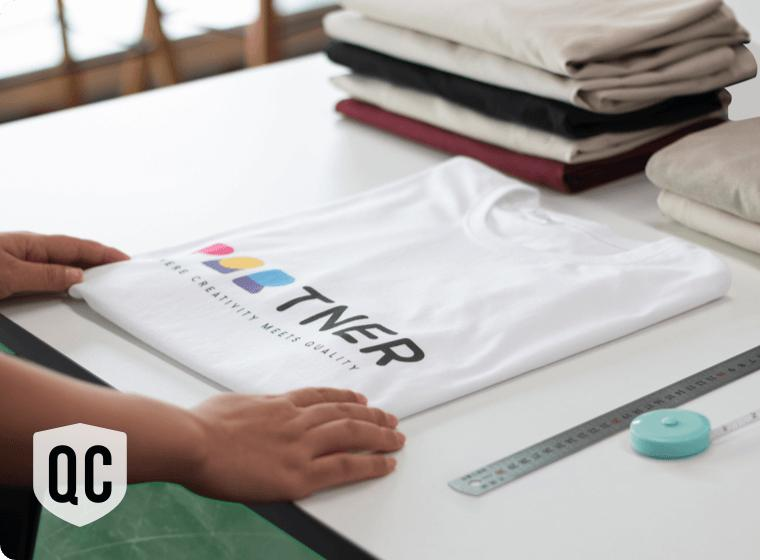
The most important aspect is that product quality from PODpartner meets retail-grade standards, ensuring that consumers cannot tell the difference between traditional inventory and printed-on-demand items. We ensure this seamless blend of models enables brands to transition smoothly without sacrificing product quality or customer experience.
Why On-Demand Manufacturing Changes Everything
On-demand manufacturing is no longer simply a trend, but a complete overhaul of the way apparel companies manage their inventory. On-demand manufacturing presents a new question: “Why purchase inventory at all?” Not only will this business model minimize your risk, but it will completely eliminate it.
The early hurdles of print-on-demand (such as restricted design requirements and fewer product offerings) have all disappeared. On-demand manufacturing is now an operational model that produces a product within 48 hours at quality levels equal to those found with traditional manufacturing models, thereby providing a viable model for not only the small startup but also for larger companies.
What On-Demand Manufacturing Unlocks
Unlike traditional retail, on-demand manufacturing provides distinct advantages that are reshaping how brands approach the holiday season:
Rapid Market Response: In 48 hours or less, you can produce enough products to respond to a market trend in real time. If a TikTok trend takes off on Friday, your brand can create and ship a response product line by Monday, rather than waiting six months for your next production cycle.
Infinite Experiments: You can try out an infinite number of small collections with virtually zero financial risk. Launch multiple designs, gauge how consumers will react to them, and then scale up those designs that are successful. If a collection fails, there is no loss, and you have only spent money on inventory.
Brand Materials Made-to-Order You are no longer limited to buying 500 units in order to add a personal touch to your products. With on-demand, you get per-order customization of packaging, professionally made hang tags, and detailed design elements as early as day one, with no need for minimum purchases.
Financial Freedom: On-demand offers a major financial advantage. Brands will be able to use 100% of their money towards increasing sales—customer acquisition or influencer marketing—creating a new way of growing sales.
Handling Peak Season Volume at Scale
In terms of handling a surge in order volume during peak seasons, such as Q4, PODpartner’s strength lies in its fully integrated system, which is unlike other platforms that rely on external factories. Many platforms collapse under pressure because they cannot control production schedules. However, we at PODpartner operate our own factories and have exclusive production capacity, giving us the edge in maintaining our commitment to a 48-hour delivery time.
The Smart Production Routing system automatically assigns orders to the best production lines based on fabric inventory, machine load, and shipping address, all within milliseconds. This ensures that even during peak times like Black Friday, products can complete the entire process, from raw fabric to finished product, within the required 48 hours. Additionally, the upgrade to advanced industrial dryers, which are 40% more efficient for thicker fabrics, ensure that every order stays on track for quick delivery. For extremely urgent orders, PODpartner even offers a ‘green channel,’ prioritizing hot-selling items to prevent out-of-stock issues.
The Competitive Reality in 2025
Although models that rely on traditional inventory remain steady, they are becoming less competitive in terms of the flexibility and scalability that the on-demand model offers. The question is not whether on-demand manufacturing is better, but which model best fits the 2025 holiday retail reality. On-demand enables brands to switch to trends in real-time, eliminating inventory risk while freeing capital for growth. The old models are too inflexible and slow, unable to keep pace with the constant changes in consumer preferences.
Of course, this flexibility means nothing without quality. In the heavyweight cotton category, we’ve invested heavily in production technology specifically to address the common technical issues of ‘print-through’ and ‘insufficient fastness’ that have plagued traditional POD. This is precisely the confidence that allows us to benchmark against top-tier fashion brands.
Why Brother GTX Technology Makes the Difference
Instead of choosing industrial models that prioritize speed at the expense of image quality, we have firmly opted for the industry-leading Brother GTX series of direct-to-garment printers. These are the preferred choice for many internationally renowned brands when producing limited editions or high-end custom collections.
When it comes to handling heavyweight fabrics, Brother’s performance is far ahead. Their exclusive Innobella textile ink technology offers a wider color gamut and higher color density. This means that even on dark 300g+ heavyweight sweatshirts, our prints can still achieve photo-realistic finesse and vividness, completely avoiding the common ‘bleeding through’ or ‘graying’ issues associated with ordinary equipment.
We’ve also developed a dedicated color profile (ICC Profile) for Brother devices, ensuring that every gradient and shadow can be reproduced 1:1 on the clothing. Through this combination of Brother devices and our proprietary process, we have enabled POD products to bid farewell to the ‘cheap look’ and deliver what we call ‘retail-grade quality.’
Where the Industry Is Heading
The demand for on-demand manufacturing continues to grow rapidly. New manufacturing techniques have allowed for larger product prints, various print options for individual clothing items, and higher quality embroidery than traditional methods could produce. It is likely to be an increasingly important method in the near future and will also allow brands to capitalize on consumer trends as they are occurring by utilizing social commerce platforms to manufacture and deliver products to consumers.
At PODpartner, we are working hard to advance the possibilities of on-demand manufacturing. We have invested significant capital into high-end production technologies and have created relationships with top-tier manufacturers around the world. This has given us the opportunity to provide brands with capabilities that match or even surpass those found in traditional manufacturing models while still offering them the flexibility and no-inventory advantages inherent in the on-demand model.
Freedom From Financial Gambles
The transition to on-demand manufacturing is not only about logistics but also about freedom. It means leaving behind the financial gambles that have defined conventional retailing. By eliminating the risk of prediction and overstocking, on-demand allows brands to focus on what matters: growth. On-demand is the future of holiday retail, and it is here. It is time for brands interested in removing the risk of inventory and redesigning their operations to take action.
We have experienced at PODpartner how brands can transform their operations when they eliminate inventory risk. We have the infrastructure and support that makes this transition not only possible, but also profitable.
Understanding the True Cost of Production
Why gamble with overstocking and markdowns when you can eliminate inventory risk entirely and turn your capital into a marketing powerhouse instead? In 2025’s holiday season, profitability hinges on cash flow efficiency, and PODpartner unlocks that advantage.
Let’s do some math: While unit cost of POD is indeed higher than that of traditional bulk goods, when inventory risk is taken into account, the final net profit margin of the POD model is more advantageous. We must honestly acknowledge this point: The per-unit production cost of POD is indeed higher than that of traditional bulk production. After all, the cost logic of finely printing each piece on a high-end Brother device is entirely different from that of a factory assembly line applying screen printing ink.
However, focusing solely on ‘production cost’ is the mindset of a novice seller. A mature CEO focuses on the ‘landed cost per sold unit.’
Consider this example: In the traditional model, the cost of a heavy sweatshirt might be $20 each. If you order 1,000 pieces, it costs $20,000. But in the fashion industry, achieving a 70% sell-through rate is considered excellent. The remaining 300 pieces that don’t sell become dead inventory. This means you’ve spent a total of $20,000 to sell those 700 pieces. Breaking it down, the real cost per piece you sell is actually $28.6 ($20,000 ÷ 700). And that doesn’t even include storage fees and interest on capital.
At PODpartner, the cost of the same sweatshirt might be $25. It looks $5 more expensive than $20, right? But you only pay for one piece at a time as it sells. Your real cost is locked at $25. The result: The actual cost under the POD model ($25) is lower than the hidden real cost of the traditional model ($28.6). So, PODpartner is not selling ‘more expensive clothing.’ We’re helping you eliminate the ‘wasted money spent on unsold inventory.’ That’s the accounting logic for high-profit brands in 2025.
Why Cash Flow Efficiency Matters More Than Unit Cost
More importantly, it’s about cash flow efficiency. Under the traditional model, that $10,000 in goods would be tied up in the warehouse for half a year. In contrast, under the POD model, this $10,000 can be fully invested in Facebook or TikTok ads. If your ROAS is 3, this money can generate $30,000 in sales for you.
Therefore, the competition in 2025 will not be about who has a lower purchase price, but about who has faster capital turnover. PODpartner is the engine that accelerates your capital turnover.
The opportunity is clear. Test on-demand manufacturing against your current model and discover how your capital can be better invested in growth rather than inventory. The future of holiday retail is already in motion.
Key Takeaways
What is on-demand manufacturing for apparel? On-demand manufacturing is a production model where garments are created only after orders are placed, eliminating inventory risk and enabling brands to respond to trends in real-time with 48-hour turnaround times.
How does the Hybrid Strategy work? The Hybrid Strategy combines traditional bulk production for 20% of core basics with on-demand manufacturing for 80% of trend items, holiday editions, and collaborative products, allowing brands to maintain cost efficiency while capturing trending opportunities.
Why is print-on-demand quality now comparable to traditional manufacturing? Advanced technology like Brother GTX printers with Innobella textile ink technology enables retail-grade quality on heavyweight fabrics (300g+), achieving photo-realistic prints without common POD issues like print-through or color fading.
What is the true cost comparison between POD and traditional manufacturing?
While POD costs $25 per unit versus $20 for traditional bulk, the landed cost per sold unit is actually lower with POD ($25) compared to traditional models ($28.6) when accounting for unsold inventory, storage fees, and capital costs.
How does cash flow efficiency impact profitability? POD enables brands to invest capital in marketing instead of inventory. For example, $10,000 spent on ads with 3x ROAS generates $30,000 in sales, versus that same capital sitting in a warehouse for six months under traditional models.
Ready to eliminate inventory risk and transform your holiday strategy? Visit PODpartner to learn more about our retail-grade print-on-demand solutions, or contact our team to discuss how the Hybrid Strategy can work for your brand.

