

“[I]t has always seemed to me that graft, bribery, etc., at the public level, is one of the worst crimes that there is. These people hide behind the façade of some great company or corporation and consequently no one knows how dreadful they really are, what awful things they do.”
Akira Kurosawa1
“Corruption cases are not directly connected to people’s everyday lives, so they occur repeatedly and we’ve grown indifferent to them. But in this film, we want to present an individual who hasn’t grown indifferent and whose anger drives him unceasingly to punish the guilty.”
Eijiro Hisaita, co-screenwriter2
When the American Occupation of Japan began in 1945, the foreign authorities now governing the Land of the Rising Sun institutionalized a myriad of new laws with the aim of ridding the country of the nationalism and militarism blamed for its aggression during the Pacific War. This included imposing a new constitution, outlawing “problematic” media, and implementing changes to the legal system. As academic David T. Johnson writes in a 2000 issue of Asian Perspective, “Occupation officials, like many Japanese, believed that prewar prosecutors had abused their power by trampling human rights and pursuing their own political objectives. As a result, Occupation reforms aimed above all at decreasing the procuracy’s control over the police and judiciary and at increasing the procuracy’s responsiveness to democratic forces.” And so, in 1947, the Japanese codified, with the Americans’ blessing, Article 14 of the Public Prosecutors Office Law, granting the Minister of Justice authority over the Prosecutor General in “the investigation and disposition” of criminal cases.3
Less than a year after the Occupation ended in April 1952, Japan’s government passed the Law for the Subsidization of Interest and Insurance Against Losses of Oceangoing Shipbuilding. Enacted toward the end of the Korean War, this legislation was designed to benefit transportation and shipbuilding companies by allowing contractors to borrow money at below-interest rates. The law wasn’t even two years old when investigators uncovered a memo written by the president of Yamashita Steamship Company containing the names of thirty-plus bureaucrats and politicians, along with the dates he met them and his illicit goals with each rendezvous. Further detective work revealed the subsidization law had, in fact, been the result of a mass bribery that distributed more than ¥100 million between the recipients. Prosecutors arrested seventy-one businessmen and officeholders, among them Japan’s transportation minister, the deputy prime minister, and Liberal Party Secretary General Eisaku Sato.4
The scandal was destined for greater infamy when the majority of those implicated evaded justice. Of the seventy-one men seized, thirty-two were indicted, twenty-three received convictions, and only one went to prison.5 Some never even faced police interrogation. Hayato Ikeda, president of the Liberal Party’s Policy Aims Research Council and the man who in 1952 went on record proclaiming “It makes no difference to me if five or ten small businessmen are forced to commit suicide” so long as big corporations continued thriving,6 got off when his ¥2 million bribe was reclassified as a legal gift. And the police weren’t even allowed to question Sato—on account of his mentor, Prime Minister Shigeru Yoshida, implementing Article 14 to prevent his arrest.7
The Shipbuilding Scandal of 1954 was the first major scandal of Japan’s post-Occupation era. And yet, as much as it exemplified the corrupt dynamic that existed between Japan’s government and the private sector—not to mention how an Occupation-era law had been weaponized to null accountability—in many ways, it represented nothing new. In 1948, when the country was still under American rule, Prime Minister Hitoshi Ashida’s cabinet resigned—after just seven months in power—following the discovery that the finance minister had taken nearly ¥3 million “in return for special favors to the Showa Denko fertilizer company.”8 (Ashida himself likewise confessed before Japan’s House of Representatives to accepting a ¥1 million “donation.”)9 The year’s controversies ballooned further still with the Coal Mine Scandal, the proceedings of which included the indictment of a government official10 but ended with half of the defendants walking and one dying in the trial process.11
Two deaths occurred during the Shipbuilding Scandal:12 one man was found hanging in the storeroom near his residence, and another either jumped or fell from a Tokyo roof.13 Suicide became a recurring consequence in subsequent postwar wrongdoing. Between the years 1958 and 1960, for instance, Japan experienced an uptick in suicides, and while the majority stemmed from financial woes, those involving chicanery drew the most attention.14 Pondering recent events was Akira Kurosawa, the director of such internationally acclaimed classics as Rashomon (1950), Seven Samurai (1954), and—most recently—The Hidden Fortress (1958). “There was so much corruption going on [at the executive level of Japanese industry] at the time. The investigations were always dropped when some assistant manager would kill himself. That made no sense.” Unchecked power wasn’t a new subject to Kurosawa. Earlier films of his addressed topics like government persecution and companies bribing individuals, and 1952’s Ikiru even addressed the link between bureaucracy and organized crime. But he now found himself begging the question: “What would happen if somebody investigated the corruption and followed it through to the end?”15
Kurosawa was concurrently at a crucial juncture, career-wise. He’d entered the film industry in 1936 by joining Photo Chemical Laboratory,16 a production outlet that two years later participated in the merger that became the company Toho.17 And while he ceased being a permanent employee in the late ‘40s,18 the majority of his work continued to be financed at his former stomping grounds. As time went on, Toho grew flustered with the money Kurosawa’s perfectionism frequently cost them (and was likewise hearing complaints from filmmakers unhappy not to be receiving comparable budgets). All of this led to the front office persuading Kurosawa to form his own company, Kurosawa Production, to help shoulder expenses.19 Such a move surely came with pressure, spoken or not, to shoot pictures of obvious commercial value. But Kurosawa insisted that films “made only to make money did not appeal to me—one should not take advantage of an audience. Instead, I wanted to make a movie of some social significance.”20
As it turned out, he wasn’t alone in contemplating recent scandals. Around the time of his company’s formation, he read a promising script authored by his nephew, Yasuo “Mike” Inoue. A graduate of Waseda University’s Department of Political Economics, Inoue was knowledgeable about bureaucratic chicanery; however, his scenario was returned with a suggestion: “Why don’t you write a script about avenging these corrupt men?” The revised screenplay, titled Bad Men’s Prosperity, was submitted six months later, after which Kurosawa conducted a rewrite with a team of regular collaborators. He first brought on board Eijiro Hisaita, co-scenarist on his most outwardly political postwar film, 1946’s No Regrets for Our Youth, and together they penned approximately forty pages before being joined by Ryuzo Kikushima and down the road by Hideo Oguni.21 Another writer, Shinobu Hashimoto, joined later still, though he only committed to the two weeks asked of him.22 Toho agreed to provide distribution and assist with financing. However, the studio imposed a restriction: the scandal in the movie was not to be modeled on a real-life case. “If we had based it on a true story,” stated Kurosawa, “[Toho] wouldn’t have allowed us to make it.”23
This wasn’t the first time Kurosawa’s creativity had been stifled by the front office. The earlier-mentioned No Regrets for Our Youth told the story of a sheltered young woman in wartime Japan whose father loses professorship for liberalism. Given the script’s loose basis on actual academic persecution in the 1930s, Kurosawa wanted to open No Regrets with prologue text calling out Ichiro Hatoyama, Japan’s Education Minister of 1931-1934. But as Kurosawa discussed in a 1985 interview with writer Kyoko Hirano, Hatoyama’s name was struck because “the Toho company told me […] it would have been upsetting.” No Regrets excoriated a since-dismantled government—an action the Occupation authorities encouraged—but there was conflict in that Hatoyama, at the time, was the head of the powerful Liberal Party.24 Consequently, the prologue text was rewritten to pin blame, more generically, on “militarists.” Flashing forward to the late ‘50s, things seemingly hadn’t changed. Perhaps due to known ties between government and contemporaneous scandals, Kurosawa and his team were forced to devise a scenario that was plausible yet entirely fictitious for their anti-corruption movie, retitled The Bad Sleep Well.
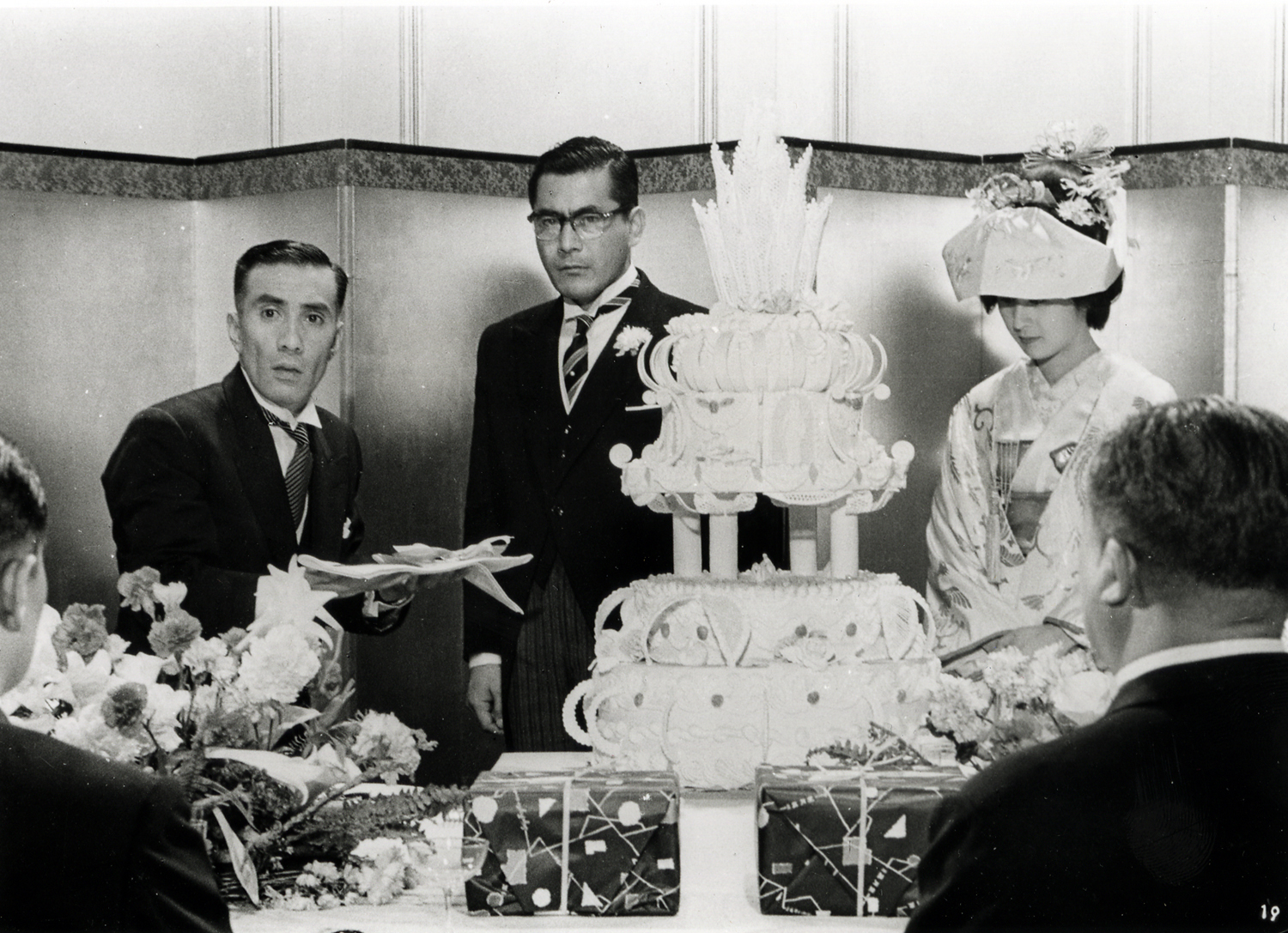
Kurosawa presents the results in what is justly one of the most celebrated sequences in his filmography. The movie opens with a high-class yet seemingly ordinary wedding; guests emerge from the elevator and approach the registry table—suddenly, a mob of wisecracking, camera-armed reporters barge in, announcing they’re here to witness an arrest. From the foyer, they document a Public Corporation for Land Development employee being taken into custody before marching to the sidelines of the ballroom. There, they oversee and comment on the ceremony, much in the manner of a Greek chorus. Their observations disclose that guests at the wedding include senior members of not only Public Corp. but also Dairyu Construction—and that, five years earlier, the two were implicated in a kickback scandal culminating with the suicide of an assistant chief. Kurosawa introduces his vengeance theme with the wheeling out of a wedding cake—one meticulously carved to resemble the office building from which the aforementioned assistant jumped. The cake passes members of Public Corp. and is finally parked behind the company’s vice president, Iwabuchi, who is also the father of the bride.
As the plot unfolds, Public Corp. underlings are manipulated into committing suicide—thus putting a stop to pending investigations. Meanwhile, the wedding cake turns out to be the first in a series of taunts aimed at those responsible for the kickback scandal. The movie is still relatively young when Kurosawa informs us the cake and subsequent taunts were arranged by Iwabuchi’s new son-in-law Nishi (Toshiro Mifune). The plot advances further before revealing he is, in fact, the illegitimate son of the dead assistant chief and that he’s seeking to expose Public Corp. and avenge his father. As has been argued before, The Bad Sleep Well bears a passing resemblance to Shakespeare, with Nishi frequently being interpreted as a Hamlet stand-in and Iwabuchi representing Claudius. To my knowledge, Kurosawa never admitted to being influenced, at least consciously, by the Bard on this production, though it’s worth noting he considered Hamlet one of his two favorite Shakespeare plays—the other being Macbeth, which he unambiguously adapted in 1957 as Throne of Blood.25 Regardless, a Hamlet-esque story allowed him to denounce corruption through the vindictive person angle that interested him.
The Bad Sleep Well is an angry film populated by variously culpable men. In its 150 minutes, colleagues instruct colleagues to sacrifice themselves, co-conspirators turn against one another (there’s a chilling moment wherein executives plot an assassination), and even our (anti-)hero is hardly a figure of innocence. Nishi admits to having resented his father in life (for abandoning him to take a career-advancing marriage), only to commit a quasi-repeat of his progenitor’s sin: he weds Iwabuchi’s daughter Yoshiko to enter Public Corporation and gain access to the man he seeks retribution on. And in the process, he inflicts pain on one of the few good people in the story. Yoshiko, touchingly played by Kyoko Kagawa, is presented as a kind-hearted person bearing wounds (both physical and emotional) caused by others. She walks with a limp—the result of a biking accident caused by her overprotective brother (Tatsuya Mihashi) when they were kids—and her new husband hurts her with his reluctance to give her affection. In one of the most heartbreaking scenes ever filmed by Kurosawa, Nishi rushes to his wife’s aid after a fall. He scoops her up, and their faces wind up in a taut close-up as they nearly kiss—until Nishi withdraws. He then deposits her in her bedroom (they sleep separately) before closing the sliding shoji door. Kurosawa’s camera lingers on the shoji as Yoshiko’s sobs permeate the soundtrack.
In what further complicates Nishi’s quest, he not only comes to reciprocate his bride’s feelings—culminating in a powerful love scene that was axed for the movie’s U.S. release26—but also recognizes the genuine connection she shares with her father. Yoshiko enunciates disbelief that her parent, who has always doted on and cared for her, could be involved in anything so unscrupulous as murder. And in a touching Act Two sequence—wherein she cooks dinner with her father—we see why. Iwabuchi is played by Masayuki Mori (utterly unrecognizable under thick make-up—one wouldn’t know at glance this is the samurai from Rashomon), who lends humanity to the character in these scenes and creates a villain who isn’t all Black Hat. But he also delivers cold-blooded, manipulative nastiness when the script reminds us that, at the end of the day, Iwabuchi holds nothing—not even his daughter—above corporate evil. As is demonstrated in one of the most bone-chilling endings in cinema history.
Late in Act Three, Iwabuchi learns of Nishi’s hideout, drugs Yoshiko to prevent her from warning him, and dispatches a troupe of thugs to seal the protagonist’s fate. The climax occurs off-screen and is recounted by an associate of Nishi’s in front of a traumatized Yoshiko and her brother. Actor Takeshi Kato evokes remarkable intensity as the associate, screaming how his friend was drugged with alcohol and left in the path of a freight train. With that, Nishi’s mission to bring down evil came to an undignified and frankly humiliating end: his legacy will be that of a drunk who got himself killed. Iwabuchi feigns sadness to the press (the Greek chorus of reporters this time remains solemn and respectful—no wisecracks) before the vice president retreats to privacy and reveals again where his loyalty lies. His children, having discovered their father’s actions, leave him. He makes a move to follow, only to spin around mid-stride to answer a phone call from an unseen superior who has periodically contacted him. Iwabuchi hurls apologies and suggests he resign for the corporation’s sake—only to be instructed to go abroad for a short period and then come back, whereafter business will resume as normal. The vice president, who has talked often of a future government career, returns the phone to its cradle, at which point the film’s title—The Bad Sleep Well—reappears, its very literal nature reinforced by everything we’ve seen.
That the man on the opposite end of the line remains unseen and unnamed is due, once again, to restrictions. Kurosawa described his ending as “not explicit enough [that] an even worse man is [calling Iwabuchi], but in Japan if you go any further then you are bound to run into serious trouble. This came as a big surprise to me, and maybe the picture would have been better if I had been braver. […] Maybe I could have in a country like America. Japan, however, cannot be this free and this makes me sad.”27 That said, The Bad Sleep Well’s finale is a case where limitations worked to the film’s advantage: the ending is ten times more chilling because of the unanswered question as to who controls Iwabuchi. (Is it the president of Public Corporation, someone associated with another company, a government official? It’s more scary—and scarily accurate—to let the audience ask questions.) Furthermore, ambiguity in this case pushes the viewer to draw comparisons to the role corruption plays in their world. Which is precisely what Japanese filmgoers did when The Bad Sleep Well premiered in 1960.
Kurosawa once suggested that he would’ve shown “someone very high in the Japanese government,”28 and the director remarked in an interview with Cinéaste magazine that “everyone in the audience must have deduced that it must be the then Premier [Nobusuke] Kishi who is the ultimate source of corruption and who is talking at the other end of the telephone.”29 Historian David Conrad notes in his book Akira Kurosawa and Modern Japan that The Bad Sleep Well premiered not long after Kishi renewed the controversial Security Treaty with the United States.30 Ratification of the treaty permitted American military bases to remain on Japanese soil and triggered riots by people who felt Japan, despite being rid of the Occupation, was still a U.S. military outpost. Kishi responded to protests at the National Diet Building by dispatching the police, and a young woman was trampled to death amid the resultant chaos. The tragedy provoked his resignation, only for him to be replaced by Hayato Ikeda; Japan was now governed by one of the participants in the Shipbuilding Scandal.
The Bad Sleep Well wasn’t among the hits of Akira Kurosawa’s career. Despite ranking third on Kinema Junpo’s list of the year’s best films, it was—financially speaking—a picture that just came and went. Film historian Stuart Galbraith IV writes that it “earned its money back and then some, but in the end turned a smaller profit than the Kurosawa films that immediately followed.”31 What’s more, Toho—for decades—denied it the opportunity for re-release32 and hesitated to provide export to the Occident (deeming the picture too “Japanese” and the setting too modern for audiences that associated the country with period dramas).33 Eventually it appeared at the 1961 Berlin International Film Festival but failed to take home any awards and received tepid to negative reviews. W.L. Webb of The Guardian saluted fine individual qualities—namely Mori’s “magisterial performance”—but dismissed Kurosawa’s latest as one that “will hardly find a place in the history of the cinema beside its creator’s Rashomon or The Seven Samurai.”34
The mixed reception continued following distribution to American arthouses in 1962-63. Per Motion Picture Exhibitor, Kurosawa had delivered a “lengthy, talky entry” with merely “average” direction35 while Boxoffice magazine declared it “too grim and tragic for many patrons.”36 The New Republic’s Stanley Kauffmann, ordinarily a champion of Kurosawa, was especially harsh: “It is so remote in every way from the mainstream of his work that, except for the opening sequence and the presence of some of his ‘stock company,’ there is no internal reason to believe that Kurosawa did it. It could have been made by any experienced, tamely imaginative director of films or television.”37 One of the more glowing reviews came from Kevin Thomas of the Los Angeles Times, who complained that “Far too many critics are writing off the new Akira Kurosawa film […] as second-rate in comparison to his celebrated period dramas. […] This is a grave injustice, for Kurosawa perceives that the world of high finance and corporate intrigue is material for classic tragedy acted in the grand style with a hero who has imagination and courage far beyond the usual Man in the Gray Flannel Suit. […] Through style and technique Kurosawa transforms his lurid expose of corrupt government and high-level bribery into timeless and universal social criticism.”38
Kurosawa speculated years later that The Bad Sleep Well was a victim of being made too early.39 While there is room to question this—that contemporaneous viewers associated the finale with Nobusuke Kishi indicates an audience actively contemplating recent events—perhaps co-scenarist Eijiro Hisaita was right in saying Japan had grown indifferent to chicanery as a broad topic. To Kurosawa’s point, time would bring headline-grabbing incidents of greater scope, such as the Lockheed bribery scandal of 1976, the consequences of which included the arrest of a former prime minister40 and actor Mitsuyashu Maeno carrying out a suicide attack in an attempt to kill businessman Yoshio Kodama.41 The following decade witnessed the insider trading Recruit scandal that involved Japan’s Liberal Democratic Party. As for The Bad Sleep Well’s reception across the Pacific: a friend of mine once suggested (I think accurately) its impact might’ve been greater in the 1970s, in the wake of Watergate and amid other corporate thrillers like Alan J. Pakula’s The Parallax View (1974).
Regardless, the initial lukewarm reception is unfortunate, for The Bad Sleep Well is one of Kurosawa’s great films and perhaps his most internationally relevant. The movie premiered in 1960, and if the ensuing decades—marred by the above mentioned incidents as well as Iran-Contra, Gürtel, Hanbo, Epstein, etc.—have taught us anything, it’s that corruption exists worldwide, guilty parties don’t always get comeuppance, and victims aren’t guaranteed justice. Japan was no exception. In spite of Prosecutor General Shigeki Itoh’s popular maxim “We will not let the wicked sleep,” fighting corruption in the Land of the Rising Sun has been historically cumbersome thanks to Article 14 and restrictions placed on sting operations, wiretaps, and plea bargains. Investigative journalist Takashi Tachibana might’ve been responding to Itoh when he cried out, “The wicked are sleeping. Prosecutors, wake up!”42
And for Akira Kurosawa, the Japanese film studios, throughout his lifetime, remained too timid to properly confront their nation’s sins. The roadblocks he faced with No Regrets for Our Youth in the 1940s and again with The Bad Sleep Well in the ‘50s-60s remained prevalent and even left him unwilling to pursue certain projects. In a 1991 interview with Mark Schilling of The Japan Times, the director remarked that, for all his fame and prestige, he still didn’t enjoy true carte blanche. A movie about Emperor Hirohito, for instance, would likely lead to an assassination by “rightists who oppose any film about the emperor.” Kurosawa likewise commented, “It would [be] hard to make a film about modern-day Japan. There would be a lot of resistance to such a movie. If I wanted to make a film about the Recruit scandal—which would be an excellent topic, by the way—I probably couldn’t get any companies here to finance it. We are supposed to have freedom of speech in Japan, but in fact there are a lot of restrictions.”43
References:
- Richie, Donald. The Films of Akira Kurosawa (Third Edition, Expanded and Updated). Berkeley and Los Angeles: University of California Press, 1996, p. 140
- Akira Kurosawa: It is Wonderful to Create. Directed by Yoshinari Okamoto. Kurosawa Production Co., 2002
- Johnson, David T. “Why the Wicked Sleep: The Prosecution of Political Corruption in Postwar Japan.” Asian Perspective, Vol. 24, No. 4, 2000, p. 63
- Ibid, pp. 64-5
- Ibid, p. 65
- Conrad, David. Akira Kurosawa and Modern Japan. Jefferson: McFarland & Company, 2022, pp. 137-9
- Johnson, pp. 64-5
- Beech, Keyes. “Graft and Corruption the Rule in Jap Politics, Scandals Reveal.” Louis Post-Dispatch, 30 December 1948, p. 11
- “Tojo’s Successor Admits Cumshaw from Contractors.” The Independent, 29 November 1948, p. 3
- “Member of Jap Diet Is Indicited.” The Flint Journal, 22 December 1948, p. 1
- Johnson, p. 61
- Ibid, p. 65
- “Leader in Japan Scandal Suicides.” The Index-Journal, 13 April 1954, p. 1
- Conrad, p. 142
- Galbraith, Stuart, IV. The Emperor and the Wolf: The Lives and Films of Akira Kurosawa and Toshiro Mifune. New York: Faber & Faber, 2002, p. 285
- Ibid, p. 25
- “History.” Toho. Accessed 11 January 2026
- Kurosawa Akira. Something Like an Autobiography. New York: Vintage Books, 1983, p. 168
- Yoshimoto Mitsuhiro. Kurosawa: Film Studies and Japanese Cinema. Durham: Duke University Press, 2000, p. 274
- Richie, p. 140
- Galbraith, pp. 284
- Hashimoto Shinobu. Translated by Lori Hitchcock Morimoto. Compound Cinematics: Akira Kurosawa and I. New York: Vertical, Inc., 2015, p. 169
- Galbraith, pp. 284
- Hirano Kyoko. Smith Goes to Tokyo: Japanese Cinema Under the American Occupation, 1945-1952. Washington, D.C.: Smithsonian Institution Press, 1992, pp. 187-9
- Richie, p. 141
- Galbraith p. 294
- Ibid, p. 288
- Ibid
- Hirano Kyoko. “Making Films for All the People: An Interview with Akira Kurosawa.” Cinéaste, Vol. 14, No. 4 (1986), p. 24
- Conrad, p. 139
- Galbraith, p. 294
- Hirano, “Making Films for All the People: An Interview with Akira Kurosawa,” p. 24
- Galbraith, p. 294
- Webb, W.L. “Berlin Film Festival.” The Guardian, 3 July 1961, p. 7
- Motion Picture Exhibitor (December 1962 – March 1963), p. 5018
- Boxoffice (Jan-March 1963), p. 10
- Kauffmann, Stanley. A World on Film: Criticism and Comment. New York: Dell Publishing Co., Inc., 1966, p. 382
- Thomas, Kevin. “High Finance Theme of New Film Tragedy.” The Los Angeles Times, 16 February 1963, p. 14
- It is Wonderful to Create
- Blaker, Michael. “Japan 1976: The Year of Lockheed.” Asian Survey, Vol. 17, No. 1, A Survey of Asia: Part I (January 1977), p. 83
- “Star Dies in Kamikaze Dive on Bribes Man.” Northern Echo, 24 March 1976, p. 1
- Johnson, p. 59
- Schilling, Mark. Contemporary Japanese Film. Boston: Weatherhill, 1999, p. 58

