

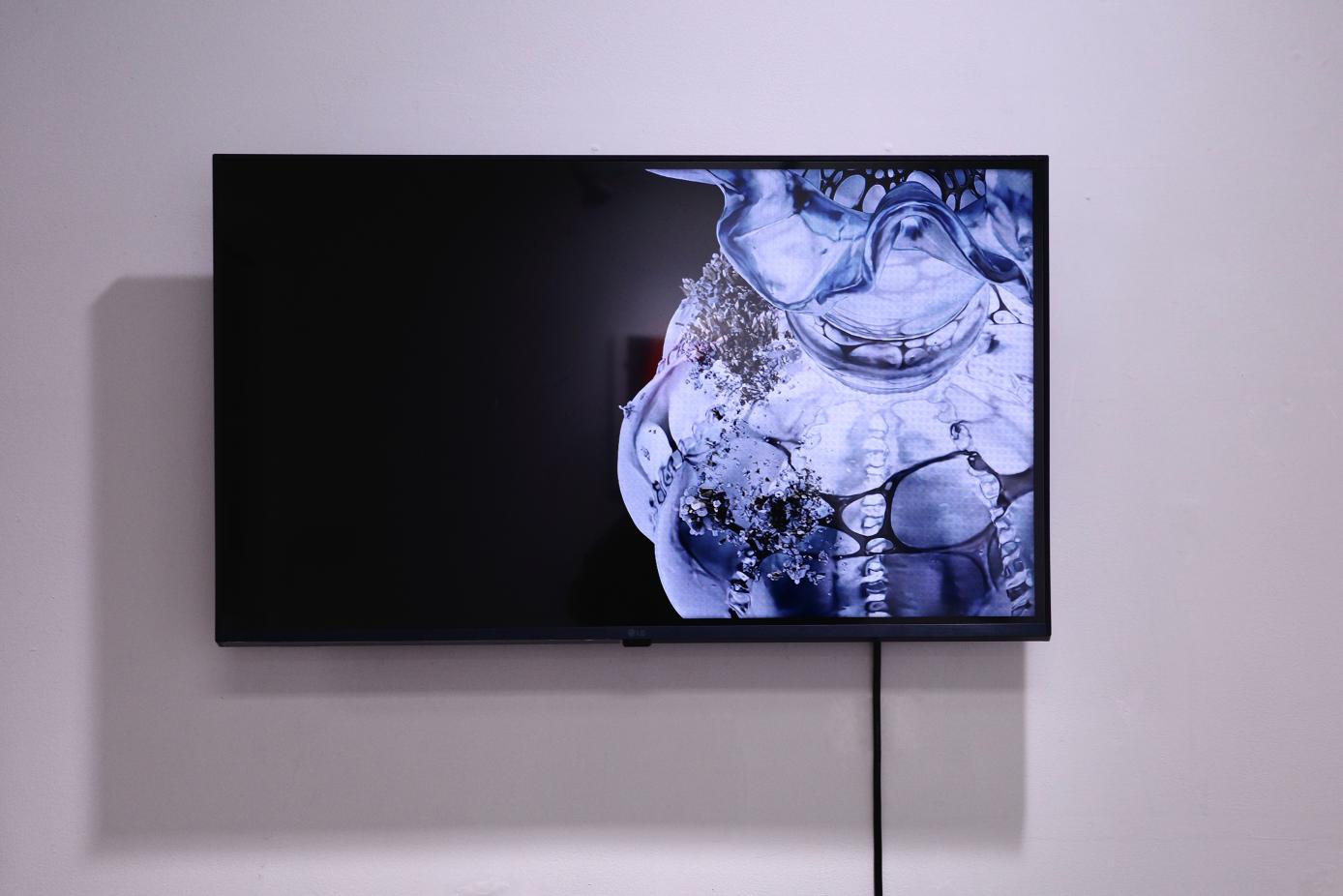
Although the text description in Xiao Ge’s work explicitly mentions ‘the body’, it does not present the human body directly. Instead, the artist constructs a poetic metaphor through three ceramic vessels. This choice is not a coincidence. Ceramics have long been closely related to humanity’s pursuit of beauty, refinement, and power, and the vase serves as a proxy for the body due to this charged history. Despite its smooth and sophisticated appearance, the body of the ceramic vessel is born from the tension between contradicting forces. Thrown on the wheel, one hand is placed inside the vessel, pushing outwards, while the other hand is positioned on the outside, stabilising the form to create the curves. Between the outward force expanding the form and subtle pressure compressing the shape, the elegant contour of the vessel emerges. Xiao Ge dwells on this condition of fluidity, malleability, and liminality of the body.
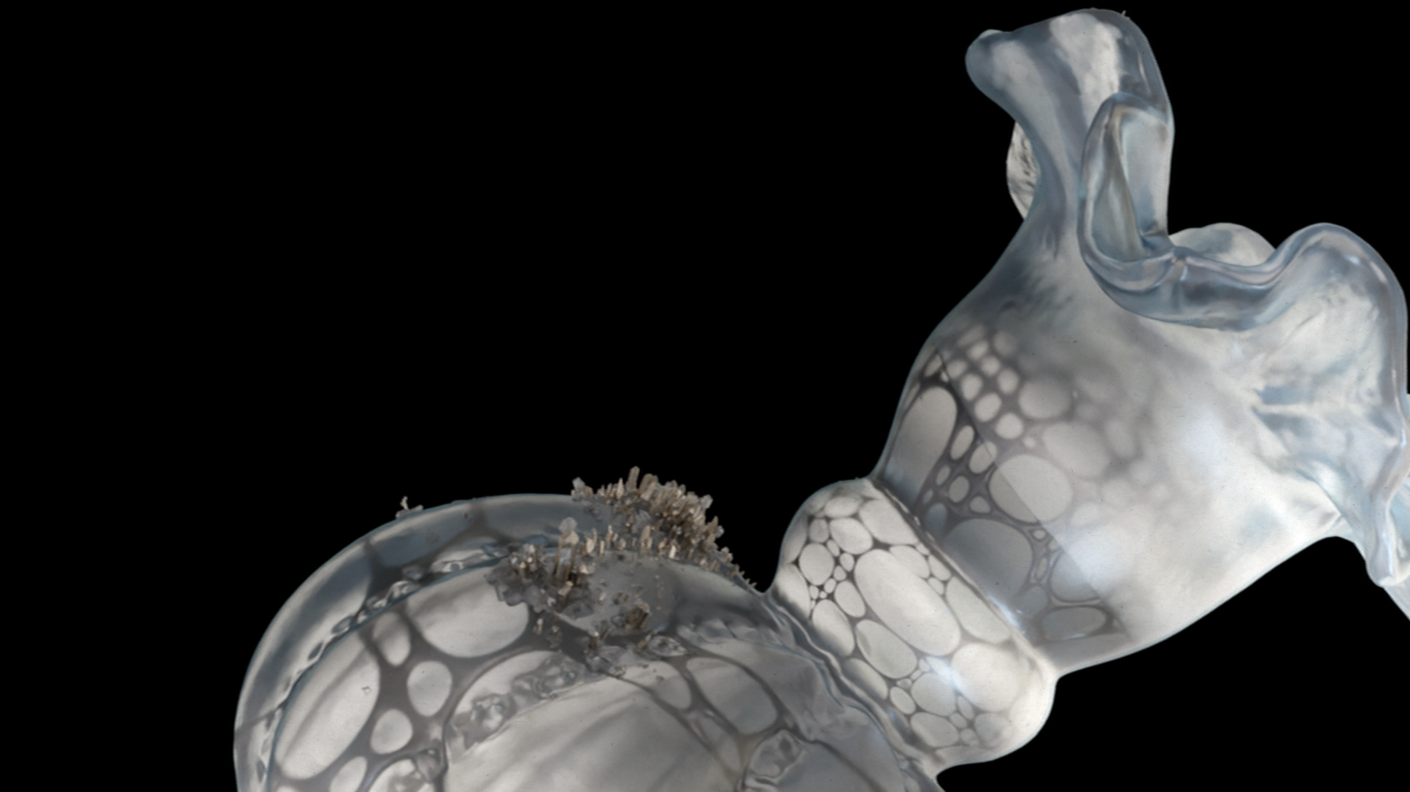
The artist continues to expand on this particular dynamic of the body, positing a hypothetical scenario that imagines the boundless fluidity without the limit of stable form. In Beneath Soft Folds, three scenarios articulate different ways the body continues to morph, constantly negotiating the aesthetic standards, the othering gaze, and unstable identity. Across the three sections, or three acts, the heightened fluidity is materialised through organic matters rooted in and growing out of the vessel’s surface. With accumulating time, crystalline structures accrete onto the ornate vase decorated with vertical ribs and grooves. The crystal proliferates, spreading out to the curves and settling into delicate valleys. The sharp, angular edges of the crystal alter the sleek silhouette of the body, rupturing the rippling surface.
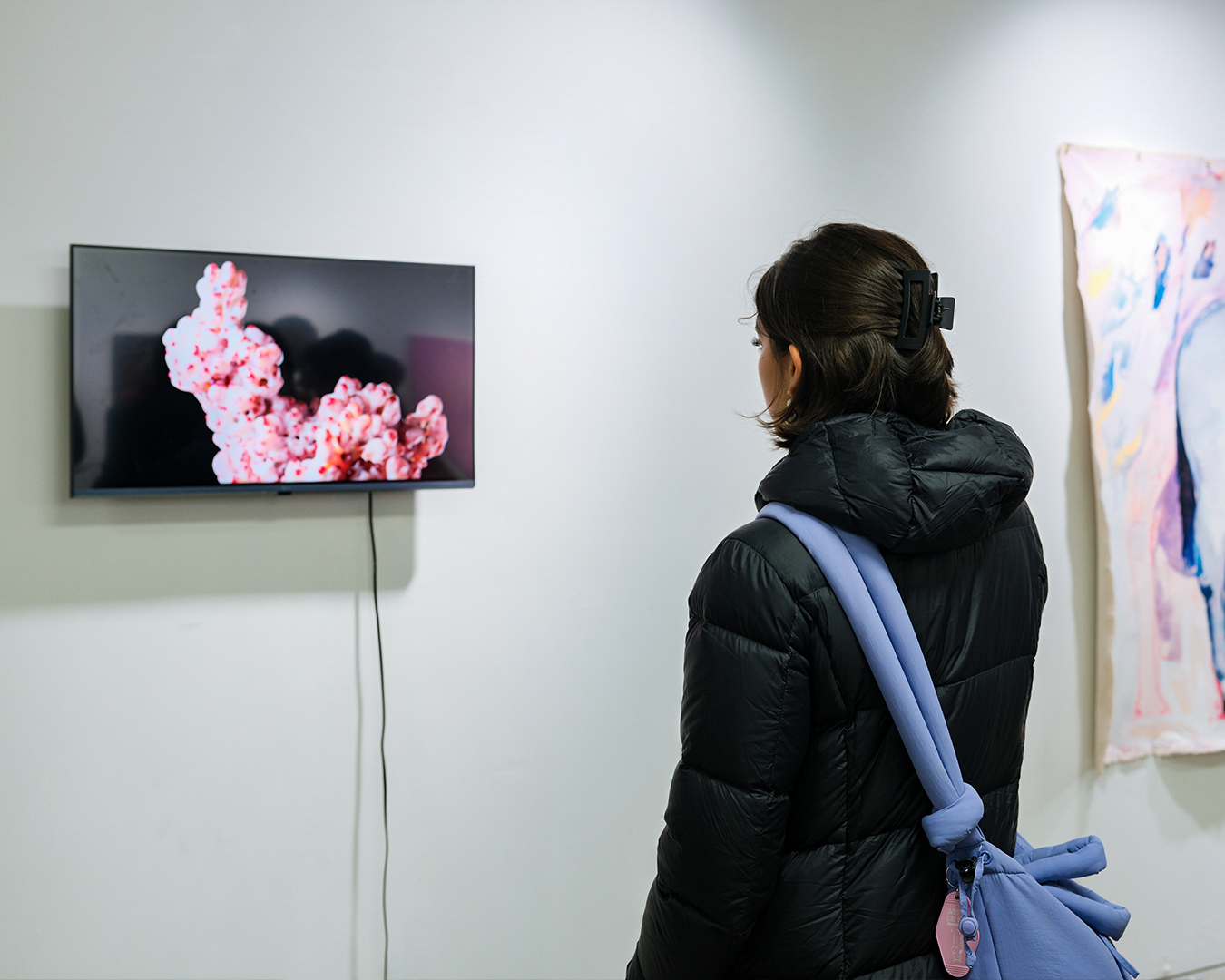
Pink corals multiply across the vase, ultimately engulfing it. The colonies of corals refuse to be legible for classification and claim their space through excessive and unpredictable growth. In the final section, a meiping vase—characterised by its simple and graceful shape with rolled rim, small neck, and tapered body—appears. In contrast to its minimal and refined silhouette, vegetation arises from invisible cracks. Soon the vessel transforms into a site, a ground for the bush, mushrooms, and insects to thrive on.
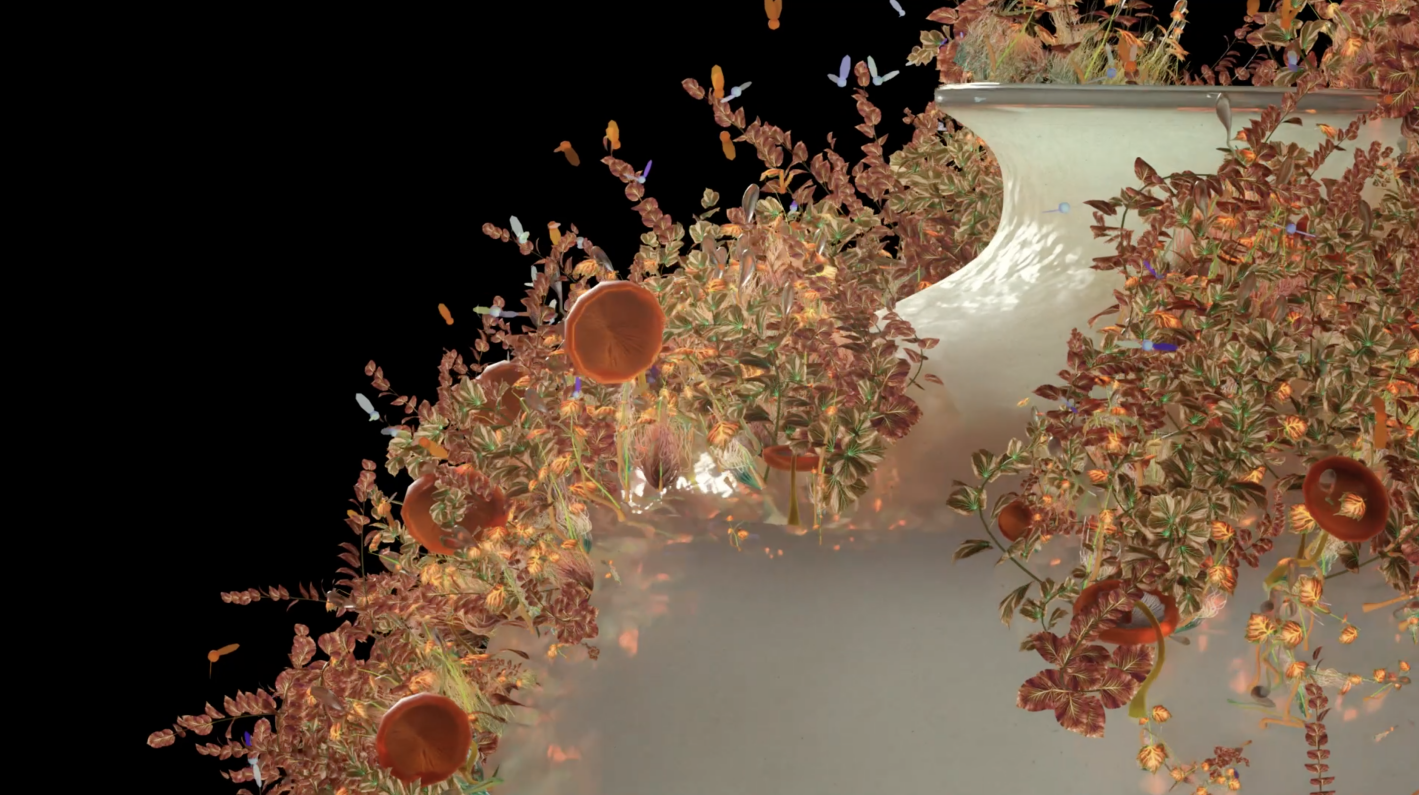
The three scenarios demonstrate how the body is perpetually in action. As the title Beneath Soft Folds suggests, the artist questions what lies beneath an ostensibly soft exterior of the body. The vases reveal the arduous movements and sustained negotiations that unfold on and under the surface of the body.
If Barbara Kruger employs the visual language of mass media and direct words to address the viewers and declare the body as the battlefield, Xiao Ge adopts a poetic approach, illustrating the constant battles unfolding on the skin of the body. In Xiao Ge’s practice, the skin is a porous and responsive membrane, living with the pressure, speaking back at the gaze.

