

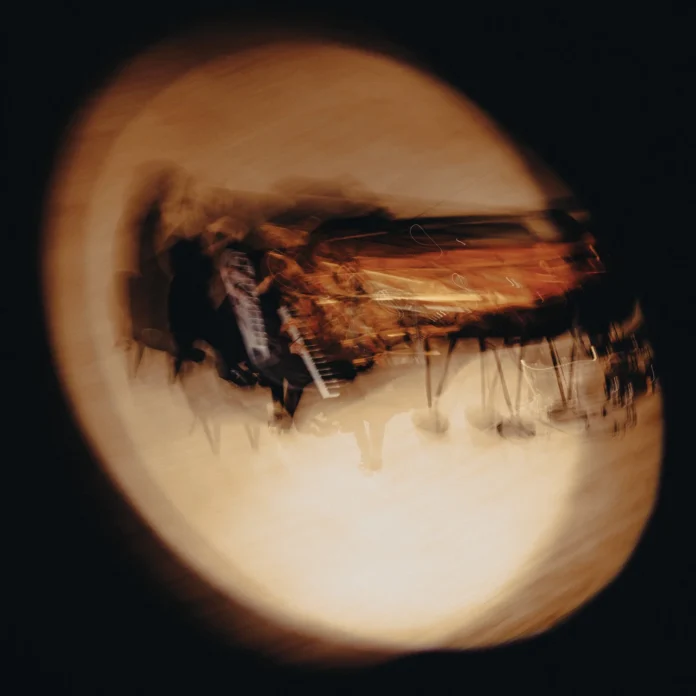
By the time Geese released their rapturously received fourth album, Getting Killed, Cameron Winter’s debut solo album already had the air of an instant classic. Its success wasn’t quite instantaneous, though: Heavy Metal came out in December 2024 to little fanfare, landing on very few year-end lists that month and ranking higher on every single one it made in 2025. Though it became one of my most-listened-to releases last year, I didn’t get to write about it in any significant capacity until I caught his intimate set at Primavera Sound’s auditorium this summer, the closest I thought I’d get to grasping the reception to his already-mythical performance at New York’s iconic venue. Now, Live at Carnegie arrives as a near-perfect time capsule alongside a Paul Thomas Anderson-directed concert film. As I did in my introduction to the Getting Killed review, I’m prompted bring up a quote by Leonard Cohen, who once warned Jarvis Cocker against dissecting the “sacred mechanics” of songs. Winter has always been at least somewhat deceitful in that crucial way, especially around the promotion of Heavy Metal. But the old mechanics are thrown out the window here, and stripping these songs – including three unreleased tracks – down to their core has a strange way of sanctifying them.
1. It All Fell in the River
Despite opening the record with an unreleased song, Winter allows himself to get comfortable on ‘It All Fell in the River’, whose relatively uncomplicated arrangement belies its overwhelming emotionality. As his pace quickens on the second verse, the song’s peppiness opens the door to existential anxiety: “I’m remembering when what fell in the river once fell on my head,” he sings ambiguously. There is something here about being present with the immensity of loss, not at the moment something passes, but in its fervent memory. Soon, Winter will start launching at the keys of the grand piano as if searching for remnants of it in the grass; for now, he is mostly remembering.
2. Try as I May
All warmed up, Winter accentuates the vulnerability inherent in ‘Try as I May’ with literal effortfulness, nowhere more pronounced than in his recurring, variable falsetto. In this rendition of the track, he has nowhere to hide, all too aware of how this exposure magnifies its emotional dynamics – not to mention the irony of “You came down to watch/ My private ceremoniеs/ All in the dark parts of rooms.” Listening to Live at Carnegie Hall in the dark comfort of your own home, this privacy feels intrusively true. And devastating as it already is, there is some relief in watching him land on a genuinely melancholy note by the song’s end.
3. Emperor XIII in Shades
With the live album’s release, ‘Emperor XIII in Shades’ feels so entrenched in the church-like atmosphere of Winter’s post-debut performances that it’s hard to imagine it fitting into his next solo record. More than a canny prelude to the “God is real” climax, the song sustains a reverent, swoony mood, though not without delivering the set’s most deceptively obvious punchline: “It’s too bad what happened to Jesus/ But Friday was alright.” He’s kind of kidding this time.
4. The Rolling Stones
Winter’s virtuosic cheekiness on the piano permeates the entire performance, but it gets a moment in the spotlight right down the middle of ‘The Rolling Stones’, which finds him sustaining a trill long enough to invite rapturous response before bathing the room in a beam of light. He knows good sense never did its master any favours, but madness has only left his “brown hair all over the goddamn floor.” The best he can do, then, is lean back in desperation and let the authorities bear witness to “me and the pianos,” sounding so much more literal in this context.
5. Love Takes Miles
The applause at the end of ‘Love Takes Miles’, noticeably (as edited) a few seconds longer than the previous songs, signifies that it was already a beloved classic by the recording of this performance, a year into its release. Winter clearly isn’t tired of it, though – his stripped-back rendering is straightfoward but breathless (notice how he careens through the lines “I need somebody sent down from the sun/ Talking to me the way you used to”), lingering in the song’s lonely romanticism as opposed to its wider resonance; as if he’s writing it down in this moment rather than registering the audience beside him.
6. Drinking Age
That loneliness is exacerbated on ‘Drinking Age’, the Heavy Metal song that most gives itself over to a piano-only performance. Still, stripping it of the French horn that imbues the original with a dreamy haze has a bone-chilling effect. The reverberating silence makes even you, the listener not present at the venue (a reality underscored by the inscrutable laughter heard at the end), wonder: Is this night forcing Winter to contend with who he’s become? Is there a meta dimension to “I’m gonna be a piece of meat”? Maybe not, but he allows himself to get lost in the thought, “oohing” and “ahhing” through another melancholic ending.
7. Cancer of the Skull
Winter addresses the crowd for the first time while introducing the song, but no spell is broken. He’s got nothing to lose at this point; after its most quotable lyric, “Songs are a hundred ugly babies/ I can’t feed,” he hums a little and stretches his voice for a full 15 seconds before launching into the verse that foreshadows ‘$0’.
8. If You Turn Back Now
A couple of tracks prior to that highlight, though, sits its evil twin: an unreleased song that betrays the narrator’s emotional avoidance – and transparency – relating to matters of the heart, where the devil is as real as God. His performance is kaleidoscopic and stunningly melodic, his voice sliding into affectation only when he sings, “You’re trying to know who you should want, but you can’t.” Like ‘Emperor XIII in Shades’, his religious language is impossible to ignore, but these lyrics have the demystifying, humanizing effect of a classic breakup ballad. There’s no dressing up the closing couplet: “You’re trying to win back my heart, but you won’t/ My heart is for those who leave me alone.” A small part of it, at least.
9. Nina + Field of Cops
My strongest memory of watching Winter live is of the torrent of feeling culminating in ‘Nina + Field of Cops’, which registers as the most inspired performance on Live at Carnegie Hall, too. The studio version’s swirling piano feels like ambience compared to its visceral closeness here, reflecting a man on the verge of eating his keys. Verbose and exacting, transcendent and naked, the current of words is ripe for interpretation yet unmistakable in its earnestness. Winter fumbles some towards the end, voice faltering, the sign of an artist in complete awe and despair, and stupidly, stupidly good.
10. $0
No doubt the album’s apotheosis, ‘$0’ stands as proof that a live album wouldn’t hit the same way at any other point in Winter’s career – these songs are so intricately connected, rife with references to each other, that cutting some would water the rest ones down. The “Woo!” that some guy yells when he dryly intones “Fuck these people” is canonical in its own way, reoccurring at subsequent shows. Blown out to nearly nine minutes, though, it must be taken as a whole, a feat of endurance unlike anything in his discography.
11. Take It With You
When Winter released ‘Take It With You’ and ‘Vines’ as his debut solo music, almost exactly two years ago, “frontman of NYC-based band Geese” was a necessary appositive, and Live at Carnegie Hall seemed far-fetched. But the first of the two tracks that close out the live album is a gut-wrenching ballad that fits right in, scanning as a direct companion to ‘If You Turn Back Now’. Though seemingly more resolute, his voice has rarely sounded as fragile as when he sings, “If you’re aching to come home, remembеr/ This place ain’t home anymore.” But while his lyrics speak of memories and simpler times, there is once again a viscerality to their rendering: on the line “If you ever get the ache some cold December,” ever is accompanied by a low note that sends shivers down your spine. 2024 may or may not have been a simpler time in Winter’s life; this is a record of something else.
12. Vines
“I keep killin’ your soul with my coldness,” Winter admits, as if in direct response to the previous track and its vindictive farewell. But maybe it also reflects some wariness around the temperament of his music; maybe there’s a way in which “I feel lonеliest when I’m with you” extends to the listener, selfish as that thought may be on our (“the banana-growing masses,” if you will) part. Winter may think little of it, but a few bits of dark humour and embittered sentimentality do nothing to detract from the set’s pervasive warmth, dizzying in a way that the album cover makes sure to capture. We can only thank God it’s a moment frozen in time.

