

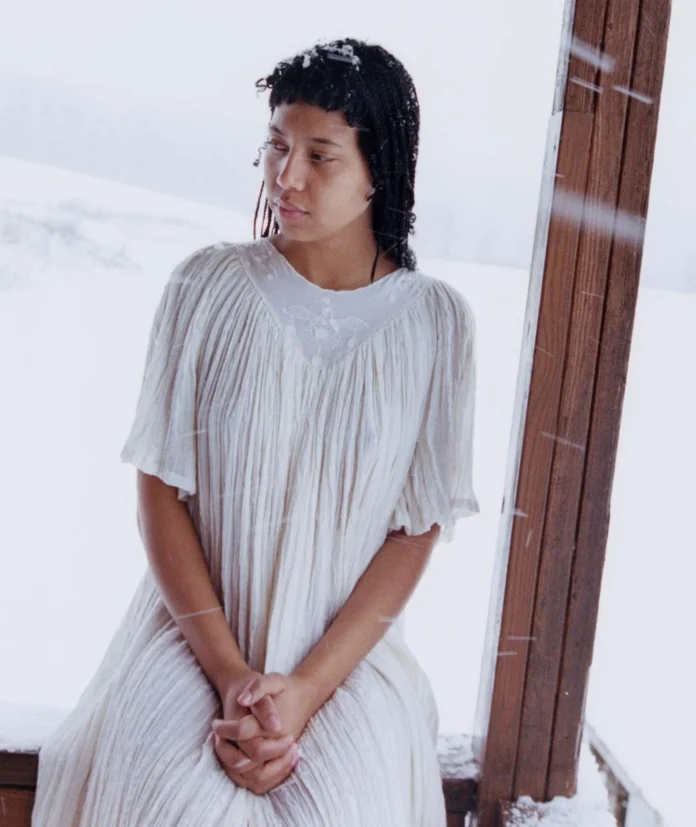
June McDoom is a New York-based singer-songwriter who grew up in South Florida in a Jamaican household. Though a love of reggae music was ingrained in her from an early age, she developed a fascination for ‘60s and ‘70s folk music in high school, when she also started getting into into jazz singing. After moving to NYC for a degree in Jazz Performance, she honed her songwriting and recording skills, releasing her self-titled EP, which she tracked with her partner and longtime collaborator Evan Wright, four years ago. 2024’s With Strings EP saw McDoom incorporate luscious harp and string arrangements, which also introduce her debut album, Follow the Light, out Friday via her new label home, Jagjaguwar. Conjuring a dreamworld with technical precision, the record is meticulously layered, a seamless blend – or rather, careful diffusion – of reggae, dub, and folk elements that manages to be both spacey and tactile in its intimacy. “Be my human angel,” she pleads on its latest single, finding ways to sound grounded and ethereal in the same breath.
We caught up with June McDoom for this edition of our Artist Spotlight interview series to talk about her upbringing, studying jazz, the process behind her debut album, and more.
I was struck by the opening lines on ‘Forever’ about the innocence of childhood, and I was wondering if you could start by sharing some early memories of growing up.
Generally, a lot of the songs on the album talk about family and family relationships. I grew up in a really large extended family. I had so many cousins around me, so many aunts and uncles. Every Christmas it was at least 50 people, and I was really, really close with all of them. So that was a really formative part of my early life. We all got along in this really close way. I would talk to them often; it wasn’t like I would see my family once a year. I grew up in this really wholesome, really supportive family structure. My whole family were immigrants, too. I grew up in America, but my whole family moved from Jamaica individually on their own, and then we all reconnected in South Florida when I was growing up there in the ’90s. I’ve realized as an adult that’s shaped a huge part of who I am. I’m a really big family person.
In ‘Forever’, I’m talking about those relationships that you grow together with – family members, but also I kind of wrote the record and the message of Follow the the Light to remind people of general relationships like that in life that feel so pure. The record feels full circle, because my family’s Jamaican, I grew up in Jamaican culture, but I would go to school and feel pretty different from my peers. I never really fit in with anyone. I didn’t have that many friends basically throughout my entire period in school, but it never really bothered me that much because my family was really supportive.
My mom, growing up and even now, is the type of person where every other week – because we have so many family members – would be like, “Call your aunt, wish her a happy birthday.” It’s a huge thing my mom’s instilled in me, just remembering to appreciate your family members, which is a skill that you need to work on as you get older. I grew up with that as a kid, but as I’ve gotten older, I’m realizing that I’m growing away from it. It’s a special thing that I feel really grateful for that my family has taught me, and that’s mostly what I’m talking about in those songs.
I know you grew up around reggae music, but obviously, as a kid, you’re not engaging in any kind of genre conversation. You were exposed to different kinds of music without necessarily labeling them. What comes to mind when you think about music entering your life in a significant way?
I got into music more professionally later than some of my peers. I started singing jazz when I was in high school, and that’s why I ended up going to music school. But a lot of my peers that I was singing jazz with had been playing on a professional level since they were kids – they were really, really high-level technical musicians. For me, I never really considered music as a true part of my identity, like I do now, until I was older, and I never even considered it as a career until I was 17 or 18.
I never really thought about genres like that. I didn’t have a community of friends that were musicians, and I also didn’t really start singing until I was older. My grandpa was a musician – he made Jamaican folk music, and I grew up seeing his guitars and his banjos, but it just never really processed for me to think about music in that way until I was older. It’s really interesting because I think we don’t realize, until you start making art, how compartmentalized so much of our society is. Now that I’m an artist and people are asking me, “What genre are you?”, you’re forced to think of yourself in these labels.
But when I was a kid, I found folk music on my own kind of randomly because I was watching a lot of old movies. I was watching The Graduate, and that’s how I found out about Simon & Garfunkel. I just loved it for some reason, and that became the music I really loved. I never thought, “Oh, folk music is typically listened to by a certain type of person, and I should be associated with that type.” And with the music my parents listened to, I never thought, “This is a certain type of music that a certain type of person listens to,” until I got older and realized a lot of music spaces are so separated.
I think the cool thing about my experience growing up in America is that I grew up in a family that pretty much only listened to Jamaican music – reggae music, early Jamaican music, rocksteady and stuff. But I was always encouraged to make and listen to whatever I wanted to, and that is really special because I feel like I’ve found my own things, and I feel really grounded in that and with who I am. It’s tricky, because I think they label my music, like, a folk fusion sort of thing. But I feel like the beauty of a lot of music is the spaces in between genres.
Do you remember a sense of excitement in discovering music that was separate from what your parents enjoyed?
Yeah. I remember being in my room, listening to these things on my own. I guess I never really thought, “Oh, I’m going against my family. But for some reason, I think it’s fascinating because it is kind of random to find ’60s folk music, since no one around me was listening to it. I look back on my younger self, and I think there’s just something really sweet about me finding something like that randomly, and even though none of my friends were listening to it, really feeling this strong sense of self, to identify with that music and keep loving and listening to it. Because high school is a weird time to like something that’s different from other people. You want to fit in with people. But I guess by high school, I kind of gave up on fitting in with people because I didn’t. [laughs] so I was just like, “Whatever.” I also really liked a lot of ’90s grunge. That’s a really random one, too, but a lot of people, I guess, like that too. I loved Kurt Cobain.
I listened to the record a couple times before reading any of the press materials, and I was struck by the duet on the album, ‘Grandpa’, before realizing it was your actual grandfather, Colin Smith. What have you learned from him, not just growing up, but with a more adult curiosity in recent years about his musical background?
I’m glad you asked like that because I think a lot of people ask how he shaped me as a kid, but actually I feel like as a kid I never really thought that much about him and his music as much as I do now. My grandpa’s been making music since the ’60s. He started playing guitar when he was a kid, and then also banjo. He grew up in the countryside of Jamaica, and then he moved eventually to the city, which is where all the musicians move. But he is in the folk scene in Jamaica, which I find now such an interesting thing, because I love American folk music, and we have this correlation where it’s very similar instrumentation. Every time we had parties, his band would play. He has a band that has violin and flute – it’s like a 10-person band. That was another fabric of my childhood: always hearing my grandpa sing or play. I feel like as a kid, I almost took that for granted, because it’s so special to have a family member like that who makes traditional music from your culture.
When I realized I wanted to first start playing guitar, my grandpa was one of the first people I told, and he gave me some advice on the type of guitar to get. I kind of went against him, actually, and got more of the classic American-style guitar, which is so funny, because the guitar that I play now is the guitar he recommended to me at the time. He’s just always been there, giving advice throughout the years. Then, when I was in college, I re-discovered a lot of earlier Jamaican music, and I was just, “Oh my gosh, my grandpa’s basically a music historian when it comes to Jamaican music.” He knows a lot of really important Jamaican artists. The community’s so small, so he’s met a lot of them, and he also knows so much about the history of Jamaican music. He was actually just honored by the Jamaican government for keeping folk music alive.
Now, one of the most amazing things that inspires me about him is that he’s been making this very specific music his entire life, and he’s so dedicated to it. He’s so knowledgeable about music, and he’s basically a community leader. He just retired from the day job that he was doing most of his life – he was a contractor – and now he’s doing music full-time. It’s insane. He’s so busy, more than ever now, and I’m so inspired by that. I’m in the early part of my career, and it’s really hard to be passionate about something and stay true to it and continue to create. He’s been doing it for decades, and I feel a deeper appreciation now more than ever, pursuing music, seeing him.
With the record, I knew I wanted him to be a part in some way for sure. I was like, “Should I do a cover or something of an older Jamaican song?” But then I thought it would be special to write something. So that song is the only song that I wrote in the studio, kind of on the spot. I had my dad voice-memo-record my grandpa from Florida and then send it to me on my phone. But I want to do more with him. I want to find a way to do something else, for sure. That was just a quick way to get him on the record. And he has an incredible bass vocal. His voice is insane.
You talked about pursuing music in a more serious way after moving to New York for your jazz studies. How did your relationship to music change as a result of both your degree and the move to New York?
I hadn’t really been singing in a way where it felt like it was my identity at the time when I found jazz. My parents didn’t listen to any jazz. I didn’t really know who John Coltrane was until I went to this summer program at Berklee College of Music. I think it was the summer of 10th grade. My grandma encouraged my mom to let me go, and then when I got there, it was basically high schoolers from around the country who were, a lot of them, coming from music high schools, and they were all singing jazz really seriously. I was like, “Whoa, this is so cool!”
I went home from that program and just intensely started learning jazz standards every day, because I was like, “Wow, that’s really cool that all these kids know for a fact they want to pursue music.” That really inspired me, and I became friends with someone who told me to audition for this program that was associated with the Grammy Foundation. I got into it somehow, and it was a really selective program, so from the minute I made that program, my life kind of shifted, and then I became a jazz musician. That became my identity, basically.
It was interesting, because when I did that, it was basically a program of 30 kids across the country, and a lot of them had been playing for many years, and a lot of them were going to Juilliard, and they already knew their route. Their whole families were very invested, and I kind of had major imposter syndrome, where I was trying to pretend that I’d been singing jazz for a long time when I kind of hadn’t been, to be honest. I was definitely intimidated by how serious everyone was, so that made me try and accelerate my technique. I just spent the years from 11th grade till college just trying to get really great at learning how to improvise and learning jazz harmony, which I love. I’m so grateful for the fact that I just randomly found it like that, because I didn’t know any jazz musicians in Florida.
I ended up going to school for jazz, and I chose The New School because I knew that eventually I would want to start writing music. I hadn’t been really writing – I wrote an occasional song every once in a while, but at the time, my focus was, “I’m a singer, and I want to become a technically proficient singer,” because that was what all my peers were doing, and I also just wanted to improve my voice. I did that for a while in college, but I think I quickly realized that I was feeling technical burnout, and I was kind of tired of thinking of music in such a technical way. Also, I felt like sometimes I was just singing things that maybe I just didn’t really want to sing, but I felt like I should be. So a year into college, I was like, “I kind of just want to start thinking about what my own space in music is, and what that would look like.”
Then I started thinking a lot about folk music again, and I started being more selective about the jazz things that I wanted to sing. I think the thing about college in that period is that it made me a really technical creator. Even now, when I make my records, I’m super technical about stuff. I think my brain has officially been changed by studying music in the institution, just because I think about things in a way that I wish sometimes felt a little bit more natural. That was the period when I started writing the songs for my first EP, and towards the end of college, I started realizing I really loved recording. I started listening to a lot of old music, and I started getting into the technical side of making a record, which we don’t really talk about in music school.
My partner that I met that I’ve been making music with, Evan [Wright], comes from a similar background where he played jazz guitar. We both kind of at the same time in school realized we wanted to write music, and then we both found that we loved recording, so we both had each other to springboard off of. I think we’re really grateful that we met each other for that reason, too. And then I started recording my EP. We recorded it at Evan’s parents’ place. They have a barn kind of thing, and we just recorded it at home. After the period of being in school, I wanted to just try and see what would happen if I made something completely on my own without going and studying in a studio and learning how to record properly. There’s no rulebook for the perfect-sounding thing, so I’ve been trying to remind myself of that with making my records.
‘Outside the Window’, from Follow the Light, kind of reminded me of Evan’s song, ‘Sound from Out the Window’ – they have a similar kind of dreamlike warmth. I thought it was a good excuse to ask about the flow of ideas between the two of you, how that has developed over the past few years, and whether it’s become more subconscious or unspoken.
I would say at this point, we definitely have an unspoken flow that is really special. I can’t really see myself creating without him. We’ve known each other for 10 years, and we started making stuff together like this about five or six years ago. We listen to the same things. If he shows me a song, I know I’m gonna love it. If I show him a song, I kind of know he’s gonna love it. We know exactly what each other likes, and we know the elements in music that we love. Because we’ve spent so much time learning what each other loves, it’s so easy to create together. Evan plays most of the instruments, so we do them one at a time. We’ll spend a whole day just working on the bass, getting really particular about the bassline melody. When Evan’s playing the bass, I’ll sing the melody to him, and he knows generally how I want the bassline to sound based on all the music he knows I love, which is super special.
I do that a bit with his music too – I don’t play the instruments, but we know how to guide each other to the thing we’re looking for. That’s basically how we work: we write our songs separately, and then once the songs are finished, we bring them to each other and figure out how we want to make them. Then it becomes this intertwined process. With my project, I’m leading and Evan is following and helping me figure it out, and it’s the same with his. It’s been special to form that language that we have, and we found that we really like recording completely on our own. We really like recording at home, because our process is really slow. We’ll spend a good amount of hours just on a bassline, which is crazy. [laughs] I don’t want to do that anymore, but we do nerd out. He’s a very technical creator like me, because he studied jazz for many years, so we do think about things more technically. I was in another interview, and because he’s my partner, someone asked, “Oh, when you guys make stuff, is it super romantic and emotional?” And I was like, “No, it’s not. [laughs] It’s super nerdy.”
I can hear that sort of nerdiness on a song like ‘Dream Dub’ – the synth, Preet Patel’s bass, they’re so particular. The record is easy to enjoy as a whole, but if you want to dig into those details, it opens itself up to that kind of listening, too.
Yeah, I’m just a huge “parts” person – I love little details. Even trying to figure out how to play the music live, I’m really trying to hold onto all the little parts and play them exactly, because I feel like they all play a role in supporting something.
You mentioned having real harp and string arrangements as a new thing on Follow the Light, though you also tested them out on the With Strings EP. At the same time, you don’t over-rely on them. There are songs deeper into the record that retain that sparser quality.
For sure. The weird thing was that when I first started making the whole record, I wanted it to be more like the minimal songs, because I was thinking it’d be nice to see what I could make if I really limited myself with the instrumentation. But some of the songs, I just felt like – I think from listening to classical music – I wanted some depth that only comes from adding more instrumentation. But I was actually really trying to keep it as minimal as possible, so I think that’s why on certain songs, I was like, “This only needs this thing.” With why I love classical music so much, it’s the dynamics in the music – there are those really heavy moments, and then there are those intimate moments where there’s like one instrument playing and you can barely hear it. I wanted to mirror that, because I love that in music when there are those dips and valleys.
I think that’s also been my thing with drums. Most of the folk records that I love, none of them have drums. But I also love so much music with percussion and drums, so I always add drums, but sometimes I feel like drums are a tricky one to mix with delicate guitars. I’m always really trying to find space for drums, and that’s challenging, because I feel like maybe sometimes you don’t need that, too.
A lot of that comes down to the drum engineering, too; I know Evan does some of that on the record, along with Victor Axelrod.
Yeah, the Victor Axelrod collaboration was super intentional, because we had never worked with another engineer before. But I reached out to Victor because he’s amazing at engineering drum sounds that sound like that ’60s era of reggae drums. He makes the most amazing records with that, and I was really curious about his process. He lives in Brooklyn, so that was super fun because we recorded in his basement, and he has such an interesting process of recording drums that was really cool to see. There are a couple of songs where we have those.
Tell me about playing the flute on a couple of songs.
Oh, yeah! On ‘Get Out of My Life’ and on ‘Weaver’, I’m playing these recorder flutes that I never really planned on doing. I was in Brussels for a gig, and I was walking around and stumbled on this flea market where I found this vintage wooden recorder. So when I got back, I really wanted to add it to the record. I can’t play very well, but I basically made those melodies for the record and practiced them a ton before we recorded it. My friend Kana [Miyamoto], who’s a traditional flute player, plays on the record too.
I read an older interview, around the EP, where you said you’d been reading more and trying to improve your lyric writing. I’m curious what was helpful to you in that regard over the past couple of years.
When I did that interview, I was probably working on the lyrics of the record at the time, trying to be really intentional about them. I think that’s the biggest difference between my first project, the EP and record. When I made my EP, it was my first time writing songs, and I was more naive. I was just so excited to make a project. When the record was finished, there were some lyrics that I felt like I wished I had spent more time on. So with the album, I knew that I really wanted to be intentional about everything I was saying, and so I started reading as references, and I was reading a lot of Zora Neale Hurston books. Her books are amazing because she’s constantly referencing nature to explain things in life that are so difficult. I think I was reading her before I had started really writing, and I was kind of blown away by how she would say something so simple, but there were so many layers of what she meant.
The book that I was reading at the time was about a girl who’s finding herself as a woman and how hard it is in society, and there was a part of the book talking about a tree. The way that she referenced the tree ended up becoming a really big inspiration for how I can try and use nature in my writing, because I’m really inspired by nature as a metaphor for life. A lot of times I’m kind of hard on myself as a lyricist, because I feel like I’m not the most poetic – you can probably tell I’m not the most poetic in the way that I speak. I guess everyone’s kind of hard on themselves as writers – I’m sure you, too. So I’ve never really hyped myself up as a lyricist, but I just wanted the lyrics to be simple to understand. A lot of the time, for some reason, when I write songs, it always ends up being a lot about finding yourself. I really identify with writers who can write about that so simply.
My favorite line on the record [from ‘Searching to Find’] has that sort of simplicity: “Dream like a girl as I grow old.”
I think that’s one of my favorites, too, actually. I just felt like as I’m getting older, I’m realizing how much, as an adult, you’re pushed into this work-grind lifestyle that you have to really work against the flow to try and preserve things that are childlike – ways of living that feel more natural. I think the record in general inspires you to be more free to explore the things that you’re not encouraged to on the daily, whatever that is, in a loose way. I was telling someone else that I feel like we’re just living in a weird, echo-chamber period with a lot of things being put out, and we’re inundated with so much that we can consume. Stepping in, if the record can act as a space to step back and reflect, like, “What are the things that I really love, how can I explore them deeper, and how can I honor them?” – if I do that at all with the music, that’s really cool and special. That’s what the record kind of did for me.
This interview has been edited and condensed for clarity and length.
June McDoom’s Follow the Light is out October 16 via Jagjaguwar.

