

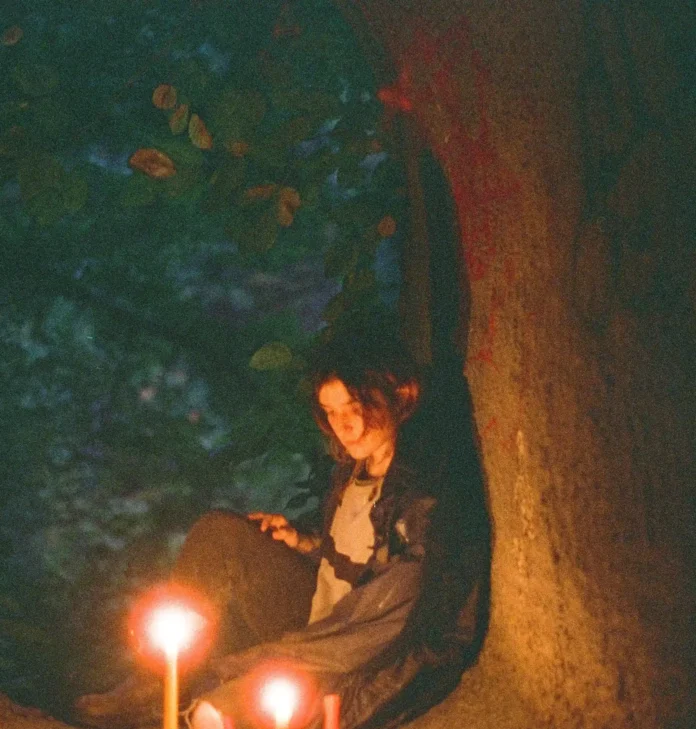
Sadurn is a Philadelphia band that began in 2017 as a solo outlet for G DeGroot. Joined by guitarist Jon Cox, drummer Amelia Swain, and bassist Tabitha Ahnert, they laid down their 2022 debut album, Radiator, at an isolated cabin in the Poconos with collaborator Heather Jones (aka ther). While DeGroot already had new songs in the works, a host of medical issues, including chronic pain, gut problems, and issues with their voice, started intensifying in the wake of the album’s release through Run for Cover. Most of the recording for its follow-up, The Underworld, took place in January 2024, when they once again rented a house in Poconos, though they needed to take a break and go back on the road before finally completing it. Arduous as the process may have been, it positively sounds like a group settling into songs they’ve lived with for a while, from the pedal steel that accentuates Cox’s guitar playing to the fiddle that draws the record to a close. In moving through a perpetual cycle of pain and yearning, it doesn’t wear the listener out so much as foster a space where they can warmly coexist, both intimately weighty and free-wheeling in nature. “I’m afraid that the way down is a long one,” DeGroot sings, a fear that never prevents The Underworld from coaxing itself upward.
We caught up with Sadurn’s G DeGroot for this edition of our Artist Spotlight interview series to talk about following up their debut album, dealing with medical issues, the idea of destiny, and more.
I know there were a lot of stops and starts in the process of making The Underworld. How much did the feeling that it was due colour each time you went back into it?
That was definitely present the whole time. I think what that had the biggest effect on was probably the writing process, because it’s not really good as an artist to feel like there’s any pressure around something coming out. And I had never before been in that situation where I was writing songs knowing that there was already an expectation of what they were going towards, like an album, and there was already an audience because we had another album out. But we recorded most of the album in January 2024; some of the songs I was writing before Radiator even came out. There’s the pressure, but there were also other uncontrollable forces at work when it came to moving things through. Like, I had a long-term vocal injury that prevented us from recording.
Are you comfortable talking about the physical challenges you dealt with around that time? To what extent do you think they stemmed from that pressure?
For me, all of the physical issues that I had that started to mount as we started touring the first record had to do with the internal pressure of feeling like I needed to be perfect, I guess. It’s kind of a funny way of putting it, but I truly believe that all of the health issues and vocal health issues that came in a cascade following the escalation of this situation of being on stage and performing and being visible – there were other things happening in my personal life that added to the intensity of the moment for me, but I was experiencing chronic pain in my hands and arms where I couldn’t play guitar sometimes or do basic things. I was experiencing a lot of other health issues, some of which overlapped with my vocal health. And that just made it hard to tour. To me, these things are all related. They’re not separate.
I’m just gonna be honest, it’s almost like an arms race of external validation. For me, it felt like this band and doing this thing was a way for me to be safe. This was my future and my identity. It gave me a sense of self-worth and value, and I felt so deeply afraid of failing. I felt like this was our one chance as our dreams were happening. There’s a lot of pressure to just push and push and do and say yes to everything and do all of this. Touring is hard before you’re a band that actually makes any money – you’re sleeping on couches and floors, and you’re getting up really early and going to bed really late just to get to the next place and play. You’re getting sick and playing shows with a fever. It’s pretty intense.
We’re all trained to believe that making it as an artist is the best possible thing that could happen to you, and you should definitely do it at all costs. It’s funny, we started touring and I started meeting all of these other bands that we were touring with, and there were so many of these people – especially the frontperson of the band, weirdly – who would have these autoimmune disorders and vocal health challenges, and while they were on tour, they had to compromise so much. And I’m like, “This is so weird! Why is this so ubiquitous?” Essentially what I believe is that your body will tell you when you should stop, but if you believe that you shouldn’t stop or you can’t stop, then that’s going to lead to a breakdown physically.
So that’s what had to happen for me. I wanted to put out a new record soon. I wanted to share more songs. I wanted to keep doing it. But it was tied too much to my feeling of safety and self-worth, and that became the reason that I was pushing. It was like a feeling of scarcity. That’s a better way of saying it – sorry, it took a long time to get there, but I was basically doing it with a feeling of scarcity. And I don’t think everyone does it that way, but a lot of people do. That’s kind of how capitalism works, on this idea of scarcity. You either get the opportunity or you miss it. You either take it and push yourself to do this thing, or you’re going to miss it and fall behind.
It’s actually really interesting for me right now to be going back into this stuff, because when health and vocal health things took me out of it definitively, it gave me the chance to rewrite my sense of self and my sense of what actually made me safe and whole and worthy. I basically had to learn that chasing that was not going to be the real solution to that, that I actually needed to build up an internal feeling of those things. That’s what this journey kind of allowed me to do. That’s what I was doing in the time that this record wasn’t being made or coming out.
I understand a lot of this boils down to the visibility of being an artist, and I wonder if you can expand on how this affected the invisible parts of it – not just your internal questioning but the songwriting itself; things that are more private to that identity.
Thanks for asking that. I think it did make it slower for me to write. I don’t think that it affected the songs themselves too much, because that space of making songs is so sacred for me. When I’m in that space of writing a song, it is just for me. But I think that having the pressure of creating an album made it harder to get into that space. So it was just less often, or less consistently, that I was able to get into that space and stay in that space. The space itself of where I write songs wasn’t corrupted, it was just harder to access. When you’re making something, no matter whether it’s a song or anything else – which, I think everyone should write songs – it’s about communing with yourself. It’s not about communing with yourself and wondering how that’s going to look to other people. If someone else is in the room evaluating, or even someone in your head, you’re not really communing with yourself.
In the bio, you mention that songwriting is “a place where you can circle back to your own truth.” That sounds like a good thing written down, but I suspect that there are moments of struggle or frustration, in some way, when you find yourself circling back to the same truths. Do you feel like that cycle ever manifests in a negative way?
I do think that it’s always a positive thing to go to your truth. I think a lot of times it means going through layers of pain. And I think that’s a positive thing, because if you’re feeling and looking at that, then that’s how you actually move through it. If you’re not looking and touching down onto it, then it’s just getting shoved down, affecting you in other ways. The way you’re talking about that makes me think about, on the album, the song ‘why does my heart’, which is about that – a lot of the album is about this feeling of not being able to move on from a relationship. In that sense, a lot of the feelings that I was moving through that end up on this record are about coming back to what I really feel and where I’m really at, and realizing that this person was still just at the center of… It can be frustrating when you feel like your brain wants to move on from something, but your heart has not done that. That’s why I ended up with so many songs about it.
It’s a complicated feeling, because it’s like, I would like to be free from this, but I’m not, and there’s layers to that. It’s not just frustrated; it’s also just like, I’m still in love. And so, ‘why does my heart’ cycles between these different chord progressions with the same phrase. One is frustrated, like, “Why does my heart always lead me back to you?” Like, I can’t do anything about this, I’m powerless to it. And the other one is kind of accepting. There’s so many dimensions to those feelings.
When I saw that quote, I was thinking of the line about having “a head full of planets circling my one desire” from ‘never tell me’. That’s one of my favorites on the record, partly because I feel like it paints a picture of that one desire as a solar system as opposed to something one-dimensional. Maybe I was curious about the negative implications of that creatively, because one layer of this pain that you sing about is that it tends to dull everything out. I was wondering how this numbness can act as a barrier to writing.
Yes, because when we are numbed out, it’s because there’s something that’s painful and there’s parts of us that want to protect us from that, and so they numb us out. That can look like so many things. It can look like looking at your phone, or just dissociating in different ways, or substances and other things that could be worse, more disruptive. But when we’re numbing out, we’re fundamentally not connected to what’s actually happening, and there’s a reason for it. It’s designed that way. The numbness is designed to protect you from something that’s really challenging. But it’s only by being in touch with the thing that’s challenging that you can move through it. Songwriting is in that place where you’re in touch with what’s happening for you. If things are too painful to be in touch with, then good luck writing a song. But you can write about being numbed out, because that is a way to get back in touch. First you can acknowledge, “Oh, I’m numbed out.” That’s like your trailhead, that’s your way back into what you’re feeling. It’s really important, because that is a feeling in itself.
It’s one thing connecting to put pen to paper and writing something in the moment, and it’s another thing staying connected throughout the whole process to that original feeling. I wanted to ask about that in relation to the gap between the first sessions and the last, and through the mixing process. How did that time affect your connection to the songs?
It’s hard. When it comes to the whole process of making a song, the time that you feel the most alive with it is the moment that it comes out of you. I’ve heard this Alex G quote about this, too, where he talks about how when he’s producing a song, creating the recording, it feels like it gets further and further and further away from that raw first moment of when it was coming out and he first demoed it. It’s not just linear like that; there are so many really beautiful moments that happen in the recording process. That’s its own creative process, especially because it’s with my friends. When they add their parts to a song, or when we play it live to track the song together – like, when we were playing ‘the weight’ and Jon ripped this amazing solo that we kept in the song, that just took it to a new place. There are parts along the way that are inspiring and giving even more life to something.
I would say mixing and mastering… not so much. Mixing and mastering have always been some of my least favorite – shout out to Mark [Watters], who mixed this record, because it’s a painful process for me, and he made it as painless as it could be. When you’re mixing, you have to put on your critical ears, so you’re taken out of just feeling it and appreciating it, because your job is to be listening to it critically. I always go through a phase when making an album in mixing where I completely hate it. [laughs] The thing is, I just have to know that that’s what happens to me. I’m going to go through this phase where I don’t like a single thing, and it feels like nails on a chalkboard. I don’t think it’s just me, but that’s a consistent reality for me, and I just have to take a break from it for a while.
Unfortunately, towards the end of making a record is when I feel the least connected to it, because you’ve distended your energy on this thing, and I’m like, “I just want to write songs. I don’t want to record, I don’t want to mix, I don’t want to master, I just want to write songs. Why am I even doing this?” So part of me is just relieved that we’re putting this record out. I want to go back to the part of being an artist that I really identify with, which is writing songs.
In terms of the recording, do you have a vocal performance on the album that you’re really proud of? ‘why does my heart’ is especially moving to me.
I’m glad you say that. That was just a practice take. I had just written the song within weeks of when we recorded it, right before the recording session, January 2024, so it was new to us. We were figuring out how we wanted to play it, with what instruments, so we just set up one mic in the middle of the room, and we were just all around it. We did a few takes with different instruments, and that was just one of the practice takes, and we just kept it. We were like, “What if it was just this? What if we just didn’t try harder on this?” The only thing is we added little pieces of Dobro after the fact, super subtle. But other than that, it’s this one mono take. It’s vulnerable to do that, so it means a lot. I like to have a mix of those things – some vocals are live on the record and some vocals are more comped, trying to get the best version of it.
For me, ‘the whole thing’ is one of the funnest songs to sing. I’m fundamentally a singer – before any of this, I just like to sing – so it just feels good to do that. I love doing harmony arrangements, so I got to add a bunch on that song.
As a whole, The Underworld is so wrapped up in the idea of destiny, which you directly address on the closing track. I’m sure your feelings around a lot of things have kind of changed since writing these songs, and I wonder if you speak to whether that’s true about fate, the way it registers in you.
I think it’s something that I struggle with, and that’s documented in all of these songs. I think that sometimes a connection – a romantic connection – can open up whole dimensions of reality for both of you, that you feel like you can only access through that person or that relationship. And those new dimensions of this magical reality feel like the most real, important, meaningful, beautiful thing. It can be hard to imagine that you’re supposed to do anything except move towards it. It feels like, without that, things are just flat.
I think that we live in a very magical reality. The way reality works is really squishy, and I’ve come to know that a lot more intimately since writing those songs. I think I always knew it, but my experience of metaphysical reality has expanded a lot in the past couple of years.Something that was really important for me to do was to rediscover that that magical layer of reality was something that was actually fundamental to me and how I experienced things, and that I didn’t need any other person in particular to experience that. I do think that if we’re really in love with someone, that probably doesn’t go away. I don’t necessarily feel like I’m ever going to not feel that way about that relationship that I wrote about so much. But what I did discover is that I have access to my own magic, and that I could reclaim that, and that I needed to put myself at the center of my destiny, so to speak. Someone else can’t be at the center of that for you.
Tying this back to the idea of musical destiny, something that comes up in these interviews is identifying the moment you first realized you’re meant to be doing this. But I understand that’s a realization that recurs, that you also circle back around, and I wonder if you can share the last time you remember having that thought.
I hope this isn’t too preachy – I just believe that, if you’re curious or excited about something, that is your destiny. If you are curious about it, if you’re excited about it, if you feel genuine desire to do something – it doesn’t matter if it’ll make you money, or if it’ll earn you anything, or if anyone will look at it or like it at all – none of that matters. If you feel curious, or excited, or it makes you feel connected to yourself, then that is your destiny. I think we are meant – born – with things that we’re meant to do, and I think that that feeling of curiosity and excitement and enlivenment is the compass towards those things, so it doesn’t really matter whether we think that we’re that good at them, or whether they’re gonna do anything – this or that for our life to make us secure, or have a reputation. I really think it’s just about whether we feel that internal little fluttering about wanting to do it. That means it’s your destiny.
This interview has been edited and condensed for clarity and length.
Sadurn’s The Underworld is out October 16 via Run for Cover.

