

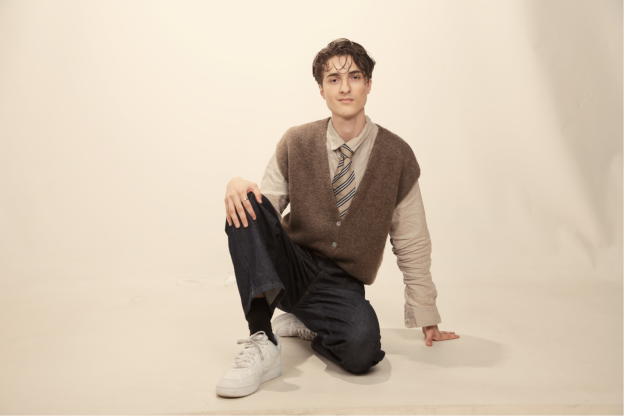
“Hang on, who’s Robert again?” It is a familiar moment for readers with ADHD, says French entrepreneur Noé Cabannes Michel. Forty or fifty pages in, a character slips from memory and the thread of the story is lost.
For over a year, he has been running a new non-profit dedicated to inclusive publishing. The word “commitment” makes him think of joining the army: you sign up for a term of service. He sees a parallel with his own work, which he has thrown himself into so wholeheartedly that “there’s no turning back”. He believes there are still no books adapted specifically for readers with attention disorders anywhere in the world, and feels a certain responsibility. “If I don’t do it, I feel as though no one will.” His first adaptation will be Stefan Zweig’s Chess.
The 20-year-old has the support of around ten volunteers and an ADHD specialist, and now also of Ashoka, the international network of social entrepreneurs, through its Impact’Ers programme. This selective, three-year programme supports twenty entrepreneurs aged 18 to 29. He is the youngest in his cohort.
A calling rooted in childhood
“As a child, I always wanted to change the world. I had this idea for a device that would capture lightning and supply the whole of Paris with electricity. It was a bit of a pipe dream, but it was going to revolutionise the world.” In real life, he has found, “it’s much harder than building things with my LEGO”.
He remembers himself in his early secondary school years as “a very creative kid, a bit of a daydreamer”. Then came the difficulties: paying attention, managing time and concentrating well enough to read “only once in a blue moon”. His mother, a keen reader, tried in vain to pass on her love of literature. At 16, he was diagnosed. He finally had a name for what he was experiencing: attention deficit hyperactivity disorder (ADHD), which can present with or without hyperactivity.
“ADHD means doing everything, having energy for everything, except the one thing you need to focus on,” he says.
Today, the former reluctant reader says he reads around forty books a year, some supplied for his contributions to the French magazine Lecture Jeunesse. The experience has left him convinced that “falling in love with just one book is enough to open the door to reading (…) and for me, that book was Gibran’s The Prophet”.
His mother, a special education teacher, had made him aware of disability long before that. “After school, over dinner, while she was working from home during the pandemic, we would hear about her work with children with multiple disabilities, deaf and hard-of-hearing children, autistic children and children with ADHD.”
There is a spontaneous streak to his story, too. While at school in the Paris region, he found the cold unbearable. Partway through the school year, he decided to go on his own to live with his grandmother in Guadeloupe, in the Caribbean. Two weeks later, he was on a plane. “She’d invited me the summer before, almost as a joke. Taking her up on it turned out to be the best decision of my life,” says Cabannes Michel.
Getting started
He founded the non-profit Art x Science International at 18. He soon enlisted consultants working pro bono, recruited volunteers and met academic Steve Ollington, who would advise him on incorporating multisensory elements. He also secured his first partnerships with organisations that had approached him about European grants, and applied to Ashoka France’s programme. That process took longer than expected.

“Altogether, the process took a year: two video interviews, two in-person interviews and an afternoon of group exercises with the other candidates,” he says. The twenty participants meet for at least one day a month. Some, including Cabannes Michel, are driven by a desire to bring about lasting change. “I wanted to be part of a community of motivated young entrepreneurs where we could learn from one another.”
What does a book adapted for readers with ADHD look like?
“It isn’t a book about ADHD,” explains Cabannes Michel. “It’s a classic, in this case one in the public domain, adapted to make reading both easier, through reworded text or a built-in guide, and more enjoyable, through illustrations or multisensory elements.” He insists that it is “neither a children’s book nor a summary”, describing those options as “not engaging enough” and “a long way from what readers are looking for”.
On that last point, the organisation surveyed 80 professionals who work with children, most of them teachers. Around 30% said they had never recommended an alternative to a child with attention difficulties, despite wanting to, because no suitable options were available.
Cabannes Michel has identified five stumbling blocks for readers:
-
- They encounter a concept, a word or a character, turn back through the book or look something up online or in a dictionary, and end up moving on to something else instead of reading on.
- Their eyes move across the page, but their mind does not follow. Eventually, they realise they have not really taken in or remembered what they have just read.
- After several dozen pages, they may forget characters or key plot points.
- Some stories can leave readers cold if they are looking for thrills and dramatic events.
- Finally, the sheer length of a book can be daunting.
Asked how feasible such an adaptation project is, the economics student replies that he draws on the easy-to-read approach (known in French as FALC), without directly answering the original question. Developed in 2009 through a European project led by Inclusion Europe and adopted in France by Unapei, the approach calls for one idea per sentence, simple words and no metaphors, among other rules. Texts must also be reviewed with the people they are intended for.
That means substantially rewriting the original, and Cabannes Michel stands by that choice.
“We sacrifice the author to give them a new lease of life. It’s a deliberate choice (…) because you can’t have your cake and eat it.” Noé Cabannes Michel
Three questions for Cabannes Michel
Question: As a child, you wanted to change the world. What do you want to change about it today?
N.C.M.: The world is overwhelmed by problems we create without even realising it. Like many people, I worry about children spending too much time on screens and turning away from reading, which has been the foundation of human knowledge for centuries. So first of all, I dream of a world where everyone can feel at home in a book, whoever publishes it. In a way, my project encourages our “competitors” to do the same. I also want us to place greater value on what people actually contribute. In economics, we measure a country’s performance in monetary terms, even though a significant share of the value created comes from volunteering. At school, we judge students by their grades, even though AI will render some of their qualifications obsolete. What if working for change no longer had to be an act of boldness? Jérémy Lachal of Libraries Without Borders, an Ashoka Fellow, has spent his life persuading people to set up libraries in places where they say the need is for water and blankets. In terms of social return on investment, the organisation is surely making the right choice: children have been able to get an education, improve their prospects and escape poverty for good. Ultimately, I want a career in impact investing to give human potential a chance, at a time when too many talented entrepreneurs are unfairly passed over because their profit margins are too slim.
“I dream of a world where everyone can feel at home in a book, whoever publishes it.” Noé Cabannes Michel
Question: What public policy would you like to see introduced to make culture more accessible?
N.C.M.: One recommendation in the think tank Impact Tank’s report Penser la culture à partir des publics (“Understanding Culture Through Its Audiences”) is to give people who work with children free access to cultural activities. France already has a Culture Pass* for young people, and I think extending it to these professionals would be an excellent idea. Money is not the only barrier for young people who receive the pass. There are also differences in the cultural experiences their parents introduce them to, or simply in knowing what to do, what to read or where to go. These professionals already have the influence and the opportunity to help bridge that gap.
*The Culture Pass (Pass Culture) is a credit provided by the French government to young people aged 17 to 21. It can be used through a dedicated app to buy books, cinema and concert tickets, music lessons or video games.
Question: What was the last book you read?
N.C.M.: Contre courant (“Against the Tide”) by children’s and young adult author Florence Cadier. It is a collection of moving short stories, set in different countries and periods, about people who face violence and choose to act, to disobey. Beyond the beautiful writing, it reminded me of the often-forgotten part of France’s national motto, “Liberty, Equality, Fraternity”. Fraternity means helping others even when circumstances or the law give you little encouragement to do so. The fact that France’s Constitutional Council has recognised that principle is a symbolic reminder that I have every right to keep taking the initiative.

