

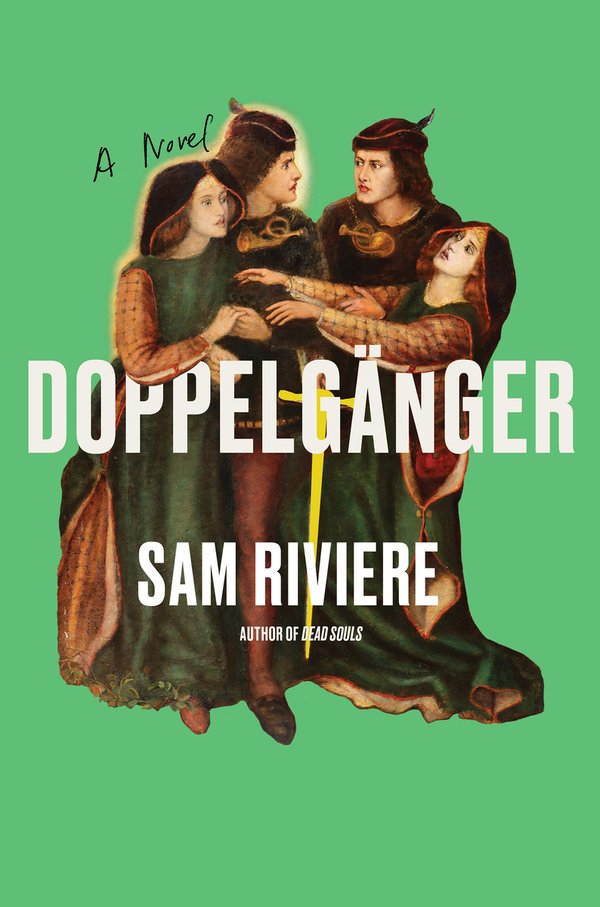
If there’s been an uptick in campus novels with melancholy attitudes toward academia recently, there’s pretty good reason—the job market is crumbling, we’re increasingly throwing our cover letters and resumes to AI agents, no one’s reading anymore (or, wait, everyone is), and when we do pick up a book, it might be slop. Can you even be sure a human is writing this? (One is, I swear!)
Last year, Sebastian Castillo’s Fresh, Green Life traced a disaffected student following his aging professor’s New Years Eve party invitation, and Jordan Castro’s gym bro professor had open disdain for his colleagues’ squishy bodies in Muscle Man. This year, Maria Adelmann’s titular character in The Adjunct is burrowed under the weight of her less-than-weighty title. Sam Riviere’s Doppelgänger, an excellent hall of mirrors of a novel, enters the canon of dejected diagnoses of academia—and it might be the sharpest of them all.
Riviere is funny, often deliriously so, and Doppelgänger stretches itself to absurd proportions in order to criticize the inner workings of what is essentially an MFA program—the Northwick Author Development Academy, an elitist and outrageous school for burgeoning “high-achieving and eager fledgling authors.” NADA’s Media Production Unit surveills each candidate in the hopes of catching a eureka moment for a best-selling novel for any presumptive documentary, faculty follow a style of “disturbance and destruction” wherein candidates swap subjects (“the fantasy epicist was schooled in physics”; “the media columnist was fed tragedies from antiquity”) and when they graduate, they go onto establish their own Author Houses, hubs where underlings pump out writing specific to the “author-master,” known as a house style. After graduating, one such candidate, Nathaniel Isoku, began to purchase property around the area, imposing authorly gentrification: “The collective social quality of Northwick, a feature often expounded upon by the zealots of the academy, and subscribed to by the yearly cohorts as a special facet of the programme, was not the collectivity of a community but the collectivity of a corporation,” Riviere writes.
Doppelgänger laughs acidly at the idea of a landscape wherein everything is homogenized and stripped of its personality
A twinning trend—one of many that had swept campus, like the “lemon coffee” or “obelisk” trends—started innocently enough, with two girls wearing similar-enough outfits to the birthday party of an aging poet, and with another man, Carl Sample, becoming so convinced that he will be punched in the face that, about to venture out and find someone to do so in order to counteract the surprise, is met with a different student, who has been punched in the face herself. But the twinning trend has an obvious parallel in the work the authors have created; returning from summer breaks, despite all the prior writing disruption, they had the disheartening realization that “all of the work was the same…the same impoverished spirit was discernable, the same complaining note was heard.” They’d paid so much money for this “hothouse environment,” this challenging place to test one’s skills, and they all simply blended into each other? “The work resembled,” Riviere writes, “the work of a madman, and not a vital and inspired madman, but a dreary and derivative madman, a boring an unlikeable madman who tirelessly and involuntarily churned out charmless and predictable material, possibly by decorating the walls of his madhouse with his own bodily fluids.” Yeowch.
The critique—MFA writing is dreadfully similar—isn’t new, but Riviere’s scorched-earth pen is. One of many things keeping Doppelgänger afloat as a dastardly alluring read and not a disdainful manifesto is his absolute joy in pillorying our most ridiculous forms of modern writing—the author-as-brand, the feckless little not-so-fictions scooped by indie presses, the exploitation and shaping of the student, an automaton trained on sets of data from one “author-master” to create online magazines, mastheads, and articles (sound familiar?)—Riviere’s glee makes all of this readable, his worldbuilding makes it surprisingly inventive. The novel is venomous, for sure, but it’s diluted by a commitment to surrealism as it spins into an art experiment, a cosmic reckoning, a conspiracy theory come to life. It’s like watching a capable critic give a subject their comeuppance—you’re rooting for them to get nastier, really roll around in the mud.
But if someone asked me to say what Doppelgänger is about, my response—“a twinning trend spreads across a campus”—would be similarly insufficient as when my boyfriend said what David Lynch’s Inland Empire is about—“A woman auditions for a movie.” My description is true but insufficient in explaining Doppelgänger’s constant nooks and crannies, its playfulness and instability. Riviere picks up on one thread of the narrative and burrows into it so intensely that its layers begin to pile up in increasingly ridiculous ways—at one point you’re lodged in an email written by a rogue dupe of an inventor that basically admits to the falsity of what came before it; chapters take the form of post-mortems, interview transcripts; its narrative zooms and pivots; he flies through organizations and acronyms with a George Saunders-like flair for worldcrafting; there’s an index in the back that’s quite helpful.
I was reading this trick of a novel in the days up until I was set to see You Can See Everything, Nathan Fielder and Lance Oppenheim’s meta-documentary about their month spent with Theranos fraudster Elizabeth Holmes in the month before her 11-year prison sentence. Doppelgänger squirming in my hands excited me for the movie to come, similarly billed as being able to “break your brain” and confusing critics to the core. Maybe, I thought, I could review them both? That their similarities lie in auteurs breaking apart the conventions of their medium? I was itching to compare and contrast.
Unfortunately, You Can See Everything didn’t live up to its promise, and Doppelgänger is, in my mind, the better art experiment. Ridiculous and unflinching and very funny, it’s a book that actually dissects how a book should be—sometimes in frustratingly cerebral ways—but fascinating ones nonetheless. I became more charmed by Riviere’s smart-alecky methods of chipping away at a simple narrative, mangling a once-recognizeable campus novel into a suffocatingly clever indictment of modern culture.
The day I finished reading Doppelgänger, the day after its release, it was reported that Catapult, the book’s publisher, was being sold, and operations were to shut down at the end of the month. It was a sudden move: its authors were not told; it’s not sure what will happen to its 25 employees and the 16 titles it has slated for Spring 2027. The move was made by its founder, Elizabeth Koch, the daughter of a billionaire who also had a hand in shuttering Catapult’s online classes and magazine.
I’m a man who loves irony, but it’s a little too on-the-nose that a day before this news, this disgruntled book, which gestures incisively at all the ways contemporary publishing sucks, was published. It dismays me greatly that some of the finest, most interesting books I’ve read have come through those doors, delivered by people who care endlessly about their work. “It is brutal that these days, pursuing creative work so often means operating under the whims of a billionaire whose attention, when shifted, can cut the ground from under your feet,” Sabrina Imbler writes in their Defector column (“Catapult Elizabeth Koch Into The Sun”).
So Doppelgänger broke my brain, but it also might have broken Catapult; at the very least, the parallel of its publication and the news of its closure has a skosh of absurdist flair that Riviere, I think, would smirk at, if only for a brief moment. Doppelgänger laughs acidly at the idea of a landscape wherein everything is homogenized and stripped of its personality; with one less daring publisher in existence, aren’t we one step closer to Riviere’s vision?
Doppelgänger is out now.

