

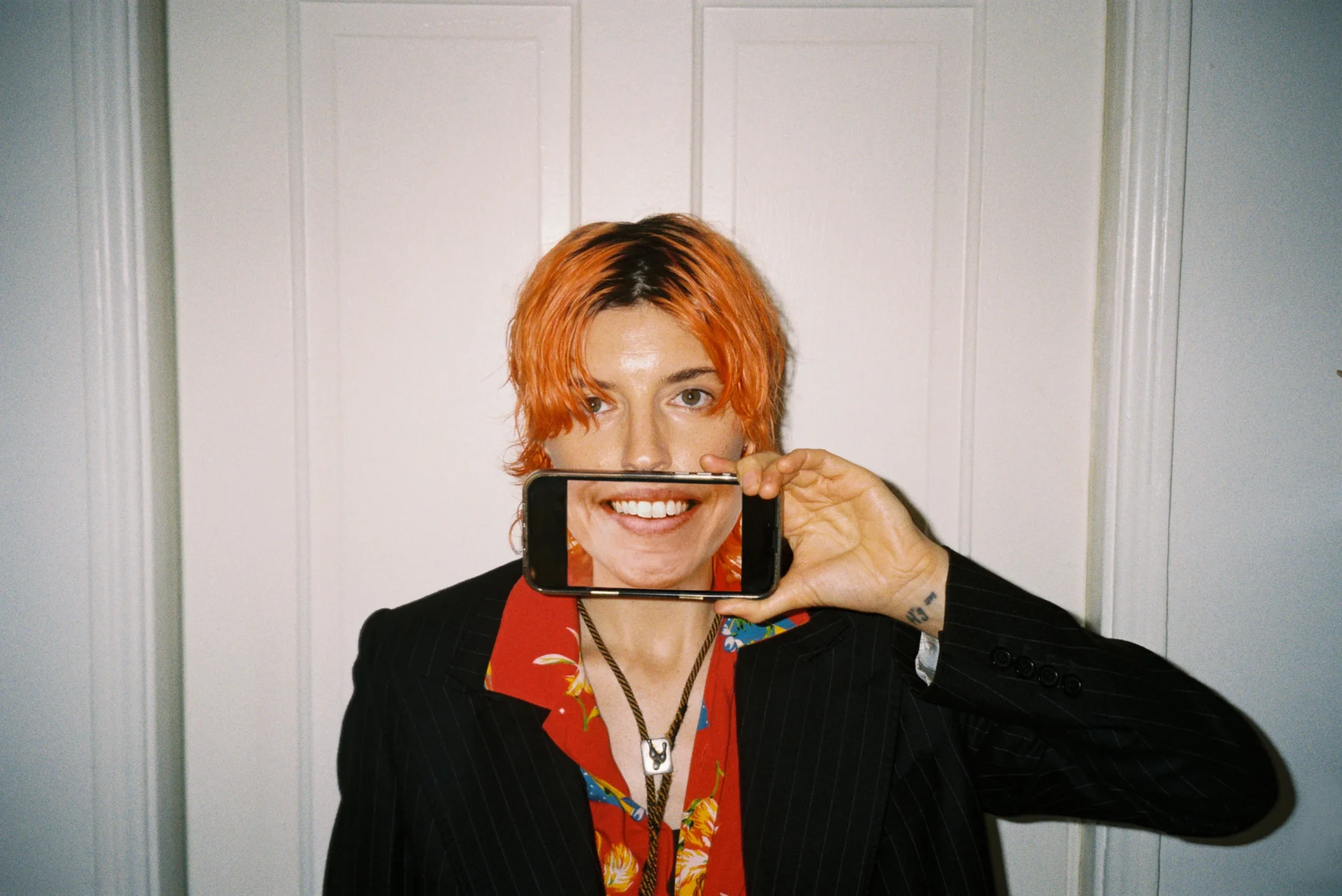
It’s kind of fitting that the first song on Caroline Rose’s last album, 2025’s year of the slug, serves as the closer on their latest, Gentling the Horse at the Walt Whitman Mall. While the previous record was a collection of Garageband recordings exclusive to Bandcamp, the new album – Rose’s first independent release on their new label, SUCK – was recorded with indie super-producer John Congleton, amplifying the raw immediacy of some of those older songs and rounding it out with new ones. For Rose, the beautifully imperfect vision of euphoria captured in ‘Everything in Its Right Place’ – yes, that’s the title of the song, brought into sharper focus in its more polished, properly capitalized version – is the beginning and end of it all. It’s not far off from the world they remember their teenage self wanting to create, a refuge from the chaos that, in time, has sucked up every side character on the record, narrator often included. On their rowdiest effort to date, Rose barrels through “alien decisions,” weird pockets of American culture, and strange alleys of memory others would rather abandon. Like the title of their new album suggests, though, Rose uncovers in them an absurd fusion of tender optimism and unvarnished nostalgia.
We caught up with Caroline Rose to talk about strip malls, fast food, spaghetti westerns, and other inspirations behind Gentling the Horse at the Walt Whitman Mall, which is out today.
Strip malls
The record is named after a shopping center that’s named after Walt Whitman – I realize now it’s called Walt Whitman Shops, but formerly the Walt Whitman Mall. That’s in Long Island, where you grew up, right?
Yeah. There’s other things named after Walt Whitman, too. We were just in the tri-state area, there’s a truck stop named after him. But the Walt Whitman Mall, yeah, it’s been rebranded Walt Whitman Shops – I think they’re trying to make it fancier or something. But hilariously, that was one of the nicer malls, the upper-middle-class malls, where you could go to Abercrombie and, I don’t know, get a $120 pair of jeans or something. But I always found it hilarious that they named a mall after this poet whose whole body of work became synonymous with the labor movement and working-class people. For anybody who knows what he was like, I think anyone would find it kind of funny they named a mall after him, because he was very bohemian and queer, and he lived with his mother until he was 40. He was kind of a weirdo off-kilter guy. I laugh about it, and I always found it funny, even when I was a teenager – just a weird way to honor someone. But maybe he would like shopping, you know? [laughs] You never know.
What memories come to mind when you think of it? How did it spring back to mind and turn into album title material?
I have these images in my head of my adolescence and growing up as an American kid. There’s just a lot of boredom and ennui, and a lack of culture, at least if you don’t live in a major city. I came from a really tiny town that’s sort of on a remote part of Long Island, and there was just never anything to do. We were always just hanging out at the end of a street, drinking and smoking weed, making out in cars and stuff. I just have these images that really summarize, like, the American getting through your teenage years and your early 20s. Pretty much as soon as I could, I got out of my hometown and moved to the city, and it had its own set of characters that were riddled with problems and struggling to fully form as people in this really unforgiving, inhospitable environment where there really is no guidance. When you’re a teenager, you sort of look up to your parents, and then you get to a certain age, and you’re like, “Oh, my parents actually don’t know anything. We’re all just human beings, and nobody actually knows what they’re doing.”
Around last year – and these things will make sense, just bear with me – a fan of mine, he flew me out to West Texas, and he was showing me all around these old ranches. I saw this placard that was talking about gentling a horse, and I’d never heard the term before, and the way that they were describing it was really poetic and really beautiful. It was a non-violent way of taming a horse, and that was a new mentality. I don’t know when this became common practice, but it was a really different technique than just using whips and ropes. When I read it, I was like, “Huh, that’s such a beautiful idea,” taming a wild animal using trust and tenderness and a sort of equality.
I related it to my own life and growing up, and how hard it is to be a young person in this environment that is just spiritually bankrupt. If you come from a small town, you have so little access to understanding what the actual world is like. We experience it digitally, but there really is very little tactile, real-world experience that connects people outside of your tiny little bubble. At least that’s how I felt; I was living in my own dreamworld fantasy. So I was equating these two things, these pictures in my mind of these different American images that, combined, summed up how I was feeling about this nostalgia of my youth with where I’m at now in my life. It seemed to perfectly nail what I was going for.
You reference malls on a couple of these songs – there’s an outlet mall in ‘Conversation with Shiv (AKA liquid k song)’, and another one on the closing track, ‘Everything in its Right Place’.
If you saw the mood boards that I put together, just to immerse yourself in a world, it’s all these box stores, fast food, driving around, boredom, all these big emotions, not knowing what to do with them, and you buy stuff, binge drink, and smoke weed. I think there’s something really relatable about that. I think that’s a universal feeling of youth, trying to figure out what to do with your time and your life.
Preppers
I find it fascinating how people’s anxieties turn up. I’m kind of part-prepper. I have, randomly, a lot of things in common with old men. Whenever I get talking to an old guy who starts talking about his underground bunker, I just go off with these dudes. I just love it, because their eyes light up, and then they start talking about how they’re doing it, and the arsenal of guns that they have for the impending World War, and they know how to grow their own food, and are into alternative energy and being off-grid. I find it so interesting, because it’s really where the alt-right and the alt-left fuse. I just find that so funny and interesting. It’s so remarkably hard for people to get along, but when you do start talking to different types of people around the world, every type of human, everybody does tend to want the exact same things. But the means to get there are so remarkably different, and the branding and marketing around certain types of lifestyles are so different.
I feel, oftentimes, like everybody’s life is just a different marketing strategy. We just buy into something that maybe we were fed since we were little kids. But I always find myself gravitating towards people who are a little off-center, who just have cult-like mentalities about certain things, or people who are so lonely they get a life-size doll and put a face on it. I find myself another one of those people that’s kinda just a little off-center.
How and where do you find yourself striking up these conversations? Is it mostly online, or on tour?
I think I gravitate towards weirdos in a lot of situations. Online, as soon as you start finding the weird stuff in the algorithm, it feeds you all of this strange stuff. One of my friends always kind of searches the internet for different characters out there, and we have a lot in common, so they’re always sending me these videos that are completely changing my algorithm, and it’s just getting weirder and weirder. [laughs] I actually kind of hate being online, but one of the silver linings to how connected everybody is digitally is you really can find any type of person out there. And something that I think is really fascinating is the loneliness that people feel when it’s projected into this digital world. It’s like people going out fishing, looking for people like themselves. There’s this barren loneliness to it that I really relate to in a way; there’s a desperation to feeling so lonely that you feel misunderstood, and you feel like an outsider. That’s something that I think I’ve always felt. I’m not exactly sure why; maybe it was growing up a little queer kid in a religious family.
And then you meet people in real life all the time. I live in Los Angeles, and one of the first things I loved about this city is how kind of bizarre everybody is. I have this theory that you can learn about a city by what people staple to the telephone poles, because in New York City, you’ll go there and it’ll be like, “Dog walker” and “Want to learn piano?”, and then they’ll have the pull tabs in the bottom. And you come to LA, and it’ll be all these flyers of, “Have you experienced an alien abduction?”, and then all the pull tabs will be gone. There’s this weird underbelly here where every other person is in a cult or legitimately goes to see a psychic as a form of therapy. It’s constantly a source of inspiration.
Fast food
On the songs we mentioned before, you also namedrop the Crunchwrap Supreme and Hardee’s. Like you said, fast food was definitely on the moodboard.
I think it’s just so ingrained in the culture. I just can’t think about my life without, like, 12-lane highways and fast food and advertisements everywhere. A lot of the culture is centered around the drive-through and shopping. [laughs] I don’t know why I find it so funny. I think just because it’s so unnatural, this way that we just drive up and get a whole meal, and don’t know where it comes from, and have no connection to it whatsoever, but you just, like, roll a blunt and then hit the Taco Bell drive-through, and it’s a completely normal way of living. I guess it’s just documenting this part of life that is so ingrained.
I’ve always loved folk music and country music storytellers, and they’d talk about these really emotional stories that have this sort of nostalgia to them. I think the type of American music – Americana music, if you want to call it that – that I’m interested in is this sort of hyper-modern, hyper-reality version of the culture. That nostalgic kind of folklore is so dated, and it’s a little too cute. I wanna hear something that has a bazooka attached to it. It just feels more reflective of the absurdism we’re dealing with now.
Muscle Beach
Are you referring to the one in California?
Yeah. It’s just another alternative lifestyle. These giant muscle people – in Muscle Beach you can go down there, and people are always down there, and they’re just enormous. They’re so remarkably dedicated. They have just these enormous biceps, and they could bench press my whole body twice over. It’s just so fascinating how you can see so many different types of people here, especially when you go into touristy areas. I love going to places like Myrtle Beach, Atlantic City, Muscle Beach, and Times Square, where you see all these different types of people. I just have this endless fascination with someone who completely dedicates their life to a thing, especially when it’s a thing that’s so transformative, like body transformation or fetishes, and you become immersed in this world of like-minded outsiders. This is another one of those subcultures that I just find endlessly fascinating. I have a tattoo of a giant muscle man on my arm, and I want to get another one of this female bodybuilder, this giant muscle lady from the ’80s. I think they’re so cool.
I saw a clip of them that you posted as part of the inspiration behind ‘Calm’.
Just the idea that you could go to the gym every day and take steroids, and you are so dedicated to this supersized version of yourself? It’s also so very American: how over-the-top can I be? I do find it absurd, but I like that it’s absurd. I think I’m just a curious person; everything that’s kind of outside of my immediate realm, I’m just going to be inspired and intrigued by it.
Smoking weed
I just have a fascination with weed culture. It’s my greatest aspiration to be a pothead, because every time I smoke or ingest weed, it makes me crazy. [laughs] It either puts me right to sleep, or I have these most paranoid visions. One time I ate weed and woke up from a dead sleep, and I was just absolutely convinced there was somebody in the hallway with a machine gun, and that if I got up and had to go to the bathroom, I was going to get mowed down by this dude with a machine gun. Another time, I kind of created a whole hallucination of Hitler coming back from the dead. Talk about absurdism! The last time I remember being in Amsterdam and smoking weed, something called “purple machete.” I smoked barely any of this blunt, and it made me out of my goddamn mind. I was so weird, and everybody was like, “What is wrong with you?” I kept getting lost, and I was so paranoid about everything.
I think why I find it so interesting is that it fits right into these images that I have in my mind of this absurdist version of culture and this over-the-top, supersized, steroided version of reality, and it’s all nested right in the mix. I find a comfort, almost, in the extremeness of the feeling, because oftentimes I already feel like my mind is moving like a particle accelerator, and I have all these thoughts all the time, and everything already feels so intense, and my emotions feel so big, like they’re exploding out of my body. Maybe there’s something to be said about that, just how I feel in my day-to-day life and how maximalist the images and information that I receive feel from the outside world. Everything just feels intense and crazy, so I feel like this drug culture is nestled in there. I’m as much fascinated by meth heads as as people who smoke weed every day and binge drink every day; it’s just another way of wading through the muck of hardship and despair.
On ‘Calm’, there’s also this irony of supposedly being chill, but actually feeling paranoid about everything.
I feel like that’s the ultimate experience when I’m high on something, or when I smoke weed, or just the way that I feel maybe all the time in a social environment – just having to be normal and look normal, like everything’s fine, everything’s fine, everything’s fine, and you’re actually just kind of crumbling and imploding on the inside. I was talking about that song to somebody in an interview, and they were like, “Oh, like masking.” And I was like, “Yeah, it is kind of like masking.” Everyone kind of diagnosing my neurodivergence via my lyrics. [laughs] I’m like, “Okay, okay.”
Latex
I think you’re starting to see a theme here of subcultures that I just find fascinating. I find all these different pockets of cultures so uniquely their own thing, and I always kind of find myself feeling like a voyeur, like a visitor in these different worlds, because I’m just so curious about it. I think there’s a part of me that genuinely wants to understand or try it. I’m genuinely curious about how things might feel. I also think that the latex world is kind of beautiful. It has this beautiful imagery of texture and sensuality, and I think people kind of make it weirder than it even is. I think as an artist, it’s just beautiful; it’s fascinating from an aesthetic standpoint. And then, being a visitor and immersing yourself in a world, it’s fun. It’s fun to be inspired by different ways of life. It’s part of this absurdist reality that I feel like I’m living in, this maximalist aesthetic. I hope people reading this will be like, “I’m gonna send you some stuff,” you know?
Spaghetti westerns
Growing up, my family and I would go on these road trips to different American national parks. I grew up seeing the whole country by the time I was a teenager. We would always stay in these really kitschy places. It would be like a roadside motel off Route 66 that was shaped like a teepee. You know, it had air conditioning and was kind of modernized, but it was ridiculous. Or bizarre roadside attractions – you’d see, “100 miles away, pull off to see The Thing!” I just grew up with these American tropes – what comes to mind is simulacra, kind of reprocessed versions of itself that are no longer even applicable to the original country. It actually has nothing to do with it, it’s just an advertised version of something.
What I find really interesting is when people from other countries look at American culture, and how it gets summed into these ridiculous stereotypes. Like, a spaghetti western is a take on this classic American style of film, but then it becomes kind of its own thing, and it’s arguably better than the original thing. It becomes this legendary thing. It’s like its own reality now, and then there’ll be somebody that is inspired by the take on the take of the original Western film. So then it becomes this mosaic of these old stereotypes of Western films, and then you have the Italian version of it, and then, I don’t know, the Nigerian version of the Italian version of the US version. I think that’s so cool, this fusion of cultures and interpretations and interpolations. I think that’s why my career will always be an exploration of sounds and styles, trying fusions and being like, “Will this sound cool with this?” Maybe at some point I’ll pick something and settle with it for a while.
This interview has been edited and condensed for clarity and length.
Caroline Rose’s Gentling the Horse at the Walt Whitman Mall is out now via SUCK Records.

