

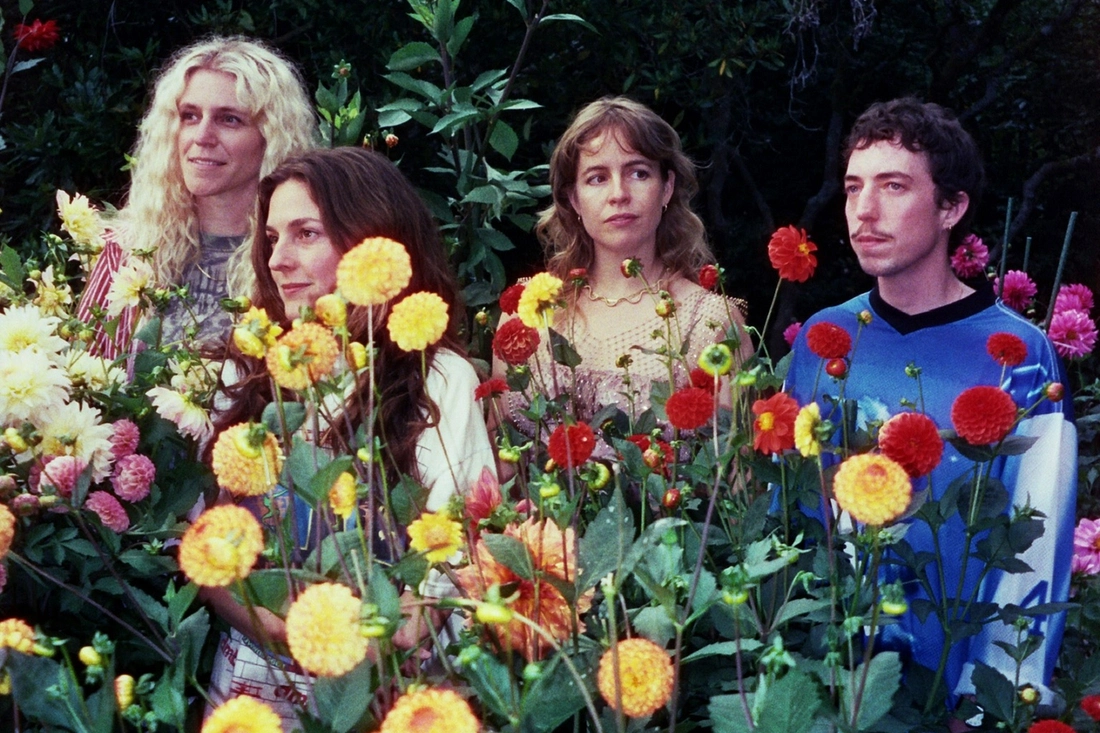
Julia Shapiro was probably listening to ambient music when she designed the artwork for Chastity Belt’s new album, All My Friends, traced off of a photo of the band in a rowboat. Since making graphic design a real practice (including work on two Elliott Smith reissues), she’s used to putting on ambient record while working, and even made one as Guest Bartender Deborah Toyota with Samur Khouja, the longtime collaborator who recorded, mixed, and mastered the group’s latest LP. The Live, Laugh, Love follow-up was tracked in different locations, including Seahorse Sound Studios in Los Angeles and the Old Harpet Factory in Hydra, Greece, and these days, the band is scattered across LA, Seattle, and Chicago; in that photo, though, they are at Washington’s Puget Sound, where guitarist Lydia Lund’s family owns a property they’ve retreated to for nearly a decade and a half. The details have almost literally been traced off – the members hardly identifiable by their outlines (though Shapiro laughingly reveals who’s trailing behind), with no signifier of time or place. Yet in dissolving the moment it finds a symbol for their friendship, the theme their new songs unwittingly coalesce around even when they reflect different perspectives. Bouts of introspection, melancholy, and nostalgia may colour All My Friends in a downcast mood, but the enduring bond that’s brought it into existence invites you to bask in it like warm water.
We caught up with Chastity Belt’s Julia Shapiro and Gretchen Grimm to talk about long walks, ambient music, friendship, and other inspirations behind All My Friends.
Long walks
Julia Shapiro: I was thinking about the process of mixing the record and listening to songs, and pretty much every time I listened to them, I went on a really long walk. I think it’s just a good way to focus for me and listen. I have trouble just sitting and listening; I’ll get distracted if I’m in my apartment. Walking is a good way to hear things differently. Sometimes I would smoke a little weed and listen, because I would hear different things in different states or moods.
Gretchen Grimm: I did that a lot during the mix, too. At one point, I was really focused and walked right by a friend, and he was just like, “Hi, Gretchen!” You get kind of sucked in and forget you’re in public sometimes.
JS: Just stopping to open my notes app and write down stuff.
Would you write down technical notes, or were they also things like seeing the record in a different light?
JS: Different things would come out, for sure. There were a couple of songs where I just noticed layers that I hadn’t noticed after listening a ton of times. I think part of that was Samur, who mixed it – he was changing different levels of stuff without telling us, just to see if we would notice, I think. [laughs] I feel like there were these really dissonant layers on your song, Gretchen, that maybe got pushed up and up until we said something.
GG: That was driving me crazy, yeah. I was like, “What is going on? I swear this is different.”
JS: Maybe that’s his way of making sure we’re actually listening, I don’t know. But also, I think he just really liked dissonant parts.
GG: He likes to sneak them in when he can.
Do you tend to write lyrics or record voice memos on long walks?
JS: Sometimes, yeah. If I don’t have all the lyrics for a song, sometimes I’ll listen to a voice memo on a walk and try to think of lyrics in my head.
GG: Yeah, I’ve done that too.
Do you remember going on long walks together in the making of this record or in general?
JS: We do go on long walks when we’re on tour, because you gotta stretch those legs.
GG: I feel like we all like to walk. But I don’t know if we do a ton of group walks.
JS: Yeah, usually it’s more of a solo thing. [laughs] Take a little time away.
Swimming
Is it a similar thing with swimming for you, Gretchen? I’m guessing that was a big part of your trip to Greece, where you went to record in the island of Hydra.
GG: I feel like not good enough at swimming for it to feel like walking, where I’m getting in the zone for a long time. Swimming is more about taking a break for me. When we recorded in Greece, we were there in August, so it was really hot. Pretty every day in the middle to late afternoon, we all took a swim break. Our intention there was really like, “We’re just gonna try to enjoy ourselves.” Yes, we’re here to record and that’s kind of work, but we’re in this beautiful place, and we don’t need to feel stressed about wasting two hours of studio time. We can let ourselves take a breather, and then when we go back, we’ll have some fresh ideas.
JS: It was very necessary to take swim breaks, too, because there’s no AC in the live room. We would get so hot we couldn’t even think. We were really baking.
GG: That was the nicest water I’ve ever been in. It was so warm, but not like – this summer I swam in water on the East Coast in South Carolina that was too warm. That water in Greece was warm, but refreshing, and so blue.
JS: It’s so salty you really just float.
Did you find yourselves recording there at night? Westerman, who recorded his last album there, told me that because there’s no AC at the building, it’s so hot during the day that it’s almost impossible to work and record.
JS: I feel like we usually were just going out to eat at night. The sun set pretty late – we might have recorded a little bit at night, but we tried to do morning-ish, take a break in the middle of the day, and then record in the evening.
Did being there feel like a holiday, despite the fact that you were working?
GG: I think that’s how we try to keep the band feeling in general. We don’t get to be together a ton, so we want to be able to have a good time when we are together. We’re working, but we try not to get too stressed. Our overall intention as a band is just to enjoy making music together.
JS: We went into it thinking, “Let’s not get too stressed about getting everything done, and let our enjoyment come first.” Fun and friendship first, and then the music. Things tend to turn out worse when we’re stressed about music. When we go into a session thinking, “These are just demos, no pressure,” it always turns out better, and we actually tend to get more done that way.
GG: I think when you get too much into a work mindset, you start to nitpick every little thing and almost forget that it’s music. It doesn’t work as well for us – that’s not what it’s about.
JS: You can’t get into a headspace where you feel like everything has to be perfect. It’s helpful to take a step back and realize that a lot of what I enjoy in other people’s music is the imperfections and weird parts that maybe weren’t intentional. It’s hard to realize that with your own music, but when we’re in a good headspace, we don’t get so perfectionist about things.
Αmbient music
Julia, you recently released a collaborative ambient record under the name Guest Bartender Deborah Toyota, which I know was inspired by a poster you saw in Hydra.
JS: You really did your research!
Has ambient music been a big part of your listening diet lately?
JS: Yeah, that’s pretty much the only music I’ve been listening to for the past couple of years. I tend to need to take a break from music and the Chastity Belt genre. It’s a nice break from that, and it goes well with everyday life – I was just in school for a couple of years, so I would put on an ambient record while doing graphic design, which is a nice combo. I enjoy listening to different genres outside of Chastity Belt, and I think it’s helpful for getting inspiration that way.
How was it helpful around the time you were making All My Friends?
JS: Some of the songs on this record are older than others, but for the newer ones, I was definitely listening to more ambient music. I don’t know necessarily how much that influenced the music, but it probably seeped in in places. The ending of ‘Designs’ has this ambient, hypnotizing quality with some synths lower in the mix that come up. The ambient record I just put out was basically all synths, so I feel like I’m better versed in synths now and have fun sprinkling them in where I can. I don’t really approach our music thinking, “I’m gonna write a song that sounds like this band.” Some bands are inspired by Stereolab and write a Stereolab record, but consciously or unconsciously, I almost don’t want our music to sound like other bands. I think it naturally doesn’t; it naturally sounds like the four of us playing together because we’ve played together for so long and created our own sound. No matter what we play, to me, it sounds like Chastity Belt. There are different kinds of Chastity Belt, but that’s just how I hear it.
Puget Sound
I know Lydia’s family has a house there that’s sort of served as an escape for you over the year. I hear it on songs like ‘Friends for This’. Tell me more about what it means to your friendship and the band.
GG: That’s our spot that we always go to just to write and get to be together. It’s kind of the best – being able to play together right on the sound, and it’s so beautiful. There are themes in this album related to cycles and tides. There’s something about the tide in the sound – it’s a cycle, but not a perfect circle. It’s returning to spots it’s been before, but things always look a little different. I feel like a few songs, like ‘Friends for This’, remind me of that. You’re coming back to a place you’ve been, but you’re a little different and the place is a little different. Life often feels cyclical like that – nothing is ever right back in the exact same place, but sometimes you have the feeling of, “Oh, I’ve been in this phase of my life before, but it’s a little different.”
JS: It’s always interesting to go back to Lydia’s family place because we’ve been going there and writing music since 2012. Each time we go back, it’s a reflection of how we’ve changed and how our music has changed. It’s a way to measure time and the changes in our lives.
GG: We were there this past summer, and I think that was one of the longer periods we’d gone without all being together. Almost immediately, I started playing a chord progression, and Lydia immediately started playing a lead line that was perfect for it. We all just started laughing because we were like, “Oh my god, here we are back in it.” We just know each other so well we can click together.
JS: We just jump right back in.
What was going through your minds at that moment?
JS: I haven’t really been playing guitar that much, and so I was like, “We’ll see what happens.” It really is something clicks when we’re all together, and all of a sudden I feel more inspired to play.
GG: Yeah, definitely. I hadn’t been playing drums much at all either, so it was nice.
What do you remember about the first times you made music there or hung out there?
JS: I have this specific memory of the song ‘Lydia’, Lydia playing a song for us, and there’s a line that’s like, “When the fog meets the water.” Looking out, you can just see the water from the room that we all play in. Sometimes when the tide is really high, it almost looks like we’re on a boat or something. I remember in that moment feeling that, and it all just coming together. I do love when the tide is high and we’re in there, because I’ll just imagine that we’re floating on the water.
GG: I feel like I remember being out on the rowboat. We had a lot of good times on the rowboat with a bottle of wine and someone trailing behind in the tube.
JS: Usually Gretchen.
GG: [laughs] Yeah. Everything was so novel then, you know? It was like, “Oh my god, this is crazy, we’re out on the rowboat!” 15 years later, it’s like, I’m up in the morning reading my book – definitely we’ve changed and aged since then, but we still like to take the rowboat out.
Elliott Smith
You mentioned playing the guitar, and I’m sure Elliott Smith has been a huge influence, even just in that department. I read you discovered his music in eighth grade, and I wonder if you went through a period of re-appreciation recently.
JS: Yeah, I definitely have that kind of relationship with his music. But when I wrote that, I was thinking of one specific song – ‘Not Today’ definitely has an Elliott Smith kind of vibe. It wasn’t like I sat down and wrote a song that sounds like Elliott Smith, but I started playing that and then kind of later realized it sounds like Elliott Smith.
I do think his style of guitar playing just naturally seeps into the way that I play guitar. I think about this interview with him that I’ve watched a couple of times where he talks about songwriting. He talks about it in this abstract way that I could kind of relate to – it doesn’t really make sense, but he’s like, “Yeah, sometimes I just make different shapes with my hands and then something happens.” I feel like I’ve written a lot of songs that way, where I’m not even thinking about what I’m doing, but I’m holding a guitar, maybe talking to someone or doing something else, and then all of a sudden my fingers just start doing stuff and I’m like, “Oh, whoa, that was cool.” It’s kind of nice to have songs that come out like that subconsciously, because I don’t really know music theory; chords are shapes to me, and I don’t know the name of the chord that I’m playing or anything. But that, to me, makes it more fun – it’s kind of more of a puzzle to find the right chord that fits.
Depression
I want to ask – and it may be difficult to pin down – whether “the heaviness setting in,” as you sing on the final track, stifles the urge to write, or if it sometimes feeds into it. Is it cyclical in the way Gretchen described before?
JS: I would say there are moments of that sort of numb depression where I don’t feel like writing and I’m not inspired. But I do sometimes worry that all the lyrics I write make it seem like I’m this really depressed person. I think someone was talking about Elliott Smith, saying you’d think he’s this sad-sack guy by listening to his music, but he’s actually really funny and fun to be around. Hopefully, people feel that way about me! [laughs] But I tend to be drawn towards sad music, and I tend to write music when I’m sad and dealing with more negative emotions. It’s a form of therapy. Sometimes subconscious thoughts come out when I’m writing lyrics, and later I’ll realize what the song was even about. When I’m writing, I don’t necessarily realize what it’s about in a conscious way, and then after having space from it, I’ll go back and be like, “Yeah, this is pretty straightforward, what I’m singing about.” Definitely, in terms of lyrics, depression is a huge influence.
You’ve also mentioned the fear of being perceived as an inspiration, and I wonder if it’s somehow tied to depression.
JS: Yeah, when I look at some of the lyrics I’ve written, a lot of them are about a fear of being perceived, but also wanting to be understood. There’s this push and pull. Another aspect of writing lyrics is knowing that there’s going to be an audience for it. It’s not necessarily just for yourself; it’s a weird feeling to know this is going to go out into the world. I consciously try not to think about how people will receive it when I’m writing, because it takes me out of it, but I’m sure it plays into things. Our first record is really special in the sense that I don’t think we were thinking about an audience at all. That’s why there’s this purity to it – we didn’t even have an audience at the time, and when we were writing those songs, we didn’t even really know we were going to put out an album. There is a freeness to that record that we’ll never have again, but that’s what makes it special.
But there’s also a special feeling to this record, which is that the audience in mind often seems to be just a close circle of friends.
JS: I think in a way, the first audience is just our band. That’s definitely something I’ve thought about.I don’t know if we knew we weren’t going to play these songs live or tour this album when we were recording, but now, not knowing when we’ll tour again, it creates this other sort of freedom. We don’t have to worry about playing this song live or figuring out how to play it live, so in that sense, we can take more chances and write more difficult parts that we wouldn’t necessarily want to play live.
Friendship
Obviously, we’ve been talking about friendship throughout the conversation, which was also at the heart of Live, Love, Laugh. I’m curious what felt different about centering your friendship as a band on this record. Did you feel like it came into the foreground in some way?
GG: It was actually Samur who mixed our album, who brought it up to us. He was mixing and said, “You know, a lot of these songs are about friends.” Then we realized he was right, they are. Again, it wasn’t like we did many things with songwriting or making an album where we thought, “This is going to be centered around this.” We just get together and write songs, and then afterwards we reflect on themes. Maybe it’s just where we’re all at in life – old enough to realize how important friendships are, and at this point, we’ve known each other for almost 20 years.
JS: I think a lot of people value career and family before friendship, but something we have in common as a band is that we’ve always valued friendship the most, it seems. Because we are all so close and such good friends, it’s really nice to have this project together where we have a reason to get together and work on something. A lot of people don’t necessarily have that. They might be like, “Let’s go on a friend vacation,” but it’s not as frequent as us intentionally deciding to take a week to do some songwriting, hang out, and have a good time. It’s really nice to have that, especially later in life when people seem to be getting more isolated, coupling up, and not hanging out as much as they did in their 20s. It’s nice to be able to make time for that.
Tell me about making time to do a Secret Santa while recording All My Friends.
GG: Our last recording session at Seahorse Sound Studios was around Christmas, and we’re there around the holidays because it’s just when people have time off. I don’t know how we decided to do a Secret Santa, but we did, and we just took it really seriously. We drew names out of a hat, and it was Seahorse Sound Studios’ solstice celebration. We took it so seriously. No one knew who had who, and all week we were trying to guess. It got to the point where I was kind of nervous the day of.
JS: [laughs] Everyone was!
GG: The anticipation really builds.
JS: So much anticipation, because every single day, Gretchen would do a countdown, like, “5 days till Secret Santa!” The other thing about it that was fun was we had to keep it to $20 and under, and you had to purchase stuff at a corner store, so there were a couple of rules. We should do it again this time.
GG: We have to.
JS: It’s like the new tradition.
This interview has been edited and condensed for clarity and length.
Chastity Belt’s All My Friends is out now via Suicide Squeeze.

