

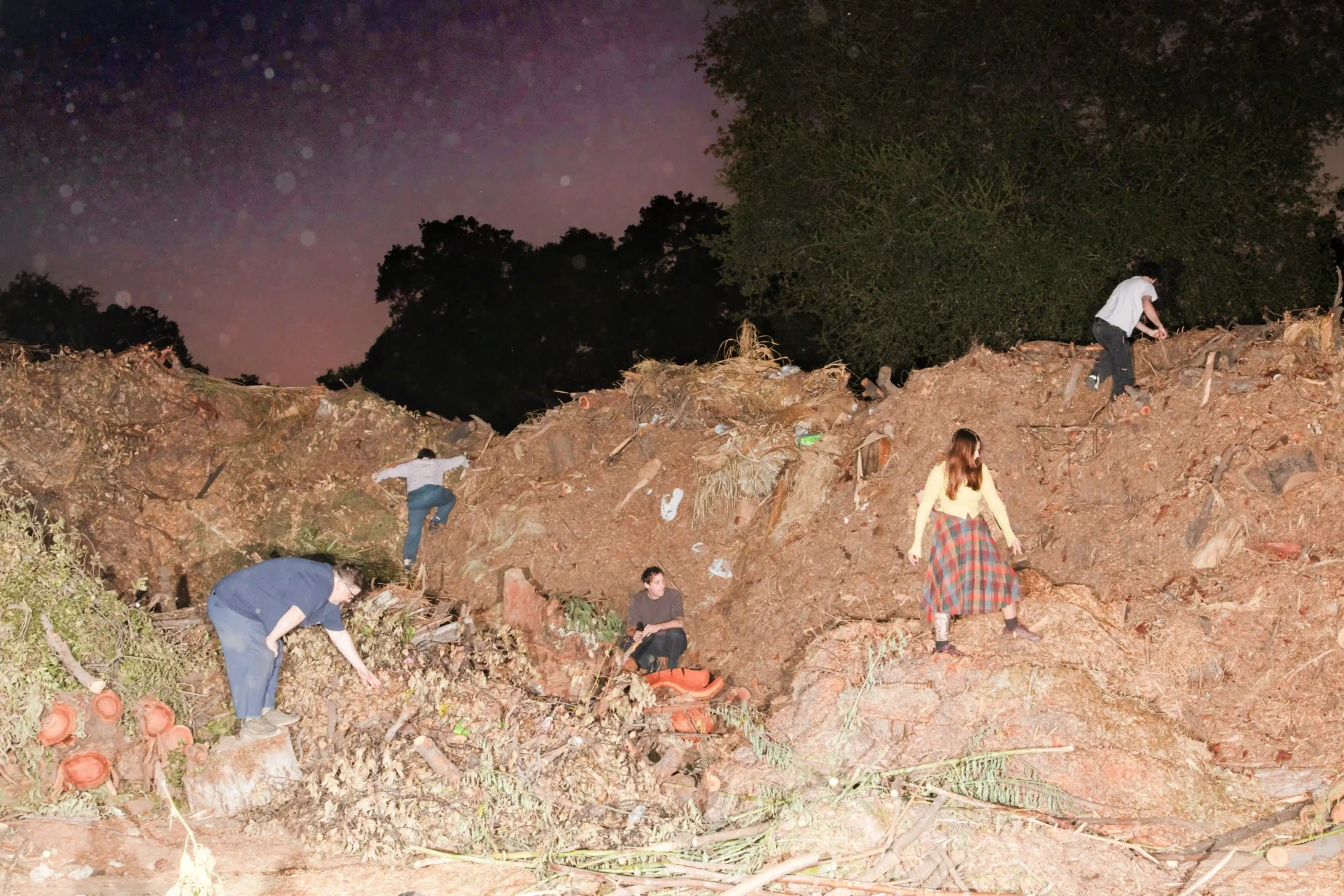
By the time Dummy formed in the late 2010s, the meme had long been dead. The title of the LA band’s new album, do you love the color of the sky?, refers to the iconic Tumblr post that, in 2012, won Know Your Meme’s top honour – if you’re nostalgic for that era of the internet, you can probably already picture the font in which the question is posed, prompting you to scroll all the way down – no swiping, of course – through the colors of the sky in daylight, starlight, and everything in between. Different versions of the post circulated, with various degrees of infinitude, but you had to assume it stretched all the way to the end, and you were probably fine with it. In a similar way, song length is the least of your concern when you listen to a Dummy track, so mutable it may float past its projected ending like ‘Squeaky Wheel’ and ‘Song of Mana’, the longest cuts on their latest record, or stick to a tight format. But the effect is immersive and inviting regardless – more so than ever on do you love the color of the sky?, which is suffused with a warm earnestness (and, per the band, “femme energy”) that has permeated but never fully been embraced in previous Dummy albums.
Ahead of their record release show in Los Angeles on November 4, we caught up with Dummy’s Joe Trainor, Alex Ewell, and Emma Maatman to talk about sincerity, self-sampling, natural beauty, and other inspirations behind their new album.
Post-rock, Kranky records, Michigan space rock / D&B, hip-hop, downtempo
This speaks to your fusion of rock and electronic music, which you’re really leaning into on this record. I hear the beauty in the ambient edges of that kind of rock music, and the more pulsating, aggressive elements coming from the other end of things.
Joe Trainor: When we were making Free Energy, we discovered a bunch of stuff towards the end of making that record that informed the last bit of it, like Locust, Colin Newman’s record Bastard, Transient Waves, Scala. All these bands were fusing electronic music, self-sampling, and manipulating guitars. That was what was driving the tail end of making Free Energy, and we knew after that we had all this inspiration that we had barely even scratched. Over the course of two years, we found more stuff in line with that. As we were making this record, I would come up with chord progressions that would be a verse-chorus kind of thing, and then Alex would have a beat, and then Alex would come up with a sound design thing for the guitar. Then we would figure out how to use that and how to play the effect more so than play the guitar, and each song would go like that to some degree. It was about manipulating the guitar in a way that we hadn’t heard done a million times, trying to make the guitar more of a textural, rhythmic enhancer, as opposed to the song just being a person jangling on a guitar and singing. Electronic music has just always been a huge part of Alex’s taste, and we have never really fully pushed into that. We’ve hinted at it throughout our discography, but for this one, that was the thing that was most inspiring to us.
Alex Ewell: I feel like in our previous work, I kind of defaulted to synths as the electronic element for our old songs. But for this album, I wanted to try not using synths, and instead try transforming guitar textures. I definitely used bass, too, but mostly just guitar, whether it was you playing a chord, or I had you playing through some delay or pitch-shift stuff. Synthifying guitars became a really interesting ground for us to start mining. With all the drum stuff, I was listening to a lot of house and techno, Berlin stuff, a lot of stuff I’ve been into for a long time. Aphex Twin is always a big source of percussive ideas; he’s kind of the master of that. Mark Van Hoen, that whole project where he used a lot of guitars as a source that ended up sounding very electronic – hearing that kind of gave us the permission to just start messing with guitars and using them in unconventional ways.
JT: For me as a guitar player, I was very uninspired and bored by what we had been doing before because we had been doing it for two records and a bunch of EPs. When we were making Free Energy, there were two songs where I was able to pull myself away from the guitar, in a way, with using loops and turning them off and on; using the guitar to enhance the rhythmic elements. For this record, I was very interested in those glacial, 10-minute drone songs by Windy and Carl. They’re really beautiful, but there isn’t any rhythmic aspect to them for the most part. I wondered how I could take stuff like that and chop it up with the hard edits of electronic music, or allow the use of rhythmic tremolo. It was all about how to break the guitar a little bit. There are bands doing the “guitar not sounding like a guitar” thing, but basically all of them are making really ugly, aggressive music, which is fine, but we wanted to do something that was more beautiful, blissful, and earnest. Trying to figure out how to do that while still retaining a certain amount of energy and pulse was difficult, because it’s easier to make something fast, aggressive, and up-tempo than something that’s up-tempo and propulsive, but more beautiful and inviting.
AE: That’s kind of the ambient element of it.
JT: All the things in the list I mentioned, like the space rock stuff from Michigan and the Kranky Records are related to drone, but a lot of those artists would sometimes progress into more electronic or dub stuff. We’re doing what we feel is missing in the world, taking the lineage of those bands and bringing it to a new audience that, in all likelihood, hasn’t heard Windy and Carl or Accelera Deck. Everyone’s heard My Bloody Valentine, and that’s obviously a huge inspiration, along with Aphex Twin. Those two artists are probably the most consistent inspirations throughout our whole discography. On this record, we took the rhythmic stuff from Aphex Twin, and with MBV, it’s about manipulating guitars in an interesting, novel way.
Warping sounds and self-sampling
I’m curious how your dynamic shifted as a result of playing with these techniques, given that you’re messing with parts you’re each separately coming up with.
AE: A lot of the songs, how they ended up, the start was completely different. A lot of times there was no drumbeat, or you were playing to some other drumbeat, just coming up with chords.
JT: I’m just messing around on the guitar, trying to find the first chord of something that sounds good to my ears, and then I get to a point where I’m like, “Okay, I have a verse and a chorus kind of idea.” I’ll be like, “Alex, are these chords good?” And you’d be like, “Yes” or “No.”
AE: I would always say, “They’re just chords, so…”
JT: And I’d be like, “No, but the chords are important!” But then Alex would come up with a beat, and I would start strumming along to it in some way. Alex would be like, “Oh, stay on this chord longer.” With ‘Squeaky Wheel’, the beginning of that song was more just me strumming through the three initial chords, and Alex said, “Stay on the first chord.” Then we got to the point where we were doing the rhythmic delay because I’d be playing with the volume pedal against the beat, and he’d say, “Don’t go to that chord, stay on the first chord.” It ended up being this sculpting process, and then we would give the demo to Emma.
Emma Maatman: ‘Squeeky Wheel’ was basically the first song for the record. They sent that to me, and I was just like, “I love this song.” Then I just get obsessive over it, listen to it endlessly for two months straight, write lyrics for it, and send it back. For certain songs, like ‘April’, which was one of the last ones, they just sent me the song and said, “Just freestyle something over this.” I did some vocalizations over it and sent it back, and they did some self-sampling with that. Alex took those, sampled them all up, chopped them up, reversed them, did all kinds of cool stuff, added that into the track, and sent it back to me again. Then I put the vocals over that again. So there’s some self-sampling even with the vocal parts, too.
JT: Self-sampling Emma’s voice was something we had started messing with on ‘Pepsi Vacuum’, where Alex took Emma’s voice and reversed it. We had done it a little bit on the last record, too, but this record, almost every song has a bit of us sampling Emma’s voice in some weird way. On ‘Full Spectrum Dominance’, the bridge of that song where it gets real wild, there’s a vocal part happening in there. I think it’s the chorus, and I just reversed it. It sounded cool and messed up. It was fun to play with because Emma had the vocals done so early for almost every song, so we were able to take what she had already recorded and mess with that stuff, too.
EM: Normally the vocals were so late on pretty much every other album or release. They were normally the absolute last minute when we were in the studio. Nate and I would be scrambling to get the vocals done, but this time I was on top of it from the start. [laughs]
JT: It was fun, because having everything so prepared allowed us to really dig into it. All the main vocal stuff was so awesome, so we were able to use little bits to enhance small parts. In the future, it could be cool if I have a guitar chord and I’m like, “Emma, just sing the guitar chord,” or stack her vocals over this guitar chord, and then manipulate it. I feel like there’s even more room to do stuff like that, especially in electronic music.
What’s that feeling like when you realize these accidents could become sonic motifs?
AE: It’s kind of intuition. A lot of my ideas come from that, where you’ll stumble onto something in one song and realize that it would work in a different song. For example, with ‘April’ and ‘Heaven’s What You Make It’, we had this drumbeat, and I think we were just jokingly messing around with it at half speed while you were playing chords to it. We were like, “Wait a second, this could work as a song, too.” Referencing yourself – I feel like that’s a great way to expand things, and that also creates cohesion across the album when you hear a similar thing or a flip of something.
JT: In terms of just knowing when you’re doing something good – for me, I just laugh. When Emma sent the vocals for ‘Omen Globe’, I was getting a haircut. I was like, “Oh, hell yeah, Emma sent vocals,” because at this point, every time she sent vocals, I was like, “Yes!” So on this one, the first verse came in and sounded sick, and then the second verse came in and she just started this insane vocal thing. I just started cackling out of joy because I was so psyched on it. That memory will live in my brain forever.
Technofeudalism and the current state of the US
Let’s start with the album title, which is open to interpretation, but in my mind feels like a question aimed at the people responsible for the current state of things.
EM: I would say yeah. It’s a question for anyone, really. It’s a question for those people, for the people that are maybe responsible for the state of the world, and it’s a question for all of us because we’re also responsible in a way. It’s not like we have to be completely complicit in everything that’s going on. I do think that people have a say in what goes on, what we accept, and we can stand up for what we think is correct in the world, what we want to be going on, and what we think is right. It’s a vague statement, but it’s also a very grand question.
JR: I think this title and Free Energy, you can take it and run with it in a bunch of different directions. This one is a reference to a Tumblr post. It’s interesting because I read a review recently where they talked about how the Tumblr post is this endless thing you have to scroll through to get through all the different phases of the sky. They were talking about how it’s like modern life in the sense that it’s so hard to find the end of things, to enjoy things as you’re constantly having to go through shit.
AE: I feel like it’s also just the idea that the post breaks out of the bounds of a normal post. It’s almost forcing you into this experience that’s somewhat frustrating or inconvenient, but it’s also kind of drone? It makes me think of drone music, where it’s like a drone post– it doesn’t end, it’s the same thing. It seems related to our music in some way.
EM: It’s just a beautifully esoteric question in and of itself: “Do you love the color of the sky? What color is the sky?” It can be literally any color. That’s the whole point of the post. It can be any color, but what color is it right now?
JR: And what’s causing it to have that color? Is it pollution that’s gonna have that color? Here in LA, we can have some of the most breathtaking sunsets you’ll ever see, but a lot of that is due to the fucking smog and the crazy pollution here.
AE: But I also feel like the question is almost suggesting that the color of the sky might be going away, which…
JR: We don’t know. Well, we kind of know.
EM: It’s ephemeral.
“Beautifully esoteric” kind of describes Tumblr in itself as a refuge from other platforms.
EM: I think we all definitely have a little soft spot of nostalgia for that old internet. I’m sure we all miss that a little bit. The way social media is built now is fairly toxic to most people’s mental health. No one’s able to kind of just scroll at their leisure anymore and go to the place that they want to go and have chosen to explore on their own volition. Now it’s like, “No, you’re gonna look at this because advertisers have told you that you’re gonna look at this. Oh, you liked that? I bet you’re gonna like this. Now you have to click on this.”
JR: Or your phone’s listening to you talk to your partner – Alex and I were talking about needing a new mattress, and then suddenly we’re just getting tons of mattress commercials and we’re just like, “What?” That’s surveillance, which obviously is another aspect of the record, lyrically. It’s just everything being shittier. Tumblr has more of an earnest sincerity to it, especially for artists who used to use it. It was a lot about emotions.
AE: Looking at art, people’s paintings, drawings, visual art, words – that was a big thing, but nowadays people don’t really have the attention span to just scroll through photos of art, maybe? You need a video that’s explaining it or something.
EM: They need an explainer video of how you did it.
AE: I think your branding as an artist is probably more important than if your art is really good.
JT: You do this art in this crazy way and you’re like, “And that’s how it turned out,” and that’s the brand. The enshittification of it.
The music industry’s ever-widening class divide
JR: The state of the music industry, the state of DIY or independent music – what is sold to you as indie music versus what is actually independent music – all those things affect us. We’re a band of working-class people. We don’t have access to all these things. We have more access to things now because of Polyvinyl, and we’re obviously very grateful for it, but they’re still an independently owned record label. They’re not owned by a bigger conglomerate, a subsidiary of a major, or a subsidiary of an indie subsidiary of a major. They’re still very much an independently owned record label. For me, my real job is doing PR for bands, so I’m in the bowels of the music industry. My perspective of it is weird because I’ll see how certain things are put out there, and then I’ll compare it to how our stuff is put out there. It’s hard not to get discouraged or frustrated by certain things. And then when you find out about stuff like Chaotic Good – you’re just like, “So, it’s all bullshit, none of it’s real, it’s all astroturfed stuff?”
On our last record, we were on tour for half a year, playing over 114 shows. We work really hard, and everything we do is so insular. Emma’s doing all the artwork and doing almost every video. All the music is produced and done by ourselves. We’ve never had a producer or anything like that, so we keep it all in-house as much as possible because we care so much about it. When you see other stuff that you can tell is low effort and uninspired, it can be very frustrating for a band working really hard on the touring end and on the art end without much financial stability or help.
AE: Average listeners probably aren’t aware of just how much control over what people see these corporate interests have. That’s the most obscured part – everything you see is determined by who has access to these forces, this money, and these resources. With social media companies, it’s not by accident that you see these posts and hear what you hear. They basically want to have complete control over what is culturally relevant because they want to control the culture.
EM: It’s not a meritocracy. It just plain isn’t.
AE: The artists aren’t gonna have the attention that they deserve. I feel like all the greatest artists working right now are complete unknowns. The way our society has organized around constantly consolidating power towards the top. We’ll never have another Beatles again, we’ll never have another Bob Dylan again. That kind of artist is impossible now. You have to be basically a celebrity already in order to have any kind of chance.
JR: That’s why you see so many huge artists who had careers in other things before they were musicians. No disrespect to the guy from Stranger Things, Djo or whatever, but if he wasn’t on Stranger Things, no one would give a fuck about his music.
AE: And he’s one of the biggest indie artists.
EM: No offense, again, to him, but to call him an indie artist is really…
JT: It’s a joke. I’m sure he’s a fine guy, I have no issue with him as a person, but we smoke the fuck out of his music. It’s not even close. I’m not like, “Oh, I wish we were as big as that guy.” We don’t care about that sort of stuff, but we just want to be able to tour and pay our rent and survive. Our ambition in that way is pretty low – it’s just rent, food, being able to go see a movie occasionally, afford to buy some shoes. We do see bands that have worked really hard and things came to them eventually, but that’s the exception to the rule. Working-class bands that are successful are so few and far between now, and every time you see a new artist that’s popping off, you eventually find out it’s some filthy rich person’s kid.
AE: The bar is just being lowered every single time that another nepo kid is made famous.
JT: In mainstream pop right now, it just feels like all it is is nepo kids, and with indie music, it’s kind of a step below that. From independent music to the top echelon, nothing feels authentic. I don’t believe too many people when they’re singing. But when I listen to Emma, I fucking believe it.
Being earnest and sincere
‘Heaven’s What You Make It’, as a closer, really embraces that quality, which is more prominent throughout the record than any of the previous ones.
JT: With my previous band, I wanted to be as far away from that as possible in some respects. A lot of that was very emotional music in a way. I was just like, “I don’t want to do that at all, I just want to have a distance.” That’s how things started. But throughout all of this, even on our first EP, the song ‘Folk Song’ is a very beautiful, earnest, kind of quiet song, and I felt like having that flavor in there is obviously good. There are hints of that kind of thing throughout our discography, and to me, those are actually some of the most effective songs. On our second EP, the final track, ‘Prime Mover Unmoved’, that’s a very emotional, sincere-sounding song, and Emma’s lyrics are really beautiful.
EM: In the older days, he would be like, “More detached, less vibrato,” if I was getting a little too emotional or something in the performance.
JT: I feel like I wasn’t ready for that sort of expression again. And then that song happened, and the next song where I felt like that hit was ‘Pepsi Vacuum’. I feel like that song was kind of the beginning of where we are now. Emma’s vocal performance on that song is just unbelievable. And then Free Energy has some of that; at that point, I started letting go of the reins and just allowing Emma to do her thing, trusting her, and not being so controlling. For this record, I was like, “I trust Emma. I don’t need to worry about that sort of thing.” Me letting go of whatever that allowed Emma to just go in.
AE: I feel like instrumentally, maybe it’s easier or more tempting to just have a song be more heavy and fast, and we would rely on that template as the driving force of the emotion for our previous albums. I also think we didn’t really leave as much room. When we started on this album, we really went into it with the idea of leaving room for the vocals to have space, to be as impactful as possible, and to have these big moments that would stick out. Also, we went in intentionally stripping things down a little bit.
JT: Not filling up every inch of space with sound, which for me is very scary. I don’t like that; I get real anxious about not being on ten.
AE: That’s kind of the instrumental vulnerability – if you just have a few elements, everything has to sound good. Whereas if you have 30 layers, you can bury something in the mix.
JT: On this record, it’s maybe more of an assault emotionally and lyrically, and less so sonically. There are heavier songs on the record, but on the whole, this record is definitely less assaulting.
AE: I think it’s also just more femme in that way. If you think of music as masculine and feminine, that vulnerability, that openness, and not having as much blasting energy.
JT: Less dude energy. Alex and I were like, “This is our gay femme record.”
AE: It definitely feels more queer.
JT: But that’s sincerely – that’s what felt correct to us at the time. We felt like we needed to express that side of Alex and I’s…
AE: It’s scary to express that in a way, and we got to a point where we had the tools to be able to do it in a confident way..
JT: And then, having Emma take the instrumentals we were working on and infuse them with beauty, lyrical themes, and the stories she’s telling – it’s interesting because on some of the most beautiful songs on the record, the lyrics are more dark and angry.
Emma, what did that vulnerability open up for you? Where did it lead you emotionally?
EM: I was completely enveloped with writing for this album. I was only listening to our demos the entire time we were writing. I wasn’t really listening to much else. I was drawing inspiration from the news, the world, and that’s kind of all I could think about, so that’s what I was writing about. But I don’t feel like my lyrics come across 100% dark and political. I feel like people read somewhere that we said they’re political, and then they’re like, “These are political lyrics,” without actually looking at my lyrics or listening to them. [laughs] A song like ‘Song of Mana’ is actually about getting fired from your corporate job because it got taken over by AI, but it should read like you’re getting broken up with. In terms of being more emotionally vulnerable and expressing my voice, I definitely felt more comfortable doing that on this record. I don’t think I’m the best singer in the world – I don’t think I can hit all the crazy high notes or do all of the R&B runs – but I was like, “I’m gonna try to the best of my ability.”
JT: You shouldn’t undersell yourself, but I understand why you’re saying that.
EM: There are all these different kinds of things that I want to make nods to and try out. On ‘Song of Mana’, it does kind of have an R&B feeling, and I wanted to give it that. On ‘Omen Globe’, there’s that dancehall vocal run, that put-your-finger-in-the-air kind of thing. I just figured I’ll go for it, and if it makes me laugh out loud the way it would make Joe laugh, I’ll send it and see if they think I pulled it off, too. I guess I did!
JT: You did. Every time Emma sent vocal stuff, it felt so exciting because. When she sent ‘Heaven’, my jaw was on the floor. I was just like, “Holy fuck, this is amazing.” The vocal performance, all the edits – Emma went in and did all those weird little glitchy edits herself and sent them to us, and the way she did it was psychotic because it’s so specific. Emma was matching our freak in terms of the effort we were putting into the instrumental. It was so gratifying to hear it come together.
Film and music videos
Like you mentioned, Emma has done all the videos for the band, except for ‘Full Spectrum Dominance’ on this record.
EM: This time, since we finally had a bit of a budget thanks to Polyvinyl, and we wanted to hire my friend Matt, his name is Post Man Animation. He did the 3D animated music video for ‘Full Spectrum Dominance’. We just loved his uncanny style of 3D animation. He threw a bunch of cool video references at us immediately and knew we had the same style and ideas in mind, so we told him to go crazy. With the other music videos, I try to connect most of them together in some way. I filmed the ‘April Limousine’ video by myself over months and months, just filming the sunset every night, so it’s just sped-up handycam footage of the sunset. Then I did some datamoshing – there’s an old-school way of doing it where you download an older program and delete specific frames, the I-frames of the video, which gives it that very specific pixelated style. Alex nailed it when he said this too – I was kind of going for the old Aphex Twin videos where he would set up a camera somewhere and make these really weird stop-motion videos of himself.
Then we did the ‘Alluvial Fan’ video with Nathan running around my neighborhood. A lot of those lyrics are related to that anime, Serial Experiments Lain. We were just going around looking at all the telephone wires, so we wanted to make it wire-adjacent. At the end of that video, if you follow the wire, it leads underneath my house. That’s where the ‘N of 1’ video starts – in my “hacker dungeon,” as I call it. Basically, I’m GeoGuessing, trying to find all the guys in the band because I’m upset that they’re at practice without me. I’m looking all around the world for them, and then I find them and they have band practice at the end.
Natural beauty and place
AE: I’ve always loved hiking, and engaging with nature feels like such a marginalized part of life now. Most people don’t really meaningfully do that at all, which is an important thing for me to do because it activates a part of my brain and whole body. It takes you back to a more primal experience that our ancestors would have been doing for millions of years, just being present in nature. I really like making field recordings, and nature’s soundscapes can be so inspiring and complex. You might hear hundreds of insects and birds chirping, but it all sounds harmonious, and your brain interprets it in a relaxing way. I feel like that’s somewhat of a theme in our music.
For me, nature is a source of spirituality. These days it’s really devastating what’s happening to the planet. A decade or 15 years ago, it was at the forefront of everyone’s minds, global warming was ramping up, and nowadays it feels like there’s even more prescient stuff happening to where it’s almost in the back of people’s minds. But obviously global warming is still happening; we’re living through the consequences already, but of course they’re only going to get worse, and it feels like there’s no meaningful way out or way back. It’s hard to internalize that, and it makes me want to spend time in nature and see things that maybe won’t be there forever. Everyone has experienced going on a hike and seeing a beautiful sight. That wonder and awe at nature is built into our DNA, and I wanted to infuse that into our music somehow.
This interview has been edited and condensed for clarity and length.
Dummy’s do you love the color of the sky? is out now via Polyvinyl.

